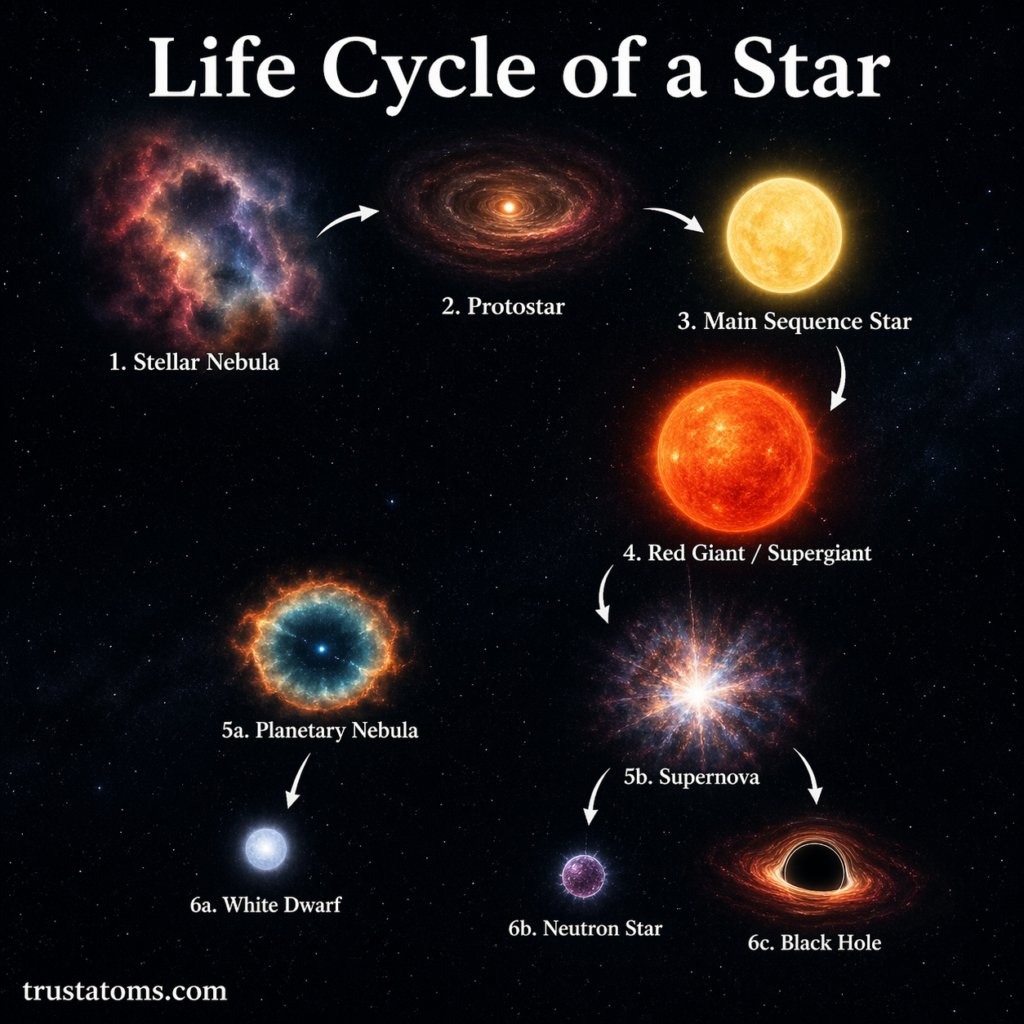
Stars are among the most fascinating objects in the universe. From their birth in vast clouds of gas to their dramatic deaths as supernovae or quiet fades into stellar remnants, the life cycle of a star is a story of gravity, energy, and time on a cosmic scale.
Understanding how stars form, evolve, and eventually die helps us better understand the universe—and even the origins of elements that make up planets and life itself.
What Is a Star?
A star is a massive sphere of hot gas, primarily hydrogen and helium, held together by gravity. At its core, nuclear fusion converts hydrogen into helium, releasing enormous amounts of energy in the form of light and heat.
This energy is what makes stars shine.
Stage 1: Stellar Nebula (Birth of a Star)
Every star begins its life in a stellar nebula—a vast cloud of gas and dust in space.
How it forms
- Gravity pulls gas and dust together
- Regions become denser over time
- These dense areas collapse under their own gravity
As the material collapses, it heats up and begins forming a protostar.
Stage 2: Protostar
A protostar is an early stage in a star’s life, before nuclear fusion begins.
Key characteristics
- Still gathering mass from the surrounding nebula
- Temperature increases as gravity compresses it
- Not yet producing energy through fusion
When the core becomes hot and dense enough, fusion ignites—and a star is officially born.
Stage 3: Main Sequence Star
This is the longest and most stable phase of a star’s life.
What happens here
- Hydrogen is fused into helium in the core
- Outward pressure from fusion balances gravity
- The star remains stable for millions to billions of years
Examples
- Our Sun is currently in the main sequence stage
Lifespan depends on mass
- Massive stars burn fuel quickly → shorter lives
- Smaller stars burn slowly → longer lives
Stage 4: Red Giant or Supergiant
When a star runs out of hydrogen in its core, it begins to change dramatically.
Process
- Core contracts under gravity
- Outer layers expand outward
- Surface cools, giving the star a reddish appearance
Outcomes
- Medium stars become red giants
- Massive stars become supergiants
This stage marks the beginning of the end for a star.
Stage 5: Final Stages (Depends on Star Size)
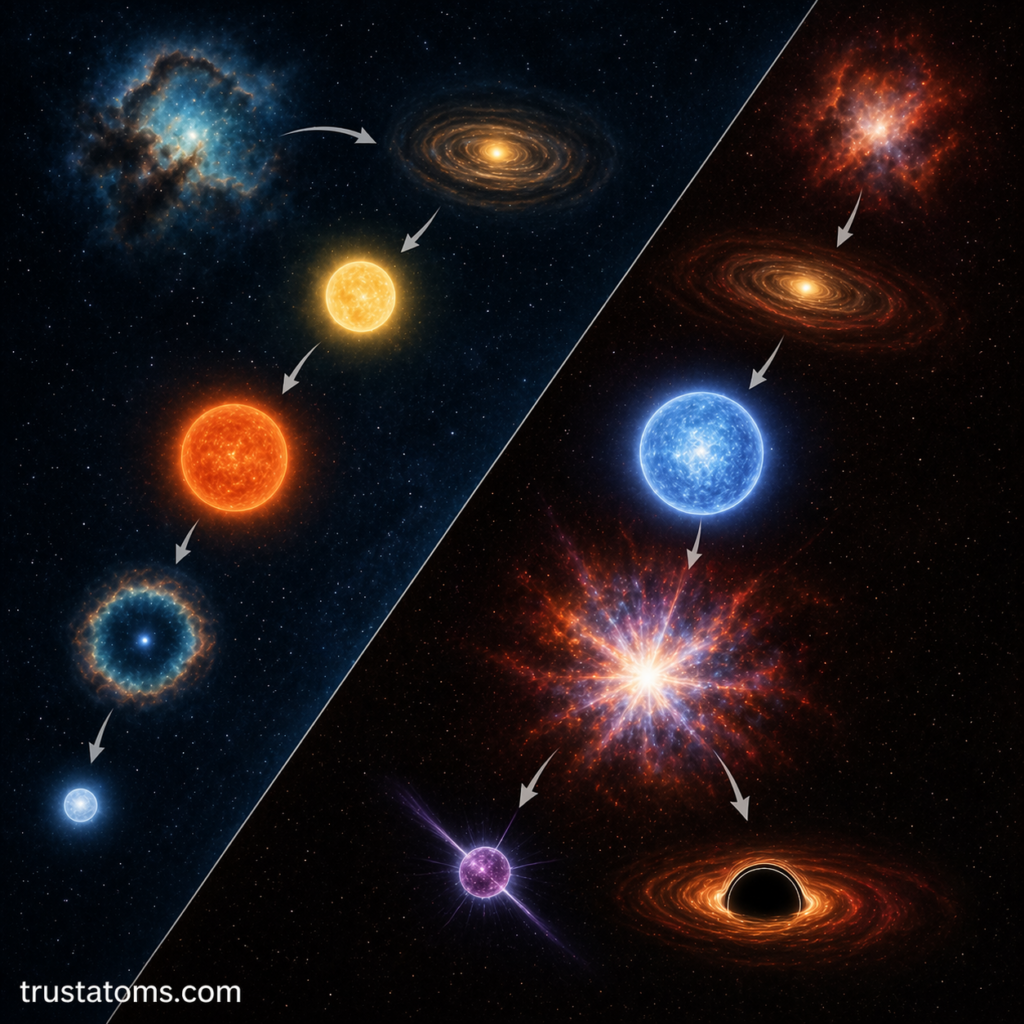
The final phase of a star’s life depends largely on its mass.
Low to Medium Mass Stars (like the Sun)
Planetary Nebula
- Outer layers are shed into space
- Creates a glowing shell of gas
White Dwarf
- The remaining core becomes a dense, hot object
- No longer undergoes fusion
- Slowly cools over billions of years
Massive Stars
Supernova
- The core collapses suddenly
- Results in a powerful explosion
- Releases heavy elements into space
Neutron Star or Black Hole
- If the core is extremely dense → neutron star
- If even more massive → black hole
Why the Life Cycle of Stars Matters
The death of stars plays a critical role in the universe.
Key contributions
- Creation of heavy elements (like carbon, oxygen, iron)
- Distribution of materials needed for planets and life
- Formation of new stars from recycled material
In a way, everything on Earth—including us—comes from the remnants of ancient stars.
Summary of the Star Life Cycle
- Stellar nebula forms
- Protostar develops
- Main sequence phase (stable burning)
- Red giant or supergiant expansion
- Final stage:
- White dwarf (small stars)
- Supernova → neutron star or black hole (massive stars)
Final Thoughts
The life cycle of a star is a powerful reminder of how dynamic and interconnected the universe is. From simple clouds of gas to brilliant celestial objects and explosive endings, stars shape galaxies and provide the building blocks for everything we know.
By studying stars, we gain insight into the past, present, and future of the cosmos—and our place within it.