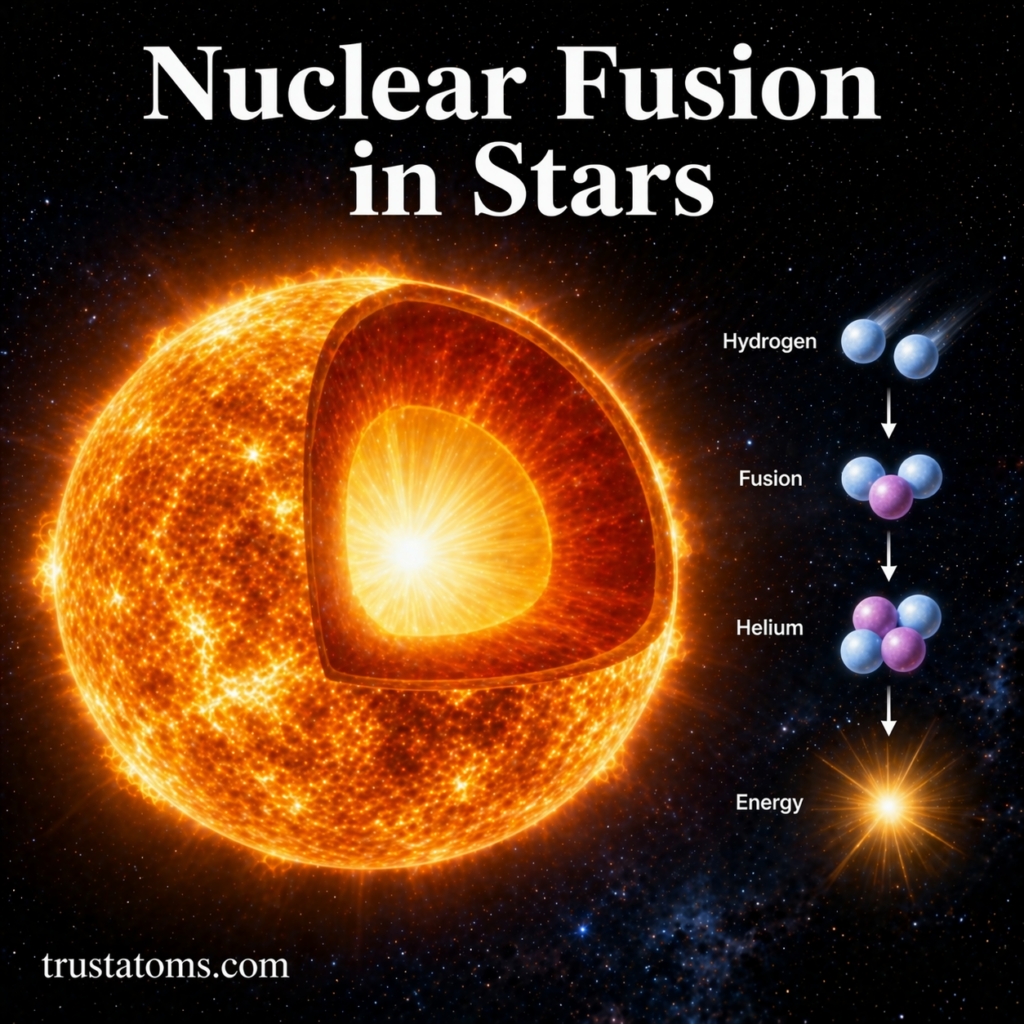
At the heart of every star lies an extraordinary process that powers the universe—nuclear fusion. This process transforms simple elements into heavier ones while releasing vast amounts of energy in the form of light and heat.
From the warmth of the Sun on Earth to the brilliant glow of distant stars, nuclear fusion is the engine that drives stellar energy and shapes the cosmos.
What Is Nuclear Fusion?
Nuclear fusion is a reaction where two light atomic nuclei combine to form a heavier nucleus.
Key Characteristics
- Occurs under extreme temperature and pressure
- Converts mass into energy
- Produces light and heat
In stars, fusion primarily involves hydrogen atoms combining to form helium.
Why Fusion Happens in Stars
Stars have the perfect conditions for fusion due to their immense gravity.
Core Conditions
- Temperatures reach millions of degrees
- Pressure is extremely high
- Atoms move at incredible speeds
These conditions allow atomic nuclei to overcome their natural repulsion and fuse together.
The Proton-Proton Chain Reaction
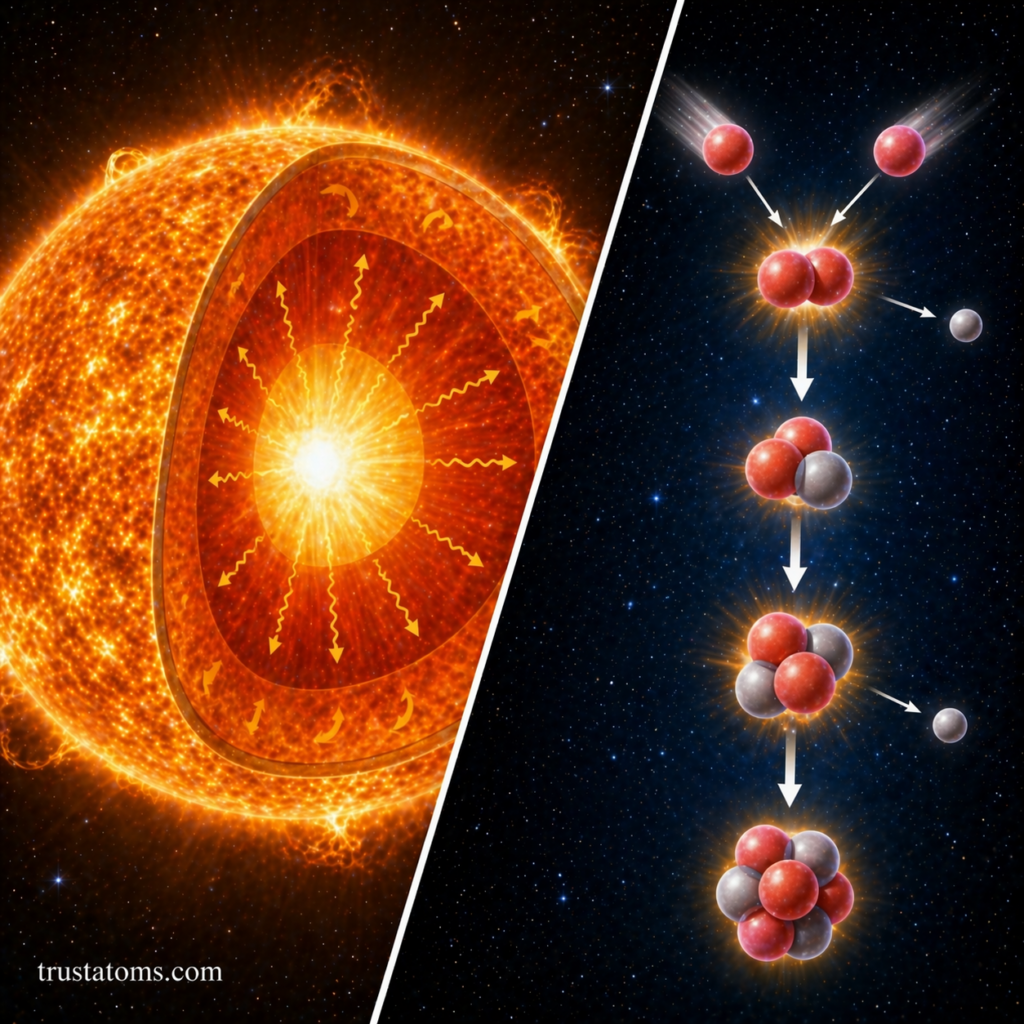
In stars like the Sun, fusion occurs through the proton-proton chain.
Simplified Steps
- Two hydrogen nuclei (protons) collide and fuse
- They form a heavier nucleus (deuterium)
- Additional reactions produce helium
- Energy is released in each step
This process powers most stars in the universe.
Energy Production and Mass Conversion
Fusion releases energy because a small amount of mass is lost during the reaction.
How It Works
- The mass of the resulting helium atom is slightly less than the original hydrogen atoms
- The missing mass is converted into energy
This relationship is described by the famous equation:
- Energy = mass × speed of light²
Even a tiny loss of mass produces enormous energy.
Balance Inside a Star
Stars remain stable due to a balance between two opposing forces.
The Balance
- Gravity: Pulls matter inward
- Fusion Energy: Pushes outward
This balance is called hydrostatic equilibrium. If fusion slows, gravity compresses the star. If fusion increases, the star expands.
Fusion in Different Types of Stars
Not all stars fuse elements in the same way.
Small and Medium Stars
- Fuse hydrogen into helium
- Eventually expand into red giants
- May begin fusing helium into carbon
Massive Stars
- Fuse heavier elements in stages
- Can produce elements up to iron
- End their lives in powerful supernova explosions
The more massive the star, the more complex its fusion processes.
The Creation of Elements
Fusion is responsible for creating most of the elements in the universe.
Element Formation
- Hydrogen → Helium (basic fusion)
- Helium → Carbon and Oxygen
- Massive stars → Elements up to iron
Heavier elements (like gold and uranium) are formed during supernova explosions.
What Happens When Fusion Stops?
Fusion cannot continue indefinitely.
End of Fusion
- When fuel runs out, fusion slows or stops
- Gravity takes over
- The star begins to collapse or expand
Final Outcomes
- Small stars: Become white dwarfs
- Massive stars: Collapse and explode as supernovae
Fusion determines how a star lives—and how it dies.
Why Nuclear Fusion Matters
Nuclear fusion is essential to the universe and life itself.
Key Importance
- Powers stars and sunlight
- Creates the elements needed for planets and life
- Drives stellar evolution
- Influences the structure of galaxies
Without fusion, the universe would be dark and lifeless.
Fusion vs. Fission
Fusion is often compared to nuclear fission, but they are very different.
Fusion
- Combines light elements
- Requires extreme conditions
- Releases more energy
Fission
- Splits heavy atoms
- Used in nuclear power plants
- Easier to achieve on Earth
Scientists are working to harness fusion as a clean energy source, but it remains a major challenge.
Common Misconceptions
- Fusion is not the same as burning—it’s a nuclear process
- Stars do not “burn out” like fire; they run out of fusion fuel
- Fusion requires extreme conditions not easily replicated on Earth
- The Sun is not unique—fusion powers all stars
Final Thoughts
Nuclear fusion is the fundamental process that powers stars and illuminates the universe. By converting hydrogen into helium and releasing vast amounts of energy, fusion drives the life cycle of stars and creates the elements that make up everything around us.
Understanding nuclear fusion not only explains how stars shine but also reveals the deeper processes that shape the cosmos—and the origins of matter itself.