When stars reach the end of their life cycles, they don’t simply disappear—they transform into what astronomers call stellar remnants. Among the most common of these are white dwarfs, along with more extreme outcomes like neutron stars and black holes.
These remnants represent the final stages of stellar evolution and hold important clues about the history and future of the universe.
What Are Stellar Remnants?
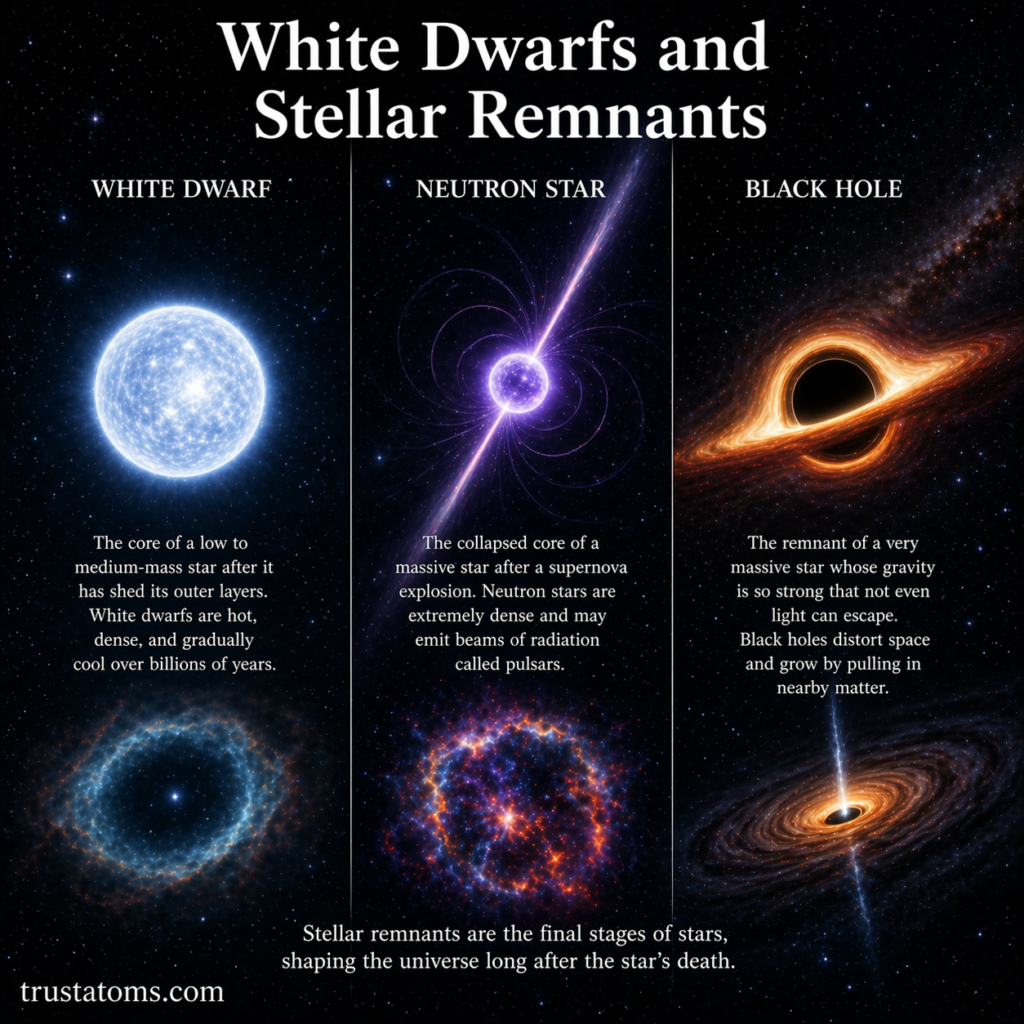
Stellar remnants are the leftover cores of stars after they have exhausted their nuclear fuel and shed their outer layers.
Main types of stellar remnants
- White dwarfs (low to medium-mass stars)
- Neutron stars (massive stars)
- Black holes (very massive stars)
Each type forms depending on the original mass of the star.
What Is a White Dwarf?
A white dwarf is the dense core left behind after a low or medium-mass star (like the Sun) finishes its life cycle.
Key characteristics
- Extremely dense (a mass similar to the Sun in a size similar to Earth)
- No longer undergoing nuclear fusion
- Very hot initially, but gradually cools over time
- Emits a faint white or bluish light
White dwarfs are incredibly stable and can exist for billions—or even trillions—of years as they slowly lose heat.
How White Dwarfs Form
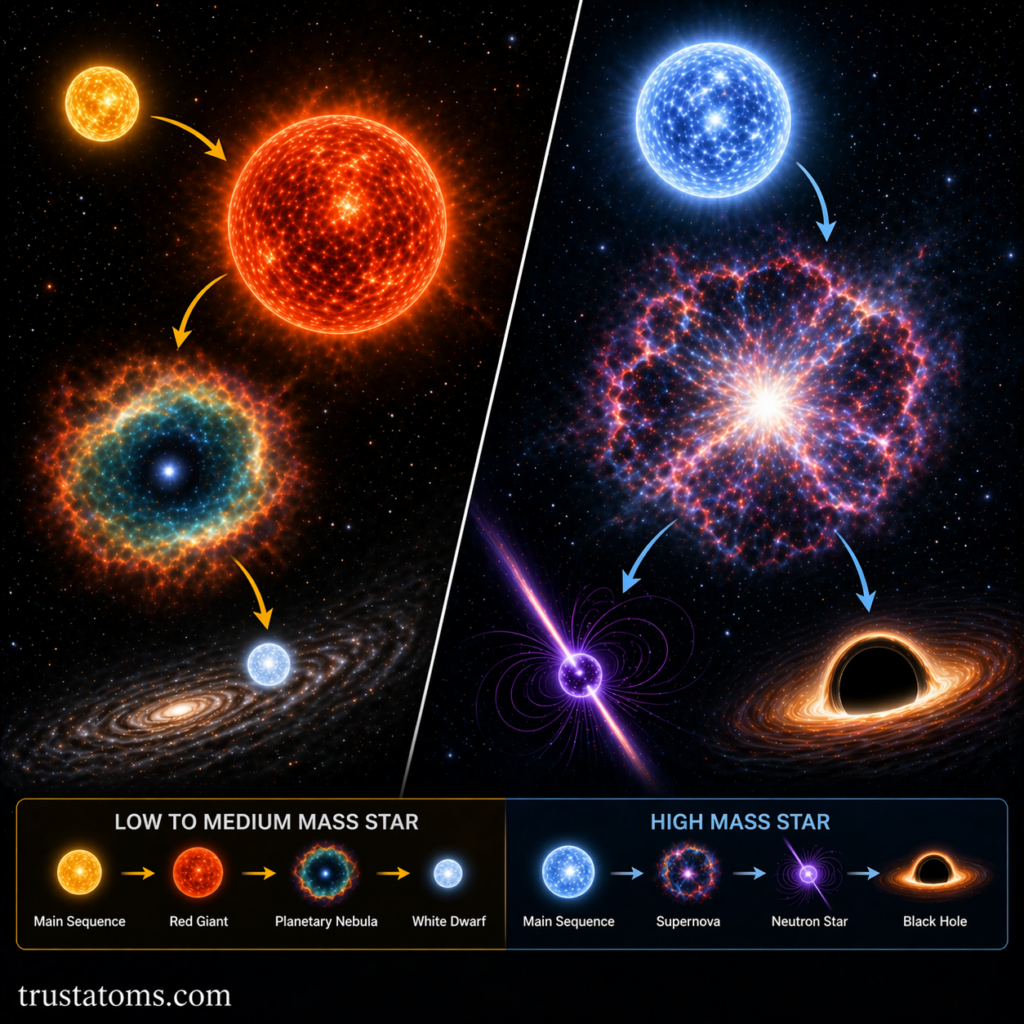
White dwarfs form after a star passes through the red giant phase.
The process
- Star expands into a red giant
- Outer layers are expelled into space
- A glowing shell of gas forms (planetary nebula)
- The remaining core becomes a white dwarf
Important note
- The white dwarf is no longer producing energy through fusion
- It shines only because of leftover heat
What Happens to White Dwarfs Over Time?
White dwarfs gradually cool and fade.
Long-term evolution
- Temperature decreases over billions of years
- Light output slowly diminishes
- Eventually becomes a cold, dark object (theoretical “black dwarf”)
Black dwarfs
- Hypothetical end state of a white dwarf
- The universe is not old enough yet for any to exist
Neutron Stars: Extreme Stellar Remnants
Neutron stars are formed from the collapsed cores of massive stars after a supernova explosion.
Key characteristics
- Extremely small (about the size of a city)
- Incredibly dense (a teaspoon would weigh billions of tons)
- Made mostly of neutrons
- Rapid rotation and strong magnetic fields
Special types
- Pulsars: emit beams of radiation that appear to pulse
- Magnetars: have extremely powerful magnetic fields
Neutron stars are among the most extreme objects in the universe.
Black Holes: The Most Extreme Outcome
If a star is massive enough, its core collapse leads to the formation of a black hole.
Key characteristics
- Gravity so strong that not even light can escape
- Defined by an “event horizon”
- Often surrounded by an accretion disk of matter
How they form
- Massive star collapses
- Core compresses beyond neutron star limits
- Gravity overwhelms all forces → black hole forms
Black holes continue to grow by pulling in nearby matter.
Comparing Stellar Remnants
White Dwarfs
- Form from smaller stars
- Stable and long-lasting
- Cool slowly over time
Neutron Stars
- Form from massive stars
- Extremely dense and compact
- Often emit radiation (pulsars)
Black Holes
- Form from the most massive stars
- Strongest gravitational fields
- Invisible except through their effects on nearby matter
Why Stellar Remnants Matter
Stellar remnants play a major role in the universe.
Their importance
- Help scientists understand stellar evolution
- Influence surrounding space through gravity and radiation
- Contribute to the recycling of matter in galaxies
- Provide insight into extreme physics conditions
They are the final chapter in a star’s story—but also the beginning of new cosmic processes.
Key Takeaways
- Stellar remnants are the final stages of stars after fusion ends
- White dwarfs are the most common remnant for Sun-like stars
- Neutron stars and black holes form from massive stars
- These objects can exist for incredibly long periods of time
- They help shape galaxies and influence future star formation
Final Thoughts
White dwarfs and other stellar remnants reveal what happens when stars reach the end of their journey. While these objects no longer produce energy through fusion, they remain powerful markers of the past and key players in the structure of the universe.
By studying stellar remnants, astronomers gain insight into everything from the life cycles of stars to the fundamental laws of physics under extreme conditions.