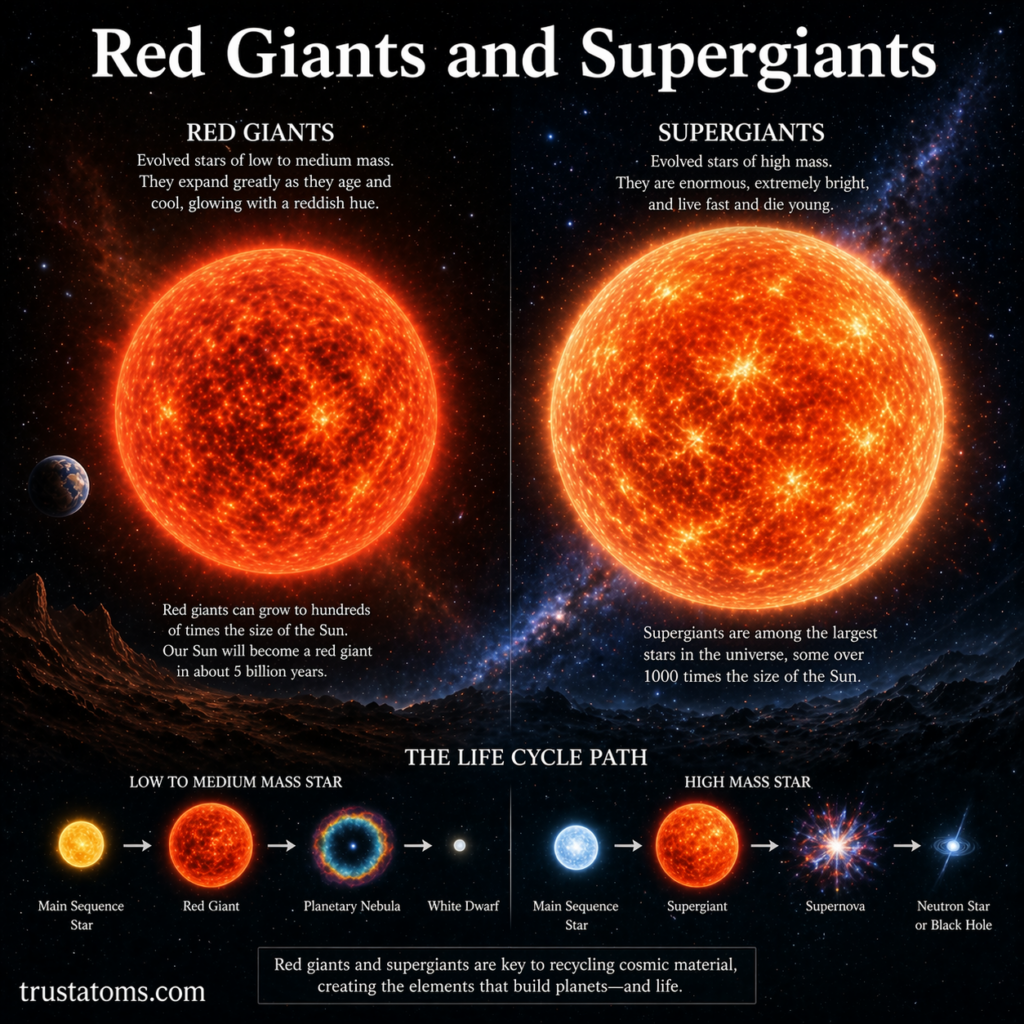
As stars age, they undergo dramatic transformations. Among the most striking stages in stellar evolution are red giants and supergiants—massive, luminous stars that represent the later phases of a star’s life cycle.
These stars expand to enormous sizes, change color, and play a crucial role in shaping the universe by producing and distributing heavy elements.
What Are Red Giants and Supergiants?
Red giants and supergiants are evolved stars that have exhausted the hydrogen fuel in their cores.
Key characteristics
- Extremely large in size
- Cooler surface temperatures (giving a red/orange color)
- Very bright due to their size
- Unstable compared to earlier stages
The difference
- Red giants form from low to medium-mass stars (like the Sun)
- Supergiants form from high-mass stars
How Stars Become Red Giants
When a star runs out of hydrogen in its core, major changes begin.
The process
- Hydrogen fusion in the core stops
- Gravity causes the core to contract
- Temperatures rise in surrounding layers
- Hydrogen fusion begins in a shell around the core
- Outer layers expand dramatically
Result
- The star becomes much larger
- The surface cools, shifting to a reddish color
- Luminosity increases significantly
A star like our Sun will eventually expand into a red giant, potentially engulfing nearby planets.
What Are Supergiants?
Supergiants are the evolved form of massive stars, and they are among the largest stars in the universe.
Characteristics of supergiants
- Enormous size (hundreds to over a thousand times the Sun’s radius)
- Extremely bright
- Short-lived compared to smaller stars
- Can appear red or blue depending on temperature
Types of supergiants
- Red supergiants: cooler and larger (e.g., Betelgeuse)
- Blue supergiants: hotter and more compact
Supergiants evolve quickly because they burn through their fuel at an incredible rate.
Internal Changes in Red Giants and Supergiants
As stars evolve into these stages, their internal structure becomes more complex.
Inside a red giant
- Inert helium core
- Hydrogen fusion shell surrounding the core
Inside a supergiant
- Multiple fusion layers (like an onion)
- Heavier elements fuse in stages (helium, carbon, oxygen, etc.)
These advanced fusion processes are what allow massive stars to create heavier elements.
How Big Do They Get?
The size of these stars is difficult to comprehend.
Red giants
- Can expand to tens or hundreds of times the Sun’s size
Supergiants
- Can be over 1,000 times larger than the Sun
- If placed in our solar system, some could extend beyond the orbit of Jupiter or even Saturn
Despite their size, their outer layers are less dense than earlier stages.
Lifespan of Red Giants and Supergiants
These stages are relatively short compared to the main sequence phase.
Red giants
- Last for hundreds of millions to a few billion years
Supergiants
- Last only a few million years or less
Massive stars evolve faster, so their supergiant phase is brief but intense.
What Happens After This Stage?
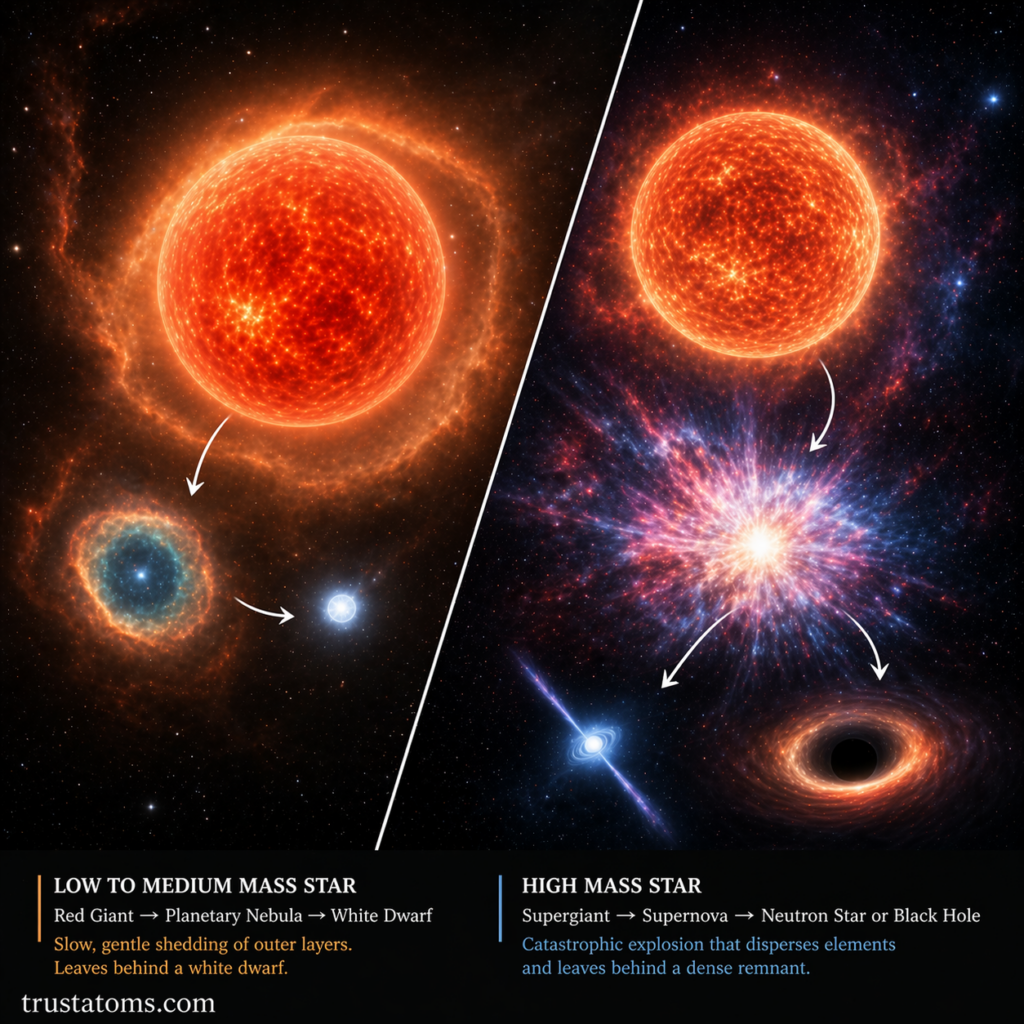
The fate of a star depends on its mass.
After Red Giant Stage (Low to Medium Mass Stars)
- Outer layers are expelled → planetary nebula
- Core remains → white dwarf
- Gradual cooling over billions of years
After Supergiant Stage (Massive Stars)
- Core collapses under gravity
- Massive explosion → supernova
- Remnant becomes:
- Neutron star, or
- Black hole
Supernova explosions are among the most powerful events in the universe.
Why Red Giants and Supergiants Matter
These stars are essential to the cosmic cycle of matter.
Their importance
- Produce heavy elements like carbon, oxygen, and iron
- Distribute these elements into space
- Enable the formation of planets and life
- Drive the evolution of galaxies
Without these stages, the universe would lack the building blocks necessary for complex structures.
Key Differences Between Red Giants and Supergiants
Red Giants
- Form from smaller stars
- Longer-lasting stage
- Simpler internal structure
Supergiants
- Form from massive stars
- Short-lived but more energetic
- Complex fusion processes
- End in explosive supernovae
Final Thoughts
Red giants and supergiants represent some of the most dramatic and important phases in a star’s life. These massive, glowing stars are not just visually impressive—they are responsible for creating and spreading the elements that make up planets, atmospheres, and even life itself.
As stars expand and evolve, they transform the universe around them, ensuring that new generations of stars and planetary systems can form.