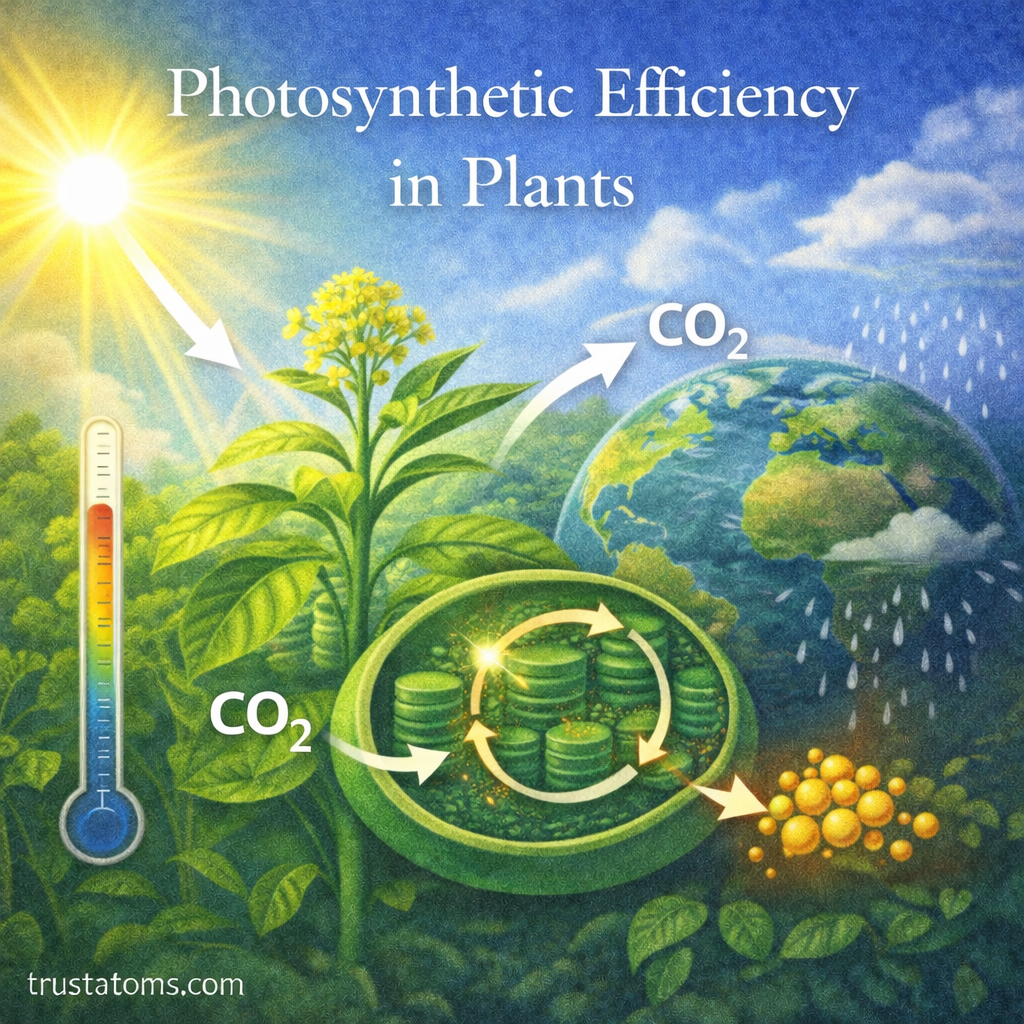
Photosynthetic Efficiency in Plants

Illustration showing a plant using sunlight and carbon dioxide to produce energy inside chloroplasts, representing photosynthetic efficiency.
Diagram illustrating how plants convert sunlight and carbon dioxide into energy during photosynthesis, highlighting photosynthetic efficiency. trustatoms.com.

Photosynthesis is the process that allows plants to convert sunlight into chemical energy. This energy supports plant growth and ultimately fuels nearly every food chain on Earth. However, not all of the sunlight that reaches a plant is converted into usable energy.

The ability of plants to convert light energy into chemical energy is known as photosynthetic efficiency. This concept describes how effectively plants capture sunlight and transform it into carbohydrates that power metabolism, growth, and reproduction.

Understanding photosynthetic efficiency helps scientists improve crop yields, study plant adaptation, and better understand how ecosystems respond to environmental change.

Continue reading “Photosynthetic Efficiency in Plants”
Carbon Fixation in Plant Metabolism

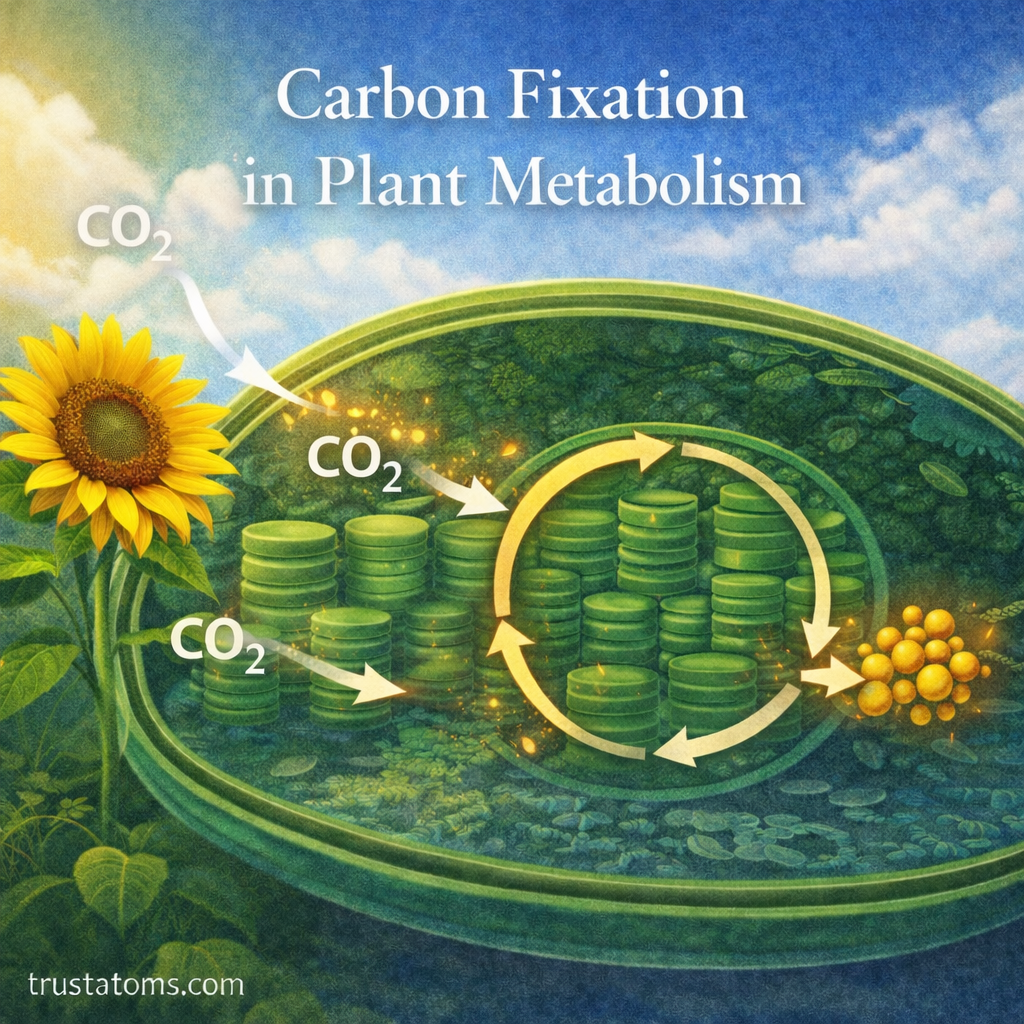
Illustration showing carbon dioxide entering a plant leaf and being converted into sugars inside a chloroplast during carbon fixation.
Simplified diagram of carbon fixation in plant metabolism showing carbon dioxide entering a plant and sugars being produced inside a chloroplast cycle. trustatoms.com.

Plants play a critical role in Earth’s ecosystems by converting atmospheric carbon dioxide into organic molecules that support life. One of the key processes that makes this possible is carbon fixation.

Carbon fixation is the step in plant metabolism where inorganic carbon from carbon dioxide (CO₂) is incorporated into organic molecules. This process allows plants to build sugars, which provide energy for growth, reproduction, and cellular maintenance.

Carbon fixation occurs during the Calvin cycle, the second major stage of photosynthesis that follows the light reactions. Together, these processes enable plants to transform sunlight and carbon dioxide into the chemical energy that fuels nearly all life on Earth.

Continue reading “Carbon Fixation in Plant Metabolism”

Light Reactions in Photosynthetic Systems

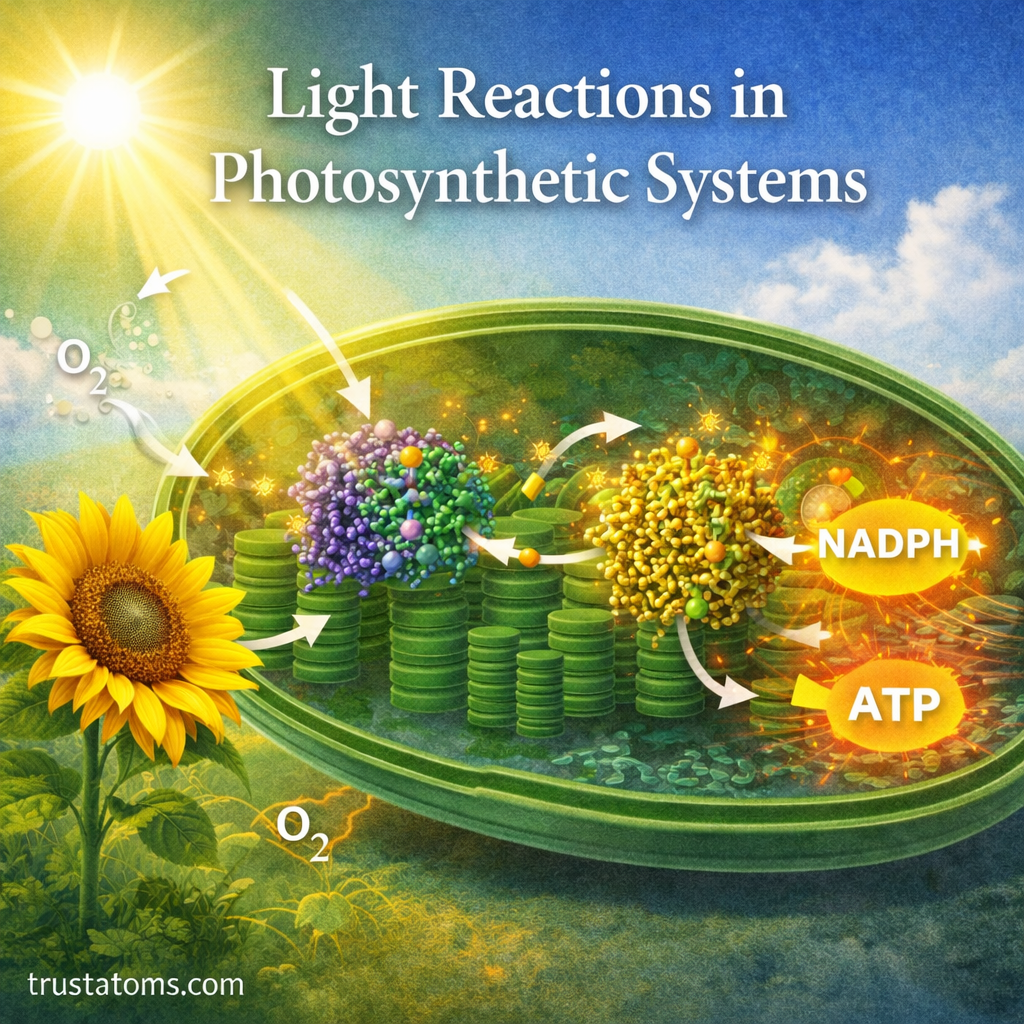
Educational illustration showing sunlight powering light reactions inside a chloroplast thylakoid membrane producing ATP and NADPH.
Illustration of light reactions in photosynthesis showing sunlight captured by chlorophyll in thylakoid membranes to produce ATP and NADPH. trustatoms.com.

Photosynthesis is one of the most important biological processes on Earth. It allows plants, algae, and certain bacteria to convert sunlight into chemical energy that fuels life across ecosystems.

The first stage of this process is known as the light reactions, sometimes called the light-dependent reactions. These reactions capture energy from sunlight and convert it into chemical forms that cells can use to build energy-rich molecules.

Light reactions take place in specialized structures inside plant cells and form the foundation for the entire photosynthetic process.

Continue reading “Light Reactions in Photosynthetic Systems”

Energy Transfer in Biological Systems

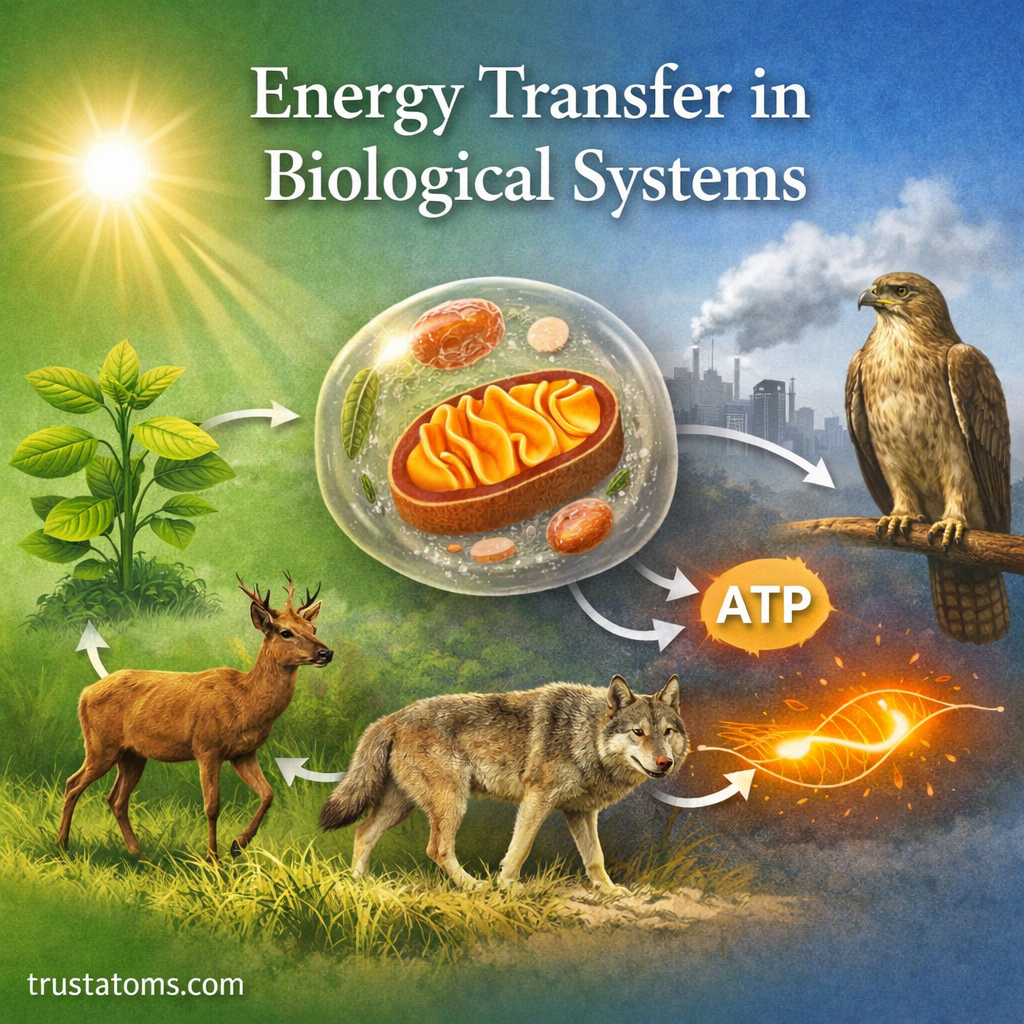
Illustrated diagram showing energy flow in biological systems from sunlight and plants to animals and cellular ATP production.
Illustration showing how energy moves through biological systems, from sunlight and plants to animals and cellular ATP production. trustatoms.com.

Energy transfer is one of the most fundamental processes that sustains life. Every biological activity — from muscle contraction and nerve signaling to growth and reproduction — depends on the movement and transformation of energy within living organisms.

In biology, energy does not appear from nowhere. Instead, it flows through ecosystems and moves through cells in highly organized biochemical pathways. Organisms capture energy from their environment, convert it into usable forms, and distribute it to power cellular processes.

Understanding how energy moves through biological systems helps explain how life functions at the cellular, organismal, and ecological levels.

Continue reading “Energy Transfer in Biological Systems”

Cellular Respiration in Mitochondrial Systems

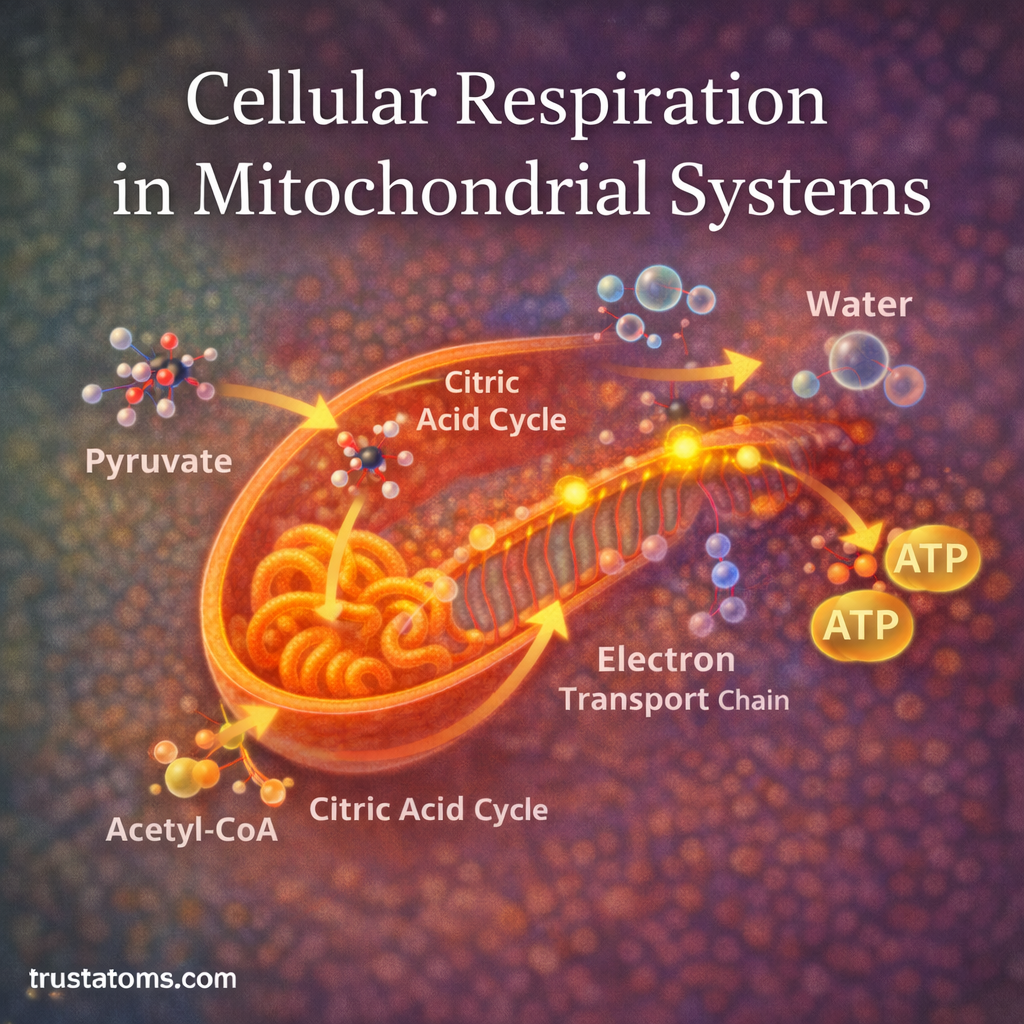
Educational illustration of a mitochondrion showing stages of cellular respiration including pyruvate conversion, the citric acid cycle, and the electron transport chain producing ATP.
Conceptual biology illustration showing how mitochondria perform cellular respiration through the citric acid cycle and electron transport chain to generate ATP. trustatoms.com.

Cells require a constant supply of energy to maintain life. Activities such as muscle contraction, nutrient transport, protein synthesis, and cellular repair all depend on a reliable energy source. In most eukaryotic organisms, this energy is produced through cellular respiration within mitochondria.

Mitochondria are specialized organelles that convert the chemical energy stored in nutrients into ATP (adenosine triphosphate), the molecule that powers cellular processes. Because of their central role in energy production, mitochondria are often referred to as the powerhouses of the cell.

Understanding how cellular respiration operates inside mitochondria helps explain how cells generate the energy needed to support life.

Continue reading “Cellular Respiration in Mitochondrial Systems”

Metabolic Pathways in Cellular Respiration

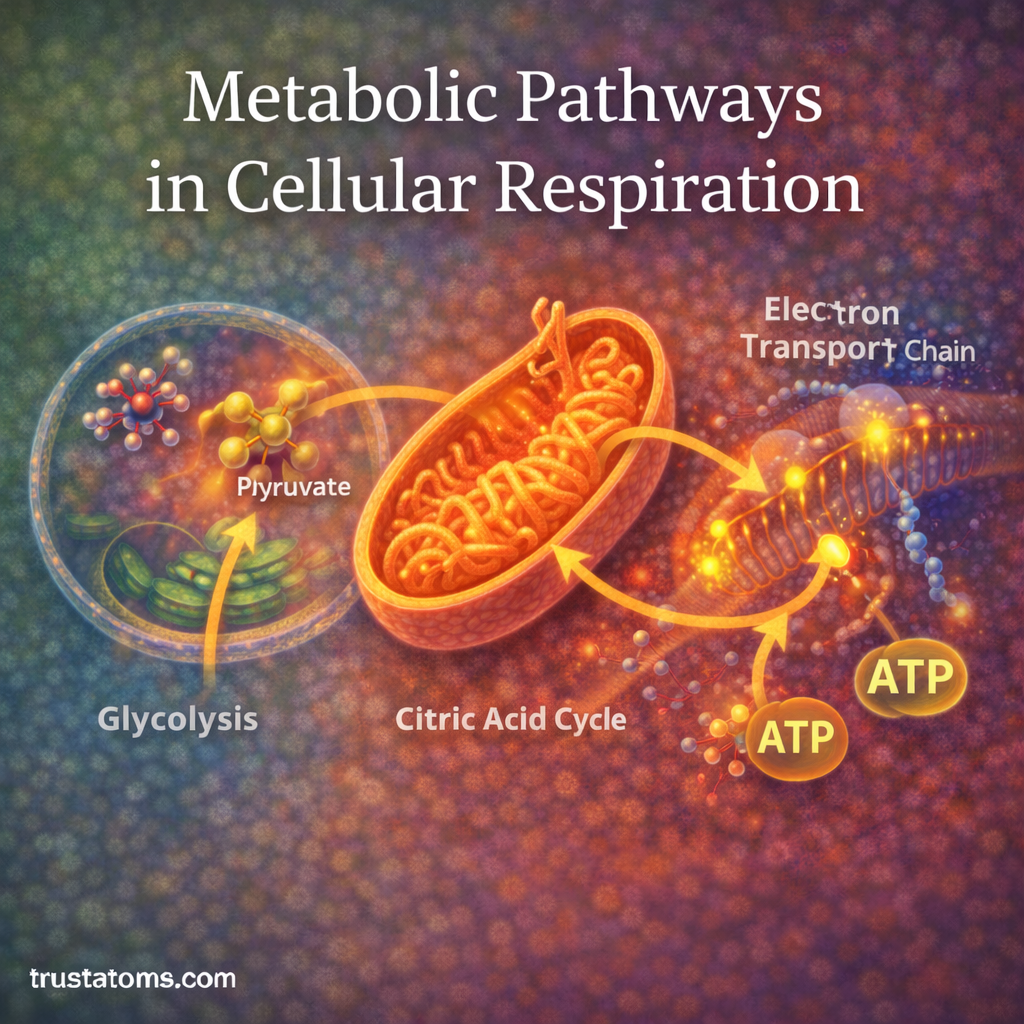
Educational illustration showing the stages of cellular respiration including glycolysis, the citric acid cycle in mitochondria, and the electron transport chain producing ATP.
Conceptual illustration showing the metabolic pathways of cellular respiration, where glucose is broken down through glycolysis, the citric acid cycle, and the electron transport chain to produce ATP. trustatoms.com.

Cells require a constant supply of energy to carry out essential biological functions. Activities such as muscle contraction, protein synthesis, active transport, and cellular repair all depend on energy stored in chemical bonds. One of the most important biological processes that supplies this energy is cellular respiration.

Cellular respiration is the process by which cells break down nutrients—primarily glucose—to produce ATP (adenosine triphosphate), the molecule that powers cellular work. This process occurs through a series of carefully organized metabolic pathways, each responsible for extracting energy from glucose step by step.

Understanding these pathways helps explain how organisms convert food into usable cellular energy.

Continue reading “Metabolic Pathways in Cellular Respiration”

Bioenergetics in Living Organisms

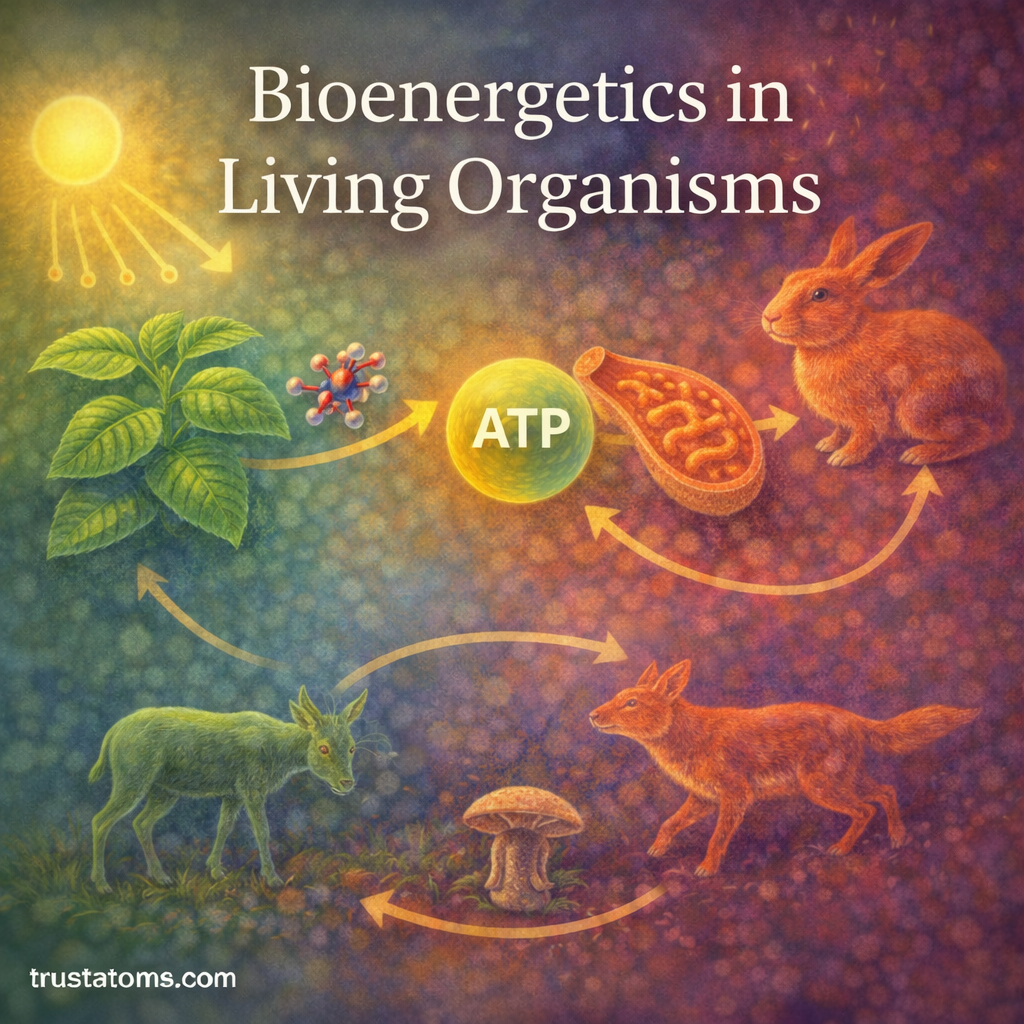
Educational illustration showing bioenergetics in living organisms with energy flowing from sunlight to plants, ATP production in cells, and transfer through animals in an ecosystem.
Conceptual illustration of bioenergetics showing how energy moves from sunlight to plants, is converted into ATP within cells, and flows through living organisms in an ecosystem. trustatoms.com.

All living organisms require energy to survive, grow, and reproduce. From microscopic bacteria to complex animals, biological systems rely on chemical energy to power cellular activities. The study of how living organisms obtain, transform, and use energy is known as bioenergetics.

Bioenergetics explains how cells convert energy from nutrients or sunlight into usable forms that support metabolism. It connects fundamental biological processes such as respiration, photosynthesis, and cellular metabolism.

Understanding bioenergetics helps explain how life maintains order, grows, and adapts in constantly changing environments.

Continue reading “Bioenergetics in Living Organisms”

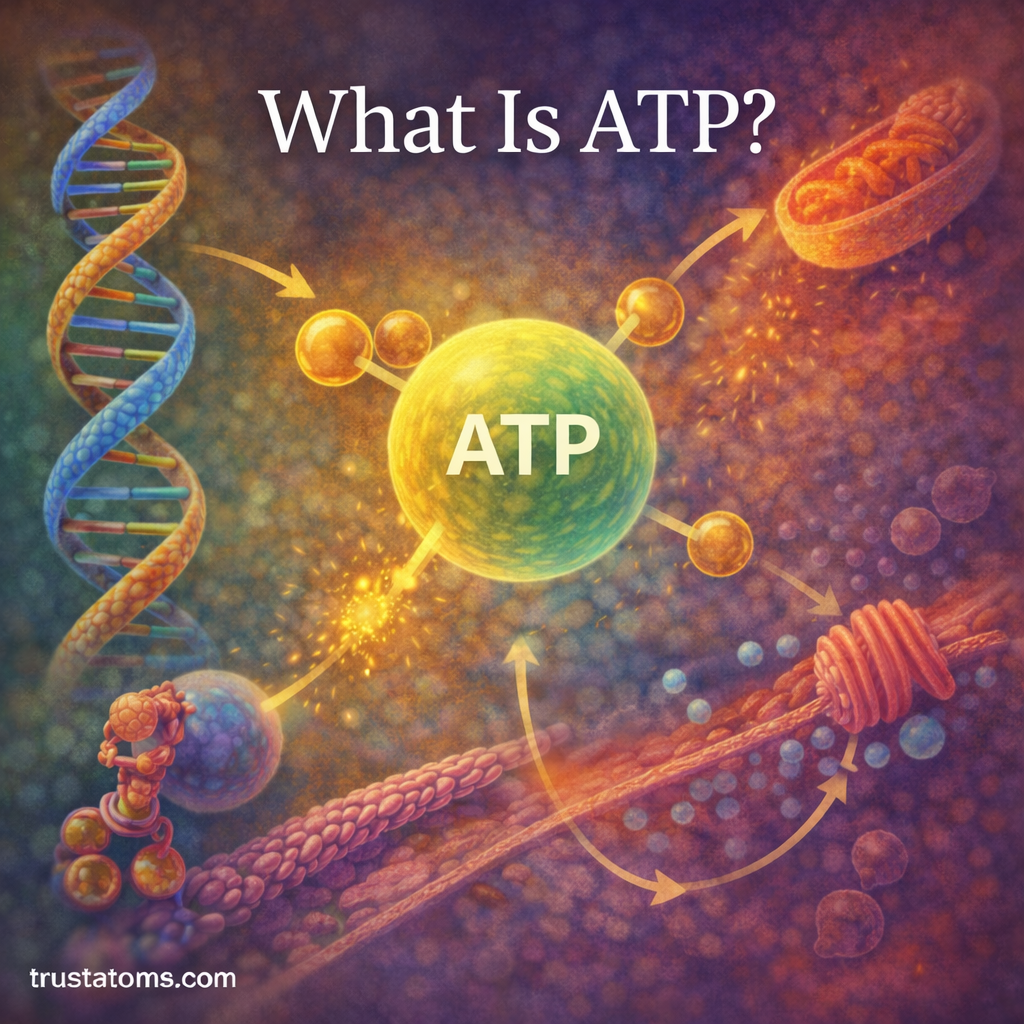
What Is ATP?

Educational illustration showing ATP as the cell’s energy molecule connected to cellular processes like DNA activity, mitochondria, and molecular movement.
Conceptual biology illustration showing ATP as the primary energy molecule that powers cellular processes such as metabolism and movement. trustatoms.com.

Every living cell requires energy to perform essential tasks. From muscle movement and nerve signaling to building new molecules and transporting nutrients, biological processes depend on a reliable energy source. In cells, that energy comes primarily from a molecule known as ATP.

ATP is often described as the energy currency of life because it stores and transfers energy within cells. Nearly every metabolic activity depends on ATP to power cellular work. Without it, cells would not be able to sustain life.

Understanding ATP is essential to understanding how organisms grow, move, and maintain their internal balance.

Continue reading “What Is ATP?”

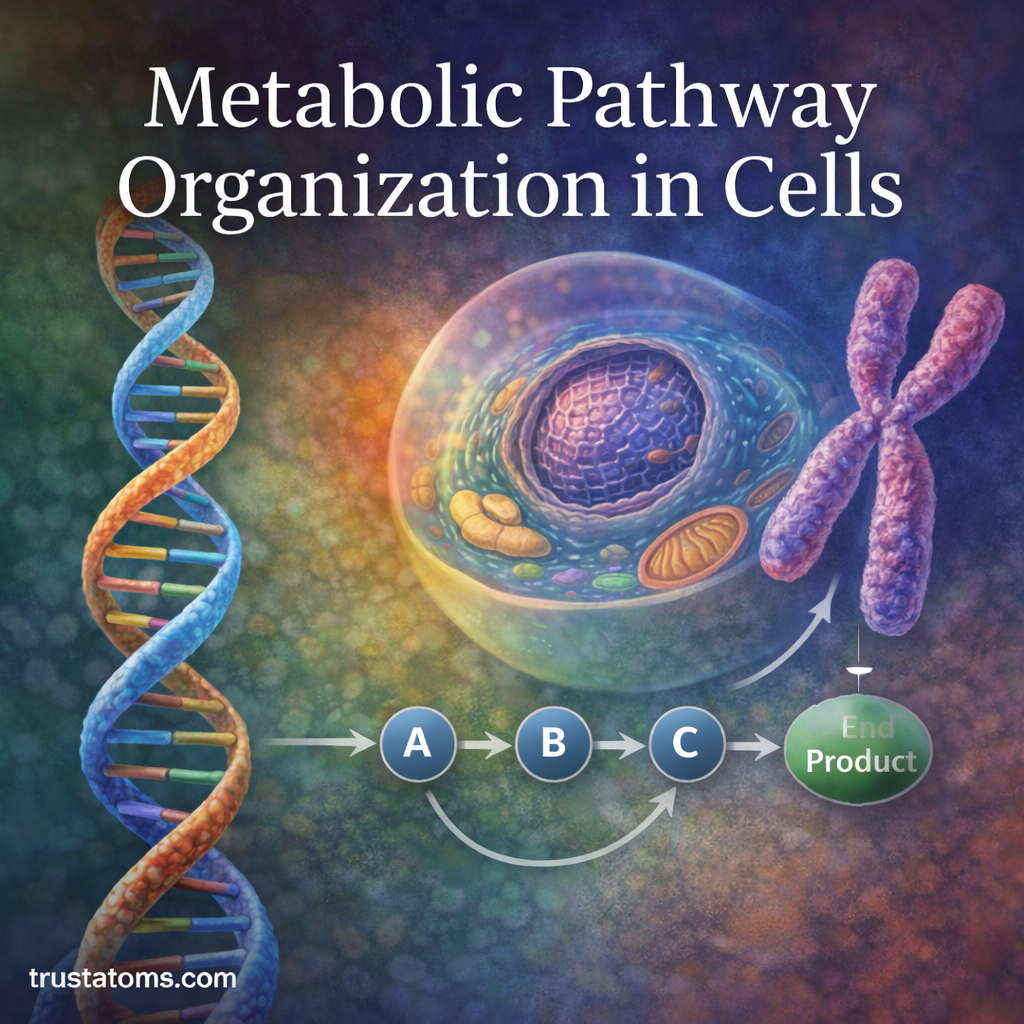
Metabolic Pathway Organization in Cells

Educational illustration showing metabolic pathway organization in cells, including a cell structure, DNA strand, and a simple step-by-step metabolic pathway leading to a final product.
Conceptual illustration of metabolic pathway organization in cells, showing how enzyme-driven reactions convert molecules step by step within cellular structures. trustatoms.com.

Cells are constantly performing thousands of chemical reactions that sustain life. These reactions allow organisms to generate energy, build essential molecules, break down nutrients, and respond to environmental changes. Rather than occurring randomly, most cellular reactions are arranged into organized sequences known as metabolic pathways.

Metabolic pathway organization allows cells to manage complex biochemical processes efficiently. By coordinating reactions in a structured way, cells can control energy use, regulate production of important molecules, and maintain internal stability.

Understanding how metabolic pathways are organized reveals how cells maintain life at the molecular level.

Continue reading “Metabolic Pathway Organization in Cells”

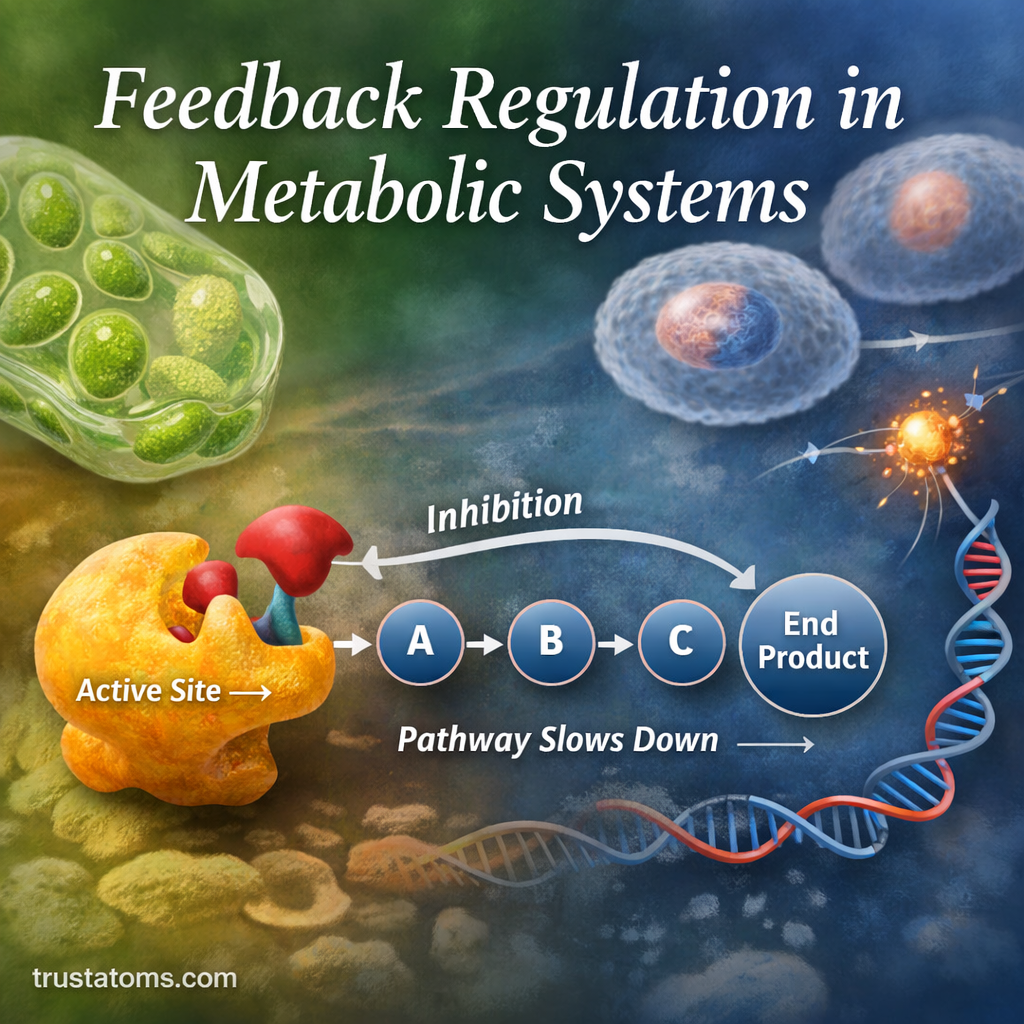
Feedback Regulation in Metabolic Systems

Simple educational diagram illustrating feedback regulation in metabolic systems, showing a metabolic pathway where the final product inhibits an earlier enzyme step.
Illustrated diagram explaining feedback regulation in metabolic systems, where the final product of a pathway slows earlier reactions. trustatoms.com.

Metabolic processes in living organisms involve thousands of chemical reactions occurring simultaneously inside cells. These reactions must be carefully controlled so that the cell produces exactly what it needs—no more and no less. One of the most efficient control mechanisms used by biological systems is feedback regulation.

Feedback regulation allows cells to monitor the levels of molecules they produce and automatically adjust metabolic pathways when necessary. This mechanism helps maintain homeostasis, conserve energy, and prevent harmful imbalances in cellular chemistry.

Continue reading “Feedback Regulation in Metabolic Systems”