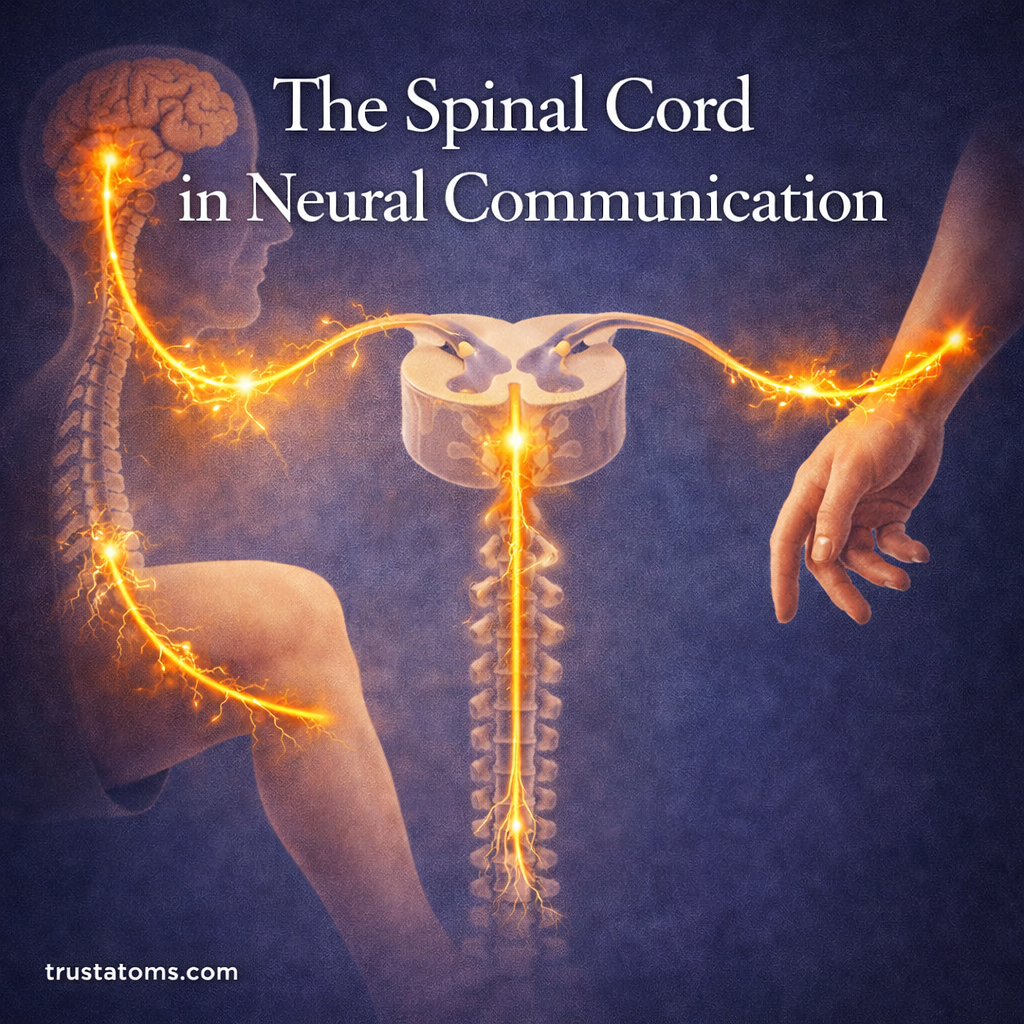
The Spinal Cord in Neural Communication

Educational illustration showing the spinal cord transmitting neural signals between the brain and the body through sensory and motor pathways.
Diagram illustrating how the spinal cord acts as a communication pathway between the brain and the body, transmitting sensory signals and motor commands. trustatoms.com.

The spinal cord is one of the most important structures in the human nervous system. It serves as the primary communication highway between the brain and the rest of the body. Every voluntary movement, reflex action, and sensory signal relies on the spinal cord to transmit information efficiently.

Located within the protective vertebral column, the spinal cord connects the brain to peripheral nerves that reach muscles, organs, and sensory receptors throughout the body. Through this network, the spinal cord allows the brain to send instructions and receive sensory feedback.

Understanding how the spinal cord functions reveals how the nervous system coordinates movement, sensation, and rapid protective responses.

Continue reading “The Spinal Cord in Neural Communication”
Reflex Arcs in Rapid Response

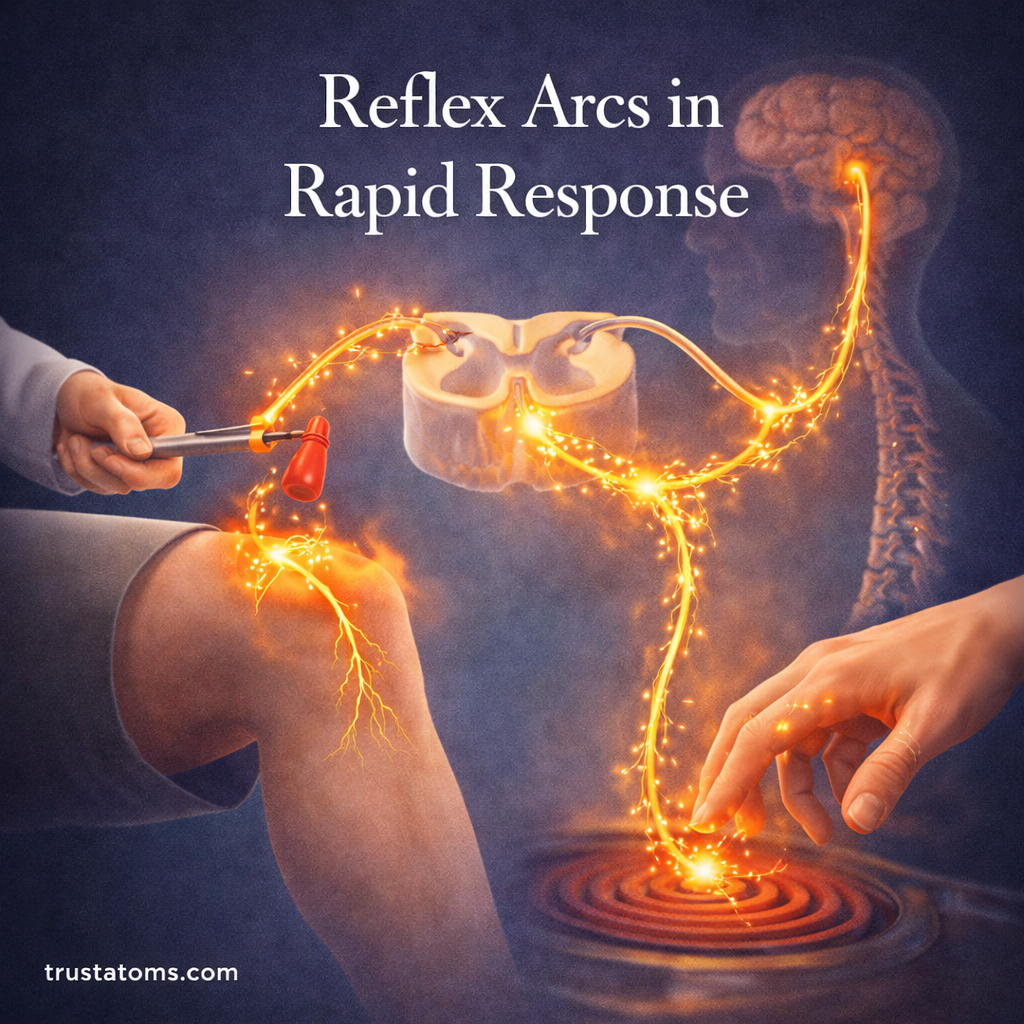
Educational illustration showing a reflex arc pathway where sensory signals travel through the spinal cord to trigger rapid muscle responses such as the knee-jerk reflex and withdrawal from heat.
Illustration demonstrating reflex arcs in the nervous system, showing how sensory signals travel through the spinal cord to produce rapid automatic responses like the knee reflex and withdrawal from heat. trustatoms.com.

The human body is constantly exposed to potential dangers such as heat, sharp objects, and sudden changes in balance. To respond quickly and protect itself, the nervous system uses specialized pathways called reflex arcs. These neural circuits allow the body to react to stimuli almost instantly, often before the brain becomes fully aware of the situation.

Reflex arcs are responsible for rapid responses like pulling your hand away from a hot surface or quickly adjusting posture to prevent falling. By processing signals through the spinal cord instead of the brain, reflex arcs reduce reaction time and help protect the body from injury.

Understanding how reflex arcs work reveals how the nervous system balances speed and coordination to maintain safety and stability.

Continue reading “Reflex Arcs in Rapid Response”

Sensory Neurons and Signal Detection

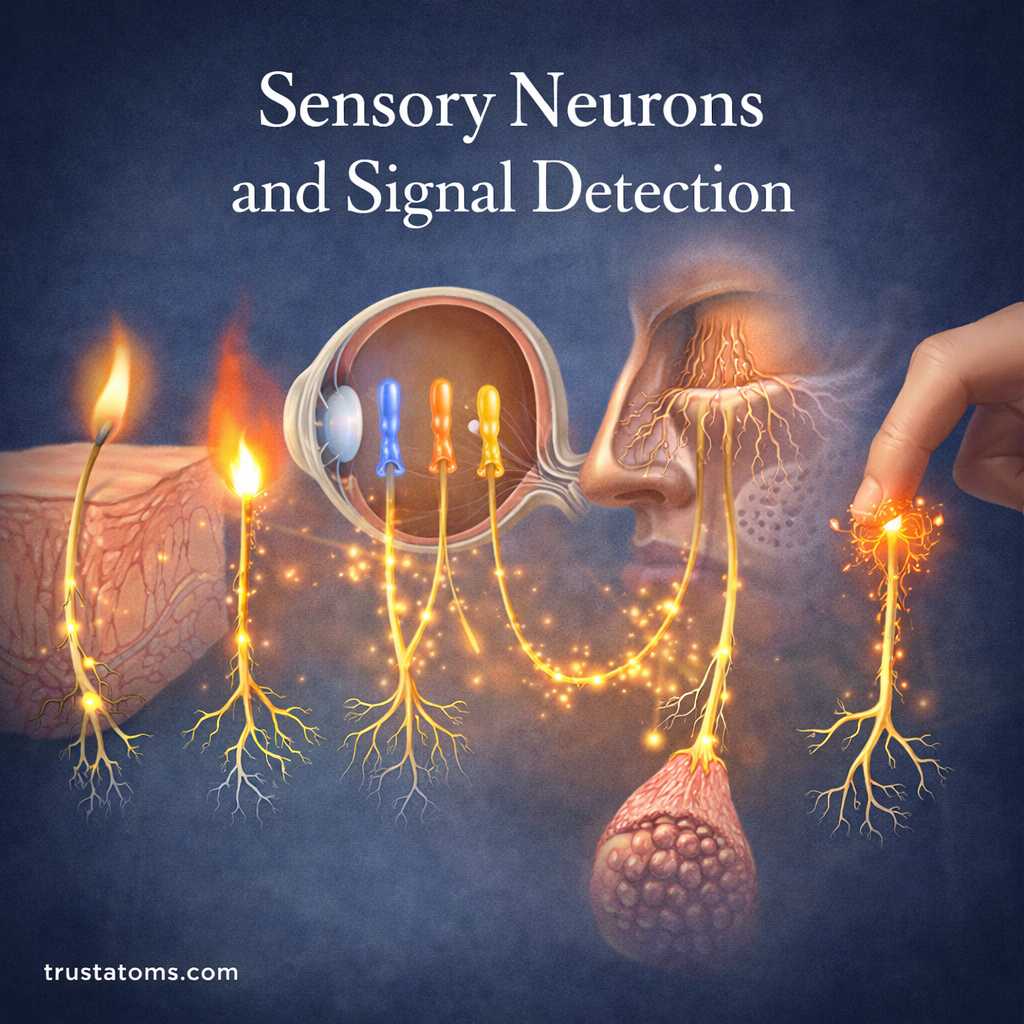
Educational illustration showing sensory neurons detecting stimuli such as heat, light, smell, and touch, with signals traveling to the nervous system.
Illustration showing how sensory neurons detect environmental stimuli like heat, light, smell, and touch and transmit signals to the nervous system. trustatoms.com.

The human body constantly receives information from the environment and from within itself. Whether feeling heat from a stove, hearing a sound, or sensing body position while walking, the nervous system relies on specialized cells called sensory neurons to detect and transmit these signals.

Sensory neurons act as the body’s detection system. They convert physical or chemical stimuli into electrical signals that travel to the brain and spinal cord. These signals allow the nervous system to interpret what is happening around and inside the body.

Without sensory neurons, the brain would have no information about temperature, pressure, light, sound, or pain. These cells are essential for awareness, coordination, reflexes, and survival.

Continue reading “Sensory Neurons and Signal Detection”

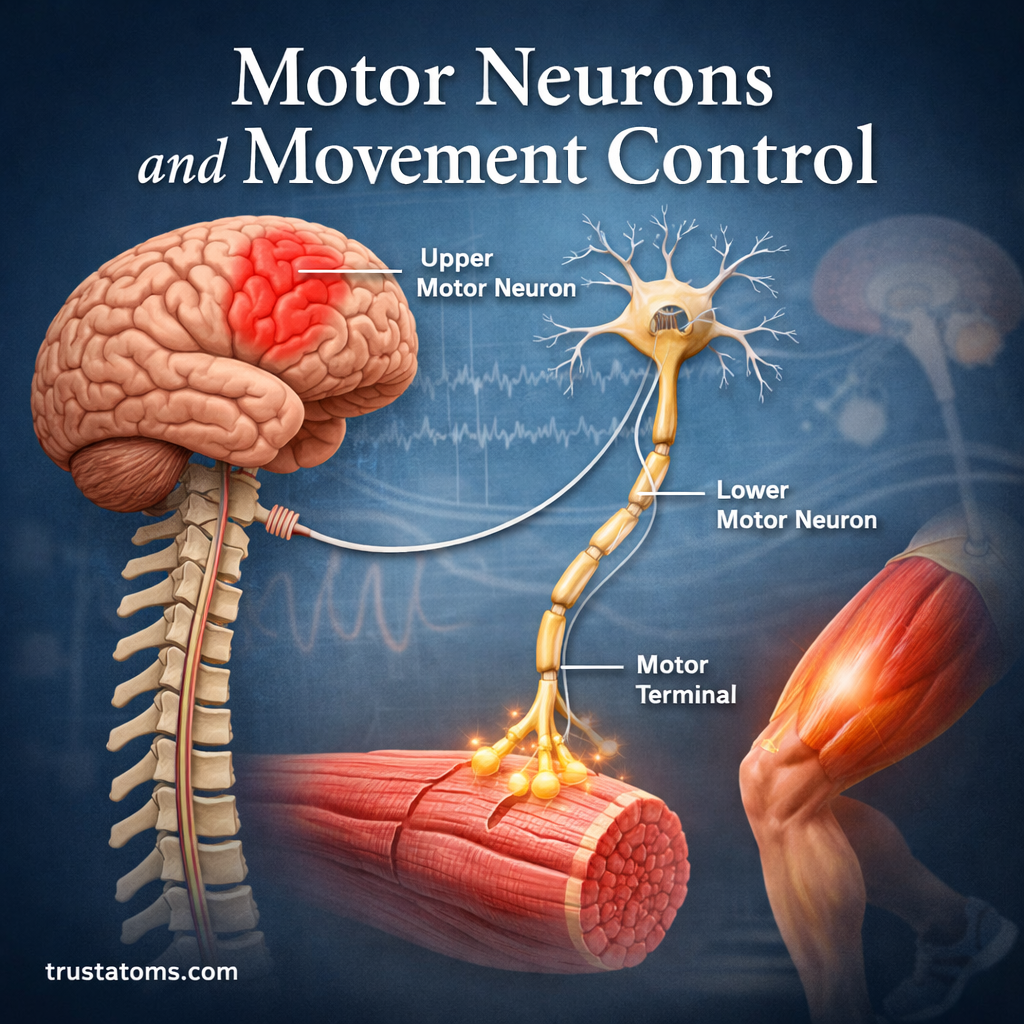
Motor Neurons and Movement Control

Educational illustration showing how motor neurons transmit signals from the brain and spinal cord to muscles, highlighting upper motor neurons, lower motor neurons, and the motor terminal.
Illustration explaining how motor neurons carry signals from the brain and spinal cord to muscle fibers, allowing the body to control movement. trustatoms.com.

Movement is one of the most essential abilities of the human body. From walking and breathing to writing and speaking, nearly every voluntary action depends on specialized nerve cells called motor neurons. These cells transmit signals from the brain and spinal cord to muscles, allowing them to contract and produce movement.

Motor neurons form a crucial part of the nervous system’s communication network. They convert electrical signals generated in the central nervous system into muscle activity, coordinating everything from simple reflexes to complex athletic movements.

Understanding how motor neurons work helps explain how the body controls movement, maintains posture, and adapts to changing physical demands.

Continue reading “Motor Neurons and Movement Control”

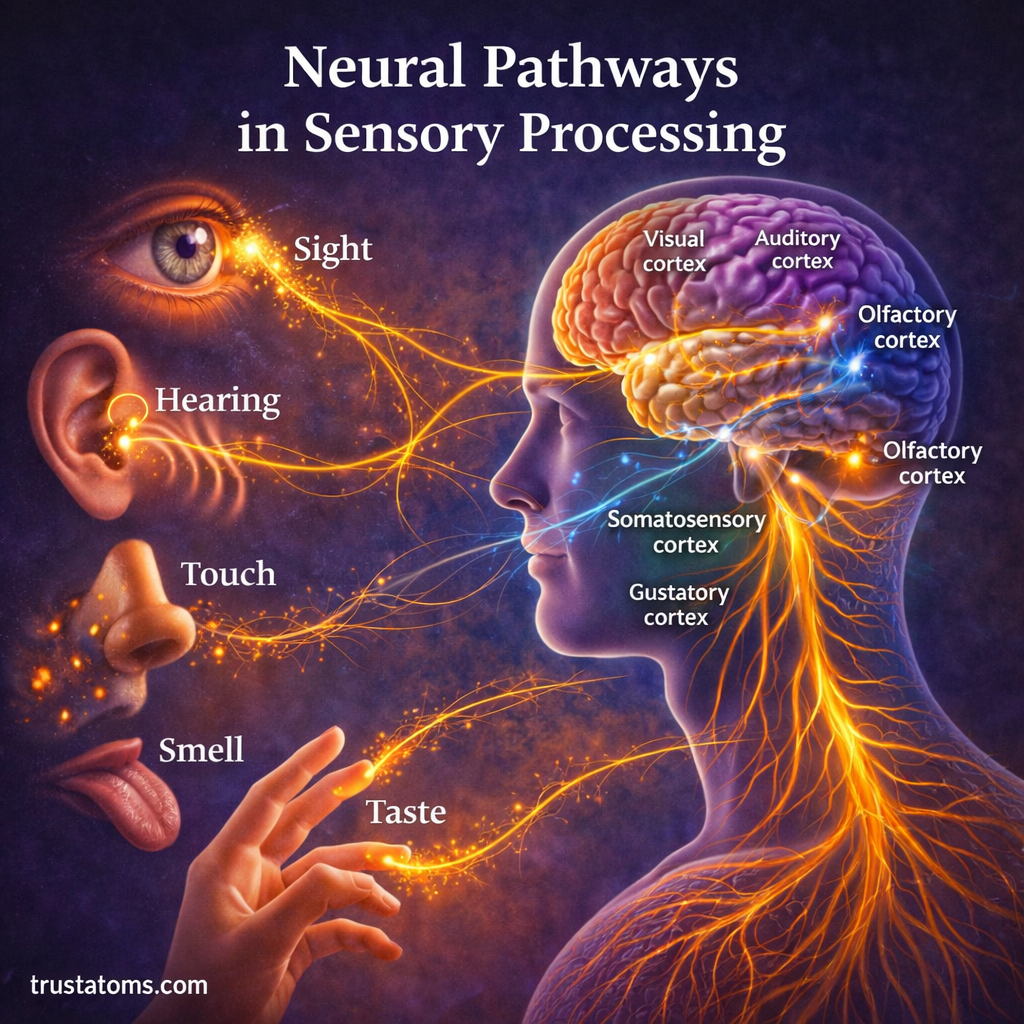
Neural Pathways in Sensory Processing

Educational illustration showing sensory organs connected to the brain through neural pathways highlighting the visual, auditory, olfactory, gustatory, and somatosensory cortices.
Illustration showing how sensory signals from sight, hearing, touch, smell, and taste travel through neural pathways to specialized areas of the brain. trustatoms.com.

Every moment, the human body receives information from the environment through the senses. Light, sound, touch, temperature, smell, and taste all generate signals that travel through the nervous system to the brain.

These signals move through neural pathways, which are organized networks of neurons that transmit sensory information from receptors in the body to specific regions of the brain.

Neural pathways allow the brain to interpret sensory input, recognize patterns, and generate appropriate responses. Without these pathways, the brain would not be able to process the constant stream of information coming from the outside world.

Continue reading “Neural Pathways in Sensory Processing”

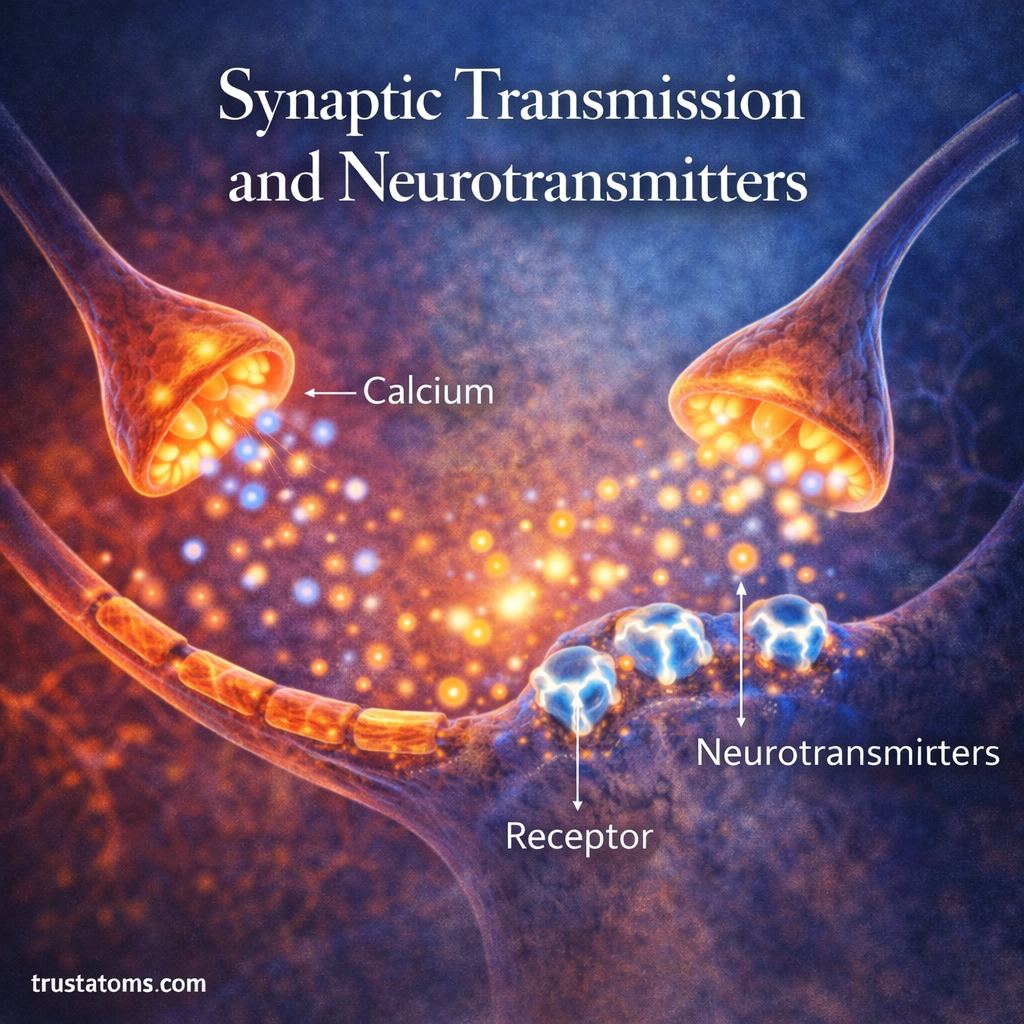
Synaptic Transmission and Neurotransmitters

Educational illustration showing neurotransmitters released across a synapse between two neurons.
Diagram illustrating synaptic transmission where neurotransmitters travel across the synaptic cleft to receptors on the next neuron. trustatoms.com.

The nervous system relies on rapid communication between billions of neurons. One of the most important processes that allows this communication to occur is synaptic transmission.

Synaptic transmission is the process by which neurons send signals to one another across tiny gaps called synapses. These signals are transmitted using chemical messengers known as neurotransmitters.

This system of electrical and chemical signaling allows the brain and nervous system to coordinate movement, process sensory information, regulate emotions, and control many automatic body functions.

Continue reading “Synaptic Transmission and Neurotransmitters”

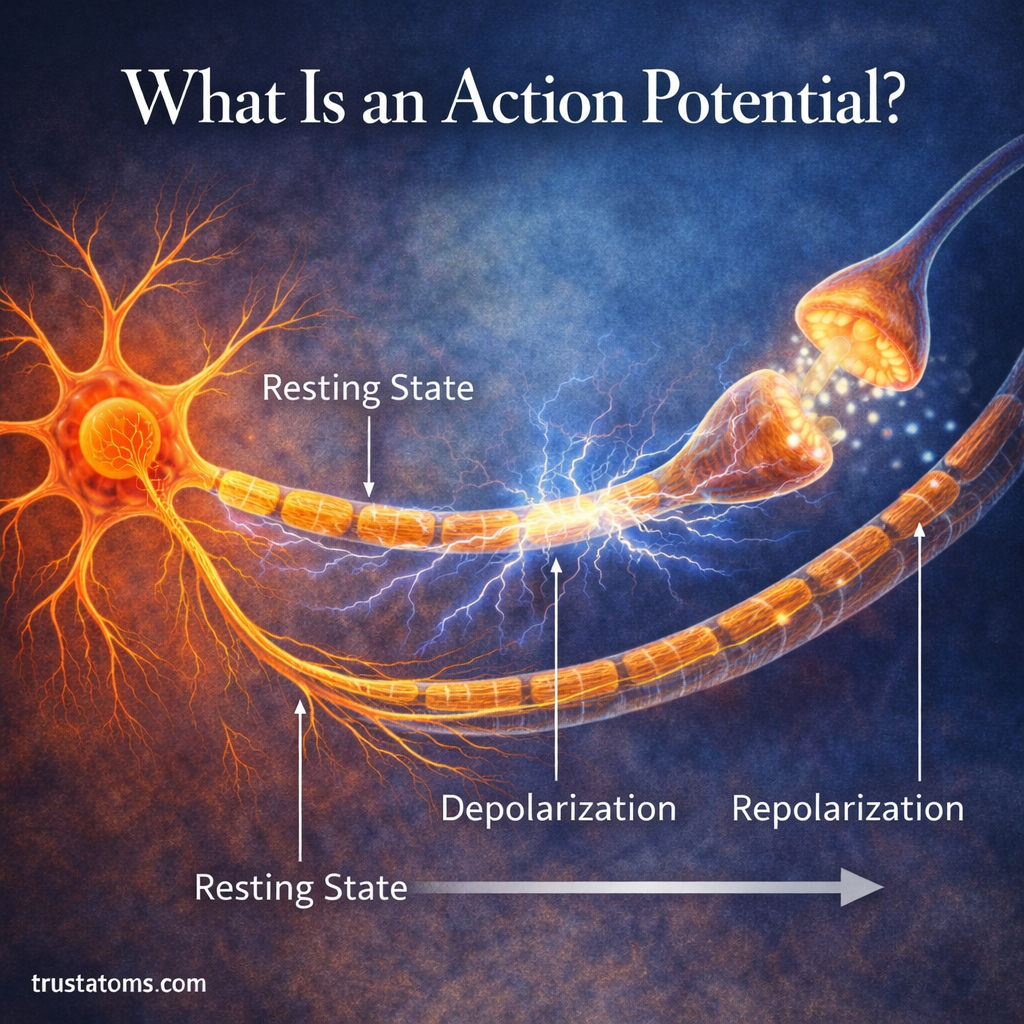
What Is an Action Potential?

Educational illustration of an action potential showing electrical impulses traveling along a neuron’s axon.
Diagram illustrating how an action potential travels along a neuron, enabling electrical communication within the nervous system. trustatoms.com.

An action potential is a rapid electrical signal that travels along a neuron, allowing nerve cells to communicate with each other and with muscles or glands. It is the fundamental mechanism that enables the nervous system to transmit information throughout the body.

Every time you move a muscle, feel pain, or process a thought, action potentials are helping carry signals through networks of neurons. These electrical impulses move quickly along nerve fibers, ensuring that messages reach their destination in fractions of a second.

Without action potentials, neurons would not be able to send signals, and the nervous system would not function.

Continue reading “What Is an Action Potential?”

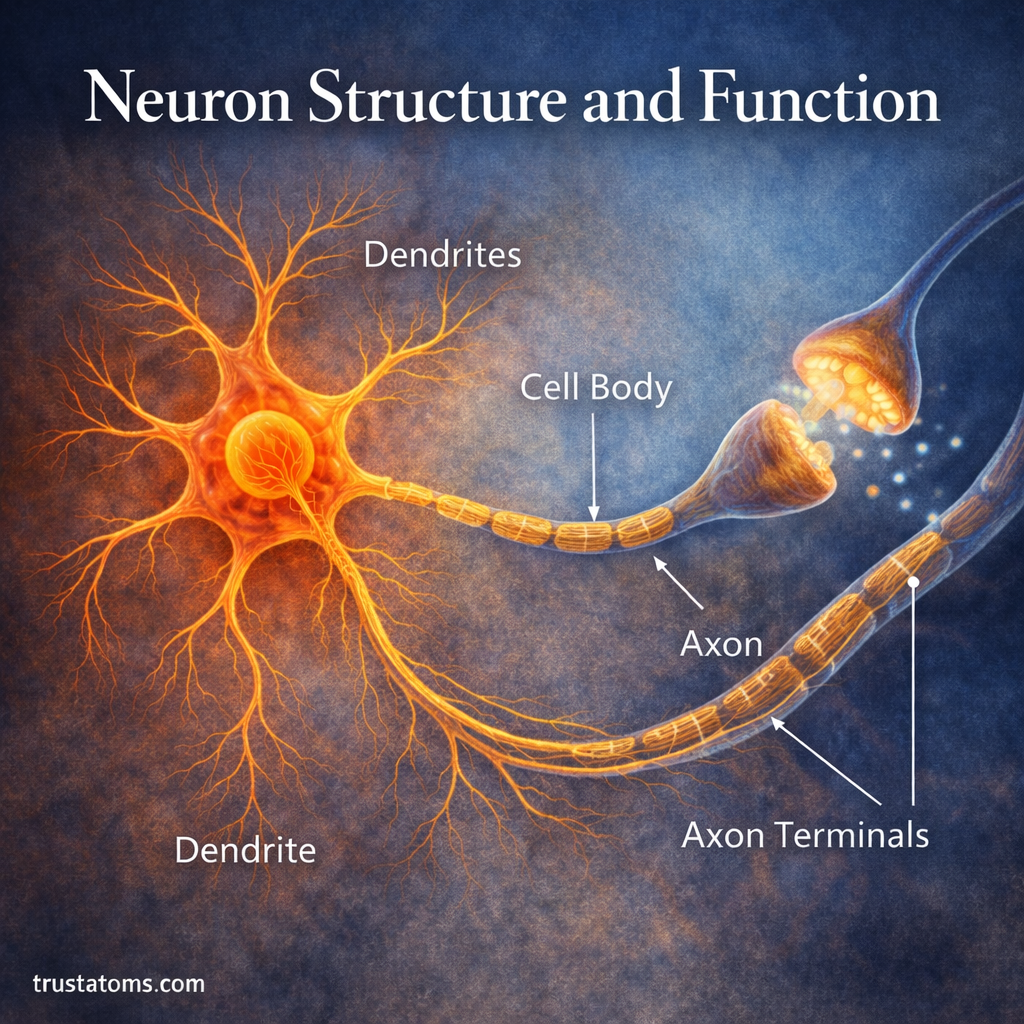
Neuron Structure and Function

Educational diagram of a neuron showing dendrites, cell body, axon, and axon terminals involved in nerve signal transmission.
Illustrated neuron diagram highlighting key parts of a nerve cell including dendrites, the cell body, axon, and axon terminals. trustatoms.com.

Neurons are specialized cells that form the foundation of the nervous system. Their primary role is to transmit information throughout the body, allowing the brain, spinal cord, muscles, and organs to communicate with one another.

Every thought, movement, sensation, and reflex depends on neurons sending signals across complex networks. These cells use both electrical impulses and chemical signals to pass information rapidly across the nervous system.

Understanding neuron structure and function helps explain how the brain processes information, how the body responds to stimuli, and how communication occurs within the nervous system.

Continue reading “Neuron Structure and Function”

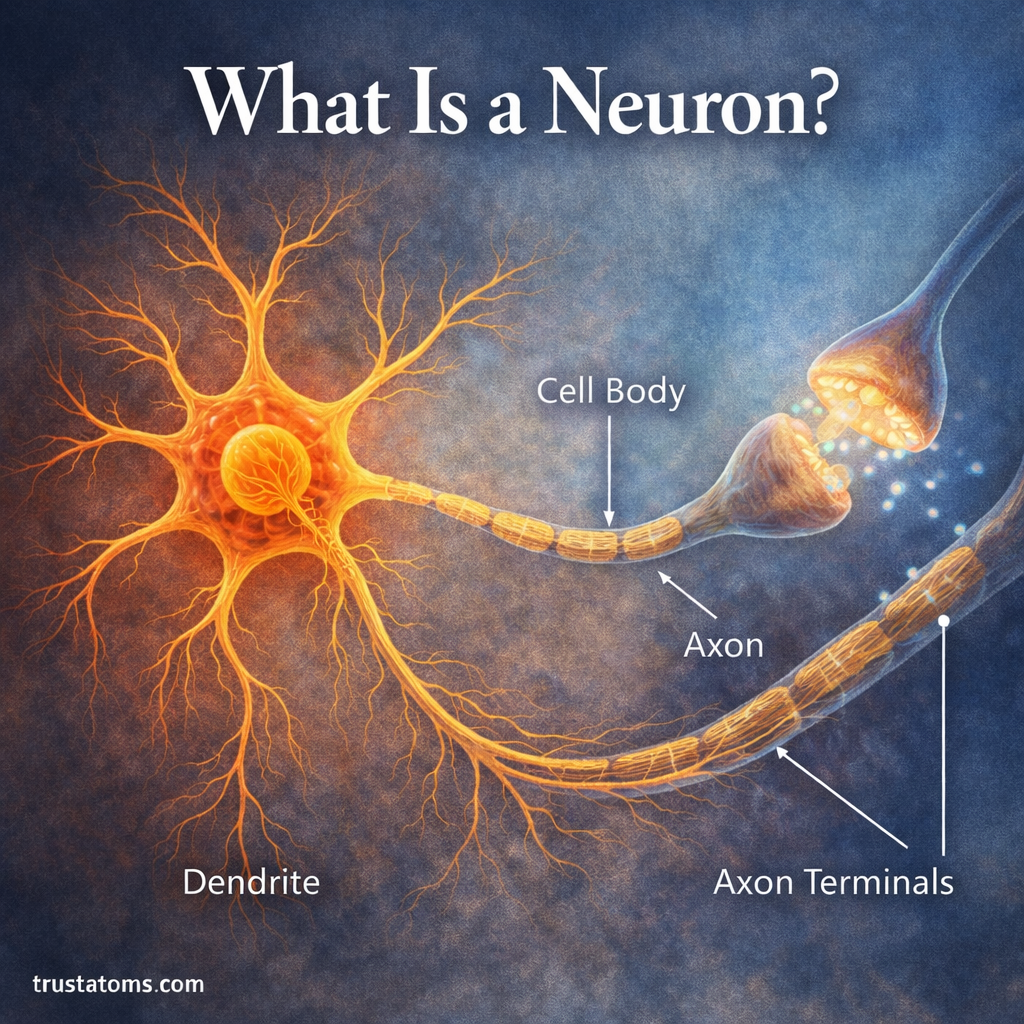
What Is a Neuron?

Educational illustration of a neuron showing dendrites, the cell body, axon, and axon terminals transmitting signals.
Simple diagram of a neuron highlighting dendrites, the cell body, axon, and axon terminals involved in nerve signal transmission. trustatoms.com.

A neuron is a specialized cell in the nervous system responsible for transmitting information throughout the body. These cells allow the brain, spinal cord, and nerves to communicate with muscles, organs, and sensory systems.

Neurons carry messages using electrical and chemical signals. This communication system enables essential functions such as movement, thinking, memory, sensation, and reflex responses.

The human nervous system contains billions of neurons, all working together to form complex communication networks that allow the body to process information and respond to the environment.

Continue reading “What Is a Neuron?”

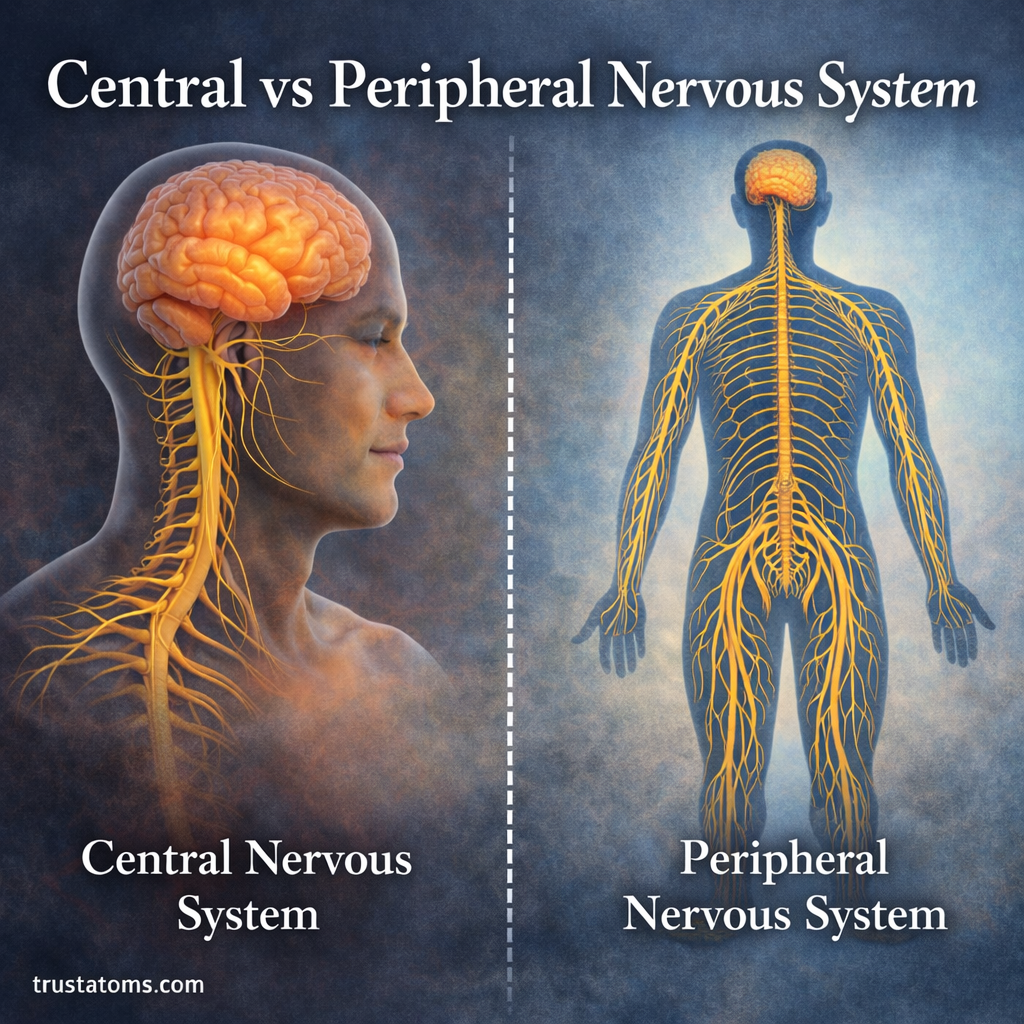
Central vs Peripheral Nervous System

Side-by-side illustration comparing the central nervous system with the brain and spinal cord and the peripheral nervous system showing nerves throughout the body.
Educational comparison diagram highlighting the central nervous system and peripheral nervous system and how nerves connect the brain and spinal cord to the body. trustatoms.com.

The human nervous system is responsible for controlling nearly every activity in the body—from breathing and heart rate to movement, memory, and sensation. To manage these complex tasks, the nervous system is divided into two major parts: the central nervous system (CNS) and the peripheral nervous system (PNS).

While these two systems work closely together, they perform different roles. The central nervous system acts as the body’s main control center, while the peripheral nervous system serves as the communication network that connects the rest of the body to that control center.

Understanding the differences between these two systems helps explain how the body processes information, responds to stimuli, and maintains balance.

Continue reading “Central vs Peripheral Nervous System”