The Appendicular Skeleton: Limbs and Girdles

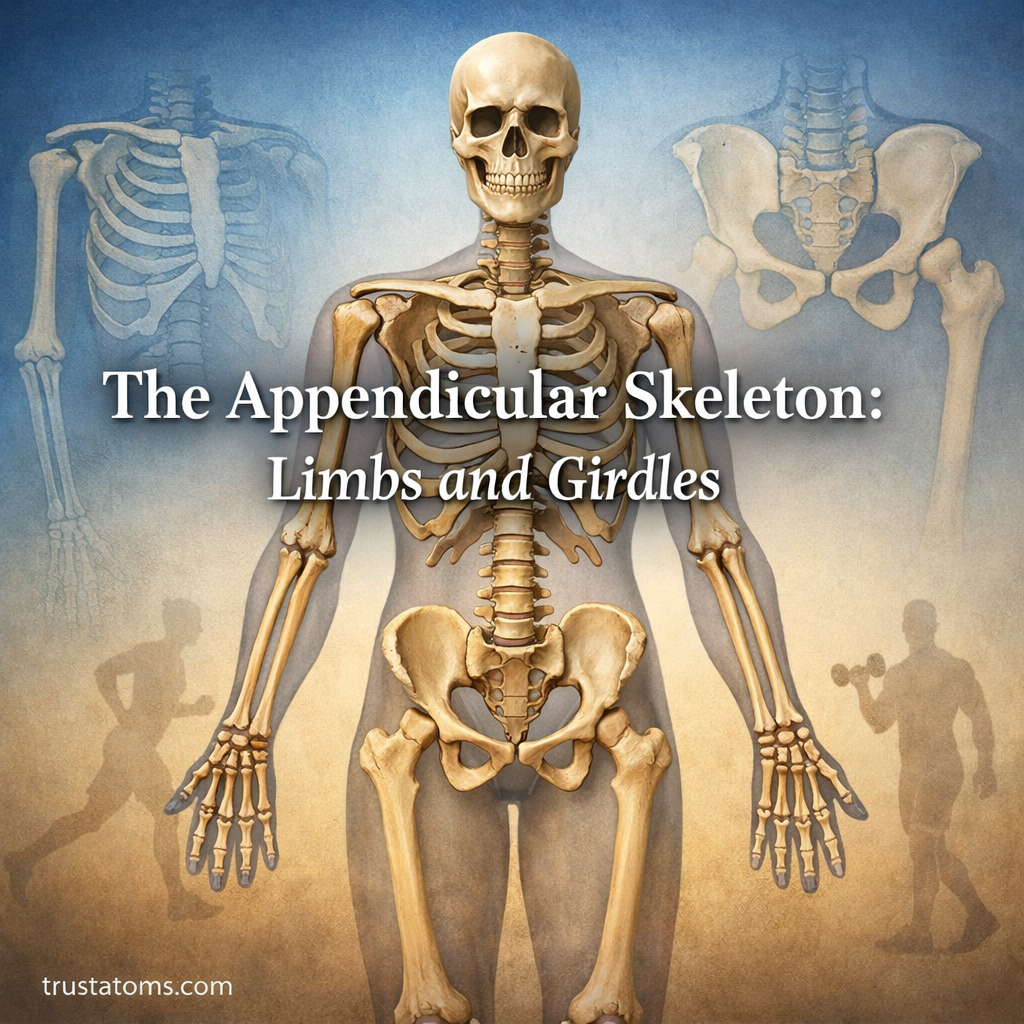
Illustration of the appendicular skeleton showing limbs and girdles including arms, legs, shoulder girdle, and pelvic girdle.
Illustration of the appendicular skeleton highlighting the limbs and girdles. trustatoms.com.

The appendicular skeleton is the part of the human skeletal system that enables movement, interaction with the environment, and physical activity. While the axial skeleton forms the body’s central structure, the appendicular skeleton includes the limbs and the girdles that attach them to the core.

Understanding how the appendicular skeleton works helps explain how we walk, lift, run, and perform everyday tasks.

Continue reading “The Appendicular Skeleton: Limbs and Girdles”
The Axial Skeleton: Spine and Rib Cage

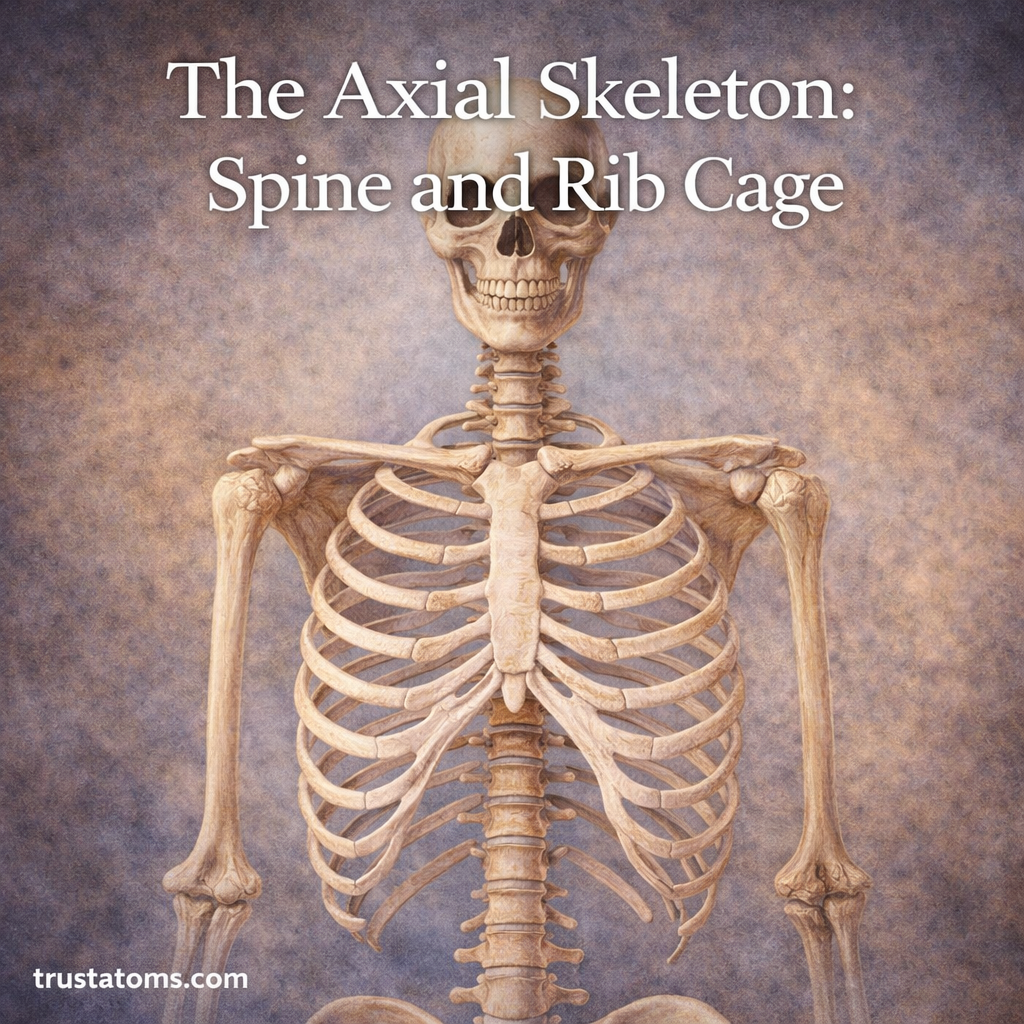
Illustration of the human axial skeleton highlighting the spine and rib cage structure.
Diagram showing the spine and rib cage as key components of the axial skeleton. trustatoms.com.

The axial skeleton forms the central framework of the human body. It includes the skull, spine, and rib cage, all of which protect vital organs and support posture.

Among these, the spine (vertebral column) and rib cage (thoracic cage) play especially important roles in stability, movement, and protection.

Continue reading “The Axial Skeleton: Spine and Rib Cage”

Connective Tissue in Structural Support

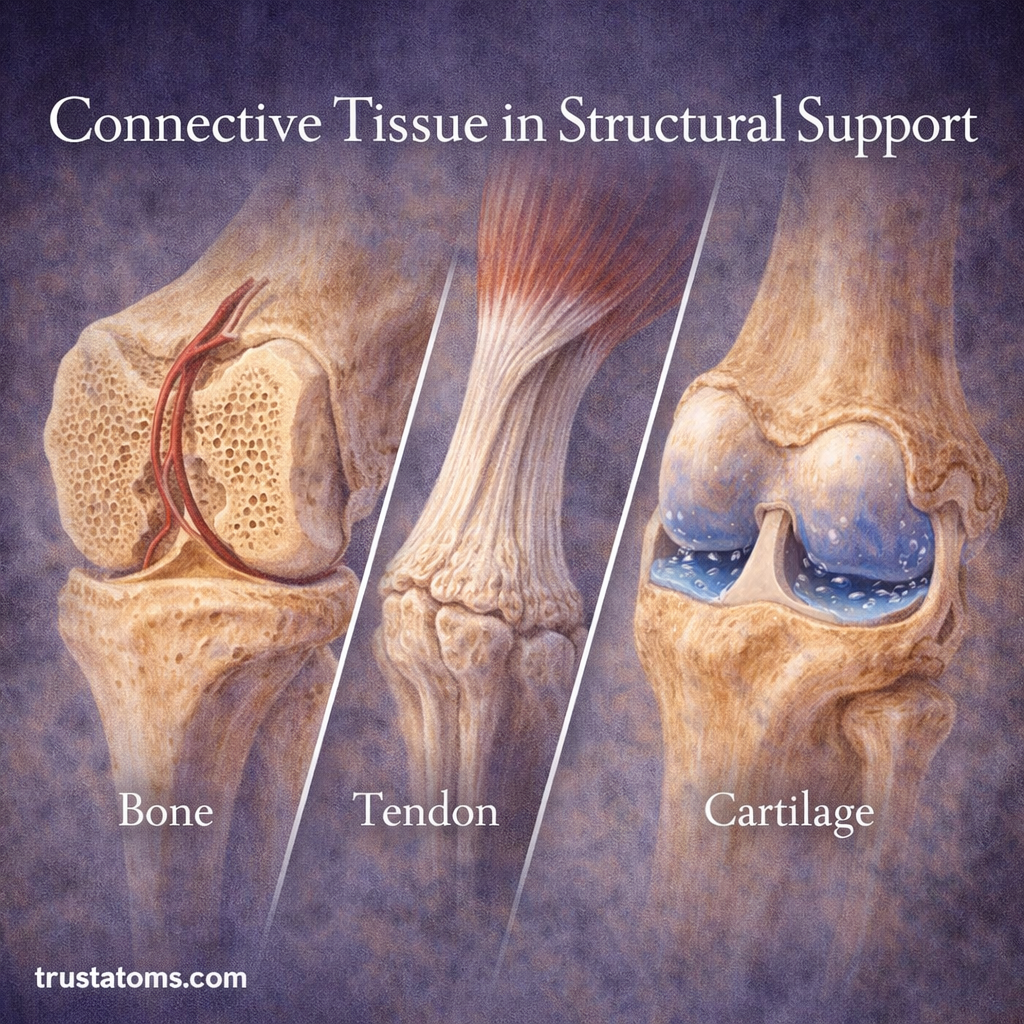
Illustration showing bone, tendon, and cartilage working together to provide structural support in the human body.
Diagram highlighting how bone, tendon, and cartilage contribute to structural support and movement. trustatoms.com.

Connective tissue is one of the most important yet often overlooked components of the human body. It forms the framework that holds everything together—supporting organs, connecting structures, and maintaining overall stability.

From bones and cartilage to tendons and ligaments, connective tissue plays a central role in structural support and movement.

Continue reading “Connective Tissue in Structural Support”

Cartilage Types and Joint Support

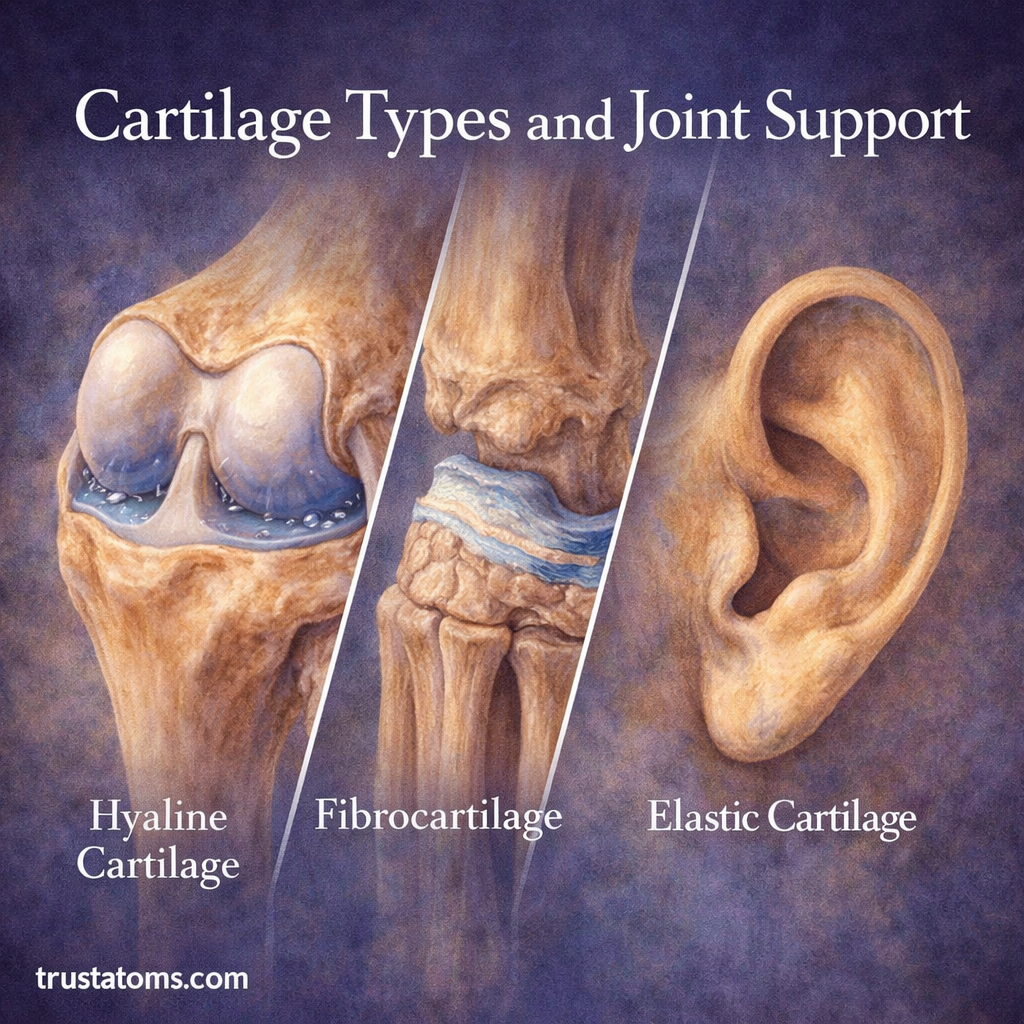
Illustration showing hyaline cartilage in a joint, fibrocartilage in the knee, and elastic cartilage in the ear.
Visual comparison of cartilage types and their roles in joint support and flexibility. trustatoms.com.

Cartilage is a specialized connective tissue that plays a critical role in joint function, flexibility, and shock absorption. Unlike bone, cartilage is smooth, flexible, and designed to reduce friction between moving parts of the body.

Understanding the different types of cartilage and how they support joints helps explain how your body maintains mobility while minimizing wear and tear.

Continue reading “Cartilage Types and Joint Support”

Synovial Joints and Lubrication

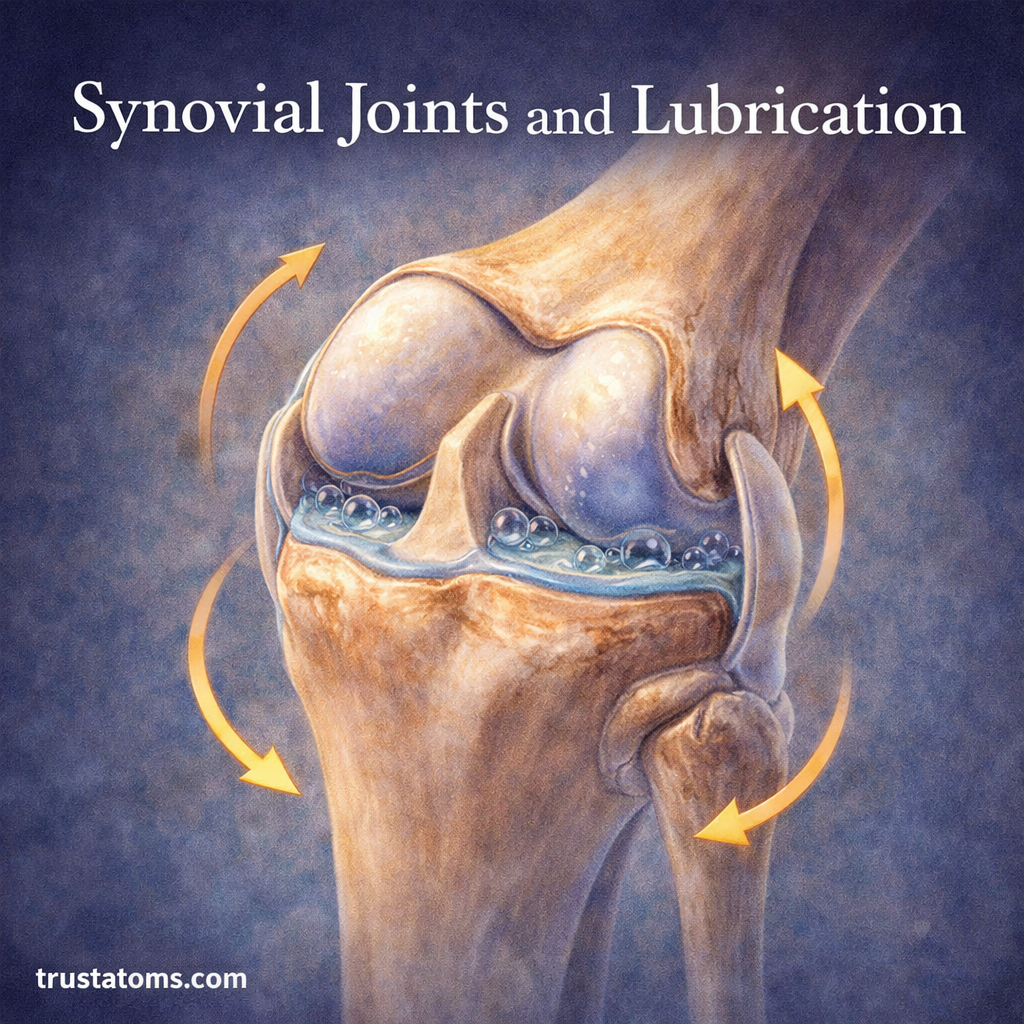
Illustration of a synovial knee joint showing cartilage surfaces and synovial fluid lubricating joint movement.
Diagram of a synovial joint demonstrating how fluid lubrication reduces friction and supports smooth movement. trustatoms.com.

Synovial joints are the most mobile and commonly used joints in the human body. From walking and running to lifting and rotating, these joints allow for smooth, controlled movement.

A key factor behind this efficiency is lubrication, which reduces friction and protects joint structures during motion. Understanding how synovial joints work—and how they stay lubricated—reveals why joint health is essential for everyday function.

Continue reading “Synovial Joints and Lubrication”

Joint Types and Range of Motion

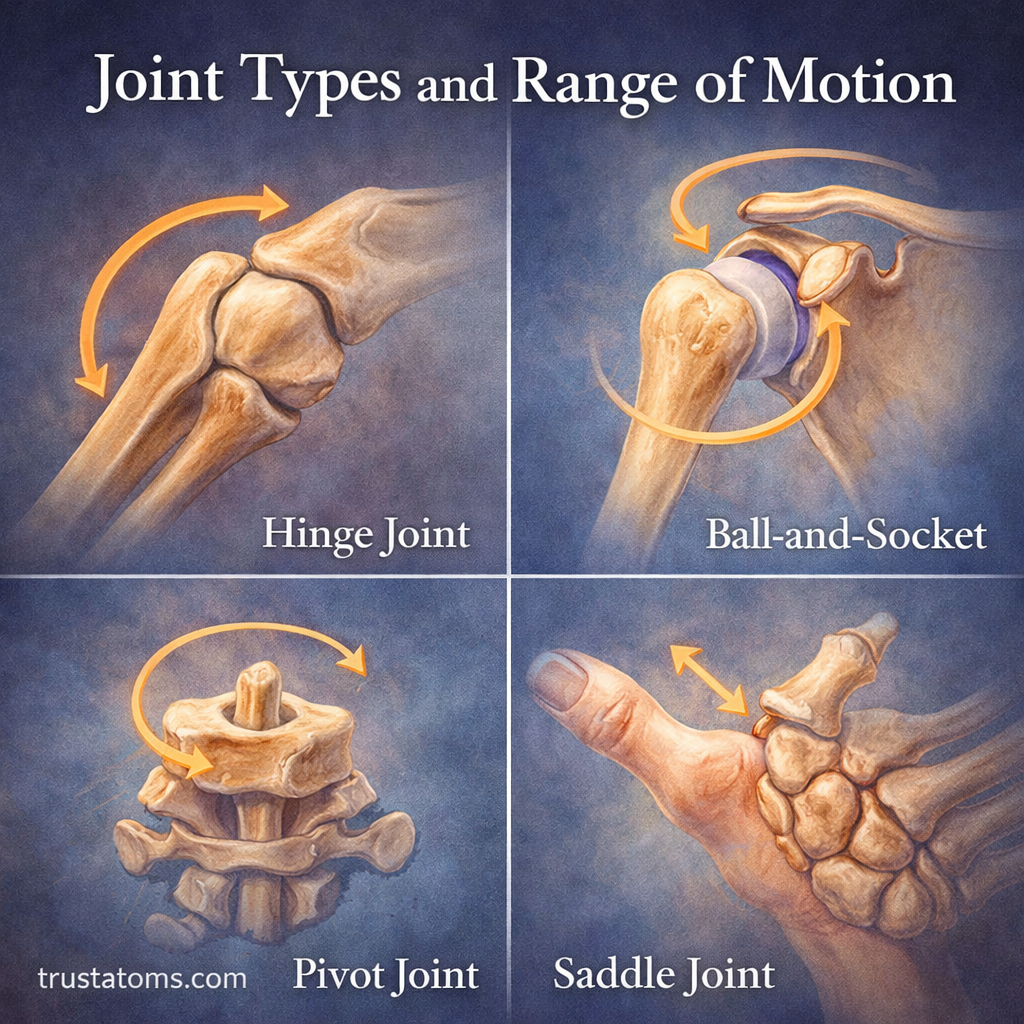
Illustration showing different joint types including hinge, ball-and-socket, pivot, and saddle joints with their range of motion.
Diagram highlighting major joint types and how each allows different ranges of motion in the human body. trustatoms.com.

Joints are the connection points between bones that allow your body to move in different ways. From bending your elbow to rotating your shoulder, joints make movement possible while also providing stability.

Understanding joint types and their range of motion helps explain how the human body performs both simple and complex movements.

Continue reading “Joint Types and Range of Motion”

Tendons and Ligaments: Key Differences

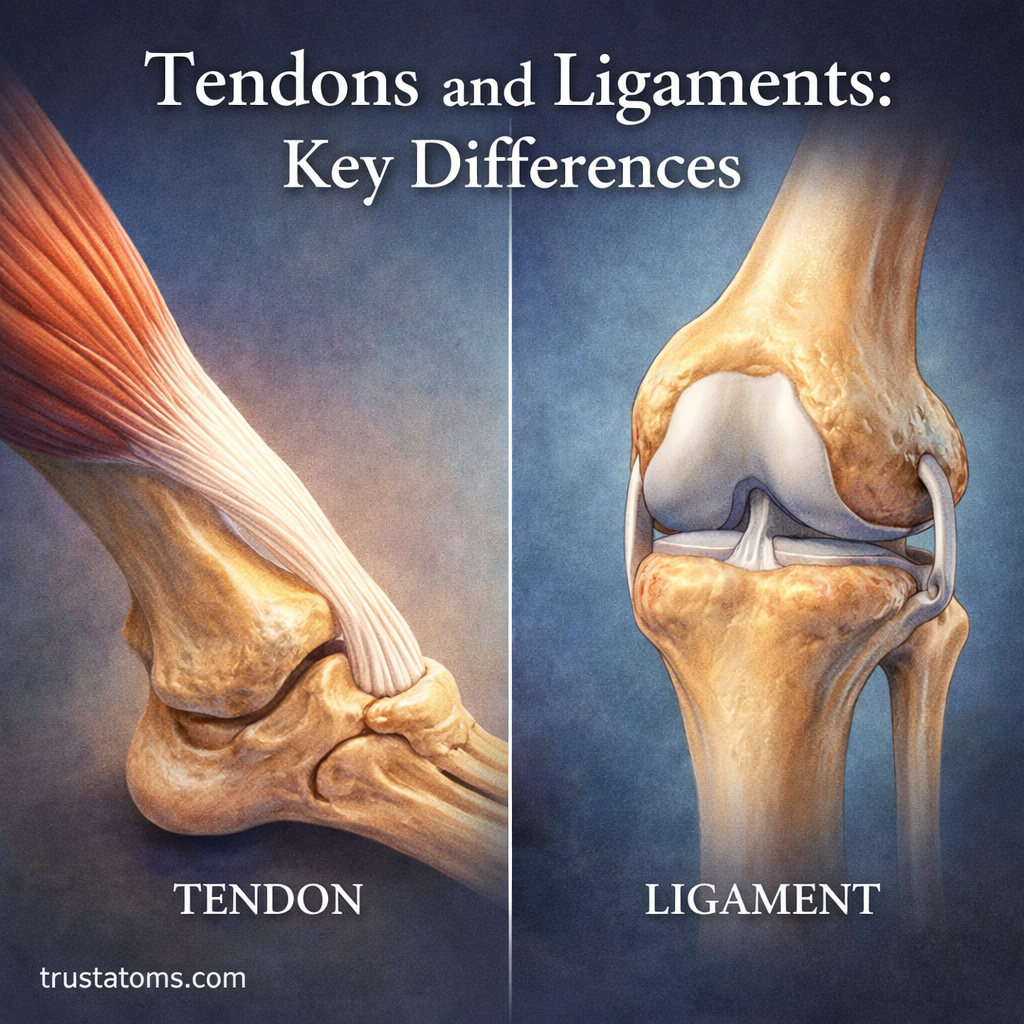
Split illustration comparing a tendon connecting muscle to bone and a ligament connecting bone to bone at a joint.
Side-by-side comparison showing how tendons connect muscle to bone and ligaments connect bone to bone. trustatoms.com.

Tendons and ligaments are essential components of the musculoskeletal system, helping your body move, stabilize, and function efficiently. While they are often confused due to their similar structure and roles, they serve distinct purposes.

Understanding the difference between tendons and ligaments can help you better grasp how movement works—and why certain injuries occur.

Continue reading “Tendons and Ligaments: Key Differences”

Neuromuscular Junction and Muscle Activation

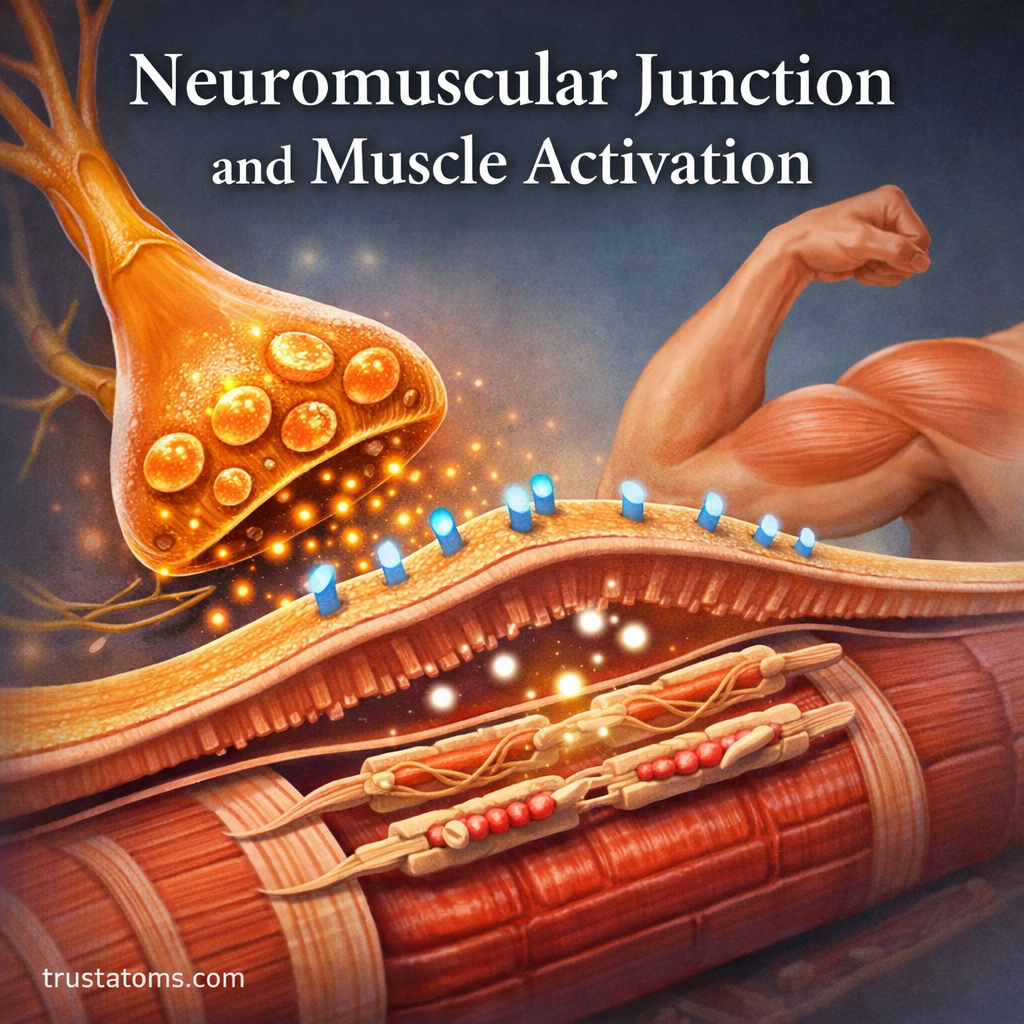
Illustration of the neuromuscular junction showing a motor neuron releasing neurotransmitters to activate a muscle fiber.
Visual diagram of how nerve signals trigger muscle contraction at the neuromuscular junction. trustatoms.com.

The ability to move—whether lifting a weight, walking, or even blinking—relies on a precise connection between the nervous system and muscles. This connection occurs at a specialized site called the neuromuscular junction (NMJ).

Understanding how the neuromuscular junction works helps explain how muscles contract, how signals travel through the body, and what happens when this system is disrupted.

Continue reading “Neuromuscular Junction and Muscle Activation”

How Muscles Contract: Sliding Filament Model

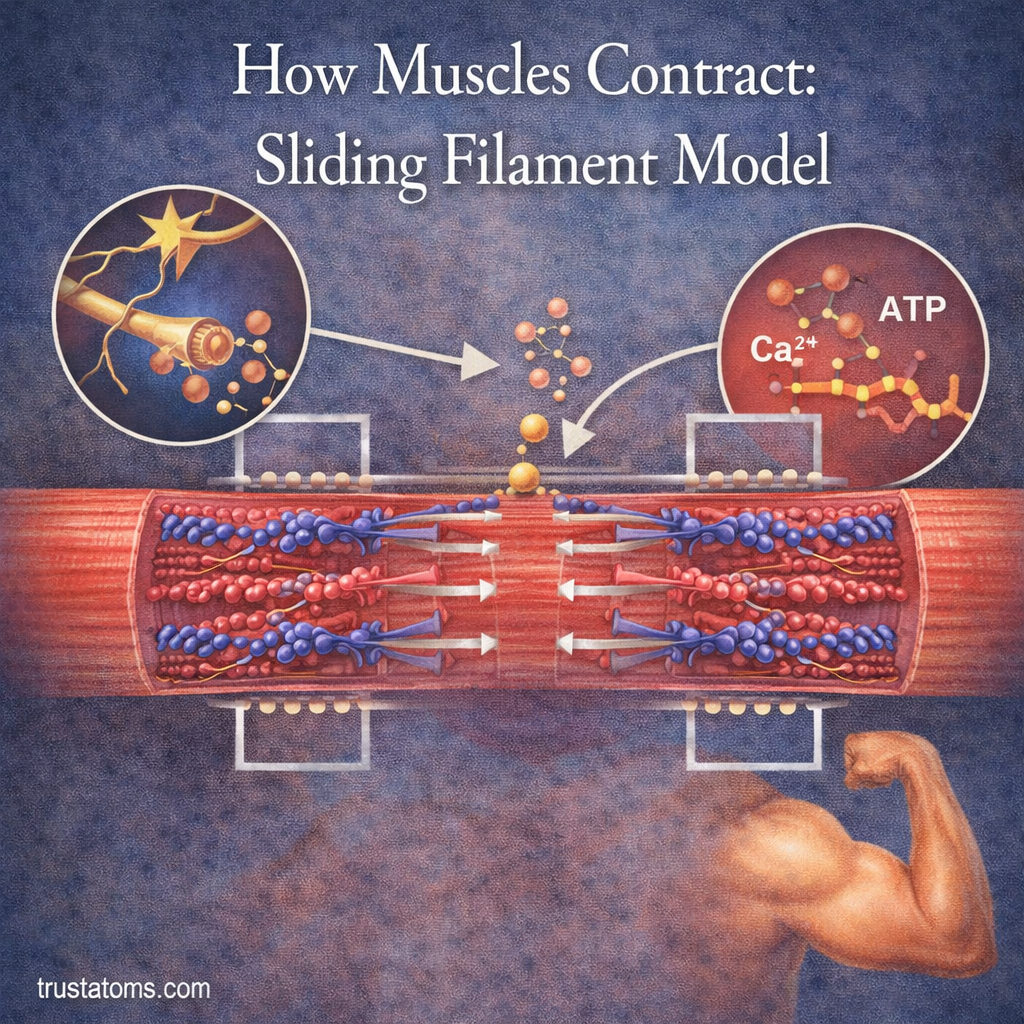
Diagram illustrating the sliding filament model showing actin and myosin interaction during muscle contraction with ATP and calcium involvement.
Illustration of the sliding filament model explaining how muscles contract through actin and myosin interaction. trustatoms.com.

Muscle contraction is what allows your body to move, lift, and perform everyday tasks. At the microscopic level, this process is explained by the sliding filament model—a widely accepted theory that describes how muscle fibers shorten to produce force.

Understanding this model helps explain how muscles generate movement and how the body responds to physical activity.

Continue reading “How Muscles Contract: Sliding Filament Model”

Muscle Fiber Types and Performance

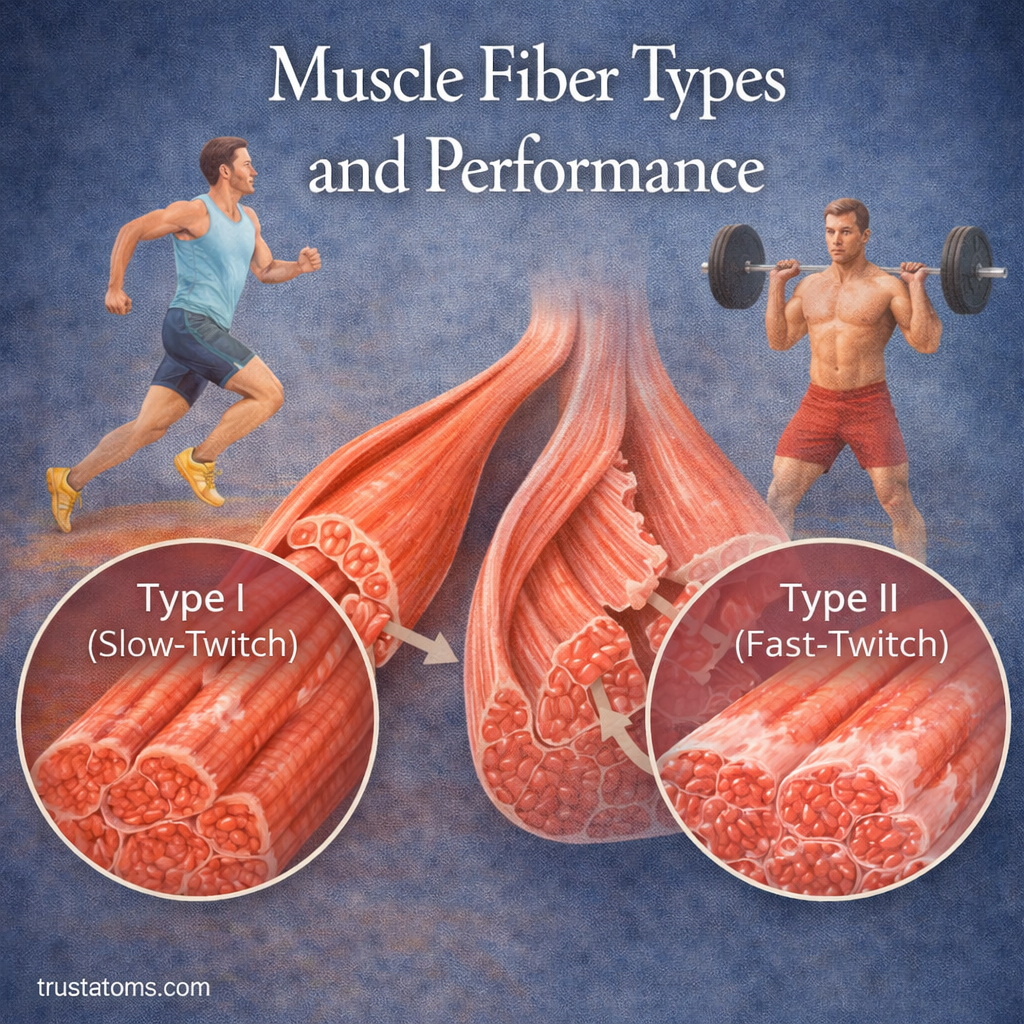
Illustration comparing slow-twitch and fast-twitch muscle fibers with examples of endurance running and weightlifting.
Comparison of muscle fiber types showing how slow-twitch and fast-twitch fibers affect performance. trustatoms.com.

Not all muscles perform the same way. Some are built for endurance, while others are designed for speed and power. These differences come down to muscle fiber types.

Understanding muscle fiber types can help explain athletic performance, training adaptations, and why some people naturally excel at certain physical activities.

Continue reading “Muscle Fiber Types and Performance”