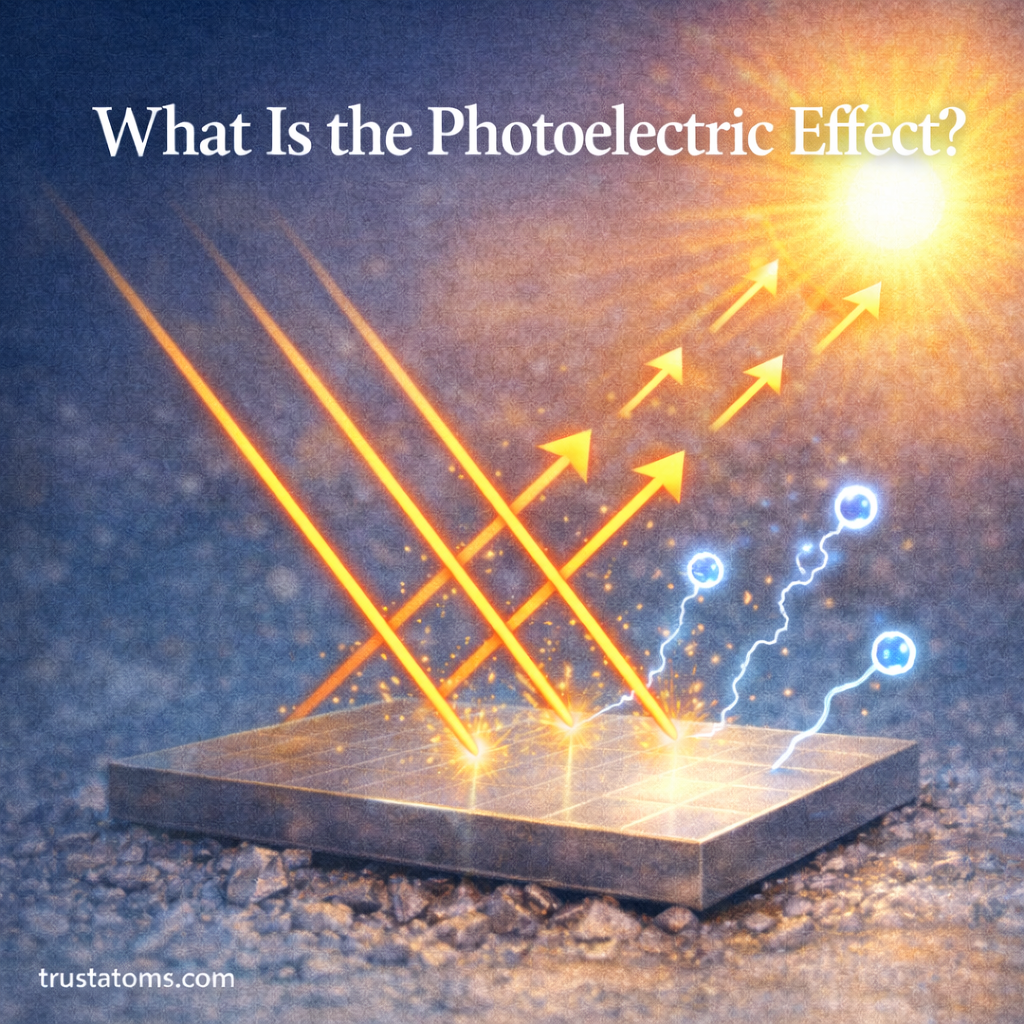
The photoelectric effect is a phenomenon in physics where light striking a material causes electrons to be emitted from its surface. This discovery played a critical role in the development of modern physics and helped scientists understand that light behaves both as a wave and as a particle.
First observed in the late 19th century and later explained by Albert Einstein in 1905, the photoelectric effect became one of the key foundations of Quantum Mechanics. Einstein’s explanation showed that light can carry energy in discrete packets called photons.
Today, the photoelectric effect is used in many technologies, including solar panels, light sensors, and imaging devices.
Continue reading “What Is the Photoelectric Effect?”