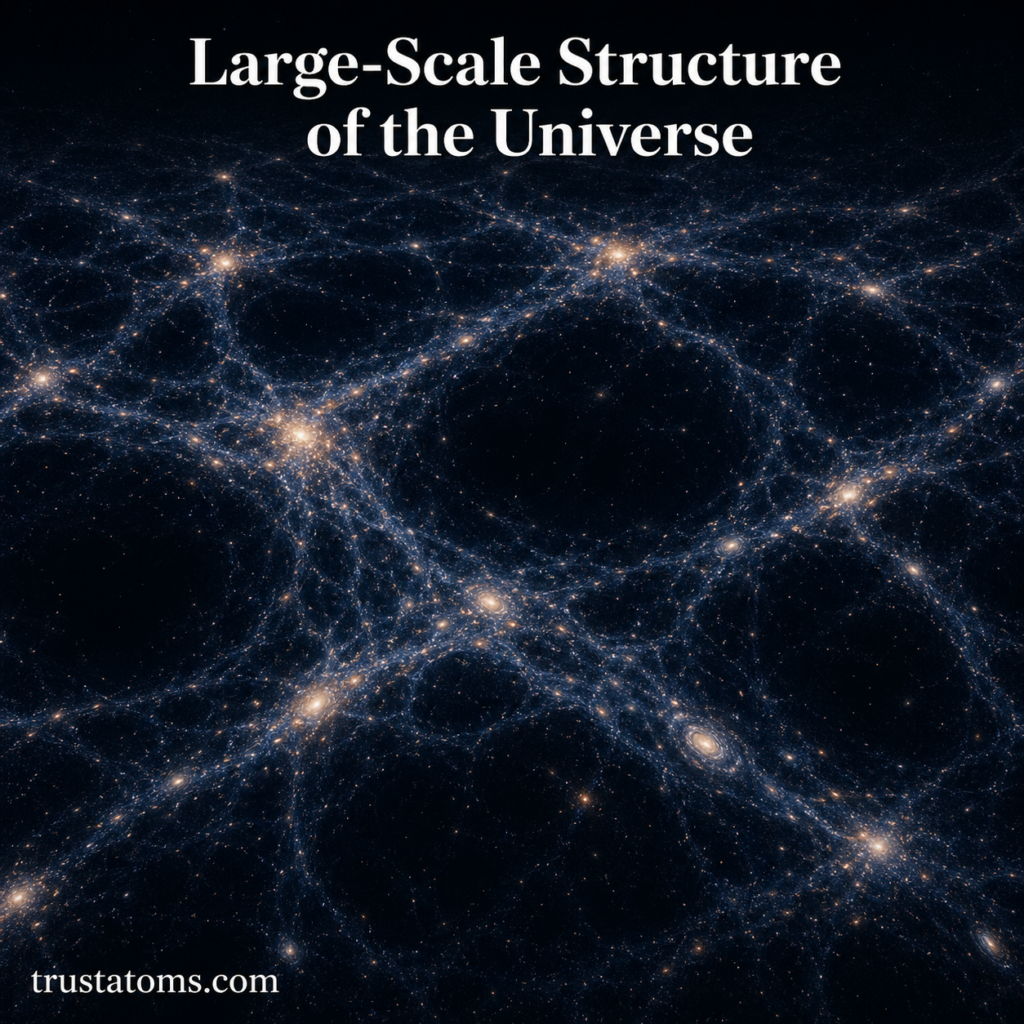
The universe is not random chaos—it has structure on the largest scales imaginable. When astronomers map galaxies across billions of light-years, they discover a vast cosmic web made of clusters, filaments, and enormous empty regions called voids.
Understanding the large-scale structure of the universe helps scientists answer some of the biggest questions: How did everything form? What is the universe made of? And where is it going?
What Is Large-Scale Structure?
Large-scale structure refers to the arrangement of matter in the universe on scales far bigger than individual galaxies.
Instead of being evenly spread out, galaxies gather into patterns that resemble a three-dimensional web.
At the largest scales, the universe is made up of:
- Galaxy clusters (dense regions with hundreds or thousands of galaxies)
- Filaments (long strands connecting clusters)
- Voids (huge, mostly empty spaces between structures)
This pattern is often called the cosmic web.
The Cosmic Web Explained
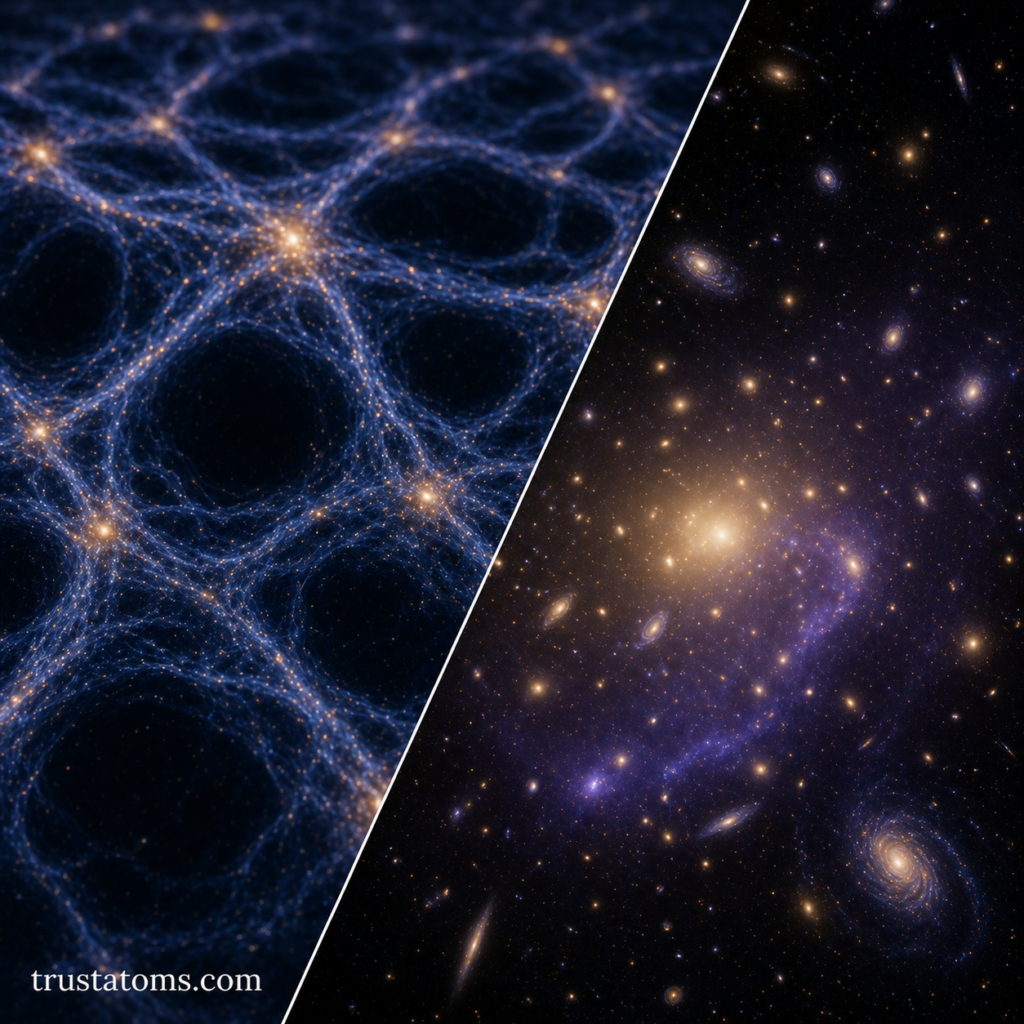
The cosmic web is the backbone of the universe’s structure.
It looks like a network of:
- Threads (filaments) where galaxies align
- Knots (clusters) where filaments intersect
- Bubbles (voids) where very few galaxies exist
This structure formed over billions of years due to gravity pulling matter together.
Key Features of the Cosmic Web
- Filaments can stretch for hundreds of millions of light-years
- Voids can be tens to hundreds of millions of light-years across
- Galaxy clusters sit at the intersections of filaments
The Milky Way itself is part of a larger structure known as a galaxy group, which is embedded within this web.
How Did the Large-Scale Structure Form?
The large-scale structure began forming shortly after the Big Bang.
Step-by-Step Formation
- Tiny fluctuations in density appeared in the early universe
- Gravity pulled slightly denser regions together
- Matter accumulated over time, forming galaxies and clusters
- These structures connected into filaments
- Less dense regions became vast voids
These initial fluctuations are observed today in the cosmic microwave background radiation.
The Role of Dark Matter
Dark matter plays a critical role in shaping the universe.
Although it cannot be seen directly, it makes up most of the universe’s matter and acts as a gravitational framework.
Why Dark Matter Matters
- It forms the “scaffolding” for galaxy formation
- It pulls visible matter into filaments and clusters
- It helps explain why structures formed so quickly
Without dark matter, the universe would likely look very different—far less structured.
Galaxy Clusters and Superclusters
Galaxy Clusters
Galaxy clusters are the largest gravitationally bound systems in the universe.
They contain:
- Hundreds to thousands of galaxies
- Hot gas emitting X-rays
- Large amounts of dark matter
Superclusters
Superclusters are even larger groupings of clusters.
They are not always gravitationally bound but represent some of the largest known structures.
Examples include:
- The Laniakea Supercluster (which contains the Milky Way)
- The Virgo Supercluster
Cosmic Voids: The Empty Spaces
While clusters and filaments contain matter, voids are regions with very little.
Characteristics of Voids
- Extremely low galaxy density
- Span tens to hundreds of millions of light-years
- Make up most of the universe’s volume
Despite being “empty,” voids are important for understanding how matter is distributed.
Observing the Large-Scale Structure
Astronomers map the universe using large surveys that measure the positions of millions of galaxies.
Common Methods
- Redshift surveys (measuring how fast galaxies are moving away)
- Sky mapping projects
- Computer simulations based on physics models
These observations reveal the web-like structure and help test cosmological theories.
Why Large-Scale Structure Matters
Studying the universe’s structure provides insight into fundamental physics.
Key Benefits
- Tests theories about the Big Bang
- Helps measure dark matter and dark energy
- Reveals how galaxies evolve over time
- Improves our understanding of gravity on cosmic scales
It also helps scientists estimate the overall shape and fate of the universe.
The Universe on the Largest Scales
Interestingly, when viewed on extremely large scales, the universe appears uniform.
This is known as the cosmological principle, which states:
- The universe is homogeneous (similar everywhere)
- The universe is isotropic (looks the same in all directions)
So while there are local structures like clusters and voids, the universe averages out to be smooth at the biggest scales.
Final Thoughts
The large-scale structure of the universe reveals a breathtaking level of organization across unimaginable distances. From galaxy clusters to vast cosmic voids, everything is connected through a web shaped by gravity and dark matter.
By studying this structure, scientists continue to unlock the history of the universe—and gain clues about its ultimate future.