Fossils are more than just preserved remains of ancient life—they are vital records that help scientists understand Earth’s history, environments, and biological evolution. Fossil formation is a rare and complex process that occurs under specific geological conditions, often taking millions of years.
Understanding how fossils form within a geological context reveals how landscapes, climates, and ecosystems have changed over time.
What Is a Fossil?
A fossil is any preserved evidence of past life. This can include:
- Bones, shells, and teeth
- Imprints or impressions in rock
- Tracks, burrows, or footprints
- Preserved organic material (in rare cases)
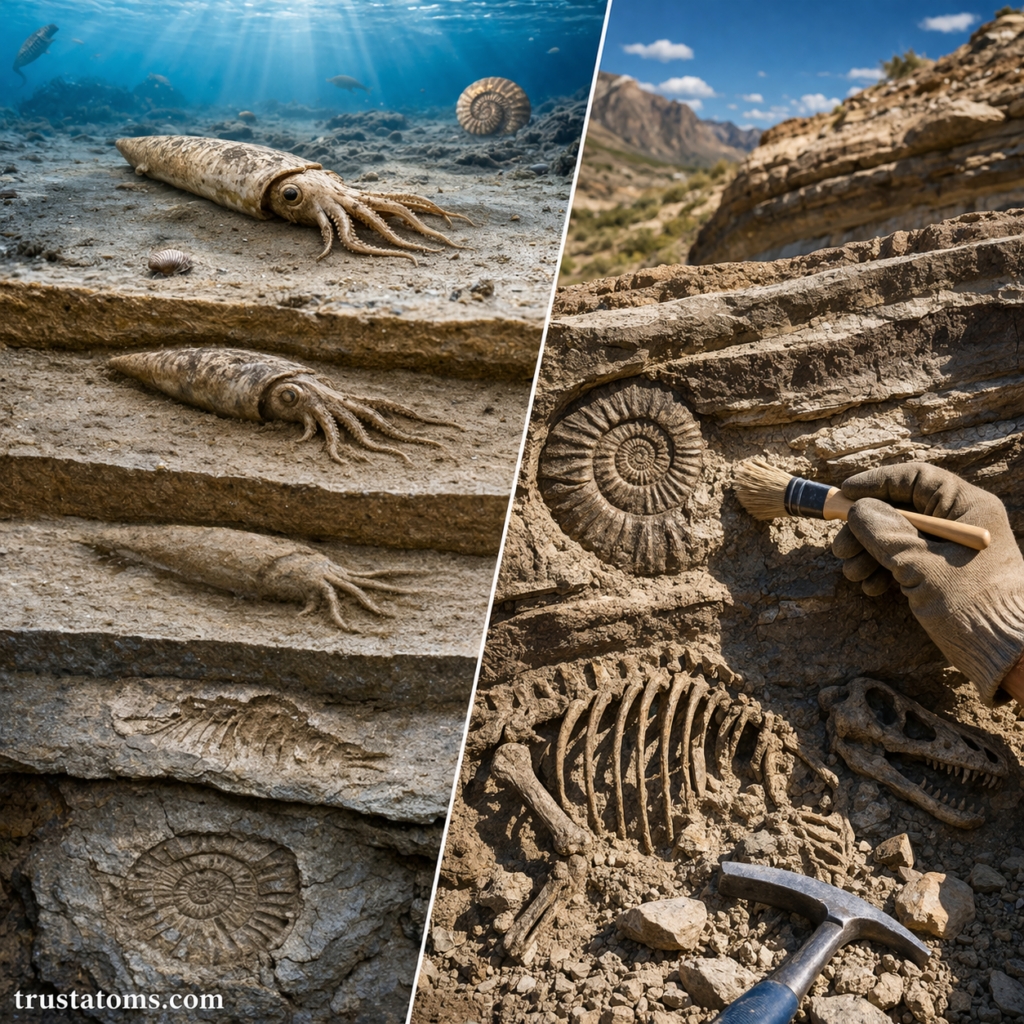
Fossils are typically found in sedimentary rock, where layers of material build up over time and preserve biological remains.
Why Fossil Formation Is Rare
Not all living organisms become fossils. In fact, fossilization is uncommon because most remains are destroyed before they can be preserved.
Common reasons include:
- Decomposition by bacteria and fungi
- Scavenging by other animals
- Weathering and erosion
- Lack of rapid burial
For fossilization to occur, specific conditions must be met.
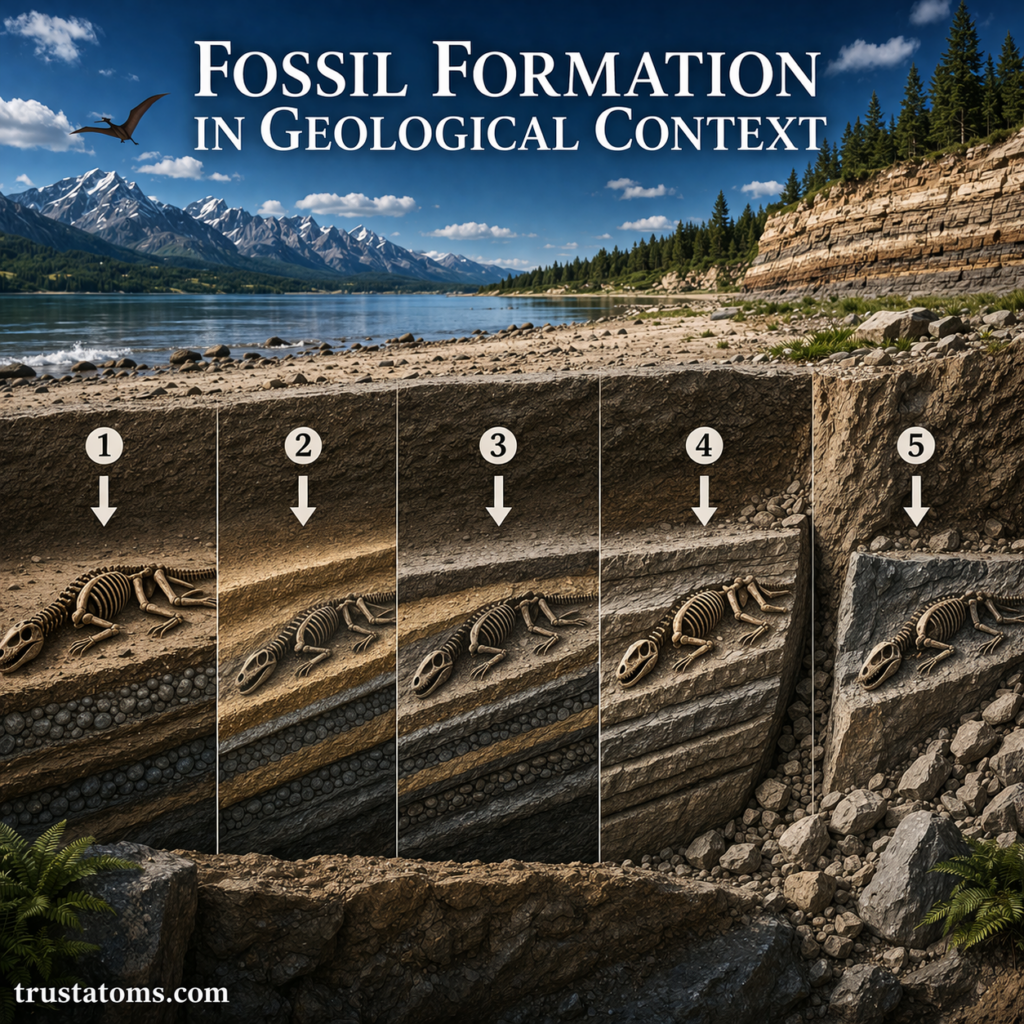
The Fossilization Process Step by Step
Fossil formation usually follows a sequence of geological and biological events:
1. Death and Deposition
- An organism dies and settles on the ground or seabed
- It is often transported by water or wind
2. Rapid Burial
- Sediment such as mud, sand, or ash quickly covers the remains
- Burial protects the organism from decay and scavengers
3. Compaction and Cementation
- Over time, layers of sediment build up
- Pressure compacts the layers into rock
- Minerals begin to bind the sediment together
4. Mineralization
- Minerals from groundwater replace or fill in the organism’s tissues
- The original material may be partially or completely replaced
5. Exposure
- Geological processes like erosion or uplift expose the fossil at the surface
Types of Fossil Formation
Different environmental conditions lead to different types of fossils.
1. Permineralization
- Minerals fill the pores of bones or wood
- Common in dinosaur bones and petrified wood
2. Mold and Cast Fossils
- Mold: An impression left in rock after the organism dissolves
- Cast: A replica formed when minerals fill the mold
3. Carbonization
- Organic material leaves behind a thin carbon film
- Common in plants and soft-bodied organisms
4. Amber Preservation
- Organisms become trapped in tree resin
- The resin hardens into amber, preserving fine details
5. Trace Fossils
- Evidence of activity rather than the organism itself
- Includes footprints, burrows, and feeding marks
Geological Conditions That Favor Fossil Formation
Fossils are most likely to form in specific environments where burial and preservation are possible.
Ideal Conditions Include:
- Sedimentary environments such as riverbeds, lakes, and ocean floors
- Low oxygen levels, which slow decomposition
- Fine-grained sediments like clay and silt
- Rapid burial events such as floods or volcanic ash deposits
These conditions help protect remains long enough for fossilization to occur.
Fossils and the Rock Cycle
Fossils are closely tied to the Rock Cycle.
- Most fossils form in sedimentary rocks
- Heat and pressure from metamorphism can destroy fossils
- Igneous processes (like lava) rarely preserve fossils
Because of this, fossils are mainly found in layered sedimentary formations.
Fossils as Geological and Environmental Indicators
Fossils provide important clues about past environments and geological conditions.
What Fossils Reveal
- Climate conditions (e.g., tropical fossils in now-cold regions)
- Ancient ecosystems and food chains
- Changes in sea level over time
- Continental movement and past land connections
They also help scientists correlate rock layers across different regions.
Fossils and Geological Time
Fossils are essential for understanding Earth’s timeline.
Scientists use them to:
- Identify and date rock layers
- Divide Earth’s history into periods
- Track changes in life over millions of years
Certain fossils, known as index fossils, are especially useful because they:
- Lived during a specific time period
- Were widespread geographically
- Are easily recognizable
Challenges in Interpreting Fossils
While fossils provide valuable information, they are not a complete record.
Limitations include:
- Gaps in the fossil record
- Bias toward organisms with hard parts (bones, shells)
- Limited preservation of soft tissues
- Geological processes that destroy or alter fossils
Because of this, scientists must interpret fossils carefully within their geological context.
Why Fossil Formation Matters
Understanding fossil formation helps scientists reconstruct Earth’s past and better understand present-day processes.
It plays a key role in:
- Studying biodiversity through time
- Understanding extinction events
- Exploring natural resources like fossil fuels
- Interpreting long-term environmental change
Final Thoughts
Fossil formation is a rare but powerful process that preserves snapshots of life from millions of years ago. By studying fossils within their geological context, scientists can uncover the story of Earth’s history—from ancient environments to the development of life itself.
These preserved traces continue to shape our understanding of the planet, offering insights into both the past and the future.