The solar system is vast—far larger than most people intuitively imagine. While diagrams often show planets neatly spaced, the real distances between them are enormous, and the scale can be difficult to grasp without context.
Understanding the scale and distance of the solar system helps explain travel times, planetary motion, and just how small Earth is compared to the space around it.
What Do We Mean by “Scale” in the Solar System?
Scale refers to the relative sizes and distances between objects in the solar system, including:
- The Sun
- Planets
- Moons
- Asteroids and comets
In most visual models, sizes and distances are not shown accurately together because doing so would make planets almost invisible or extremely far apart.
The Astronomical Unit (AU)
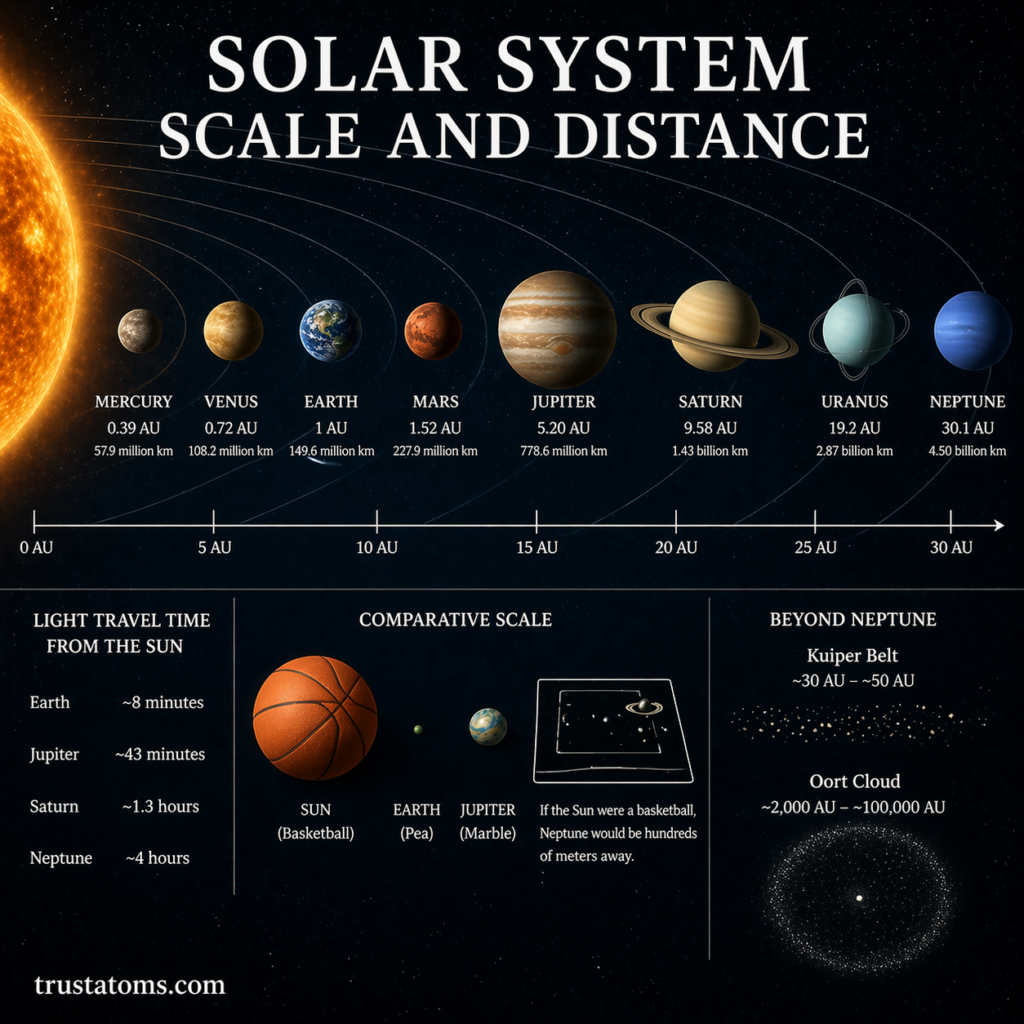
To measure distances in the solar system, astronomers use the astronomical unit (AU).
- 1 AU = the average distance between Earth and the Sun
- About 93 million miles (150 million kilometers)
This unit simplifies understanding large distances.
Examples:
- Mercury: ~0.39 AU from the Sun
- Earth: 1 AU
- Jupiter: ~5.2 AU
- Neptune: ~30 AU
How Big Is the Solar System?
The solar system extends far beyond the planets.
Key regions include:
- Inner Solar System (Mercury to Mars)
- Asteroid Belt
- Outer Solar System (Jupiter to Neptune)
- Kuiper Belt (beyond Neptune)
- Oort Cloud (outermost boundary)
The Oort Cloud may extend up to:
- 100,000 AU from the Sun
That’s nearly halfway to the nearest star.
Distances Between Planets
One of the biggest misconceptions is that planets are close together. In reality, they are separated by huge gaps.
Approximate distances from the Sun:
- Mercury: 36 million miles
- Venus: 67 million miles
- Earth: 93 million miles
- Mars: 142 million miles
- Jupiter: 484 million miles
- Saturn: 886 million miles
- Uranus: 1.8 billion miles
- Neptune: 2.8 billion miles
Even the distance between neighboring planets can be tens or hundreds of millions of miles.
Light Travel Time Across the Solar System
Light travels incredibly fast—about 186,000 miles per second—but even light takes time to cross the solar system.
Light travel times:
- Sun to Earth: ~8 minutes
- Sun to Jupiter: ~43 minutes
- Sun to Neptune: ~4 hours
This means when you see distant planets, you are seeing them as they were hours ago.
Why Solar System Models Are Misleading
Most diagrams compress distances to make them viewable on a page or screen.
If scaled accurately:
- Planets would be tiny dots
- Distances would stretch for miles (or kilometers)
- The Sun would dominate the entire model
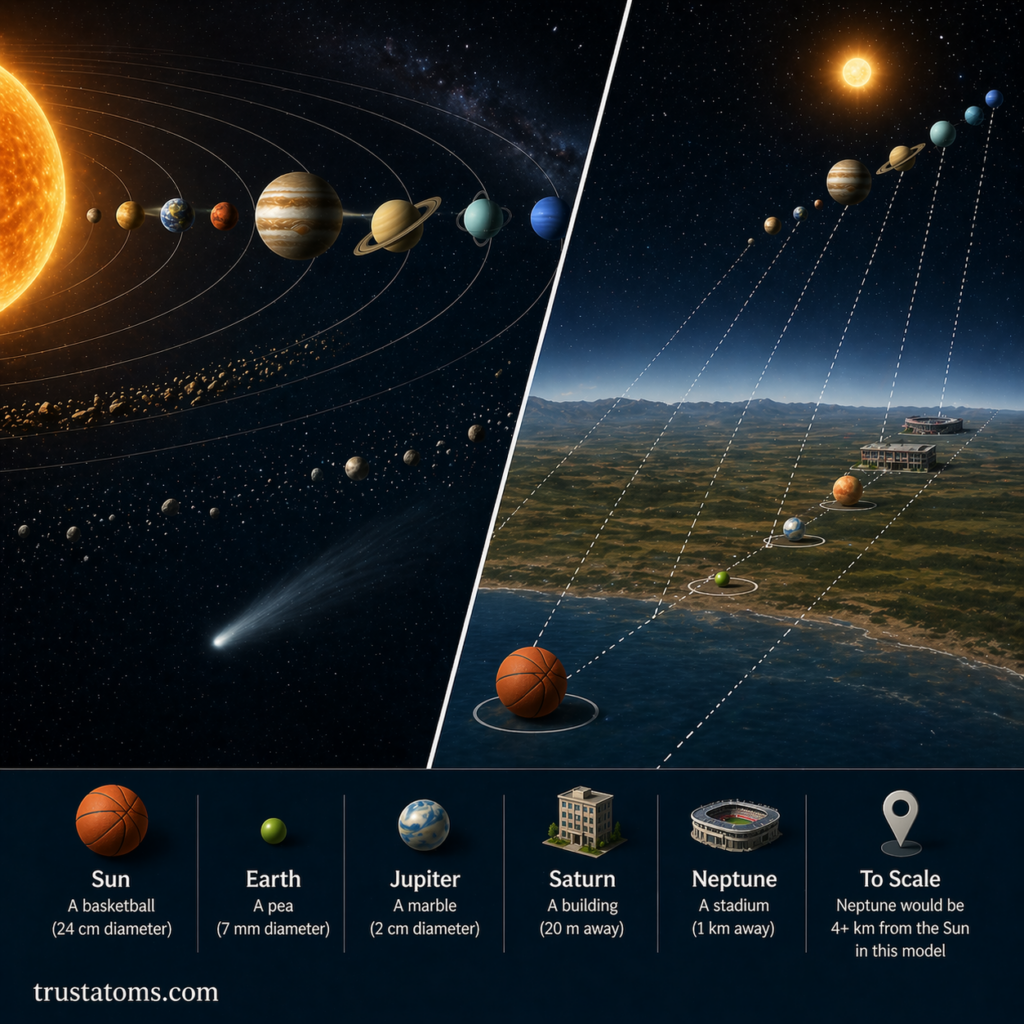
Example scale model:
If the Sun were the size of a basketball:
- Earth would be a small pea about 25 meters away
- Jupiter would be a marble over 100 meters away
- Neptune would be several hundred meters away
Space Is Mostly Empty
A key takeaway about the solar system is how empty it is.
- Planets occupy very little space compared to distances between them
- Even asteroid belts are mostly empty, not crowded fields
- Spacecraft can travel millions of miles without encountering objects
This emptiness is a defining feature of space.
Travel Times Across the Solar System
Because of these vast distances, space travel takes significant time.
Examples:
- Earth to Moon: ~3 days
- Earth to Mars: ~6–9 months
- Earth to Jupiter: several years
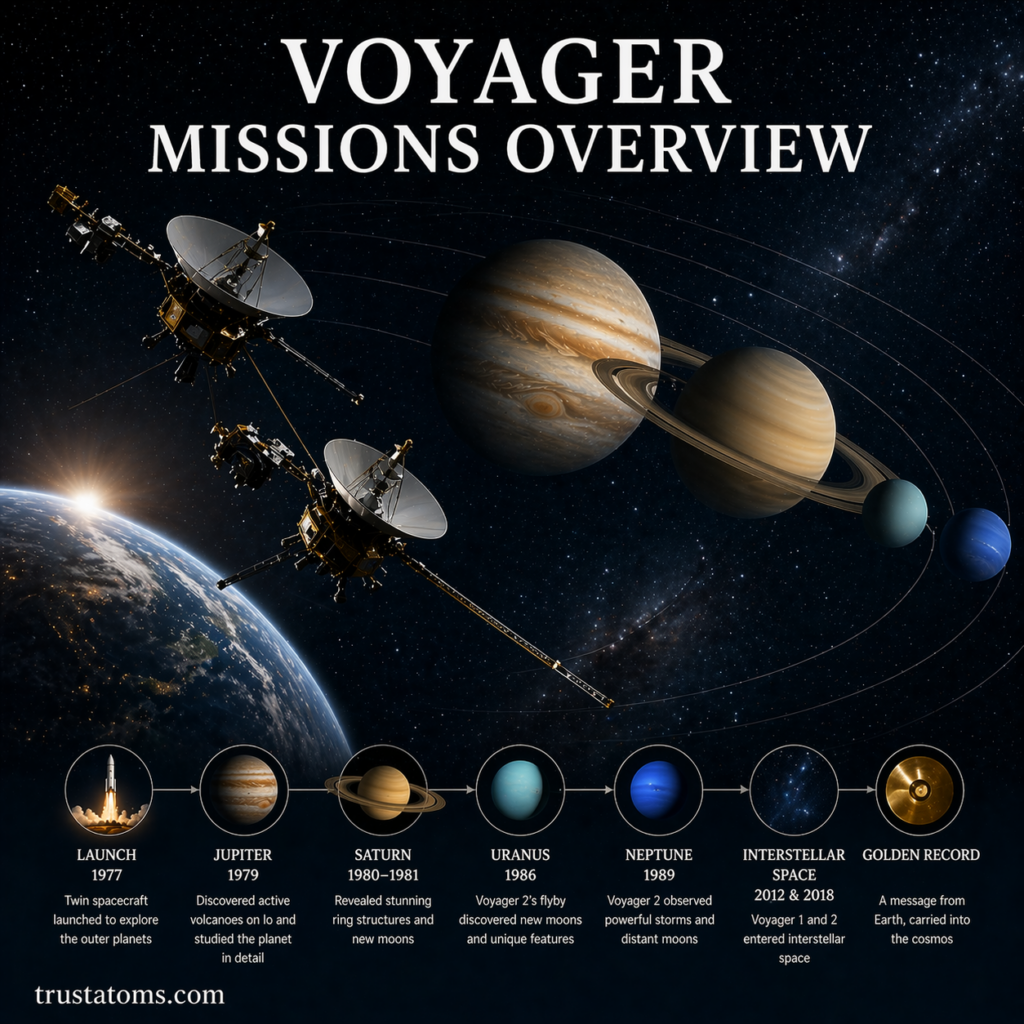
- Voyager 1 (launched in 1977) is still traveling today
Even at high speeds, crossing the solar system is a long-term journey.
Comparing Solar System Scale to Everyday Distances
To better understand the scale, scientists often use analogies.
If the solar system were a city:
- The Sun = a large building
- Earth = a small object blocks away
- Outer planets = located across the entire city
If Earth were a coin:
- The Sun would be much larger than a person
- Distances between planets would span entire neighborhoods
These comparisons highlight how spread out everything really is.
Beyond the Solar System
The solar system itself is only a tiny part of the universe.
- The nearest star (Proxima Centauri) is about 4.24 light-years away
- That’s over 268,000 AU
- Far beyond the edge of the solar system
This shows that even the vast solar system is small compared to interstellar space.
Why Understanding Scale Matters
Grasping solar system scale helps us:
- Understand space travel challenges
- Appreciate astronomical distances
- Interpret scientific models more accurately
- Recognize Earth’s place in the universe
It also deepens our perspective on how unique and isolated our planet is.
Final Thoughts
The solar system is an immense, mostly empty region dominated by the Sun and scattered with distant planets and icy objects. While models simplify its layout, the true scale is far more dramatic.
By understanding these distances, we gain a clearer picture of space—and a greater appreciation for the complexity and vastness of the cosmos.