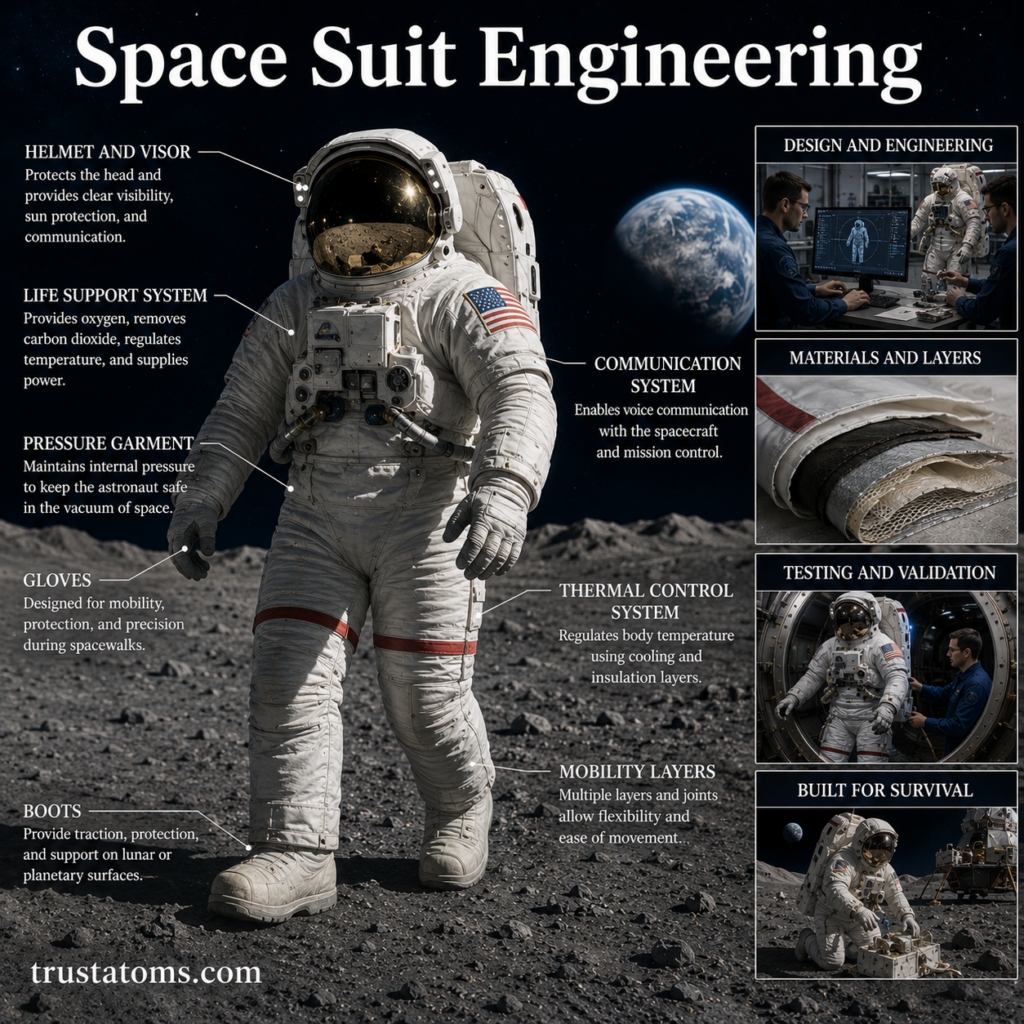
Space suit engineering is one of the most advanced and challenging fields in aerospace technology. Space suits are far more than protective clothing — they are fully functioning personal spacecraft designed to keep astronauts alive in the deadly environment of space.
Outside Earth’s atmosphere, astronauts face vacuum conditions, extreme temperatures, radiation exposure, and micrometeoroid impacts. Space suits provide life support, pressure regulation, mobility, communication systems, and environmental protection during missions.
Modern space suit engineering combines materials science, mechanical engineering, robotics, human physiology, and aerospace technology to create wearable survival systems capable of supporting astronauts during spacewalks and planetary exploration.
This guide explores how space suits work, the major engineering systems involved, the history of suit development, and how future suits may support missions to the Moon and Mars.
What Is a Space Suit?
A space suit is a pressurized garment system designed to allow humans to survive and function in space or other hostile environments.
Space suits provide astronauts with:
- Breathable oxygen
- Temperature regulation
- Pressure protection
- Radiation shielding
- Communication systems
- Mobility support
- Waste management
- Micrometeoroid protection
Without a functioning suit, exposure to space would quickly become fatal.
Why Space Suits Are Necessary
Earth’s atmosphere naturally protects humans from many dangers.
Space does not.
In the vacuum of space, astronauts would face:
- Lack of oxygen
- Extreme heat and cold
- Low pressure
- Radiation exposure
- Dangerous debris impacts
Space suits recreate a small Earth-like environment around the astronaut’s body.
A Brief History of Space Suit Engineering
Early Pressure Suits
The first pressure suits were developed for high-altitude pilots before human spaceflight began.
These suits helped pilots survive in low-pressure environments at extreme altitudes.
Mercury Program Suits
NASA’s Mercury astronauts wore modified pressure suits primarily designed for emergencies inside spacecraft.
These suits offered limited mobility because astronauts were not yet performing spacewalks.
Gemini and Apollo Suits
As missions became more complex, space suits evolved significantly.
Apollo suits included:
- Improved mobility
- Portable life support systems
- Lunar surface protection
- Better thermal control
These suits allowed astronauts to walk and work on the Moon.
Modern EVA Suits
Modern extravehicular activity (EVA) suits used aboard the International Space Station function as miniature spacecraft.
They support astronauts during long-duration spacewalks involving:
- Repairs
- Scientific experiments
- Station maintenance
- Equipment installation
Main Components of a Space Suit
Modern space suits contain multiple integrated engineering systems.
Pressure Garment System
The pressure garment maintains stable internal pressure around the astronaut’s body.
This prevents dangerous effects caused by exposure to vacuum conditions.
The suit must balance:
- Pressure stability
- Flexibility
- Comfort
- Mobility
Maintaining mobility while preserving pressure is one of the biggest engineering challenges.
Helmet and Visor System
The helmet protects the astronaut’s head while allowing visibility and communication.
Helmet systems may include:
- Radiation-filtering visors
- Anti-fog coatings
- Sun protection
- Communication equipment
- Cameras and lights
The visor protects astronauts from intense sunlight and harmful ultraviolet radiation.
Life Support Backpack
The Portable Life Support System (PLSS) acts as the astronaut’s survival unit.
It provides:
- Oxygen supply
- Carbon dioxide removal
- Temperature regulation
- Water cooling
- Electrical power
- Communication support
The PLSS allows astronauts to operate independently outside spacecraft.
Thermal Control Systems
Space temperatures can vary dramatically depending on sunlight exposure.
Astronauts may encounter temperatures ranging from extreme heat to intense cold.
Thermal systems help regulate body temperature using:
- Cooling garments
- Insulation layers
- Reflective materials
- Ventilation systems
Temperature regulation is essential for astronaut safety and performance.
Gloves
Engineering effective gloves is particularly difficult.
Astronaut gloves must allow:
- Grip strength
- Precision movement
- Tool handling
- Pressure protection
Because pressurized gloves naturally resist movement, engineers work carefully to improve flexibility and reduce fatigue.
Boots and Mobility Systems
Space suit boots protect astronauts while supporting movement on different surfaces.
Future planetary exploration suits must handle:
- Lunar dust
- Rocky terrain
- Reduced gravity
- Harsh environmental conditions
Mobility engineering remains a major focus for future exploration suits.
Materials Used in Space Suits
Space suits use specialized materials designed for extreme environments.
Protective Layers
Modern suits contain multiple layers that provide:
- Thermal insulation
- Radiation protection
- Micrometeoroid resistance
- Pressure retention
Each layer serves a different purpose.
Advanced Fabrics
Suit materials must be:
- Lightweight
- Durable
- Flexible
- Heat resistant
Engineers use advanced synthetic materials capable of withstanding extreme conditions.
Reflective Coatings
Reflective outer surfaces help reduce heat absorption from sunlight.
White outer layers are commonly used because they reflect solar radiation effectively.
Engineering Challenges in Space Suit Design
Designing safe and effective suits involves many technical difficulties.
Balancing Pressure and Mobility
Higher pressure improves safety but reduces flexibility.
Lower pressure increases mobility but may create medical risks.
Engineers must carefully balance these competing requirements.
Preventing Fatigue
Space suits can be physically exhausting to wear.
Engineers work to reduce fatigue by improving:
- Joint mobility
- Weight distribution
- Glove flexibility
- Suit ergonomics
Long-duration missions require comfortable designs.
Radiation Protection
Radiation remains one of the biggest long-term risks in space exploration.
Future suits may need improved shielding for missions beyond Earth orbit.
Dust and Environmental Hazards
Lunar and Martian dust can damage equipment and create health risks.
Future suits must resist:
- Dust contamination
- Abrasion
- Electrostatic buildup
Environmental protection will be especially important for surface exploration missions.
Space Suit Testing and Training
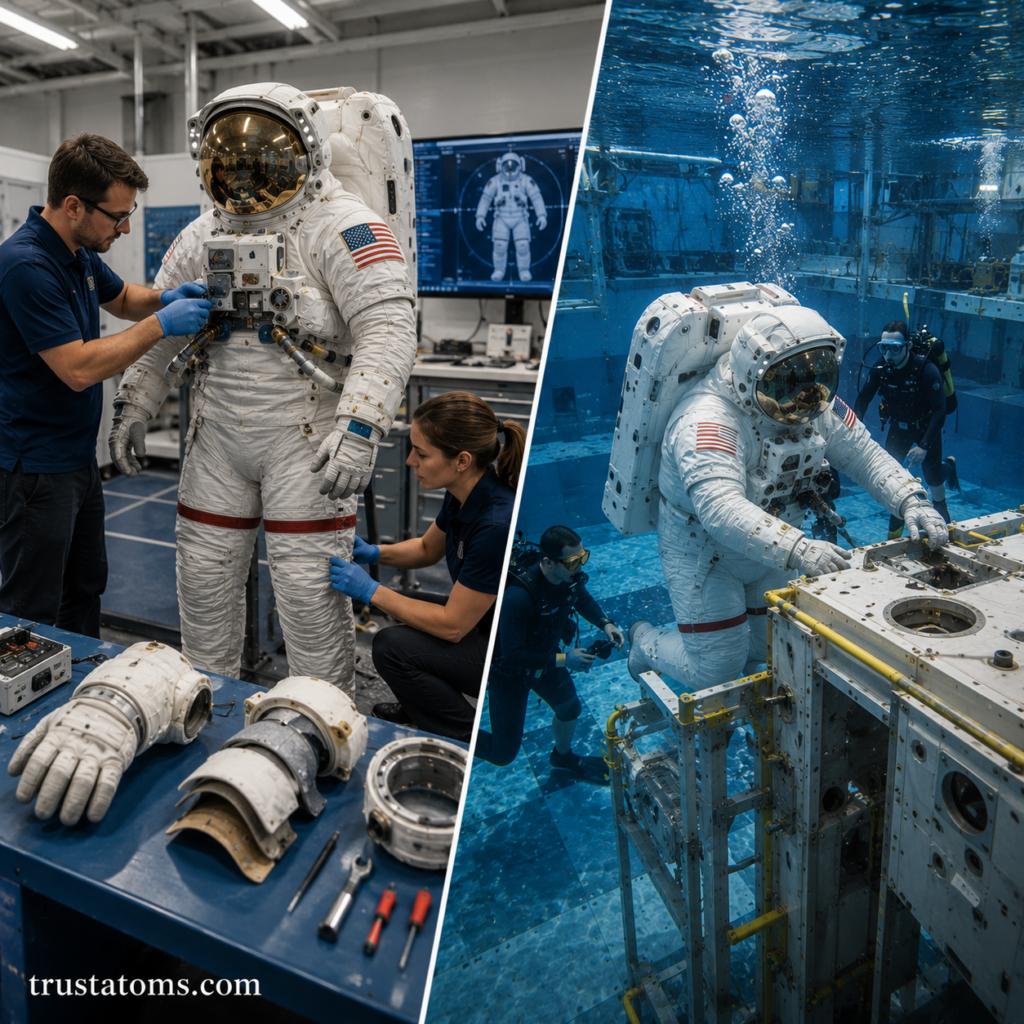
Astronauts spend extensive time learning how to use their suits safely.
Neutral Buoyancy Training
Large underwater facilities simulate microgravity conditions.
Astronauts practice:
- Spacewalk procedures
- Equipment repairs
- Tool handling
- Movement in bulky suits
Vacuum Chamber Testing
Suits undergo testing in vacuum chambers that simulate space conditions.
Engineers evaluate:
- Pressure performance
- Oxygen systems
- Temperature regulation
- Emergency procedures
Field Testing
Future exploration suits are tested in harsh environments such as:
- Deserts
- Arctic regions
- Volcanic terrain
These locations help simulate lunar and Martian conditions.
Future Space Suit Engineering
Future missions will require even more advanced suit technologies.
Lunar Exploration Suits
Artemis-era suits are being designed specifically for Moon exploration.
They aim to improve:
- Mobility
- Dust resistance
- Surface operation efficiency
- Long-duration comfort
These suits must support astronauts during repeated lunar surface missions.
Mars Exploration Suits
Mars suits may require additional features such as:
- Enhanced radiation shielding
- Greater durability
- Advanced environmental protection
- Improved repair systems
Because Mars missions could last years, reliability is essential.
Smart Suit Technologies
Future suits may include advanced technologies such as:
- Biometric monitoring
- Augmented reality displays
- AI-assisted diagnostics
- Enhanced communication systems
These features could improve astronaut safety and operational efficiency.
Mechanical Counterpressure Suits
Some engineers are exploring alternative suit concepts called mechanical counterpressure suits.
Instead of relying entirely on internal air pressure, these suits use tight-fitting materials to apply pressure directly to the body.
Potential advantages include:
- Increased flexibility
- Reduced bulk
- Improved mobility
Although experimental, these suits may shape future exploration systems.
The Importance of Space Suit Engineering
Space suits are essential to human space exploration.
They allow astronauts to:
- Conduct spacewalks
- Repair spacecraft
- Explore planetary surfaces
- Perform scientific experiments
- Survive outside protected habitats
Every major human space mission depends heavily on reliable suit technology.
Final Thoughts
Space suit engineering combines aerospace technology, materials science, medicine, and human-centered design to create wearable survival systems for space exploration.
From the early pressure suits of the Mercury program to advanced EVA systems aboard the International Space Station, space suits have evolved into highly sophisticated personal spacecraft.
As humanity prepares for lunar bases, Mars exploration, and deeper missions into space, future space suit technologies will continue pushing the boundaries of engineering, mobility, safety, and human survival beyond Earth.