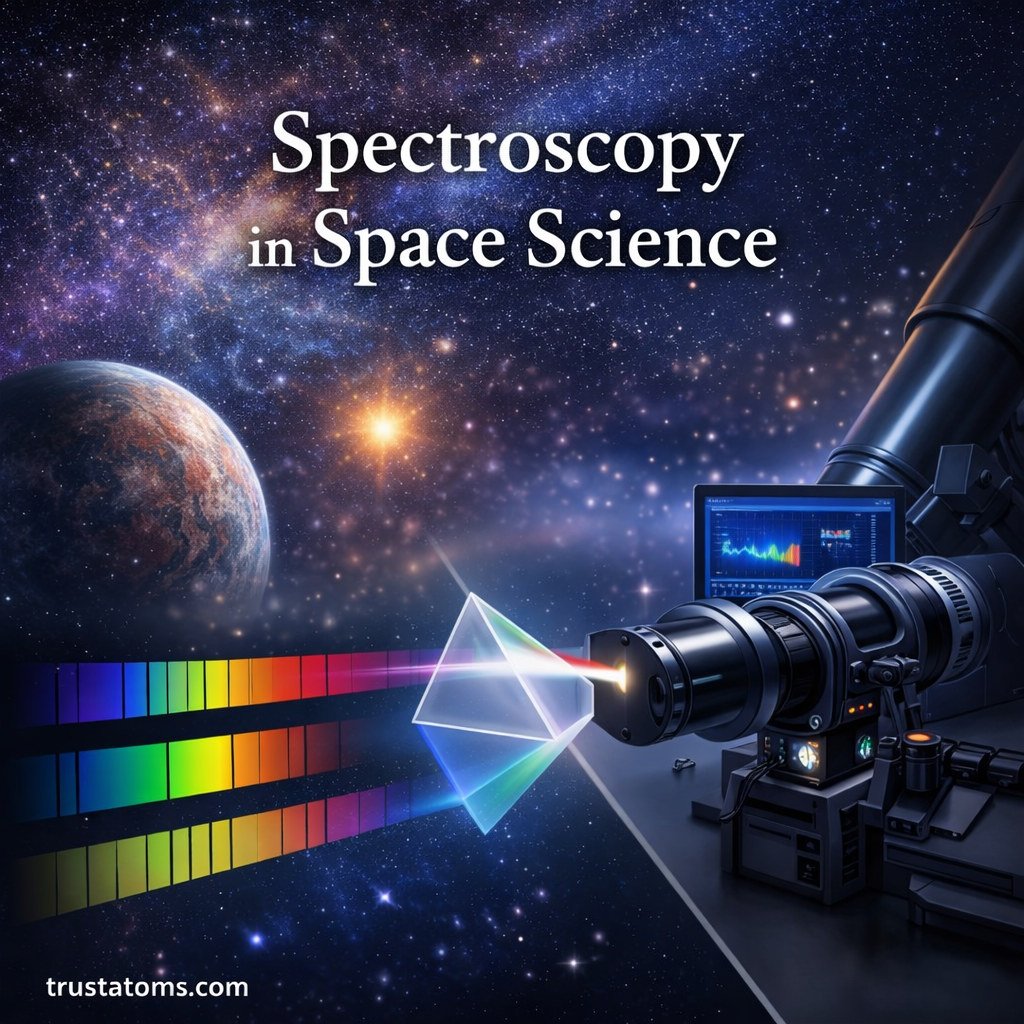
Spectroscopy is one of the most powerful tools in space science. It allows scientists to analyze light from stars, planets, and galaxies to determine what they are made of, how they move, and even how hot they are.
Instead of physically traveling to distant objects, spectroscopy lets researchers gather detailed information from light alone—making it essential for studying the universe.
What Is Spectroscopy?
Spectroscopy is the study of how matter interacts with electromagnetic radiation, including visible light, ultraviolet light, and infrared radiation.
When light passes through or is emitted by an object, it carries a unique pattern—like a fingerprint—that reveals information about that object’s composition and properties.
Key idea
Every element emits or absorbs light at specific wavelengths. By analyzing these wavelengths, scientists can identify the elements present in stars and other celestial bodies.
How Spectroscopy Works
Spectroscopy works by splitting light into its component wavelengths, creating a spectrum. This spectrum can then be analyzed for patterns.
Step-by-step process
- Light is collected from a celestial object using a telescope
- The light passes through a spectroscope or diffraction grating
- The light is separated into a spectrum (like a rainbow)
- Scientists analyze the spectral lines (dark or bright lines)
- Each line corresponds to a specific element or property
Types of Spectra
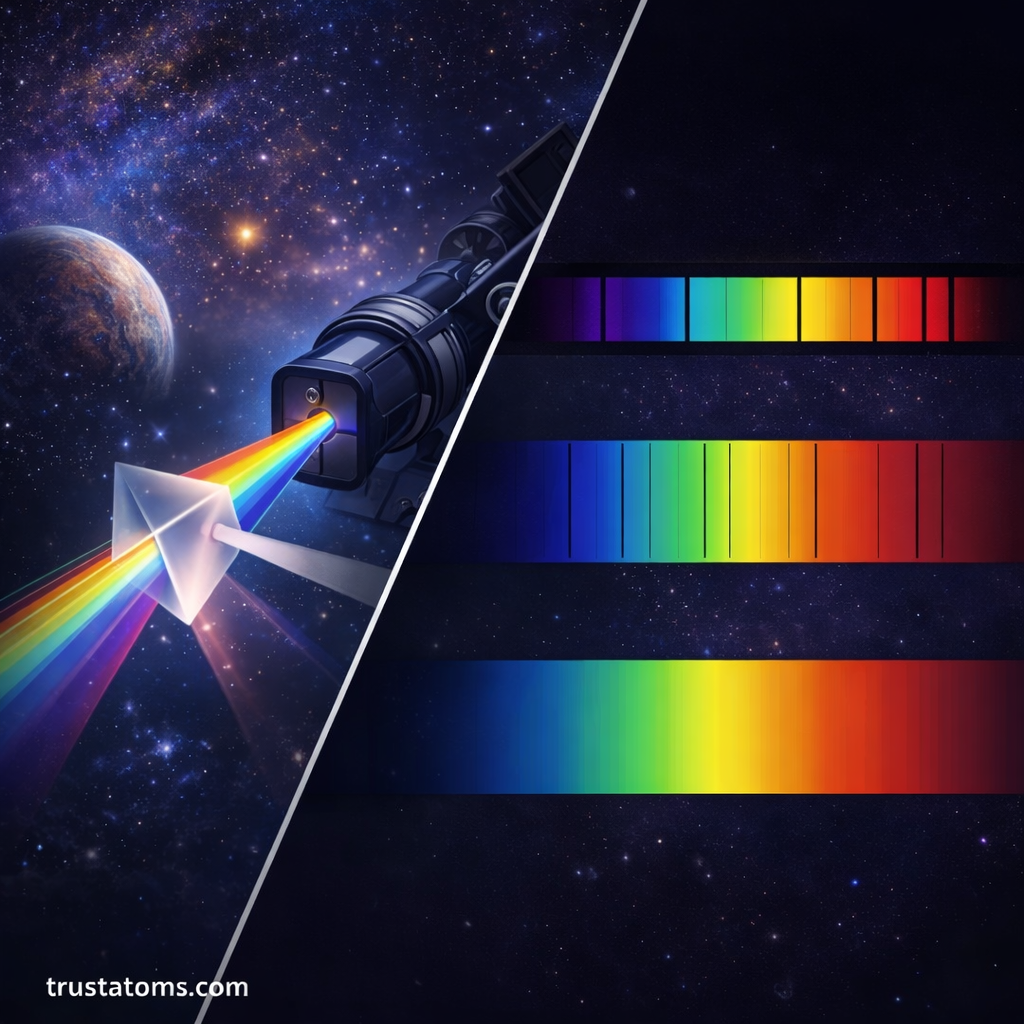
There are three main types of spectra used in space science.
Emission spectrum
- Produced when atoms emit light at specific wavelengths
- Appears as bright lines on a dark background
- Helps identify elements in hot gases
Absorption spectrum
- Occurs when atoms absorb certain wavelengths
- Appears as dark lines within a continuous spectrum
- Common in stars, where outer layers absorb light
Continuous spectrum
- A full range of colors without interruption
- Produced by dense objects like stars or planets
What Spectroscopy Reveals About Space
Spectroscopy provides a surprising amount of information about distant objects.
Key discoveries made using spectroscopy
- Chemical composition of stars and planets
- Temperature and density of celestial objects
- Motion through space (via Doppler shift)
- Presence of atmospheres around planets
- Detection of molecules such as water, methane, and carbon dioxide
Doppler Effect and Redshift
One of the most important applications of spectroscopy is measuring how objects move in space.
How it works
- If an object moves away, its light shifts toward the red end of the spectrum (redshift)
- If it moves closer, the light shifts toward the blue end (blueshift)
This effect helps scientists measure the speed of stars and galaxies and understand how the universe is expanding.
Spectroscopy and Planetary Science
Spectroscopy is also used to study planets both inside and outside our solar system.
Applications in planetary science
- Analyzing atmospheres of planets like Mars and Venus
- Detecting gases on exoplanets
- Searching for signs of habitability
- Studying surface composition using reflected light
Tools Used in Spectroscopy
Modern spectroscopy relies on advanced instruments to capture and analyze light.
Common tools
- Spectrometers for measuring light intensity
- Diffraction gratings for separating wavelengths
- Space telescopes equipped with spectroscopic instruments
- Ground-based observatories with high-resolution detectors
These tools allow scientists to study objects billions of light-years away.
Advantages of Spectroscopy
Spectroscopy offers unique benefits that make it essential in space science.
Key advantages
- Non-invasive method of studying distant objects
- Highly precise identification of elements
- Works across multiple wavelengths (visible, infrared, ultraviolet)
- Enables study of objects too far to reach physically
Limitations and Challenges
Despite its power, spectroscopy has limitations.
Common challenges
- Requires highly sensitive instruments
- Data can be affected by Earth’s atmosphere
- Interpretation of spectra can be complex
- Weak signals from distant objects can be difficult to detect
To overcome these issues, scientists often use space-based telescopes and advanced data processing techniques.
Why Spectroscopy Matters in Space Science
Spectroscopy has revolutionized our understanding of the universe. It allows scientists to determine what stars are made of, how galaxies move, and whether distant planets might support life.
Without spectroscopy, much of modern astronomy would not be possible.
Final Thoughts
Spectroscopy in space science is like decoding the language of light. By analyzing the patterns within light waves, scientists can uncover the secrets of the universe—from the composition of stars to the expansion of galaxies.
As technology continues to improve, spectroscopy will remain a cornerstone of discovery, helping us explore deeper into space and better understand our place within it.