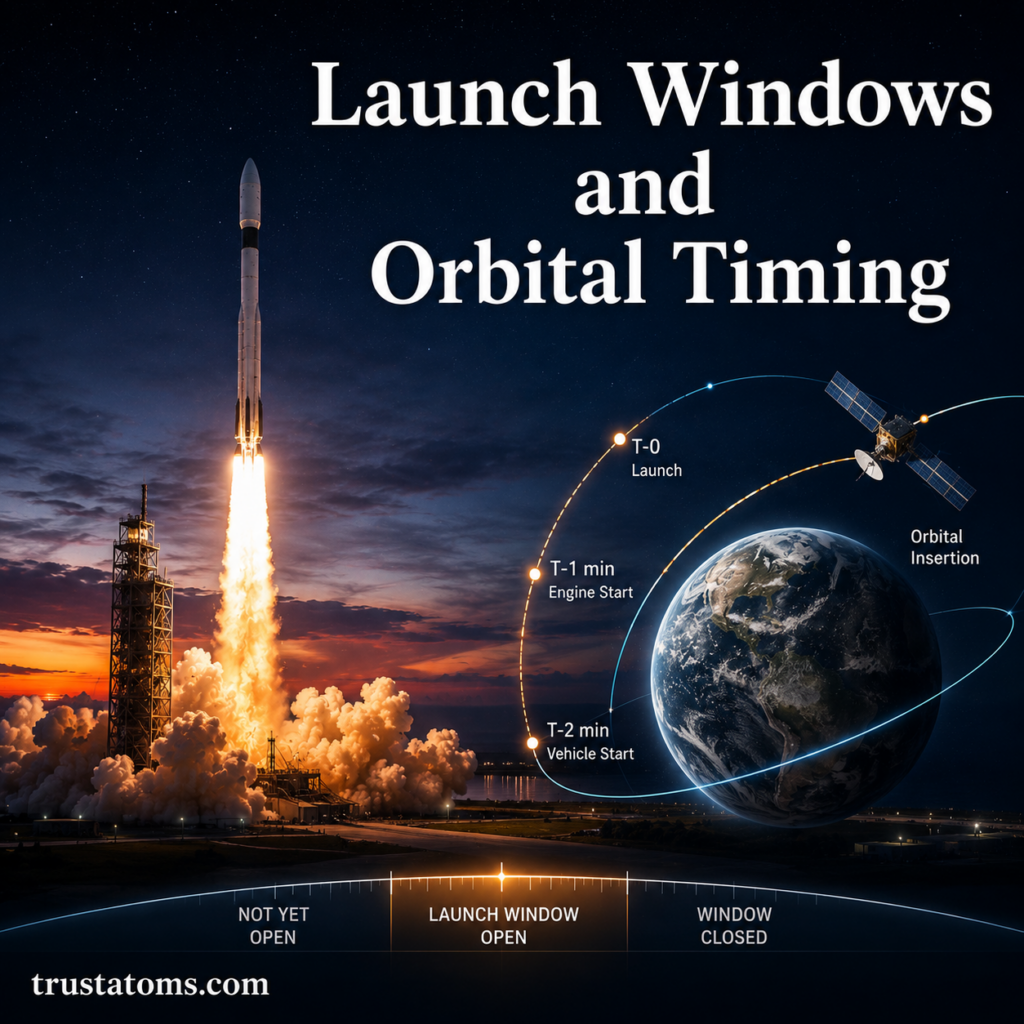
Launching a spacecraft into space is far more complicated than simply igniting rocket engines and lifting off. Every mission must account for precise timing, orbital mechanics, planetary motion, weather conditions, and fuel efficiency. Even a delay of a few minutes can affect whether a spacecraft successfully reaches its destination.
Launch windows and orbital timing are critical parts of modern astronomy and space exploration. They determine when rockets can safely launch, how spacecraft travel through space, and how missions reach planets, satellites, and orbital stations with maximum efficiency.
Understanding launch timing helps explain why some missions launch only during specific dates, why delays can be costly, and how scientists plan journeys across the solar system.
What Is a Launch Window?
A launch window is a specific period of time during which a rocket must launch to successfully complete its mission.
The timing depends on factors such as:
- Earth’s rotation
- Orbital alignment
- Weather conditions
- Spacecraft trajectory
- Fuel requirements
- Mission objectives
Some launch windows last several hours, while others may only remain open for a few minutes or seconds.
Why Launch Timing Matters
Spacecraft travel enormous distances at extremely high speeds. Precise timing ensures that a spacecraft reaches the correct position in space using the least amount of fuel possible.
If a launch occurs outside the proper window, the spacecraft may:
- Miss its target orbit
- Require excessive fuel corrections
- Fail to rendezvous with another spacecraft
- Experience unsafe flight conditions
Orbital timing is essential for mission success.
The Role of Earth’s Rotation
Earth rotates at roughly 1,000 miles per hour at the equator.
Launching eastward allows rockets to take advantage of this rotational speed, giving them an additional velocity boost.
This helps:
- Reduce fuel consumption
- Increase payload capacity
- Improve launch efficiency
That is one reason many launch sites are located closer to the equator.
Major Equatorial Launch Advantages
Benefits of near-equatorial launches include:
- Stronger rotational boost
- Easier access to certain orbits
- Improved fuel efficiency
Launch facilities in Florida, French Guiana, and other lower-latitude regions take advantage of these benefits.
Understanding Orbits
An orbit occurs when a spacecraft continuously falls around Earth or another celestial body while moving forward at high speed.
Different missions require different orbital paths.
Low Earth Orbit (LEO)
Low Earth Orbit is commonly used for:
- Space stations
- Earth observation satellites
- Scientific missions
LEO typically ranges from about 160 to 2,000 kilometers above Earth.
Examples of LEO Missions
- International Space Station
- Hubble Space Telescope
- Many communication satellites
Geostationary Orbit (GEO)
A geostationary orbit allows a satellite to remain fixed above the same point on Earth.
This orbit is commonly used for:
- Weather satellites
- Television broadcasting
- Communication networks
A spacecraft must launch at very precise timing to reach GEO efficiently.
Polar Orbits
Polar orbiting satellites travel over Earth’s poles while the planet rotates beneath them.
These orbits are ideal for:
- Global mapping
- Climate monitoring
- Environmental observation
Polar launches often require different launch trajectories than equatorial missions.
Orbital Inclination
Orbital inclination describes the angle between a spacecraft’s orbit and Earth’s equator.
Different missions require different inclinations depending on their objectives.
Why Inclination Matters
Changing orbital inclination after launch requires enormous amounts of fuel.
As a result, launch timing and trajectory are carefully planned to minimize costly adjustments.
Transfer Orbits
Many missions use transfer orbits to move from one orbit to another.
A common example is the Hohmann transfer orbit, which provides an energy-efficient method for changing orbital altitude.
Transfer orbits help spacecraft:
- Reach higher orbits
- Travel between planets
- Dock with orbital stations
Efficient transfers reduce fuel use and mission costs.
Planetary Alignment and Interplanetary Missions
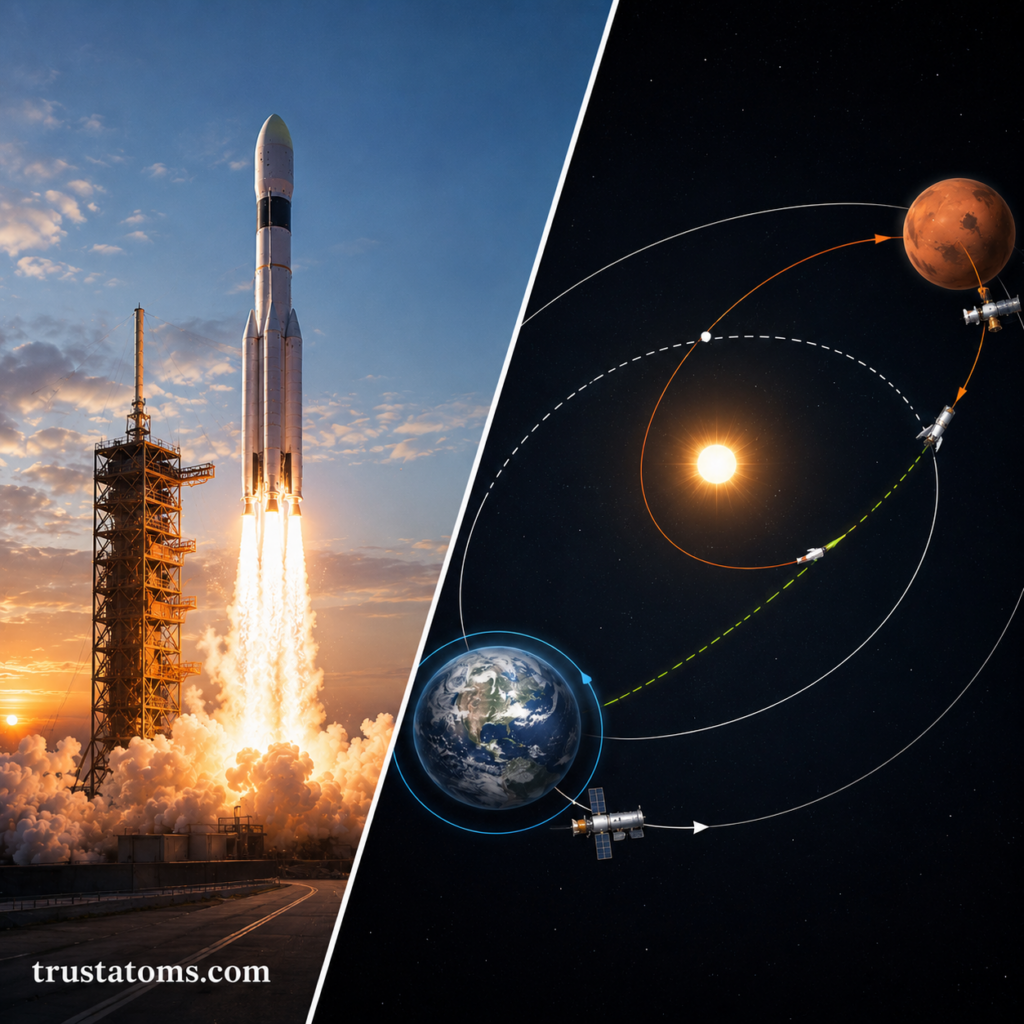
Missions to other planets require careful timing because planets constantly move around the Sun.
Why Planetary Alignment Is Important
Space agencies launch missions when planets are positioned to allow the spacecraft to travel using the shortest and most fuel-efficient route.
Missing the ideal launch period may require waiting months or even years for another opportunity.
Mars Launch Windows
Mars launch opportunities occur roughly every 26 months due to the orbital positions of Earth and Mars.
During these windows:
- Travel distances are shorter
- Fuel requirements are lower
- Flight times are more efficient
This timing is essential for robotic probes and future human missions.
Gravity Assists and Orbital Timing
Some spacecraft use gravity assists, also called gravitational slingshots, to gain speed by flying near planets or moons.
How Gravity Assists Work
A spacecraft gains energy from a planet’s motion while altering its trajectory.
Gravity assists help missions:
- Reach distant planets
- Save fuel
- Increase travel speed
These maneuvers require extremely precise orbital timing and navigation.
Famous Gravity Assist Missions
Notable examples include:
- Voyager missions
- Cassini spacecraft
- New Horizons mission
Without gravity assists, many deep-space missions would be impossible with current propulsion systems.
Rendezvous Timing in Space
Docking with another spacecraft requires highly accurate orbital synchronization.
Examples of Orbital Rendezvous
Rendezvous operations are used for:
- Space station docking
- Satellite servicing
- Cargo resupply missions
- Crew transportation
The spacecraft must match both speed and orbital position precisely.
Timing Challenges
Even tiny errors in timing can lead to:
- Missed docking opportunities
- Increased fuel consumption
- Dangerous orbital deviations
Mission control teams continuously monitor trajectories during these operations.
Launch Delays and Scrubs
Rocket launches are frequently delayed or canceled due to changing conditions.
Common Reasons for Launch Delays
Launches may be postponed because of:
- Bad weather
- High winds
- Lightning risk
- Technical problems
- Fuel system issues
- Range safety concerns
Why Weather Matters
Weather affects:
- Rocket stability
- Visibility
- Electrical safety
- Recovery operations
Even modern rockets remain highly sensitive to environmental conditions during launch.
Orbital Mechanics and Fuel Efficiency
Space missions must carefully manage fuel because spacecraft carry limited propellant.
Efficient Timing Saves Fuel
Precise launch timing reduces the need for:
- Mid-course corrections
- Major orbital adjustments
- Emergency maneuvers
This allows spacecraft to:
- Carry more scientific equipment
- Extend mission duration
- Travel farther distances
Orbital mechanics plays a major role in maximizing mission success.
Launch Windows for the Moon
Lunar missions require alignment between Earth, the Moon, and the spacecraft trajectory.
Lunar Timing Factors
Moon missions must consider:
- Lunar orbit position
- Lighting conditions
- Landing site visibility
- Communication windows
Launch timing affects both travel duration and landing safety.
Artemis and Future Lunar Missions
Modern Moon missions continue relying on extremely accurate launch windows to support:
- Lunar landings
- Cargo deliveries
- Orbital missions
- Future lunar bases
The Mathematics Behind Orbital Timing
Orbital timing relies heavily on advanced mathematics and physics.
Scientists use equations involving:
- Velocity
- Gravity
- Orbital energy
- Trajectory prediction
- Relative motion
One important orbital relationship is:
This equation helps describe orbital velocity around a celestial body.
Modern space agencies use powerful computers to calculate launch trajectories with extraordinary precision.
Launch Windows in Commercial Spaceflight
Private aerospace companies now conduct frequent launches for satellites, tourism, and cargo missions.
Commercial Timing Challenges
Commercial operators must coordinate:
- Orbital traffic
- Satellite deployment schedules
- Airspace restrictions
- Recovery zones
As space activity increases, orbital timing management becomes even more important.
Space Traffic and Orbital Coordination
Earth’s orbit is becoming increasingly crowded with satellites and debris.
Why Orbital Coordination Matters
Mission planners must avoid:
- Satellite collisions
- Debris fields
- Congested orbital regions
Careful launch timing helps maintain orbital safety.
Growing Importance of Space Traffic Management
Future systems may include:
- Automated collision avoidance
- International orbital coordination
- Real-time satellite tracking
Managing orbital traffic will become essential as space activity expands.
Future Improvements in Launch Timing
Advances in technology continue improving orbital calculations and launch efficiency.
Emerging Technologies
Future developments may include:
- AI-assisted trajectory planning
- Autonomous orbital navigation
- Improved propulsion systems
- Faster mission adjustments
These innovations could reduce mission costs and improve deep-space exploration capabilities.
How Launch Windows Support Astronomy
Launch timing is critical for astronomy missions involving:
- Space telescopes
- Planetary probes
- Solar observatories
- Scientific satellites
Precise orbital placement allows instruments to gather accurate scientific data over long periods.
Without careful timing, many astronomy missions would fail to reach proper observation positions.
Final Thoughts
Launch windows and orbital timing are fundamental to modern space exploration. Every successful mission depends on carefully calculated trajectories, planetary alignment, orbital mechanics, and precise launch conditions.
From launching satellites into Earth orbit to sending probes toward distant planets, timing affects nearly every aspect of spaceflight. Even the smallest adjustments can influence mission safety, fuel efficiency, and scientific success.
As humanity continues exploring the Moon, Mars, and beyond, advances in orbital timing and trajectory planning will remain essential for the future of astronomy and space exploration.