Space exploration has transformed humanity’s understanding of the universe. From landing on the Moon to studying distant galaxies with advanced telescopes, modern astronomy and space science continue expanding the boundaries of human knowledge.
However, as missions become more ambitious and commercial activity in space increases, ethical questions surrounding space exploration are becoming more important than ever.
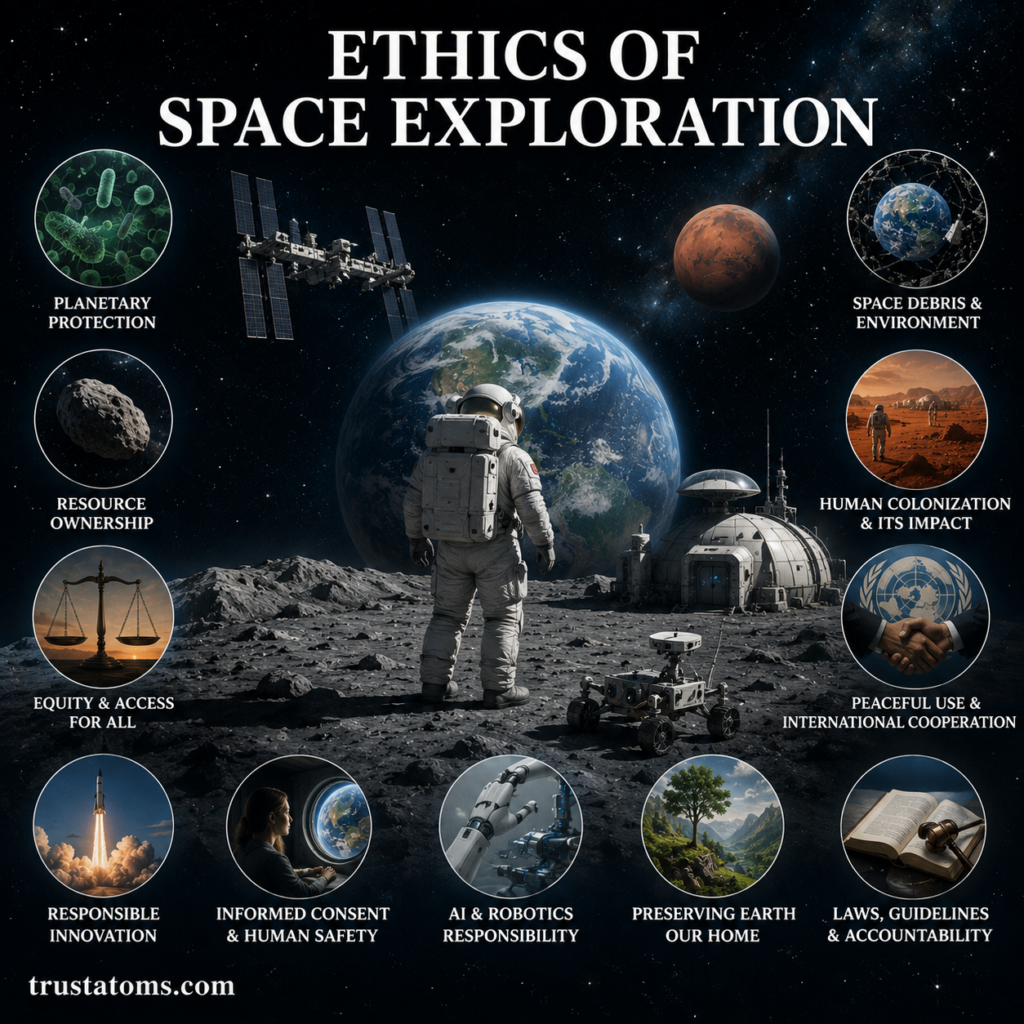
The ethics of space exploration involve debates about planetary protection, resource ownership, environmental responsibility, commercialization, human settlement, and the long-term impact of humanity’s expansion beyond Earth.
Understanding these ethical challenges helps shape the future of responsible exploration.
Why Ethics Matter in Space Exploration
Space exploration is no longer limited to scientific curiosity alone.
Today, it involves:
- Governments
- Private companies
- International partnerships
- Commercial investments
- Military interests
- Long-term colonization goals
As human activity in space grows, ethical considerations become necessary to guide decisions fairly and responsibly.
Important questions include:
- Who owns space resources?
- Should humans alter other planets?
- How do we protect extraterrestrial environments?
- Who benefits from space exploration?
- Should space remain peaceful?
- How do we prevent inequality in space access?
Ethics help address these complex issues before major conflicts or irreversible mistakes occur.
Planetary Protection and Contamination
One of the biggest ethical concerns involves planetary protection.
Forward Contamination
Forward contamination occurs when Earth organisms contaminate other planets or moons.
Potential consequences include:
- Damaging possible alien ecosystems
- Interfering with scientific research
- Altering extraterrestrial environments permanently
For example, introducing Earth microbes to Mars could compromise the search for native Martian life.
Backward Contamination
Backward contamination refers to bringing extraterrestrial materials back to Earth that could potentially affect Earth’s biosphere.
Although scientists currently view this risk as low, ethical responsibility requires caution.
Ethical Debate
Some argue humanity has a duty to preserve untouched worlds for scientific and moral reasons.
Others believe exploration and colonization are natural extensions of human progress.
Balancing discovery with preservation remains a major ethical challenge.
Ownership of Space Resources
As technology improves, asteroid mining and lunar resource extraction are becoming increasingly realistic.
This raises difficult legal and ethical questions.
Who Owns Space Resources?
Possible resources include:
- Water ice
- Rare metals
- Helium-3
- Minerals
- Rocket fuel materials
Current international treaties prohibit nations from claiming sovereignty over celestial bodies, but ownership of extracted resources remains debated.
Concerns About Inequality
Critics worry that wealthy nations or corporations could dominate space resources, creating new forms of economic inequality.
Potential concerns include:
- Monopolization of resources
- Unequal access to technology
- Corporate exploitation
- Geopolitical tensions
Some experts argue that space resources should benefit all humanity rather than a small number of powerful entities.
Environmental Ethics in Space
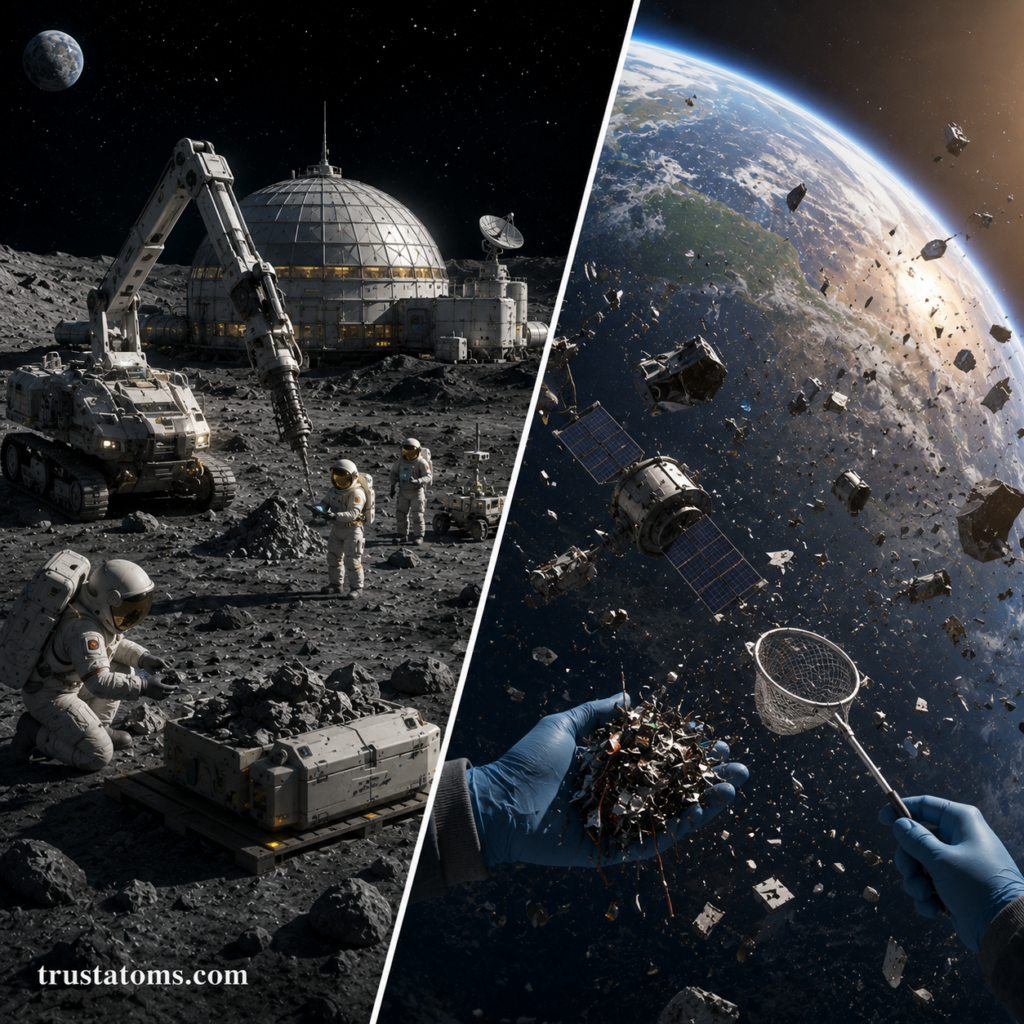
Space itself is becoming increasingly polluted.
Space Debris
Thousands of inactive satellites and debris fragments currently orbit Earth.
Space junk creates risks such as:
- Satellite collisions
- Threats to astronauts
- Damage to spacecraft
- Chain-reaction collision events
Ethically, organizations launching satellites may have responsibilities to reduce long-term orbital pollution.
Lunar and Planetary Preservation
Future human settlements could alter pristine extraterrestrial environments.
Ethical concerns include:
- Destroying geological records
- Damaging scientific sites
- Altering untouched ecosystems
- Cultural and historical preservation
For example, some scientists argue that historic landing sites like Apollo missions should receive protected status.
Human Colonization of Other Worlds
Colonizing planets like Mars raises major philosophical and ethical debates.
Should Humans Colonize Other Planets?
Supporters argue colonization could:
- Ensure long-term species survival
- Advance scientific progress
- Inspire technological innovation
- Reduce extinction risks
Critics question whether humanity should expand before solving problems on Earth.
Terraforming Ethics
Terraforming refers to altering another planet to make it more Earth-like.
Potential methods might include:
- Thickening atmospheres
- Warming planetary climates
- Introducing Earth organisms
Ethical concerns arise if microbial life already exists on another world.
Even simple microbial ecosystems could have scientific and intrinsic value worth preserving.
The Militarization of Space
Space has historically been viewed as a domain for peaceful exploration.
However, military technologies increasingly operate in orbit.
Ethical Concerns About Space Warfare
Potential risks include:
- Anti-satellite weapon development
- Orbital military conflict
- Surveillance escalation
- Space-based weapons systems
Conflict in space could damage essential communication and navigation systems used globally.
Many experts support maintaining international agreements that promote peaceful use of outer space.
Commercialization and Private Space Companies
Private aerospace companies now play major roles in modern space exploration.
Companies contribute to:
- Rocket development
- Satellite launches
- Lunar missions
- Mars planning
- Space tourism
Ethical Questions About Commercial Spaceflight
Important concerns include:
- Corporate accountability
- Environmental impact
- Worker safety
- Fair access to opportunities
- Profit versus scientific goals
Some people worry that space could become dominated by corporate interests rather than international cooperation.
Others argue private investment accelerates innovation and lowers costs.
Space Tourism Ethics
Space tourism is becoming increasingly possible for wealthy individuals.
This raises ethical discussions about fairness and environmental responsibility.
Key Criticisms
Critics often point to:
- High carbon emissions
- Extreme ticket costs
- Resource consumption
- Perceived inequality
Some question whether luxury tourism in space is ethical while major problems remain unresolved on Earth.
Supporters’ Arguments
Supporters argue that early technologies are often expensive initially before becoming more accessible over time.
They also note that commercial investment may help advance broader space technologies.
Human Health and Exploration Risks
Long-duration missions expose astronauts to serious risks.
These include:
- Radiation exposure
- Bone loss
- Muscle deterioration
- Psychological stress
- Isolation effects
Ethical Responsibilities
Space agencies and private companies must consider:
- Informed consent
- Medical support
- Long-term health monitoring
- Psychological care
- Mission risk transparency
Human exploration raises important questions about acceptable risk levels in pursuit of scientific advancement.
Artificial Intelligence and Robotics in Space
AI systems and autonomous robots increasingly assist space missions.
Potential ethical concerns include:
- Autonomous decision-making
- System failures
- Human oversight
- Exploration priorities
Future robotic systems may perform tasks such as:
- Mining operations
- Habitat construction
- Autonomous navigation
- Scientific analysis
Balancing automation with human control will remain important.
International Cooperation and Global Responsibility
Space exploration often requires collaboration between nations.
International partnerships help share:
- Scientific knowledge
- Costs
- Infrastructure
- Research data
Ethical Importance of Cooperation
Cooperation can reduce:
- Political conflict
- Resource competition
- Technological inequality
Many experts believe space exploration should remain a shared human endeavor rather than a source of geopolitical division.
Cultural and Philosophical Questions
Space exploration also affects how humanity views itself.
Major philosophical questions include:
- What responsibilities come with advanced technology?
- Does humanity have obligations toward extraterrestrial environments?
- Should exploration have limits?
- What defines responsible expansion?
The discovery of extraterrestrial life, even microbial life, could dramatically reshape ethical and philosophical thinking.
Existing Space Laws and Ethical Frameworks
Several international agreements influence space ethics.
Outer Space Treaty
The 1967 Outer Space Treaty established key principles such as:
- Peaceful exploration
- No national ownership of celestial bodies
- International responsibility for activities in space
- Avoidance of harmful contamination
Although important, many experts believe future laws will need updating as technology advances.
The Future of Space Ethics
As humanity expands farther into space, ethical discussions will become increasingly important.
Future developments may involve:
- Permanent lunar bases
- Mars colonies
- Asteroid mining industries
- Space-based manufacturing
- Advanced AI exploration systems
- Deep-space missions
Ethical frameworks will likely evolve alongside scientific and technological progress.
Responsible exploration may depend as much on ethics and cooperation as on engineering itself.
Final Thoughts
The ethics of space exploration involve balancing scientific discovery, technological progress, environmental stewardship, and humanity’s long-term future.
As exploration expands beyond Earth orbit and commercial activity accelerates, difficult ethical questions will continue emerging about ownership, preservation, equality, and responsibility.
Thoughtful ethical discussions help ensure that humanity explores space in ways that support scientific integrity, peaceful cooperation, and responsible treatment of both Earth and the wider universe.
The future of space exploration will ultimately reflect not only humanity’s technological capabilities, but also its values.