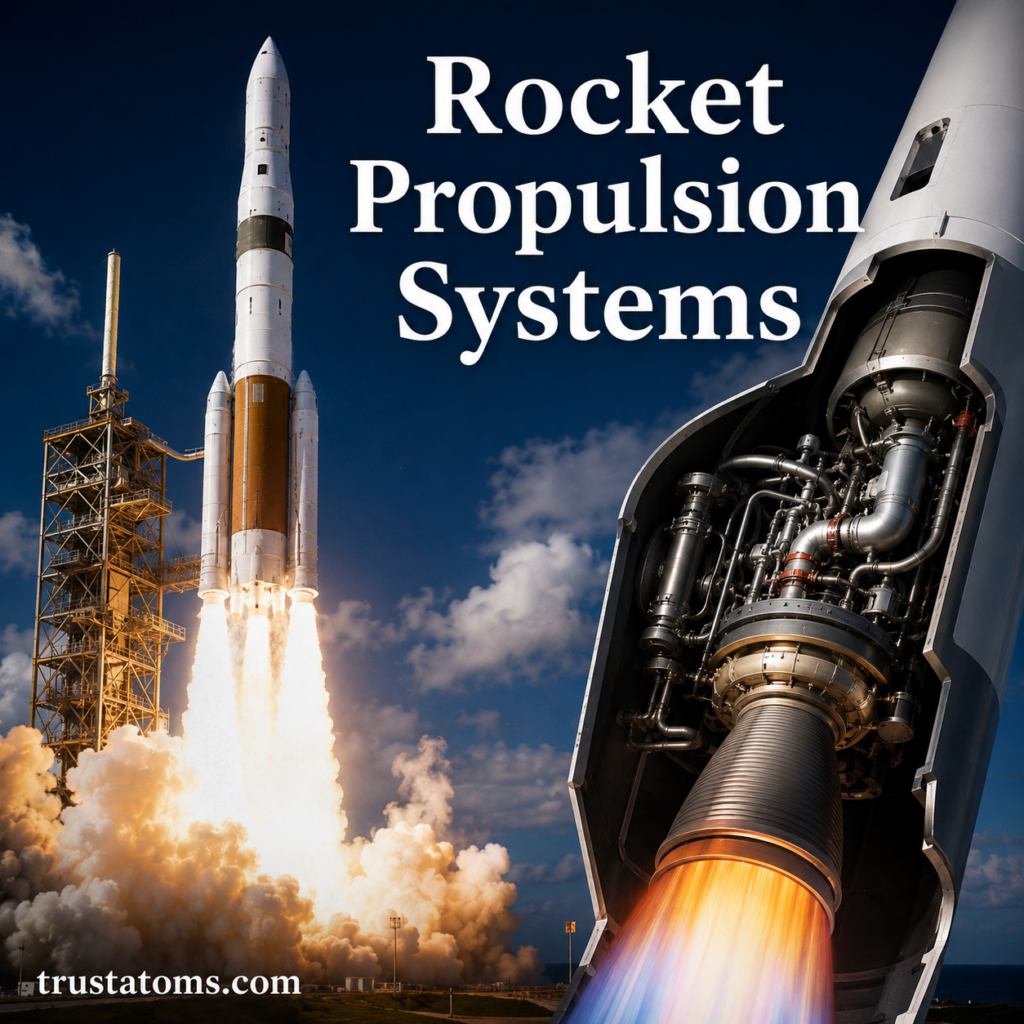
Rocket propulsion systems are the powerful technologies that allow rockets to launch into space, maneuver in orbit, and travel across the solar system. Without propulsion systems, satellites could not orbit Earth, astronauts could not reach space, and robotic probes would never explore distant planets.
Modern rocket propulsion combines physics, chemistry, engineering, and advanced materials science to generate enormous amounts of thrust. From the earliest gunpowder rockets to reusable launch vehicles and ion engines, propulsion technology continues to evolve as humanity expands deeper into space.
What Is a Rocket Propulsion System?
A rocket propulsion system creates thrust by expelling mass at high speed in the opposite direction of travel.
This principle is based on Newton’s Third Law of Motion:
When hot gases are pushed downward out of a rocket engine, the rocket is forced upward.
Unlike airplanes, rockets do not rely on atmospheric oxygen. Rockets carry both fuel and oxidizer, allowing them to operate in the vacuum of space.
The Basic Components of a Rocket Engine
Although designs vary, most rocket propulsion systems include several key components.
Combustion Chamber
The combustion chamber is where fuel and oxidizer mix and burn under extremely high pressure and temperature.
This reaction produces hot expanding gases.
Nozzle
The nozzle directs and accelerates exhaust gases out of the engine.
Most rockets use a specially shaped de Laval nozzle that increases exhaust velocity and improves thrust efficiency.
Fuel System
Rocket fuel systems store and deliver propellants into the combustion chamber.
Depending on the rocket type, propellants may be:
- Liquid
- Solid
- Hybrid
- Electrically accelerated particles
Ignition System
The ignition system starts the combustion process.
Some engines use spark igniters, while others use hypergolic propellants that ignite automatically upon contact.
How Rocket Thrust Works
Rocket thrust is generated when exhaust gases rapidly leave the engine nozzle.
The simplified thrust equation is:
Where thrust depends on:
- Mass flow rate of exhaust
- Exhaust velocity
- Pressure differences at the nozzle exit
Higher exhaust speeds generally produce more efficient propulsion.
Types of Rocket Propulsion Systems
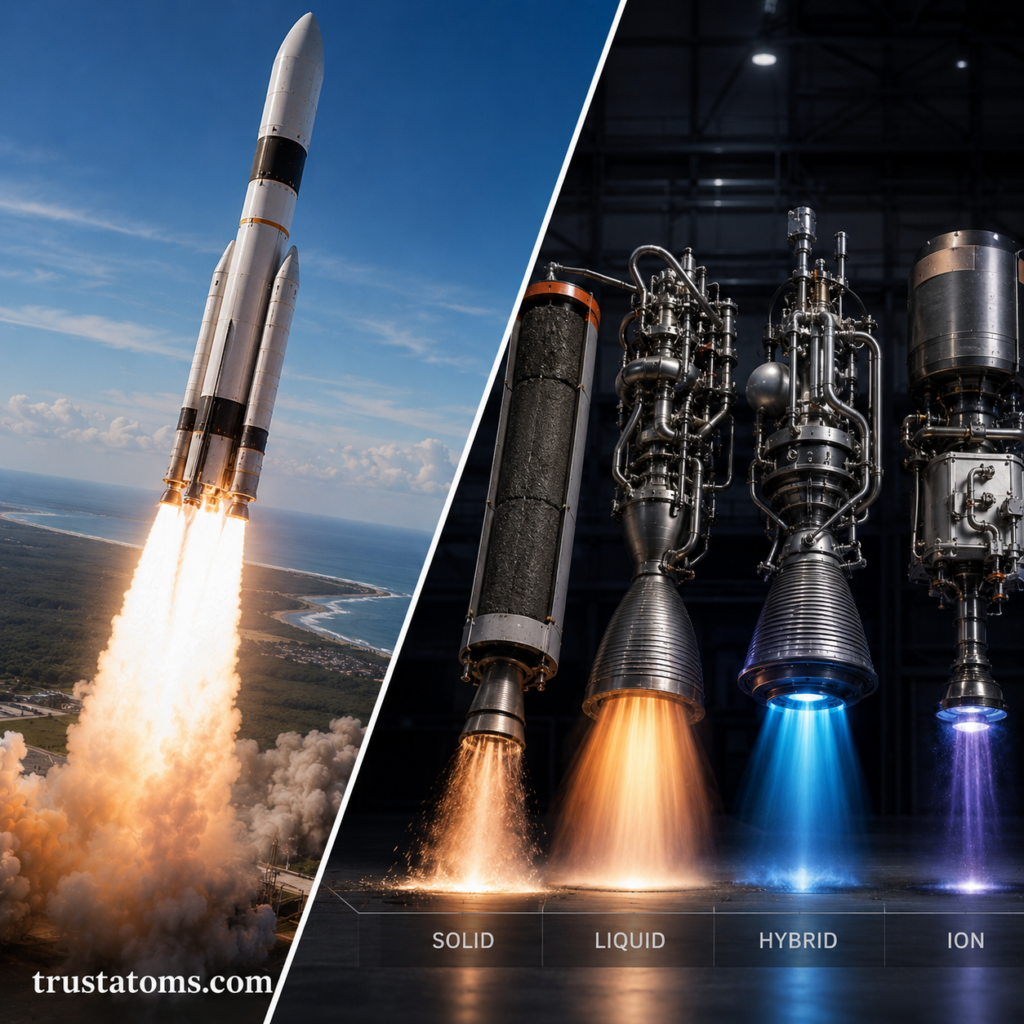
There are several major categories of rocket propulsion systems used in modern spaceflight.
Solid Rocket Propulsion
Solid rocket motors contain fuel and oxidizer mixed together in a solid form.
How Solid Rockets Work
Once ignited, the solid propellant burns continuously until exhausted.
Solid rockets are valued for:
- Simplicity
- Reliability
- Long-term storage capability
- High launch thrust
Advantages of Solid Rockets
Benefits include:
- Fewer moving parts
- Lower manufacturing complexity
- Rapid launch readiness
- Strong initial acceleration
Disadvantages of Solid Rockets
Limitations include:
- Limited throttle control
- Difficult shutdown capability
- Lower efficiency than many liquid systems
Examples of Solid Rockets
Solid rocket boosters have been used on:
- The Space Shuttle
- NASA’s Space Launch System (SLS)
- Military missiles
Liquid Rocket Propulsion
Liquid propulsion systems use separate liquid fuel and oxidizer tanks.
These propellants are pumped into the combustion chamber during flight.
Common Liquid Propellants
Popular combinations include:
- Liquid hydrogen + liquid oxygen
- RP-1 kerosene + liquid oxygen
- Methane + liquid oxygen
Advantages of Liquid Rockets
Liquid propulsion offers:
- Higher efficiency
- Adjustable thrust
- Engine restart capability
- Better flight control
Challenges of Liquid Rockets
Liquid systems are more complex because they require:
- Pumps and turbines
- Cryogenic storage
- Precise fuel management
- Advanced cooling systems
Examples of Liquid Rocket Engines
Liquid propulsion powers many major launch vehicles, including:
- Falcon 9
- Saturn V
- Ariane rockets
- Atlas V
Hybrid Rocket Propulsion
Hybrid rockets combine features of solid and liquid propulsion.
Typically:
- Fuel is solid
- Oxidizer is liquid or gaseous
Benefits of Hybrid Systems
Hybrid rockets offer:
- Improved safety
- Simpler design than liquid engines
- Better throttle control than solid rockets
Drawbacks of Hybrid Systems
Challenges include:
- Lower combustion efficiency
- Complex fuel burn behavior
- Limited large-scale use
Hybrid propulsion is often used in experimental and commercial aerospace projects.
Ion Propulsion Systems
Ion engines are highly efficient electric propulsion systems used primarily in deep-space missions.
How Ion Engines Work
Ion engines use electricity to accelerate charged particles at extremely high speeds.
These engines produce:
- Very low thrust
- Extremely high efficiency
Advantages of Ion Propulsion
Ion systems are excellent for:
- Long-duration missions
- Deep-space travel
- Fuel conservation
Disadvantages of Ion Engines
Limitations include:
- Slow acceleration
- Dependence on electrical power
- Inability to launch from Earth’s surface
Missions Using Ion Propulsion
Ion propulsion has been used in missions such as:
- Dawn spacecraft
- Deep Space 1
- BepiColombo
Nuclear Propulsion Concepts
Scientists are also researching nuclear-powered propulsion systems for future space exploration.
Nuclear Thermal Rockets
Nuclear thermal propulsion heats propellant using a nuclear reactor instead of chemical combustion.
Potential advantages include:
- Higher efficiency
- Faster interplanetary travel
- Reduced mission duration
Nuclear Electric Propulsion
Nuclear electric systems use reactor-generated electricity to power ion engines.
These systems could support future missions to:
- Mars
- Jupiter’s moons
- Deep-space exploration targets
Although promising, nuclear propulsion still faces technical, political, and safety challenges.
Rocket Staging
Most launch vehicles use multiple stages to improve efficiency.
Why Rockets Use Stages
As fuel is consumed, empty tanks and engines become dead weight.
By discarding used stages, rockets become lighter and more efficient during ascent.
Types of Staging
Common staging designs include:
- Two-stage rockets
- Three-stage rockets
- Strap-on boosters
Staging has been essential for reaching orbit and conducting deep-space missions.
Reusable Rocket Technology
Modern aerospace companies are increasingly developing reusable propulsion systems.
Benefits of Reusability
Reusable rockets can:
- Lower launch costs
- Increase launch frequency
- Reduce manufacturing waste
- Improve access to space
Examples of Reusable Rockets
Reusable systems are used by:
- SpaceX Falcon 9
- Blue Origin New Shepard
- SpaceX Starship testing systems
Landing reusable boosters requires highly advanced propulsion control and guidance systems.
Cooling Systems in Rocket Engines
Rocket engines generate extreme heat that can melt engine components.
Regenerative Cooling
Many liquid rocket engines use regenerative cooling, where fuel circulates around the engine before combustion.
This process:
- Cools engine walls
- Preheats fuel
- Improves efficiency
Heat-Resistant Materials
Rocket engines also use:
- Ceramic materials
- High-temperature alloys
- Carbon composites
These materials help engines survive harsh operating conditions.
Rocket Propulsion and Space Exploration
Rocket propulsion systems make nearly all modern space activities possible.
Applications include:
- Satellite launches
- Human spaceflight
- Lunar missions
- Mars exploration
- Space telescopes
- Planetary probes
Advances in propulsion technology continue expanding humanity’s ability to explore the universe.
Future Rocket Propulsion Technologies
Researchers are developing new propulsion concepts that may transform future space travel.
Potential Future Systems
Emerging technologies include:
- Fusion propulsion
- Antimatter propulsion
- Solar sails
- Plasma engines
- Laser propulsion systems
Some of these concepts remain theoretical, while others are already being tested experimentally.
Faster Deep-Space Travel
Advanced propulsion could eventually reduce travel times to distant planets and make long-duration human missions more practical.
Challenges in Rocket Propulsion
Rocket engineering remains extremely difficult due to several factors.
Major Engineering Challenges
Rocket systems must handle:
- Extreme temperatures
- High pressures
- Massive vibrations
- Precise timing
- Fuel efficiency demands
Even small failures can lead to mission loss.
Environmental Concerns
Scientists are also studying the environmental impact of rocket launches, including:
- Atmospheric pollution
- Exhaust emissions
- Space debris generation
Future propulsion systems may become cleaner and more sustainable.
How Rocket Propulsion Inspires Science and Technology
Rocket propulsion has driven innovation across many industries.
Technologies developed for rockets have contributed to:
- Advanced materials
- Computer systems
- Telecommunications
- Medical imaging
- Weather satellites
Space exploration continues inspiring new generations of scientists, engineers, and astronomers.
Final Thoughts
Rocket propulsion systems are among the most important technologies ever developed. They allow humanity to launch satellites, explore distant worlds, conduct scientific research, and expand our understanding of the universe.
From chemical rockets to advanced ion engines and future nuclear concepts, propulsion technology continues evolving rapidly. As space exploration advances, new propulsion systems will play a critical role in reaching the Moon, Mars, and beyond.
The future of astronomy and space travel depends heavily on continued innovation in rocket propulsion, making it one of the most exciting fields in modern science and engineering.