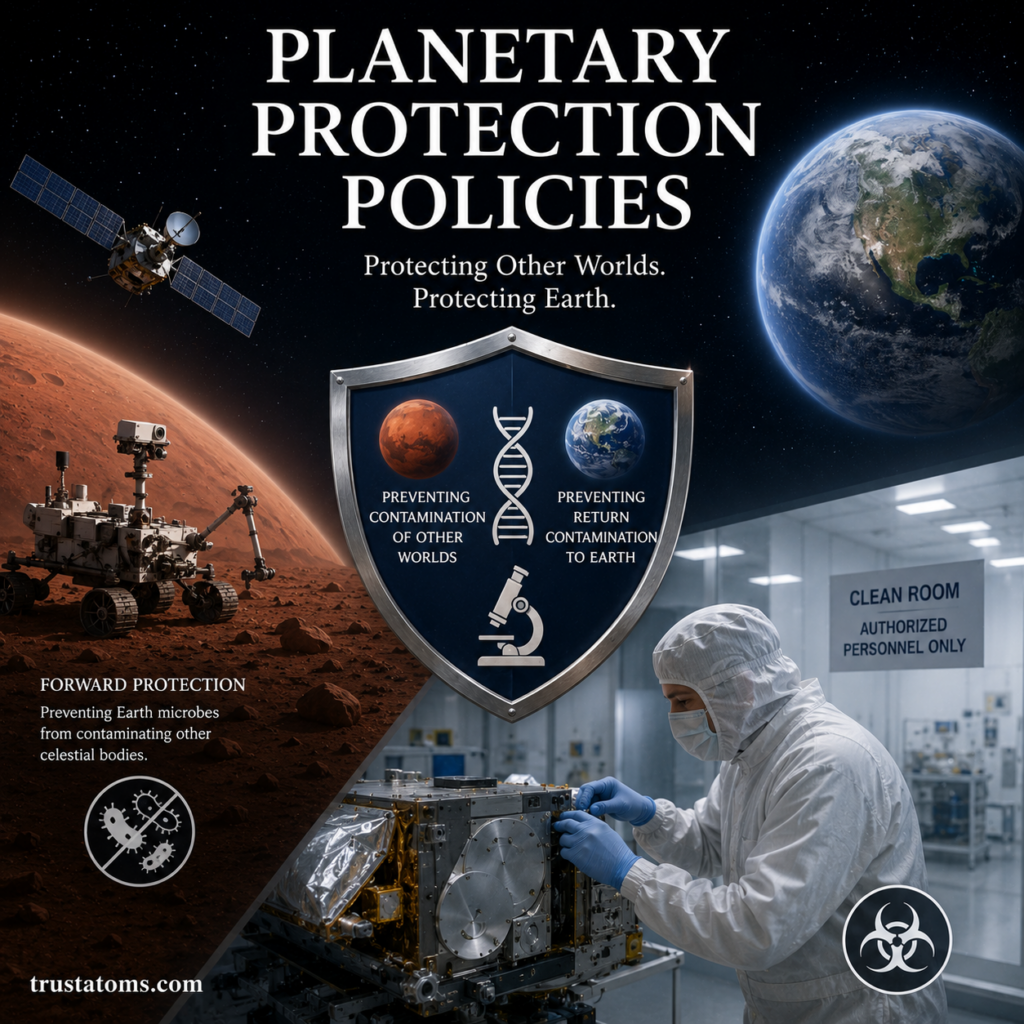
As humanity explores deeper into the solar system, scientists face an important challenge that extends beyond rockets, robotics, and engineering: preventing biological contamination between worlds.
Planetary protection policies are international scientific guidelines designed to reduce the risk of contaminating other planets, moons, and celestial bodies with Earth-based microorganisms while also protecting Earth from potential extraterrestrial material brought back by space missions.
These policies play a critical role in modern astronomy, astrobiology, and space exploration.
What Is Planetary Protection?
Planetary protection refers to practices and regulations that prevent harmful biological contamination during space missions.
The policies focus on two major concerns:
- Forward contamination
- Backward contamination
Forward Contamination
Forward contamination occurs when spacecraft carry Earth microbes to another world.
This could interfere with:
- The search for extraterrestrial life
- Scientific experiments
- Native ecosystems (if they exist)
- Future biological studies
For example, if bacteria from Earth contaminated Mars, scientists might mistake those microbes for native Martian life.
Backward Contamination
Backward contamination involves returning extraterrestrial material to Earth that could potentially affect Earth’s biosphere.
Although no evidence currently suggests dangerous alien microbes exist, planetary protection policies operate cautiously because the consequences could be significant.
Why Planetary Protection Matters
Spacecraft are never completely sterile by default.
Even highly controlled facilities contain microscopic organisms capable of surviving harsh conditions.
Without proper precautions:
- Space missions could compromise scientific discoveries
- Planetary ecosystems might be altered
- Biological evidence could become unreliable
- Earth could face unknown contamination risks
Planetary protection ensures that future discoveries remain scientifically valid.
It also supports responsible exploration practices as humanity expands into space.
The Origins of Planetary Protection Policies
Planetary protection policies became serious scientific concerns during the early space race.
As robotic missions to the Moon, Mars, and Venus developed during the 1950s and 1960s, scientists recognized the possibility of cross-planet contamination.
COSPAR and International Standards
The primary organization overseeing planetary protection guidance is the Committee on Space Research (COSPAR).
COSPAR develops internationally accepted planetary protection policies used by major space agencies worldwide.
Agencies following these guidelines include:
- NASA
- ESA (European Space Agency)
- JAXA
- Roscosmos
- ISRO
- CNSA
Although COSPAR policies are not laws themselves, they heavily influence national regulations and mission planning.
Categories of Planetary Protection Missions
Planetary protection policies classify missions into different categories depending on risk levels.
Category I Missions
These missions target celestial bodies unlikely to support life.
Examples may include:
- Certain asteroids
- Mercury
- Some outer solar system objects
Requirements are minimal because contamination risks are low.
Category II Missions
These involve worlds with some scientific interest regarding life but low contamination concern.
Documentation and mission planning requirements increase slightly.
Category III Missions
These are flyby or orbiter missions to potentially habitable worlds such as:
- Mars
- Europa
- Enceladus
Strict cleanliness and contamination control procedures apply.
Category IV Missions
These involve landers or probes touching potentially habitable surfaces.
Requirements become significantly stricter.
Spacecraft may undergo:
- Sterilization procedures
- Clean-room assembly
- Microbial monitoring
- Heat treatment
- Specialized packaging
Category V Missions
These involve returning samples to Earth.
This category includes the strongest containment and quarantine protocols.
Sample-return missions represent one of the most challenging areas of planetary protection.
Forward Contamination Prevention Methods
Space agencies use multiple strategies to reduce contamination risks.
Spacecraft Sterilization
Components may undergo sterilization using:
- Dry heat
- Chemical cleaning
- Radiation exposure
- Ultraviolet light treatment
Some spacecraft parts are baked at high temperatures to kill microorganisms.
Clean Room Assembly
Many spacecraft are assembled in highly controlled clean rooms.
These environments feature:
- Filtered air systems
- Protective suits
- Strict contamination monitoring
- Controlled humidity
- Specialized cleaning procedures
Biological Monitoring
Scientists regularly test spacecraft surfaces for microbial contamination.
Sampling helps ensure cleanliness standards remain within acceptable limits.
Mars and Planetary Protection
Mars receives special attention because it may once have supported microbial life.
Certain regions on Mars may still contain:
- Underground ice
- Briny water
- Habitable environments
- Protected subsurface regions
Because of this, missions targeting Mars often face strict contamination requirements.
Special Regions on Mars
“Special regions” are areas where Earth microbes could potentially survive.
These zones may include:
- Warm subsurface pockets
- Ice-rich regions
- Temporary liquid water areas
Exploration of these regions requires enhanced sterilization measures.
Europa and Ocean Worlds
Some moons in the outer solar system are considered high-priority targets for astrobiology.
These include:
- Europa
- Enceladus
- Titan
Scientists believe these worlds may contain subsurface oceans beneath icy crusts.
Because liquid water is considered essential for life, contamination concerns become extremely important.
Future missions exploring these moons may require some of the strictest planetary protection measures ever implemented.
Sample Return Missions and Earth Safety
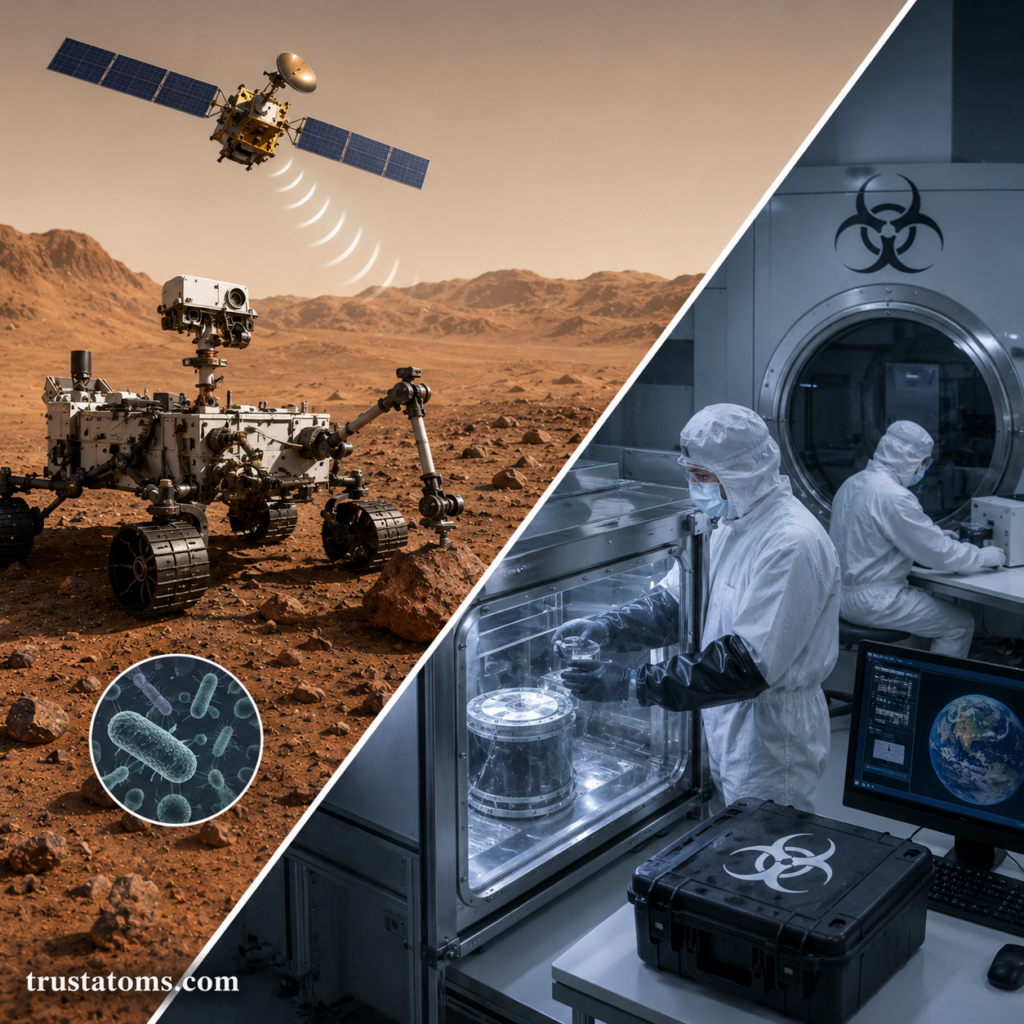
Sample return missions involve collecting material from another world and bringing it back to Earth.
Examples include:
- Asteroid samples
- Martian rock samples
- Lunar material
- Comet particles
These missions require advanced containment systems.
Containment Facilities
Returned materials may be stored in secure laboratories featuring:
- Airlock systems
- Negative pressure rooms
- Biosecure containment chambers
- Specialized filtration systems
Scientists analyze samples carefully before broader study or release.
Challenges Facing Planetary Protection
Planetary protection becomes more complicated as space exploration expands.
Commercial Spaceflight
Private companies increasingly participate in space missions.
This raises new questions about:
- International enforcement
- Regulatory oversight
- Mission accountability
- Commercial landing operations
Human Missions to Mars
Human exploration creates major planetary protection difficulties.
Humans naturally carry trillions of microorganisms, making complete sterilization impossible.
Future Mars missions must balance:
- Scientific protection
- Human safety
- Exploration goals
- Operational practicality
Technological Limitations
Absolute sterilization is extremely difficult.
Some microorganisms can survive:
- Radiation
- Vacuum exposure
- Extreme temperatures
- Long-duration space travel
Scientists continue improving contamination control technologies.
Ethical Questions in Planetary Protection
Planetary protection also raises philosophical and ethical concerns.
Important debates include:
- Does humanity have the right to alter alien environments?
- Should potentially habitable worlds remain untouched?
- How much contamination risk is acceptable?
- Could microbial ecosystems exist elsewhere?
These questions influence future exploration policies and international agreements.
International Space Treaties and Planetary Protection
Planetary protection principles connect closely with international space law.
Outer Space Treaty
The 1967 Outer Space Treaty established foundational principles for responsible space exploration.
The treaty states that nations should avoid harmful contamination of celestial bodies and adverse changes to Earth’s environment caused by extraterrestrial material.
This treaty remains one of the most important legal foundations for planetary protection today.
The Future of Planetary Protection
Planetary protection policies will likely evolve as space activity increases.
Future developments may include:
- Permanent Moon bases
- Human Mars colonies
- Asteroid mining operations
- Expanded commercial exploration
- Advanced robotic missions
- Deep-space sample returns
Scientists and policymakers continue adapting guidelines to address new technologies and mission types.
Balancing exploration with scientific responsibility will remain a major challenge.
Final Thoughts
Planetary protection policies help ensure that humanity explores space responsibly and scientifically.
By preventing contamination between Earth and other worlds, these guidelines protect the integrity of astrobiology research while reducing environmental risks associated with space exploration.
As missions travel farther into the solar system and eventually carry humans to other planets, planetary protection will become even more important.
The search for life beyond Earth depends not only on advanced technology, but also on careful stewardship of the environments we explore.