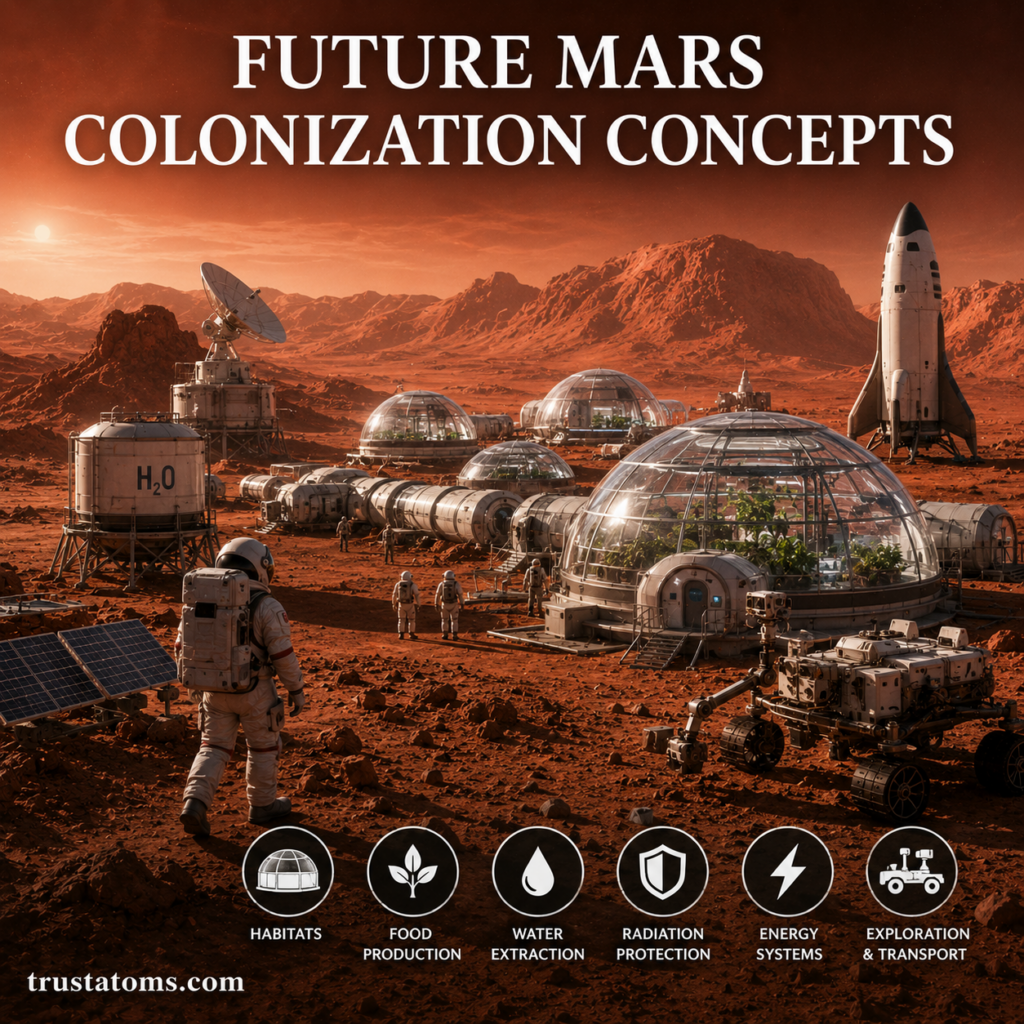
For decades, Mars has captured human imagination as the most realistic candidate for future planetary colonization. With its rocky surface, polar ice caps, changing seasons, and day length similar to Earth’s, Mars offers possibilities that no other nearby planet currently provides.
Scientists, engineers, and private aerospace companies are actively developing future Mars colonization concepts that could eventually allow humans to establish permanent settlements on the Red Planet.
Although enormous challenges remain, modern space technology continues bringing Mars colonization closer to reality.
Why Mars Is Considered the Best Colonization Candidate
Mars stands out among planets in the solar system because it shares several characteristics with Earth.
Key similarities include:
- A 24.6-hour day
- Seasonal weather cycles
- Polar ice caps
- Rocky terrain
- Presence of water ice
- Moderate gravity compared to smaller moons
These factors make Mars more practical for long-term human habitation than many other celestial bodies.
Distance From Earth
Mars is relatively close in astronomical terms.
Depending on orbital positions, travel times could range between:
- Approximately 6 to 9 months using current propulsion systems
While still difficult, this distance is manageable for future interplanetary missions.
The Main Goals of Mars Colonization
Future Mars settlement concepts generally focus on several long-term objectives.
Scientific Research
Mars could help scientists answer major questions about:
- Ancient planetary climates
- Potential past microbial life
- Planetary evolution
- Human survival in extreme environments
Species Survival
Some advocates believe becoming a multi-planetary species could improve humanity’s long-term survival chances.
Potential threats on Earth include:
- Asteroid impacts
- Global catastrophes
- Climate disasters
- Large-scale conflicts
Independent settlements beyond Earth may increase civilization’s resilience.
Technological Advancement
Mars colonization would accelerate innovation in:
- Robotics
- Artificial intelligence
- Closed-loop life support
- Renewable energy
- Advanced medicine
- Sustainable agriculture
Many technologies developed for Mars could also benefit life on Earth.
Transportation Systems for Mars Missions
Reliable transportation is one of the biggest requirements for Mars colonization.
Reusable Spacecraft
Many future concepts rely on reusable spacecraft systems designed to lower launch costs.
Key goals include:
- Multiple mission capability
- Large cargo transport
- Human passenger support
- Orbital refueling
Reusable rockets could make repeated Mars missions economically realistic.
Nuclear Propulsion Concepts
Some researchers study nuclear propulsion technologies for faster travel.
Potential advantages include:
- Reduced travel times
- Greater fuel efficiency
- Larger payload capacity
Shorter trips could reduce astronaut exposure to:
- Cosmic radiation
- Muscle loss
- Bone density decline
- Psychological stress
However, nuclear systems involve major engineering and safety challenges.
Building Habitats on Mars
Human survival on Mars depends heavily on protected living environments.
Inflatable Habitats
One proposed concept involves inflatable habitat modules transported compactly from Earth.
Advantages include:
- Lightweight structures
- Easier transport
- Expandable living space
Once deployed, habitats could be reinforced with Martian soil for radiation protection.
Underground Habitats
Many scientists believe underground colonies may offer the safest long-term solution.
Possible underground options include:
- Lava tubes
- Excavated tunnels
- Buried habitat systems
Benefits include protection from:
- Radiation
- Dust storms
- Temperature extremes
- Micrometeorite impacts
3D-Printed Structures
Future colonists may use robotic 3D printing systems to construct buildings using Martian materials.
This process could reduce the need to transport construction supplies from Earth.
Possible materials include:
- Martian regolith
- Ice composites
- Sulfur-based concrete alternatives
Radiation Protection Challenges
Mars lacks a strong global magnetic field and thick atmosphere.
This creates dangerous radiation exposure risks from:
- Solar radiation
- Cosmic rays
- Solar storms
Long-term radiation exposure could increase risks of:
- Cancer
- Neurological damage
- Organ problems
- Reproductive issues
Proposed Radiation Solutions
Scientists are exploring several protection methods:
- Underground shelters
- Thick regolith shielding
- Water-based shielding systems
- Magnetic field technologies
- Specialized radiation-resistant materials
Radiation protection remains one of the most difficult colonization problems.
Producing Food on Mars
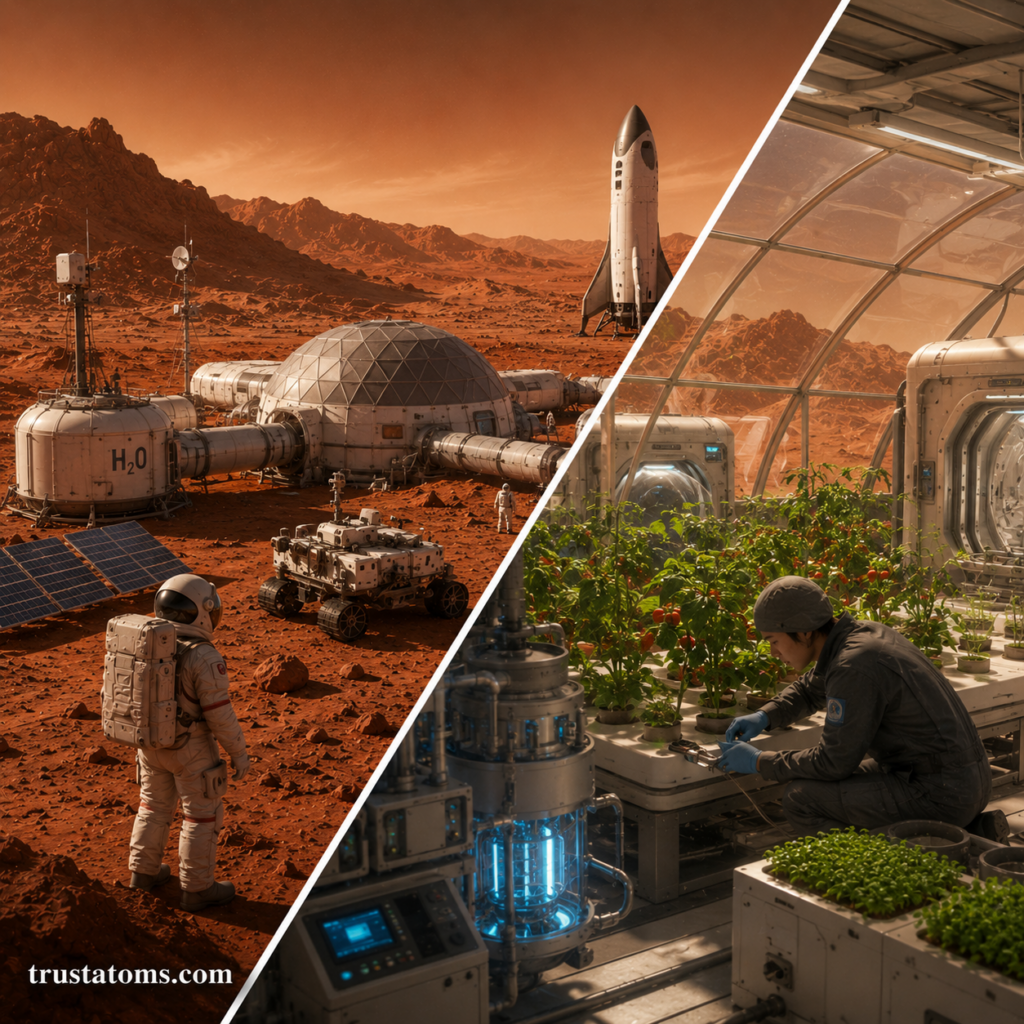
A sustainable colony must eventually produce its own food.
Hydroponic Farming
Hydroponics allows plants to grow without soil using nutrient-rich water systems.
Advantages include:
- Reduced water use
- Controlled growing environments
- Faster plant growth
- Efficient nutrient recycling
Aeroponics
Aeroponics sprays plant roots with nutrient mist instead of submerging them in water.
This method may further reduce water requirements.
Martian Greenhouses
Future greenhouses would likely feature:
- Artificial lighting
- Pressurized interiors
- Climate control systems
- Water recycling
- Carbon dioxide management
Scientists continue testing crops that could survive under Martian conditions.
Water Extraction and Resource Utilization
Mars colonization becomes far more realistic if settlers can use local resources.
This concept is called in-situ resource utilization (ISRU).
Water Ice Mining
Large amounts of frozen water exist beneath the Martian surface.
Water could support:
- Drinking supplies
- Oxygen production
- Agriculture
- Rocket fuel manufacturing
Oxygen Production
Future systems may extract oxygen from:
- Water molecules
- Carbon dioxide in the Martian atmosphere
NASA’s MOXIE experiment successfully demonstrated oxygen production on Mars using atmospheric carbon dioxide.
Fuel Production
Methane and oxygen fuel may potentially be manufactured on Mars.
This could support:
- Return missions to Earth
- Surface transportation
- Power systems
Local fuel production would dramatically reduce mission costs.
Energy Sources for Mars Colonies
Reliable energy is essential for survival.
Solar Power
Mars receives less sunlight than Earth, but solar energy remains a major option.
Challenges include:
- Dust accumulation
- Reduced sunlight during storms
- Seasonal changes
Nuclear Energy
Small modular nuclear reactors may provide stable long-term power.
Advantages include:
- Continuous energy production
- Weather independence
- High efficiency
Many experts believe nuclear systems will likely become essential for large Martian settlements.
Communication Challenges
Communication delays between Earth and Mars create operational difficulties.
Depending on planetary positions, signals may take:
- Between 4 and 24 minutes one way
This prevents real-time conversations and remote control.
Future Mars colonies would require high levels of independence and local decision-making.
Psychological and Social Challenges
Long-term isolation could significantly affect mental health.
Colonists may experience:
- Loneliness
- Confinement stress
- Delayed communication with Earth
- Social tension
- Reduced privacy
Proposed Solutions
Potential support systems include:
- Virtual reality recreation
- Structured social programs
- Mental health monitoring
- Artificial intelligence assistants
- Carefully selected crew compatibility
Building healthy social systems may be just as important as engineering solutions.
Terraforming Concepts
Terraforming refers to altering Mars to make it more Earth-like.
Proposed Terraforming Ideas
Some theoretical concepts include:
- Releasing greenhouse gases
- Melting polar ice caps
- Thickening the atmosphere
- Importing ammonia-rich asteroids
- Using giant orbital mirrors
Major Limitations
Current research suggests terraforming Mars would be extraordinarily difficult.
Problems include:
- Thin atmosphere
- Limited accessible carbon dioxide
- Weak gravity
- Lack of magnetic protection
Terraforming remains speculative and far beyond current technology.
Ethical Questions About Mars Colonization
Mars colonization raises important ethical debates.
Questions include:
- Should humans alter another planet?
- Could microbial Martian life exist?
- Who governs Mars settlements?
- How should resources be shared?
- Should commercial ownership exist?
These issues may shape future international space law.
International Cooperation and Commercial Spaceflight
Mars colonization will likely involve both governments and private companies.
Organizations involved in Mars research include:
- NASA
- ESA
- SpaceX
- CNSA
- JAXA
- ISRO
International cooperation could help reduce costs and share scientific knowledge.
Commercial spaceflight may also accelerate technological development.
Could Humans Realistically Colonize Mars?
Most experts believe temporary human missions to Mars are achievable within the coming decades.
Permanent self-sustaining colonies, however, remain much more difficult.
Major obstacles still include:
- Radiation exposure
- Life support reliability
- Transportation costs
- Psychological effects
- Resource sustainability
- Medical emergencies
Despite these challenges, Mars colonization research continues advancing rapidly.
Final Thoughts
Future Mars colonization concepts combine science, engineering, biology, psychology, and long-term human ambition.
While fully independent Martian cities remain far in the future, modern research already demonstrates meaningful progress toward sustained human presence on another planet.
The technologies developed for Mars exploration may also improve sustainability, energy systems, and resource management on Earth itself.
Whether Mars becomes humanity’s second home or remains primarily a scientific outpost, the effort to reach and live on the Red Planet will likely shape the future of space exploration for generations.