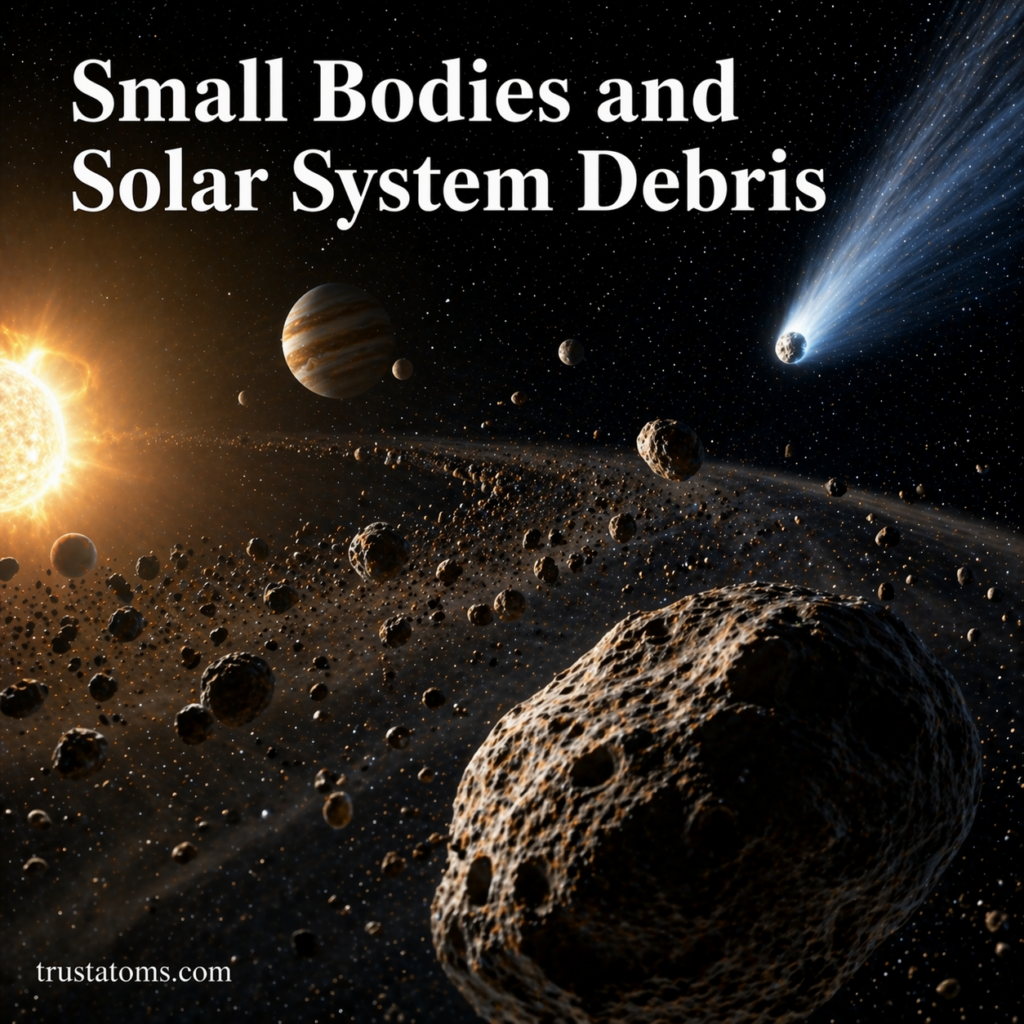
Beyond the major planets lies a vast population of smaller objects—asteroids, comets, meteoroids, and icy debris—that orbit the Sun. These small bodies are remnants from the early solar system, offering valuable clues about how planets formed over 4.5 billion years ago.
While often overlooked, these objects play a critical role in shaping planetary surfaces, delivering materials like water and organics, and occasionally posing impact risks to Earth.
What Are Small Bodies?
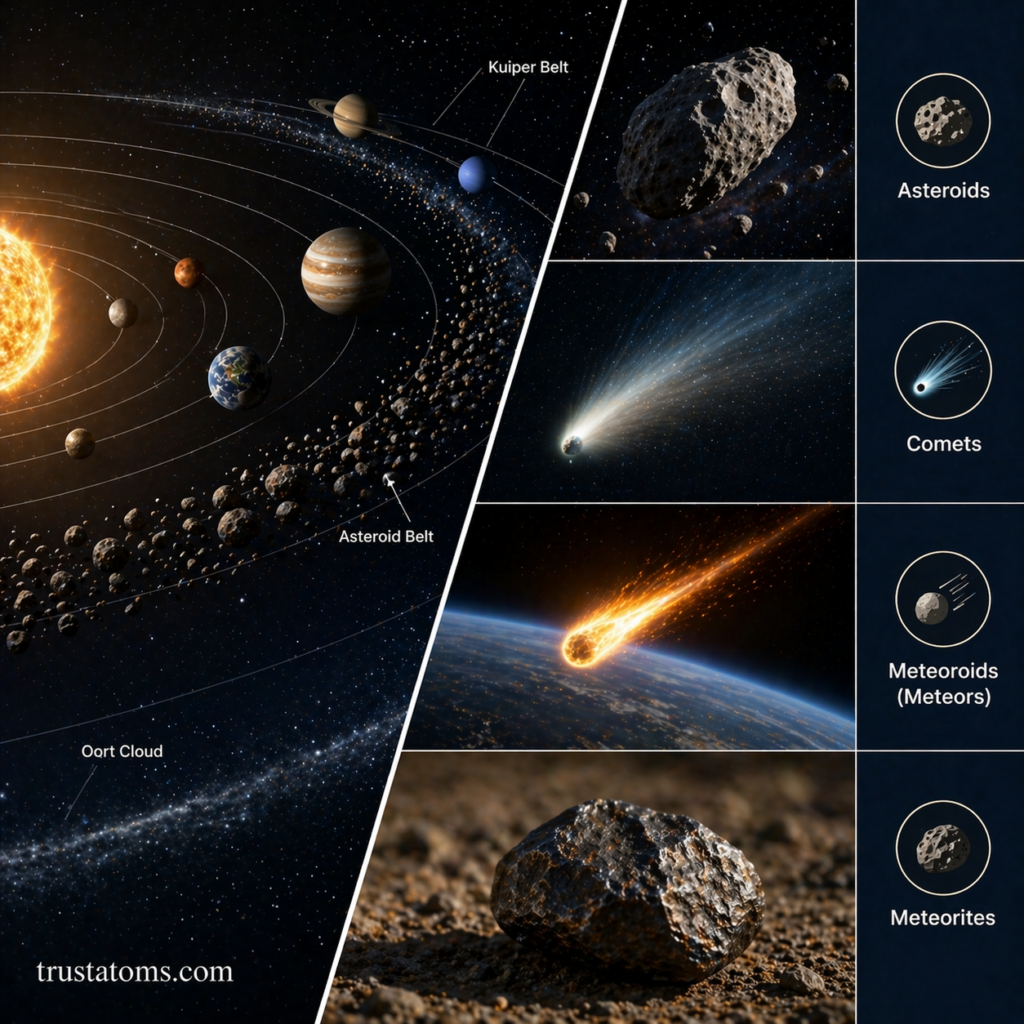
Small bodies are objects in the solar system that are not classified as planets or dwarf planets. They include:
- Asteroids
- Comets
- Meteoroids
- Trans-Neptunian Objects (TNOs)
Most of these objects are leftovers from the original cloud of gas and dust that formed the Sun and planets.
Major Types of Solar System Debris
Asteroids
Asteroids are rocky or metallic objects, mostly found in the asteroid belt between Mars and Jupiter.
Key characteristics:
- Irregular shapes
- Sizes ranging from meters to hundreds of kilometers
- Little to no atmosphere
Some asteroids are remnants of early planet formation, while others are fragments from past collisions.
Comets
Comets are icy bodies that develop glowing comas and tails when they approach the Sun.
Key features:
- Made of ice, dust, and organic materials
- Originate from the Kuiper Belt or Oort Cloud
- Become active near the Sun due to heating
They are often described as “dirty snowballs” and provide insight into the outer solar system.
Meteoroids, Meteors, and Meteorites
These terms describe different stages of small debris interacting with Earth.
- Meteoroids: Small particles traveling through space
- Meteors: Streaks of light when meteoroids burn in Earth’s atmosphere
- Meteorites: Fragments that reach the ground
These objects help scientists study material from space without leaving Earth.
Trans-Neptunian Objects (TNOs)
TNOs are icy bodies located beyond Neptune.
Examples include:
- Objects in the Kuiper Belt
- Distant bodies in the scattered disk
These objects are some of the most primitive materials in the solar system.
Where Small Bodies Are Found
Small bodies are not randomly distributed—they tend to cluster in specific regions.
Key Locations
- Asteroid Belt: Between Mars and Jupiter
- Kuiper Belt: Beyond Neptune, home to many icy bodies
- Oort Cloud: A distant spherical region surrounding the solar system
- Near-Earth Space: Objects whose orbits bring them close to Earth
Each region reflects different conditions during the solar system’s formation.
How Small Bodies Formed
Small bodies formed from leftover material that never combined into planets.
Formation Process
- Dust and gas surrounded the young Sun
- Particles collided and stuck together
- Some grew into planets
- Others remained small due to gravitational disruptions
Jupiter’s strong gravity, for example, prevented material in the asteroid belt from forming a planet.
The Role of Collisions
Collisions are a major force shaping small bodies.
Effects of Collisions
- Break larger objects into smaller fragments
- Create families of related asteroids
- Generate debris fields and meteoroids
- Alter orbits over time
These collisions continue today, making the solar system an active environment.
Why Small Bodies Matter
Small bodies are more than just space debris—they are scientifically valuable.
Key Contributions
- Clues to Solar System Formation:
Preserve ancient materials - Delivery of Water and Organics:
May have contributed to life on Earth - Impact History:
Help explain craters on planets and moons - Future Resources:
Potential sources of metals, water, and fuel
Near-Earth Objects and Impact Risk
Some small bodies have orbits that cross Earth’s path.
Near-Earth Objects (NEOs)
- Include asteroids and comets
- Carefully tracked by scientists
- Most pose no immediate threat
Planetary Defense
Efforts include:
- Monitoring object trajectories
- Developing deflection strategies
- Studying impact scenarios
Understanding these objects helps reduce potential risks.
Exploration and Study
Scientists actively study small bodies through missions and observations.
Methods
- Telescopes: Track and analyze objects from Earth
- Space Missions: Visit and sample asteroids and comets
- Sample Return Missions: Bring material back for study
These approaches provide direct insight into the composition and history of small bodies.
Common Misconceptions
- Small bodies are not insignificant—they hold key scientific information
- Not all asteroids are dangerous
- Comets are not rare; many exist but are difficult to see
- Space is not empty—it contains vast amounts of debris
Final Thoughts
Small bodies and solar system debris are essential pieces of the cosmic puzzle. They represent the leftover building blocks of planet formation and continue to influence the solar system today through collisions, impacts, and material exchange.
By studying these objects, scientists gain a clearer picture of how our solar system formed—and how it continues to evolve.