
Relativistic jets are among the most energetic and visually spectacular phenomena in the universe. These enormous beams of high-speed particles can extend for thousands or even millions of light-years from black holes, releasing immense amounts of energy into surrounding space.
Despite black holes being famous for trapping matter and light, they are also capable of powering some of the brightest and most violent cosmic structures ever observed.
Scientists study relativistic jets to better understand black holes, magnetic fields, plasma physics, galaxy evolution, and the extreme environments surrounding compact objects.
What Are Relativistic Jets?
Relativistic jets are narrow streams of ionized particles accelerated to speeds close to the speed of light.
These jets often emerge from regions surrounding:
- Black holes
- Neutron stars
- Active galactic nuclei (AGN)
- Quasars
The term “relativistic” refers to the fact that particles within the jets move at velocities where Einstein’s theory of relativity becomes important.
Why Black Holes Produce Jets
Black holes themselves do not directly emit jets from inside the event horizon.
Instead, the jets form in the extremely energetic environment surrounding the black hole.
Accretion Disks
Matter falling toward a black hole forms a rapidly spinning disk called an accretion disk.
This disk contains:
- Superheated gas
- Plasma
- Strong magnetic fields
- Enormous rotational energy
Friction and compression heat the disk to extremely high temperatures.
The Role of Magnetic Fields
Magnetic fields play a crucial role in jet formation.
As plasma rotates around the black hole:
- Magnetic field lines twist and intensify
- Rotational energy transfers into electromagnetic forces
- Charged particles become accelerated outward
The result is a pair of focused jets launched from the black hole’s polar regions.
How Fast Are Relativistic Jets?
Particles inside relativistic jets may travel at over 99% of the speed of light.
At these speeds:
- Relativistic effects become significant
- Time dilation occurs
- Particle energies become enormous
Einstein’s relativity helps explain the behavior of matter at these extreme velocities.
Relativistic Energy
As velocity approaches light speed, energy increases dramatically.
Particles in jets can carry tremendous kinetic energy across enormous cosmic distances.
Jet Structure and Shape
Relativistic jets are highly collimated, meaning they remain narrow over very long distances.
Why Jets Stay Narrow
Strong magnetic fields help guide and stabilize the plasma flow.
Without magnetic confinement:
- The jets would disperse quickly
- Energy would spread outward
- The structures would lose coherence
Instead, some jets remain focused for millions of light-years.
Supermassive Black Holes and Active Galaxies
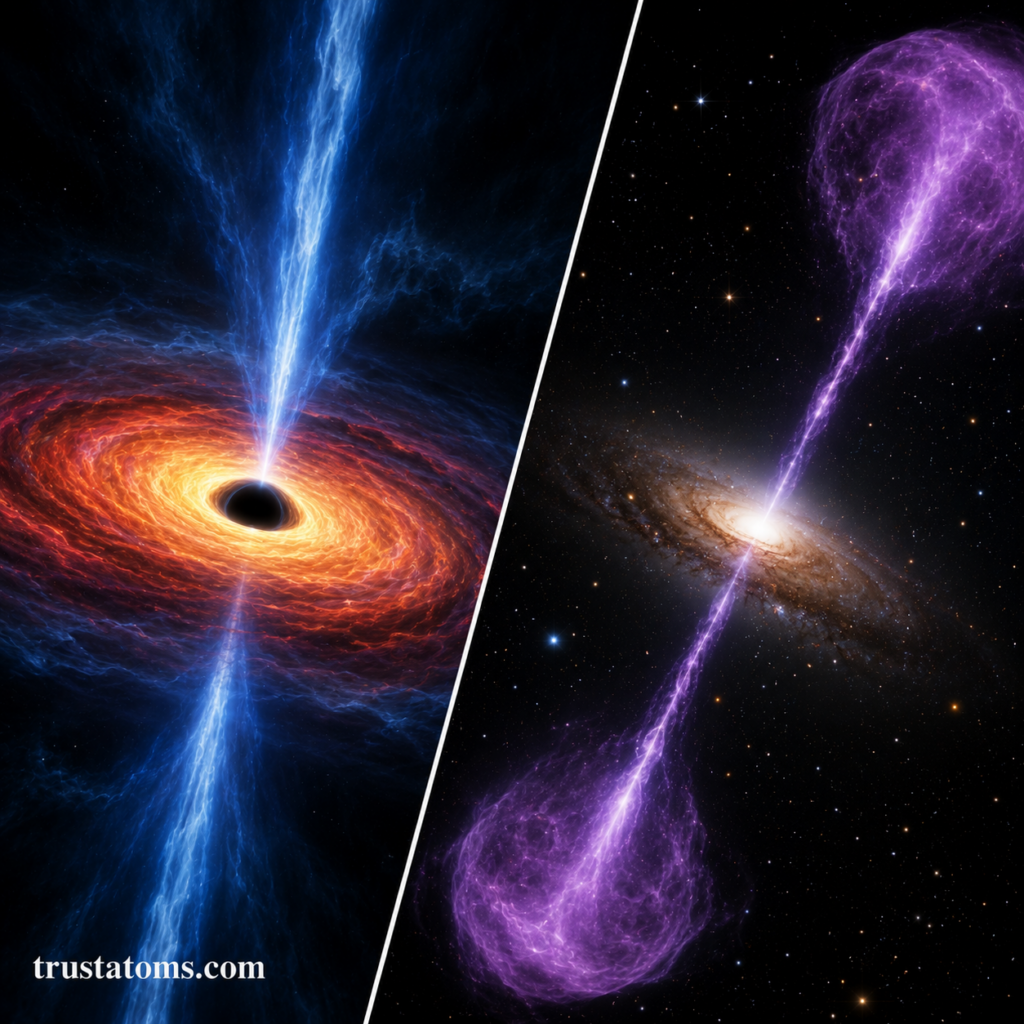
The largest relativistic jets usually originate from supermassive black holes located at galactic centers.
Active Galactic Nuclei (AGN)
When a supermassive black hole actively consumes matter, the galaxy’s core becomes extremely luminous.
These active regions are called active galactic nuclei.
AGN may produce:
- Powerful radiation
- High-energy particles
- Gigantic relativistic jets
Quasars
Quasars are among the brightest known objects in the universe.
They are powered by actively feeding supermassive black holes with intense accretion activity and enormous jet production.
Blazars
Blazars are a special type of active galaxy where one relativistic jet points nearly toward Earth.
Because of relativistic effects:
- The jet appears brighter
- Emission becomes amplified
- Variability appears more dramatic
Blazars are important sources of high-energy cosmic radiation.
What Are Jets Made Of?
Relativistic jets primarily consist of plasma.
Plasma contains:
- Electrons
- Positrons
- Protons
- Atomic nuclei
Scientists continue studying the exact composition of different jet systems.
Synchrotron Radiation
Charged particles spiraling through magnetic fields emit synchrotron radiation.
This process produces:
- Radio waves
- X-rays
- Gamma rays
- Visible light
Synchrotron radiation helps astronomers detect and study relativistic jets across the electromagnetic spectrum.
Jet Formation Theories
Several theoretical models explain how black hole jets form.
Blandford–Znajek Process
One leading model suggests rotational energy is extracted directly from a spinning black hole through magnetic fields.
This mechanism may convert black hole spin into jet energy.
Blandford–Payne Mechanism
Another theory proposes that magnetic fields anchored in the accretion disk accelerate material outward centrifugally.
Both processes may contribute simultaneously.
Black Hole Spin and Jet Power
The spin rate of a black hole likely affects jet strength.
Rapidly spinning black holes may:
- Generate stronger magnetic interactions
- Transfer more energy into jets
- Produce more powerful emissions
Scientists continue investigating how spin influences jet formation efficiency.
How Large Can Jets Become?
Some relativistic jets are among the largest structures in the universe.
Jet lengths may reach:
- Thousands of light-years
- Hundreds of thousands of light-years
- Millions of light-years
These jets can extend far beyond their host galaxies.
Jets and Galaxy Evolution
Relativistic jets influence the evolution of galaxies.
Feedback Mechanisms
Jets inject enormous energy into surrounding space.
This can:
- Heat nearby gas
- Suppress star formation
- Redistribute matter
- Alter galactic environments
This process is called black hole feedback.
Regulation of Galaxy Growth
Scientists believe supermassive black holes help regulate galaxy growth through jet activity and energy release.
Relativistic Beaming
Because jets move near light speed, relativity changes how their light appears.
Doppler Boosting
Radiation traveling toward Earth becomes brighter due to relativistic beaming.
This effect causes:
- Apparent brightness amplification
- Asymmetric jet appearance
- Rapid brightness variations
Jets moving away from Earth appear dimmer.
Can Jets Escape Black Holes?
Jets originate outside the event horizon.
This means:
- The particles themselves are not escaping from inside the black hole
- Energy comes from the surrounding accretion environment and magnetic fields
- Physics outside the event horizon powers the jet structures
This distinction is important for understanding black hole behavior.
Famous Relativistic Jet Systems
Several astronomical objects are famous for their relativistic jets.
M87*
The supermassive black hole in galaxy M87 produces a massive jet extending thousands of light-years.
The Event Horizon Telescope Collaboration famously captured the first black hole image of M87* in 2019.
Cygnus X-1
One of the best-known stellar-mass black hole systems producing relativistic jets.
Centaurus A
A nearby active galaxy featuring enormous radio-emitting jets.
How Scientists Observe Jets
Astronomers study relativistic jets using multiple wavelengths.
Observations involve:
- Radio telescopes
- X-ray observatories
- Gamma-ray detectors
- Optical telescopes
Different wavelengths reveal different physical processes inside the jets.
Relativistic Jets and Cosmic Rays
Jets may contribute to the production of ultra-high-energy cosmic rays.
These particles travel across space with enormous energies and may originate from active black hole environments.
Unsolved Mysteries About Jets
Despite major progress, many questions remain unanswered.
Scientists continue investigating:
- Exact acceleration mechanisms
- Jet composition
- Magnetic field behavior
- Stability over long distances
- Energy conversion efficiency
Modern simulations and telescope observations continue improving understanding.
Why Relativistic Jets Matter
Relativistic jets help scientists study:
- Black hole physics
- Plasma dynamics
- Magnetic fields
- Relativity
- High-energy astrophysics
- Galaxy evolution
These systems serve as natural laboratories for physics under extreme conditions.
Final Thoughts
Relativistic jets from black holes are among the most powerful and fascinating structures in the cosmos.
Powered by intense magnetic fields, rotating plasma, and extreme gravitational environments, these jets can accelerate matter to nearly the speed of light and influence entire galaxies.
Although many mysteries remain, relativistic jet research continues providing critical insights into black holes, relativity, and the energetic processes shaping the universe.