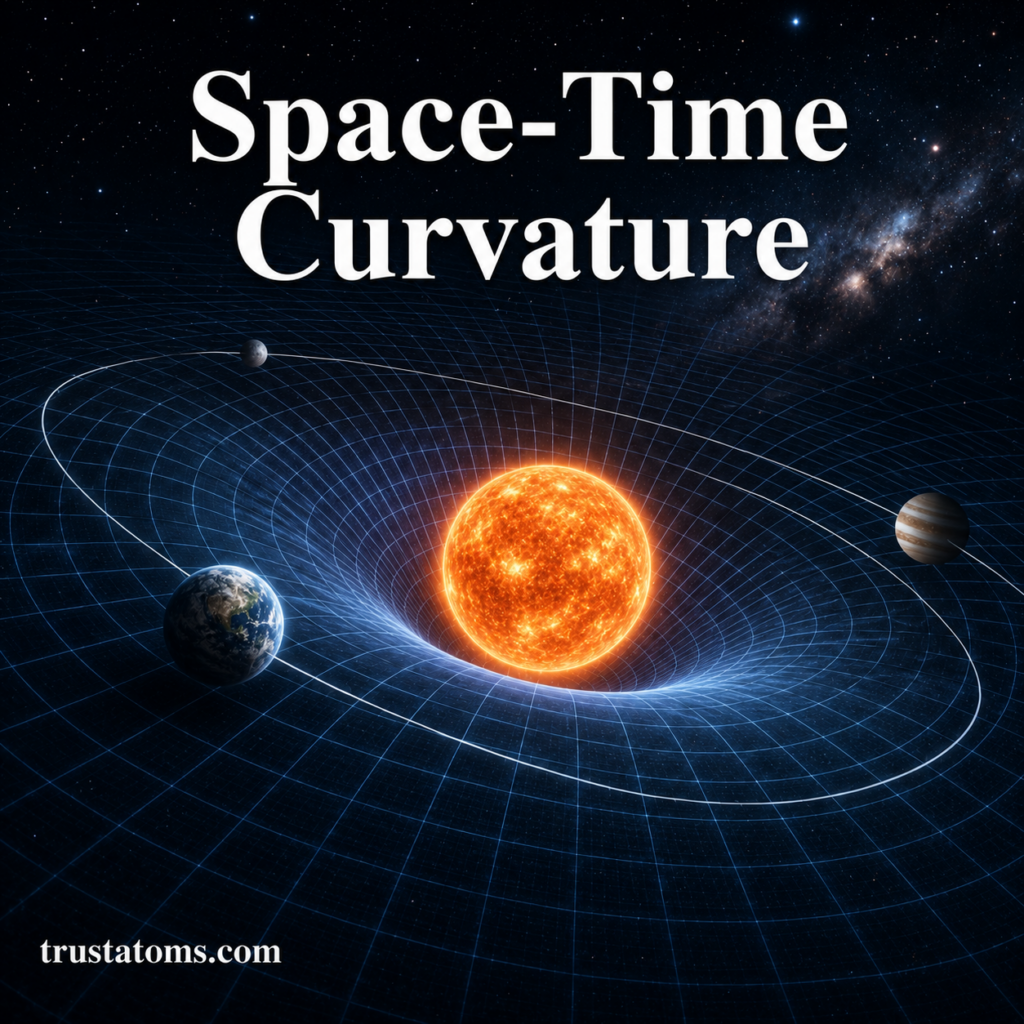
Space-time curvature is one of the most important concepts in modern physics. Introduced through Albert Einstein’s theory of general relativity, it changed humanity’s understanding of gravity, motion, and the structure of the universe itself.
Instead of viewing gravity as an invisible force pulling objects together, Einstein proposed something radically different: massive objects bend the fabric of space and time, and that curvature guides how matter and light move.
This idea explains everything from planetary orbits to black holes, gravitational lensing, and even the expansion of the universe.
What Is Space-Time?
Before understanding curvature, it helps to understand space-time itself.
Combining Space and Time
Classical physics treated:
- Space as a three-dimensional stage
- Time as a separate constant flow
Einstein showed that space and time are connected into a single four-dimensional framework called space-time.
Space-time includes:
- Length
- Width
- Height
- Time
Events in the universe occur within this combined structure.
What Is Space-Time Curvature?
Space-time curvature refers to the bending or warping of space-time caused by mass and energy.
Massive objects such as:
- Planets
- Stars
- Galaxies
- Black holes
distort the geometry of space-time around them.
Other objects then move along the curved paths created by this distortion.
Gravity as Curved Geometry
Einstein’s revolutionary idea replaced the traditional concept of gravity as a force.
Instead:
- Matter tells space-time how to curve
- Curved space-time tells matter how to move
This idea became the foundation of general relativity.
Einstein’s Field Equations
The relationship between matter, energy, and spacetime curvature is described mathematically by Einstein’s field equations.
Although the mathematics is complex, the core idea is simple:
- Mass and energy shape spacetime geometry
- Geometry influences motion and gravity
The Rubber Sheet Analogy
One common way to visualize space-time curvature is the rubber sheet analogy.
Imagine:
- A stretched rubber sheet represents space-time
- A heavy ball placed on the sheet creates a depression
- Smaller balls roll toward the heavier object because the surface is curved
This analogy helps explain how planets orbit stars.
However, the analogy has limitations because real space-time involves four dimensions, not just a two-dimensional surface.
How Curvature Affects Motion
Objects moving through curved space-time follow paths called geodesics.
What Is a Geodesic?
A geodesic is the closest equivalent to a straight line in curved geometry.
In curved space-time:
- Planets follow curved geodesics around stars
- Light bends near massive objects
- Satellites orbit Earth naturally
Gravity emerges from geometry rather than a pulling force.
Curvature Around Earth
Earth slightly curves space-time around it.
This curvature causes:
- Objects to fall toward the ground
- The Moon to orbit Earth
- Satellites to remain in orbit
Although Earth’s curvature effects are relatively small, they are measurable and extremely important.
Why Time Is Also Affected
General relativity predicts that gravity affects time itself.
Gravitational Time Dilation
Clocks in stronger gravitational fields run more slowly relative to clocks farther away.
This effect is called gravitational time dilation.
This phenomenon has been experimentally confirmed many times.
GPS Systems and Time Dilation
Global Positioning System satellites must account for relativistic time effects.
Without these corrections:
- GPS errors would grow rapidly
- Navigation systems would fail
General relativity directly impacts modern technology.
Light Bending and Gravitational Lensing
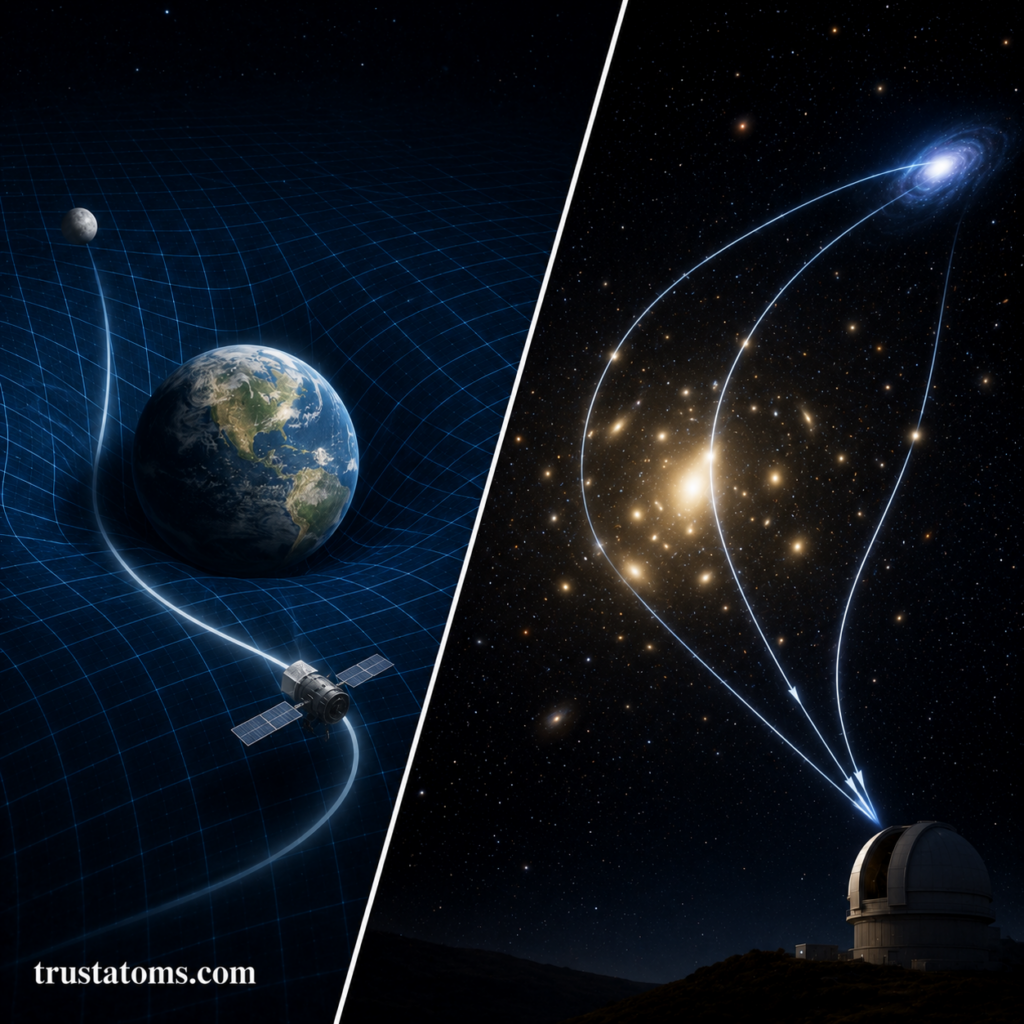
Space-time curvature also affects light.
Light Follows Curved Space-Time
Even though light has no mass, it follows curved paths through distorted space-time.
This causes light to bend near massive objects.
Gravitational Lensing
When massive galaxies or black holes bend light from distant sources, the effect is called gravitational lensing.
This can produce:
- Distorted galaxy images
- Multiple images of one object
- Magnification effects
- Einstein rings
Astronomers use gravitational lensing to study distant galaxies and dark matter.
Black Holes and Extreme Curvature
Black holes represent some of the most extreme examples of spacetime curvature.
Event Horizons
A black hole’s gravity becomes so intense that:
- Space-time bends dramatically
- Escape velocity exceeds light speed
- An event horizon forms
Inside the event horizon, curvature grows increasingly extreme.
Singularities
General relativity predicts a singularity at the center of a black hole.
At this point:
- Density becomes theoretically infinite
- Curvature becomes infinite
- Current physics breaks down
Scientists believe quantum gravity may eventually explain these regions more accurately.
Space-Time Curvature and the Universe
Curvature also shapes the structure of the entire universe.
Cosmological Curvature
The universe itself may possess large-scale curvature depending on:
- Total matter density
- Dark energy
- Cosmic expansion
Possible geometries include:
- Flat universe
- Closed universe
- Open universe
Current evidence suggests the observable universe is very close to geometrically flat on large scales.
Gravitational Waves
Einstein also predicted that moving masses could create ripples in space-time.
These ripples are called gravitational waves.
How Gravitational Waves Form
Violent cosmic events such as:
- Black hole mergers
- Neutron star collisions
- Supernovae
can disturb spacetime and send waves outward at light speed.
First Detection
In 2015, scientists at the LIGO directly detected gravitational waves for the first time.
This confirmed another major prediction of general relativity.
Space-Time Curvature vs. Newtonian Gravity
Newton’s gravity works extremely well for many everyday situations.
However, general relativity becomes necessary for:
- Strong gravitational fields
- High speeds
- Extreme cosmic environments
- Precision measurements
Key Differences
Newtonian gravity:
- Treats gravity as a force
- Assumes fixed space and time
General relativity:
- Treats gravity as geometry
- Combines space and time dynamically
Why Space-Time Curvature Matters
Understanding space-time curvature helps explain many major astronomical phenomena.
These include:
- Planetary orbits
- Black holes
- Gravitational lensing
- Time dilation
- Cosmic expansion
- Gravitational waves
Without general relativity, many modern astrophysical observations would remain unexplained.
Experimental Evidence for Curved Space-Time
General relativity has passed numerous experimental tests.
Important Confirmations
Scientists have confirmed:
- Light bending during solar eclipses
- Gravitational redshift
- Mercury’s orbital precession
- Time dilation effects
- Gravitational wave detection
These observations strongly support Einstein’s theory.
Can Space-Time Be Manipulated?
Some theoretical concepts suggest space-time might someday be manipulated.
Ideas explored in theoretical physics include:
- Warp drives
- Wormholes
- Space-time engineering
However, these concepts remain highly speculative and far beyond current technology.
The Search for Quantum Gravity
Although general relativity successfully explains spacetime curvature, it conflicts with quantum mechanics at extremely small scales.
Physicists continue searching for a unified theory combining:
- Gravity
- Quantum mechanics
- Space-time geometry
Possible approaches include:
- String theory
- Loop quantum gravity
- Quantum spacetime models
Final Thoughts
Space-time curvature transformed our understanding of gravity and the universe.
Einstein’s theory revealed that massive objects bend the fabric of space and time itself, shaping how matter, light, and even time behave across the cosmos.
From planetary orbits and black holes to gravitational waves and cosmic expansion, space-time curvature remains one of the most important concepts in modern astrophysics and cosmology.
As scientific research continues, deeper understanding of curved space-time may eventually unlock even greater insights into the structure of reality itself.