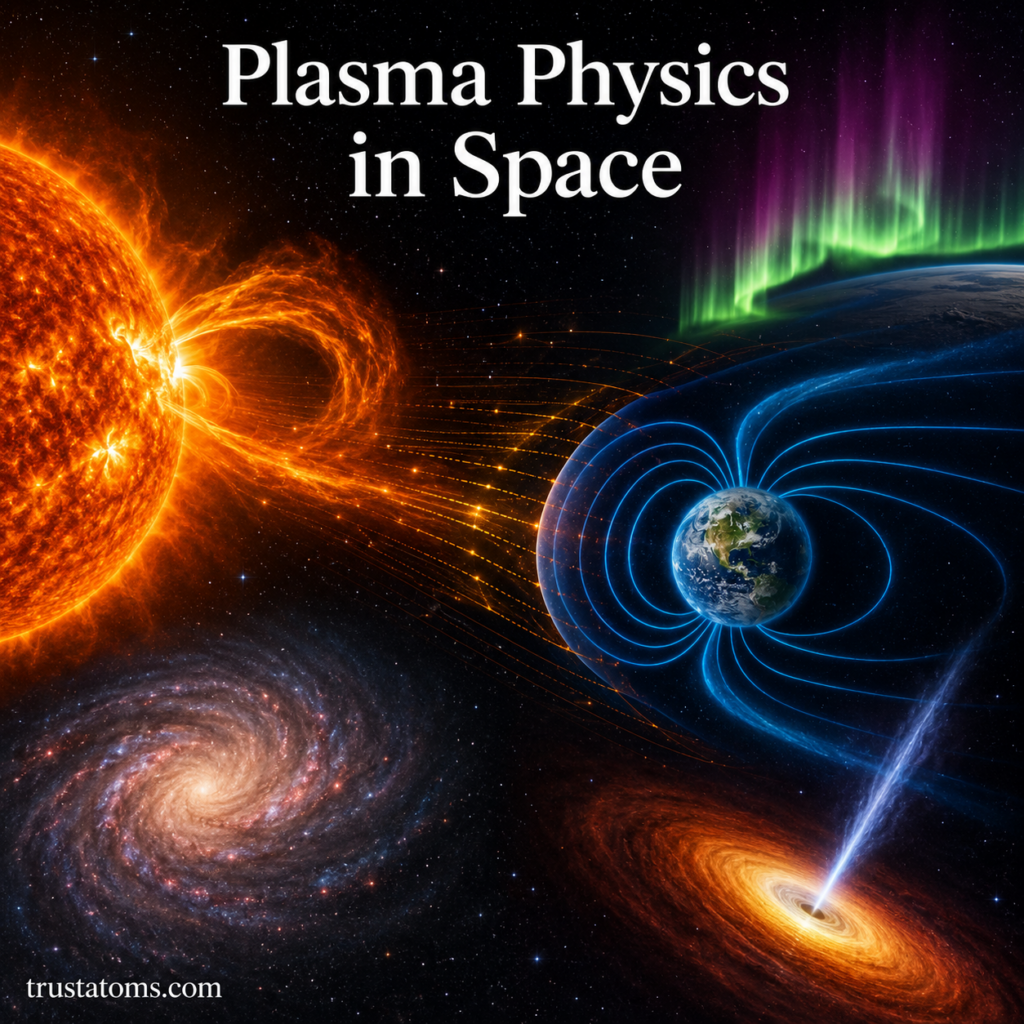
Space may appear empty at first glance, but much of the universe is actually filled with plasma — an energized state of matter made of charged particles. From the Sun’s outer atmosphere to interstellar clouds and distant galaxies, plasma dominates the visible universe and drives many of the most powerful cosmic phenomena.
Understanding plasma physics helps scientists explain solar flares, auroras, cosmic radiation, planetary magnetospheres, and even the behavior of stars and black holes. It also plays an important role in protecting Earth’s technology from space weather disruptions.
This guide explores how plasma behaves in space, where it is found, and why it is essential to modern astronomy and astrophysics.
What Is Plasma?
Plasma is often called the “fourth state of matter,” alongside solids, liquids, and gases.
A gas becomes plasma when enough energy is added to strip electrons away from atoms. This creates a mixture of:
- Positively charged ions
- Free electrons
- Neutral particles
Because plasma contains charged particles, it responds strongly to electric and magnetic fields.
Unlike ordinary gases, plasma can:
- Conduct electricity
- Generate magnetic fields
- Form complex waves and currents
- Behave collectively over large distances
Scientists estimate that more than 99% of the visible universe exists in a plasma state.
Where Plasma Exists in Space
Plasma is found throughout the cosmos at many different scales.
The Sun and Other Stars
Stars are enormous spheres of hot plasma.
Inside stars:
- Nuclear fusion releases massive amounts of energy
- Plasma circulates through convection and magnetic activity
- Charged particles flow outward into space
The Sun constantly emits plasma in the form of the solar wind, which spreads throughout the solar system.
The Solar Wind
The solar wind is a stream of charged particles flowing outward from the Sun at high speeds.
It contains:
- Electrons
- Protons
- Ionized helium
- Magnetic fields carried through space
The solar wind shapes planetary magnetospheres and can trigger geomagnetic storms near Earth.
Planetary Magnetospheres
Planets with magnetic fields interact strongly with surrounding plasma.
Earth’s magnetosphere:
- Deflects many solar particles
- Traps charged particles in radiation belts
- Creates auroras near the poles
Other planets such as Jupiter and Saturn also have massive plasma environments.
Interstellar and Intergalactic Space
Even the vast regions between stars contain thin plasma clouds.
These plasmas:
- Influence star formation
- Carry magnetic fields across galaxies
- Affect cosmic ray movement
- Shape nebulae and galactic structures
Why Plasma Behaves Differently in Space
Space plasmas are very different from plasmas created in laboratories on Earth.
Conditions in space include:
- Extremely low densities
- Huge distances
- Strong magnetic fields
- High-energy radiation
- Near-vacuum environments
Because particles can travel long distances without colliding, electromagnetic forces dominate plasma behavior.
This creates complex effects such as:
- Magnetic reconnection
- Plasma turbulence
- Shock waves
- Particle acceleration
Magnetic Fields and Plasma
Magnetic fields are one of the most important influences on plasma behavior.
Charged particles spiral around magnetic field lines instead of moving randomly.
This interaction creates:
- Plasma loops on the Sun
- Solar prominences
- Radiation belts
- Astrophysical jets
- Auroral currents
In many situations, plasma and magnetic fields become tightly linked through a process called magnetohydrodynamics (MHD).
Magnetohydrodynamics (MHD)
MHD combines:
- Plasma physics
- Fluid dynamics
- Electromagnetism
Scientists use MHD models to study:
- Solar storms
- Stellar atmospheres
- Accretion disks
- Galactic magnetic fields
These models help explain how plasma flows across enormous cosmic distances.
Solar Flares and Coronal Mass Ejections
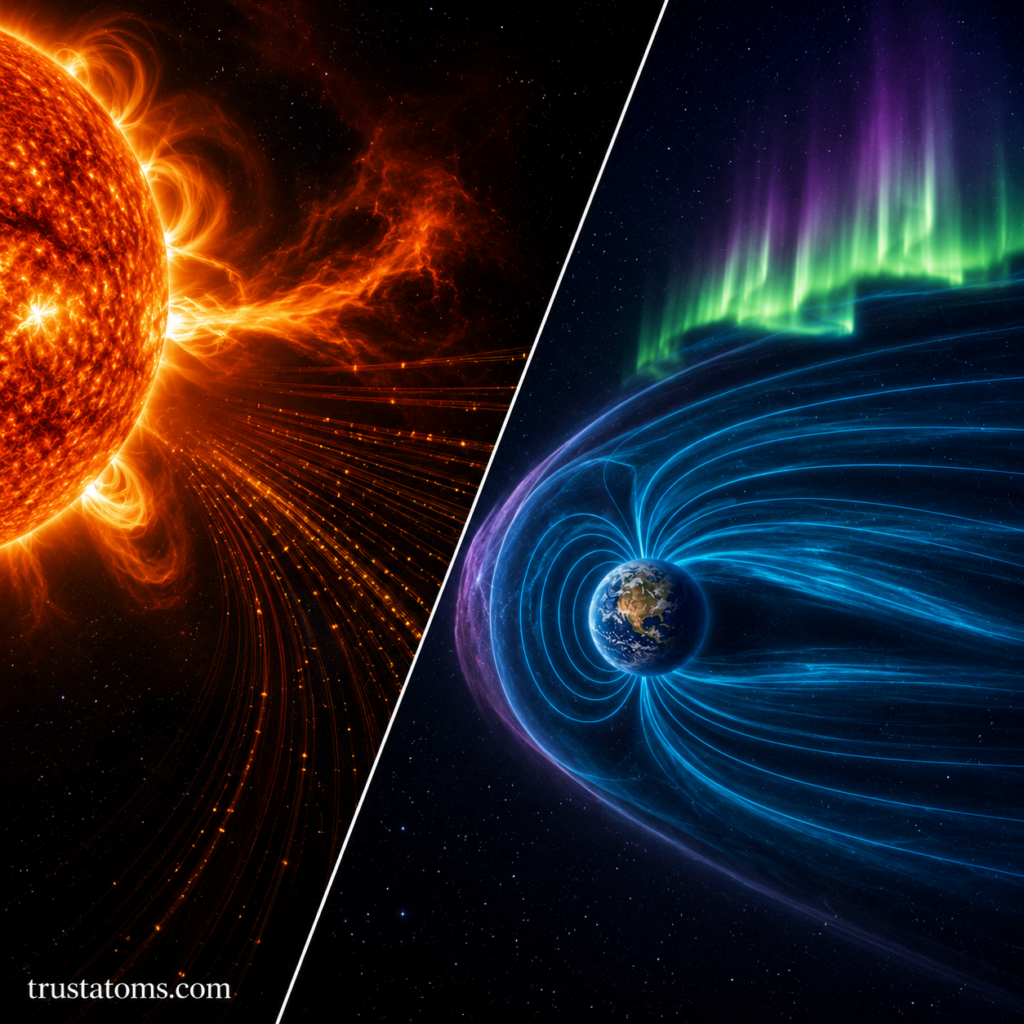
One of the most dramatic plasma events occurs on the Sun.
Solar Flares
Solar flares happen when magnetic energy suddenly releases in the Sun’s atmosphere.
These explosions emit:
- X-rays
- Ultraviolet radiation
- High-energy particles
- Radio waves
Solar flares can affect:
- Satellite communications
- GPS systems
- Radio signals
- Power grids
Coronal Mass Ejections (CMEs)
CMEs are giant eruptions of plasma and magnetic fields launched into space.
When directed toward Earth, they can trigger:
- Geomagnetic storms
- Aurora displays
- Satellite damage
- Increased radiation exposure for astronauts
Understanding plasma physics helps scientists predict these space weather events.
Plasma Waves in Space
Space plasma can support many kinds of waves.
Examples include:
- Alfvén waves
- Magnetosonic waves
- Plasma oscillations
- Shock waves
These waves transport:
- Energy
- Momentum
- Magnetic disturbances
They are important in:
- Solar wind heating
- Cosmic particle acceleration
- Auroral activity
- Star formation
Magnetic Reconnection
Magnetic reconnection is one of the most important plasma processes in the universe.
It occurs when magnetic field lines:
- Become twisted or compressed
- Break apart
- Reconnect in a new configuration
This process rapidly releases enormous amounts of energy.
Magnetic reconnection is believed to power:
- Solar flares
- Auroras
- Magnetospheric storms
- Plasma jets near black holes
NASA missions such as MMS (Magnetospheric Multiscale Mission) study reconnection near Earth.
Auroras and Plasma Physics
Auroras are one of the most visible examples of plasma interactions.
Charged particles from the solar wind:
- Travel along Earth’s magnetic field lines
- Enter the upper atmosphere
- Collide with oxygen and nitrogen atoms
These collisions release light, producing:
- Green auroras
- Red auroras
- Purple and blue auroras
Auroras demonstrate how plasma, magnetic fields, and atmospheric gases interact together.
Plasma Around Black Holes
Black holes are surrounded by extremely energetic plasma environments.
Plasma near black holes:
- Forms accretion disks
- Heats to millions of degrees
- Emits X-rays and gamma rays
- Produces relativistic jets
Magnetic fields likely help launch these enormous plasma jets across interstellar space.
Studying these systems helps scientists understand:
- Extreme gravity
- High-energy astrophysics
- Galaxy evolution
Cosmic Rays and Plasma Acceleration
Plasma processes can accelerate particles to incredible energies.
Shock waves from:
- Supernova explosions
- Solar eruptions
- Pulsars
- Black hole jets
can accelerate charged particles into cosmic rays.
These particles travel through space at near-light speeds and may carry information about distant astrophysical events.
How Scientists Study Space Plasma
Researchers use many tools to investigate plasma behavior.
Spacecraft Missions
Important plasma missions include:
- Parker Solar Probe
- Voyager spacecraft
- MMS mission
- Solar Orbiter
These spacecraft measure:
- Magnetic fields
- Particle speeds
- Plasma temperatures
- Radiation levels
Telescopes
Scientists also study plasma through:
- Radio telescopes
- X-ray observatories
- Ultraviolet telescopes
Different wavelengths reveal different plasma properties.
Laboratory Plasma Experiments
Researchers recreate plasma conditions on Earth using:
- Tokamaks
- Vacuum chambers
- Particle accelerators
- Laser experiments
These studies help test plasma theories under controlled conditions.
Plasma Physics and Space Weather
Space weather refers to changing conditions in space caused mainly by solar activity.
Plasma events can disrupt:
- Satellites
- Internet infrastructure
- Navigation systems
- Astronaut safety
- Aviation communications
As society becomes more dependent on technology, understanding plasma-driven space weather becomes increasingly important.
Scientists continue improving:
- Solar monitoring systems
- Plasma simulations
- Geomagnetic forecasting models
Why Plasma Physics Matters in Astronomy
Plasma physics connects many areas of modern astronomy.
It helps explain:
- Star formation
- Solar activity
- Galactic evolution
- Cosmic radiation
- Magnetospheres
- Black hole jets
Without plasma physics, many observed cosmic structures and energetic events would remain poorly understood.
Because plasma dominates the visible universe, learning how it behaves is essential for understanding the cosmos itself.
Final Thoughts
Plasma physics reveals that space is far more dynamic and interconnected than it may appear. Charged particles and magnetic fields shape stars, galaxies, planetary systems, and many of the energetic events observed across the universe.
From the glowing auroras above Earth to the powerful jets launched near black holes, plasma processes influence nearly every major astronomical environment.
As space exploration and observational technology continue advancing, plasma physics will remain one of the key scientific fields helping humanity uncover how the universe works.