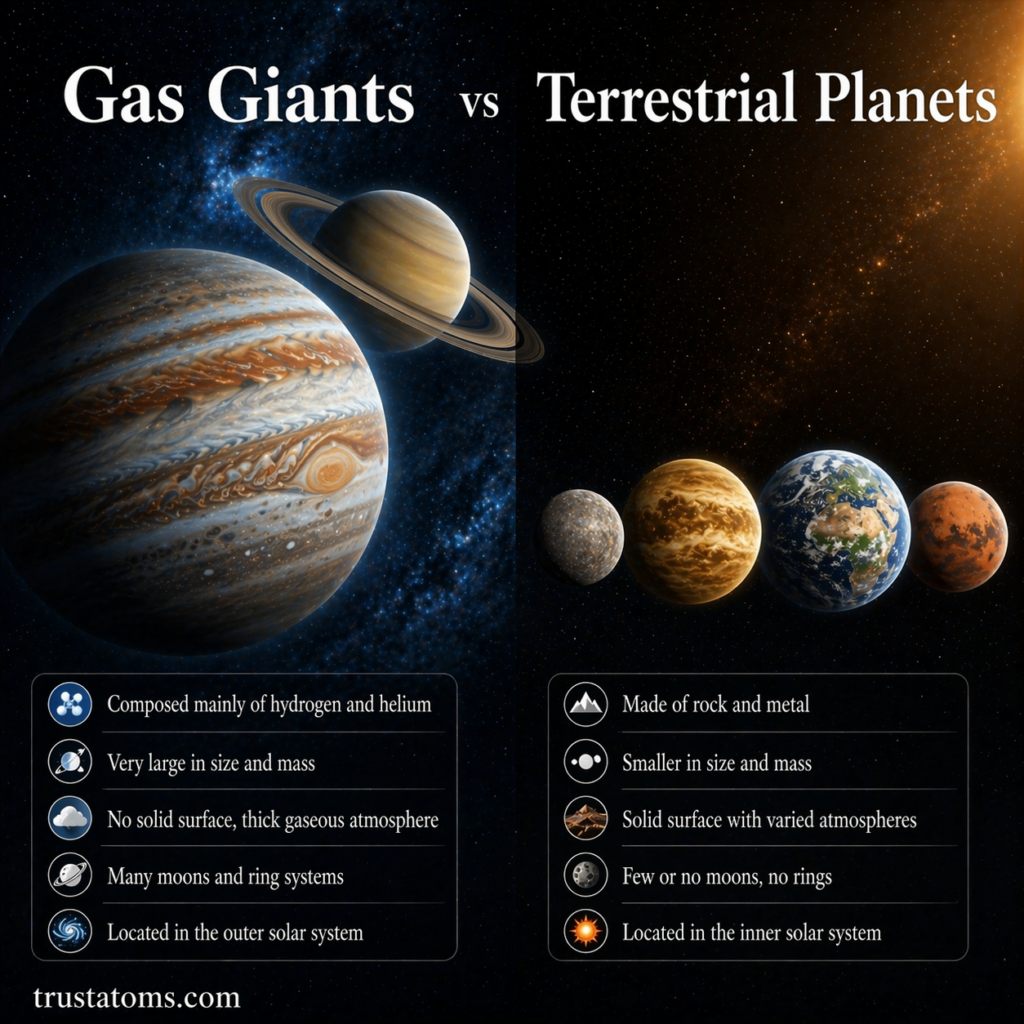
The planets in our solar system fall into two main categories: gas giants and terrestrial (rocky) planets. While they all orbit the Sun, their composition, size, atmospheres, and overall structure are dramatically different.
Understanding these differences helps explain how planets form, evolve, and what conditions might support life.
What Are Terrestrial Planets?
Terrestrial planets are rocky worlds with solid surfaces. They are located in the inner part of the solar system.
The Four Terrestrial Planets
- Mercury
- Venus
- Earth
- Mars
Key Characteristics
- Solid, rocky surfaces
- Smaller size and mass
- Higher density
- Fewer moons (or none)
- Located closer to the Sun
These planets formed from heavier elements like iron and silicates that could withstand higher temperatures near the Sun.
What Are Gas Giants?
Gas giants are massive planets composed mainly of gases, with no well-defined solid surface.
The Gas Giants
- Jupiter
- Saturn
(Some classifications also include ice giants like Uranus and Neptune, but they are slightly different in composition.)
Key Characteristics
- Extremely large and massive
- Composed mostly of hydrogen and helium
- Thick atmospheres with powerful storms
- Dozens of moons
- Surrounded by ring systems
Gas giants formed in the colder outer regions of the solar system, where lighter gases could accumulate.
Major Differences Between Gas Giants and Terrestrial Planets
1. Composition
- Terrestrial planets: Rock and metal
- Gas giants: Hydrogen, helium, and gases
2. Size and Mass
- Terrestrial planets are small and dense
- Gas giants are massive but less dense overall
For example, Jupiter is more than twice as massive as all other planets combined.
3. Surface Structure
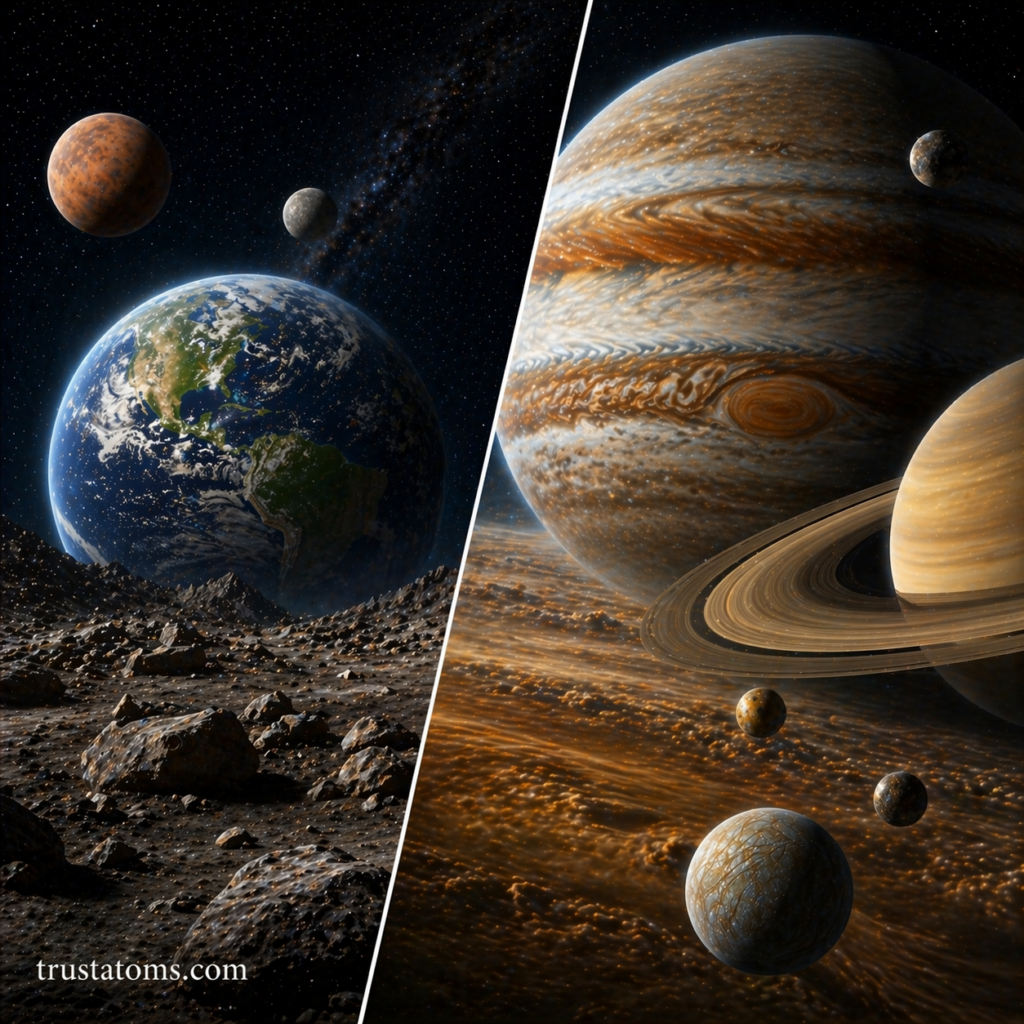
- Terrestrial planets have solid surfaces
- Gas giants have no true surface—only thick layers of gas
4. Atmospheres
- Terrestrial atmospheres vary (thin on Mars, thick on Venus)
- Gas giants have deep, complex atmospheres with storms and bands
5. Moons and Rings
- Terrestrial planets have few or no moons and no rings
- Gas giants have many moons and prominent ring systems
Formation Differences
The way these planets formed explains many of their differences.
Terrestrial Planet Formation
- Formed close to the Sun
- High temperatures prevented gases from condensing
- Built from solid materials
Gas Giant Formation
- Formed farther from the Sun
- Cooler temperatures allowed gas accumulation
- Likely started with a solid core, then attracted gas
Temperature and Distance from the Sun
Distance plays a major role in planetary characteristics.
Inner Solar System
- Hotter environment
- Rocky planets dominate
Outer Solar System
- Colder environment
- Gas and ice giants dominate
This separation is often referred to as the “frost line,” where temperatures were low enough for volatile compounds to freeze.
Gravity and Atmospheric Retention
Gravity affects how well a planet can hold onto its atmosphere.
- Terrestrial planets: weaker gravity → thinner atmospheres
- Gas giants: strong gravity → thick atmospheres
This is why gas giants retain light gases like hydrogen, while smaller planets cannot.
Can Gas Giants Support Life?
Gas giants themselves are unlikely to support life as we know it.
Reasons
- No solid surface
- Extreme pressure and temperature
- Turbulent atmospheric conditions
However, some of their moons (like Europa or Titan) may have conditions suitable for life.
Why This Comparison Matters
Studying gas giants and terrestrial planets helps scientists:
- Understand planetary formation
- Identify habitable environments
- Compare Earth to other worlds
- Study exoplanets in other star systems
Many exoplanets discovered so far are gas giants, but researchers are actively searching for Earth-like terrestrial planets.
Common Misconceptions
“Gas giants are made only of gas”
They may have dense cores, but their outer layers dominate their structure.
“All large planets are gas giants”
Some large planets, like Neptune, are classified as ice giants instead.
“Terrestrial planets are all similar”
Each one has unique conditions, from Mercury’s heat to Mars’ cold.
Final Thoughts
Gas giants and terrestrial planets represent two very different outcomes of planetary formation. One group is small, rocky, and closer to the Sun, while the other is massive, gaseous, and located in the outer solar system.
By comparing these two types, scientists gain a clearer picture of how planets form—and what makes Earth uniquely capable of supporting life.