The Sun is not just a source of light and heat—it constantly sends out a stream of charged particles that fills the entire solar system. This flow, known as the solar wind, creates a vast bubble in space called the heliosphere, which acts as a protective shield for planets like Earth.
Understanding the solar wind and heliosphere helps scientists explain space weather, planetary protection, and even how our solar system interacts with the wider galaxy.
What Is the Solar Wind?
The solar wind is a continuous flow of charged particles—mainly electrons and protons—released from the Sun’s outer atmosphere, the corona.
Key characteristics of the solar wind:
- Travels at speeds of about 250 to 750 km/s
- Composed of ionized gas (plasma)
- Carries the Sun’s magnetic field outward
- Varies in intensity depending on solar activity
There are two main types:
- Slow solar wind: ~250–400 km/s, denser and more variable
- Fast solar wind: ~500–750 km/s, less dense and more consistent
This stream of particles spreads in all directions, affecting every planet in the solar system.
How the Solar Wind Forms
The solar wind originates in the Sun’s corona, where temperatures reach millions of degrees Kelvin. At these extreme temperatures, particles gain enough energy to escape the Sun’s gravitational pull.
Formation process:
- Intense heat energizes particles in the corona
- Magnetic fields guide particle movement
- Particles accelerate outward into space
- The flow expands and fills the solar system
Coronal holes—regions of open magnetic field lines—are major sources of fast solar wind streams.
What Is the Heliosphere?
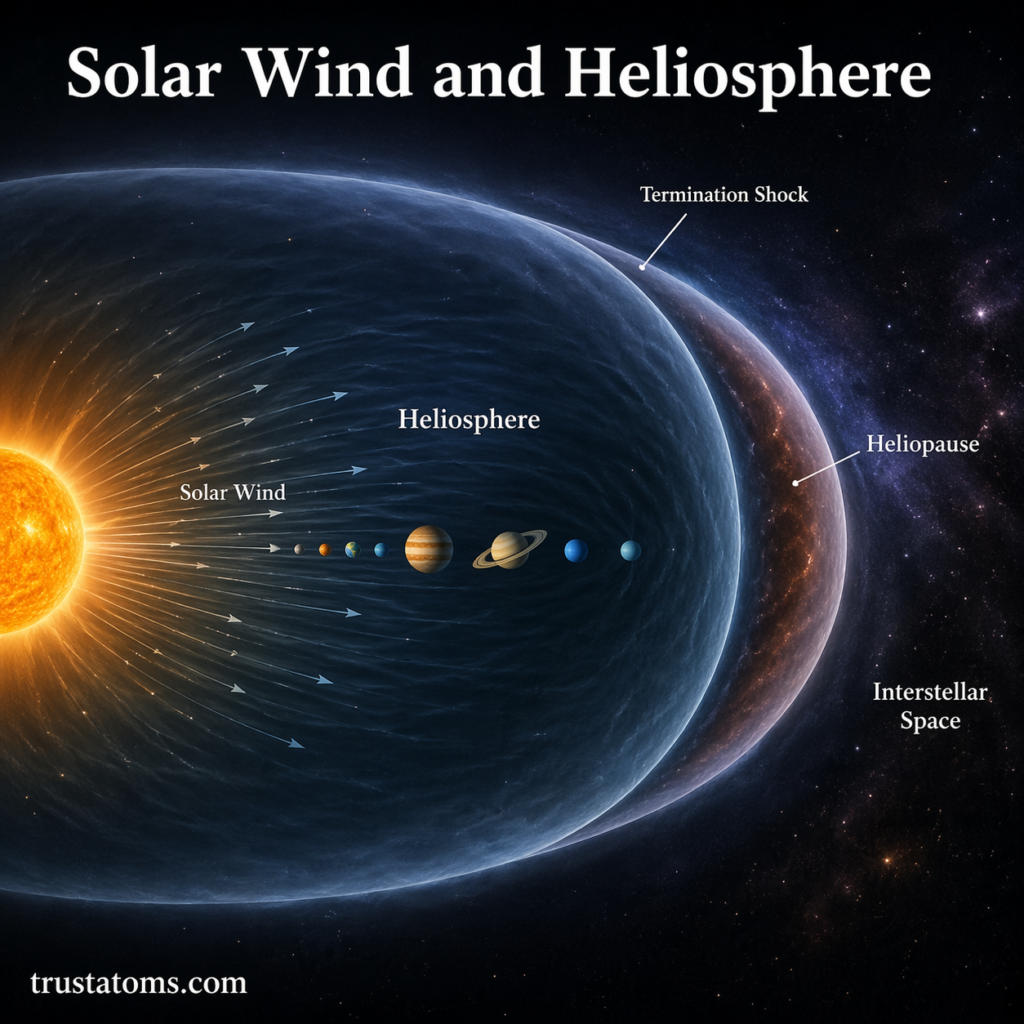
The heliosphere is a विशाल, bubble-like region of space dominated by the solar wind and the Sun’s magnetic field. It extends far beyond the orbit of Pluto and acts as a boundary between our solar system and interstellar space.
Key features of the heliosphere:
- Encloses all planets and most solar system objects
- Deflects many high-energy cosmic rays
- Changes shape based on solar activity and interstellar pressure
- Moves with the Sun as it travels through the galaxy
Think of the heliosphere as a protective “shield” that surrounds and travels with our solar system.
Structure of the Heliosphere
The heliosphere is not uniform—it has several important regions that mark transitions in particle behavior and pressure.
Major regions:
- Termination shock
- Where the solar wind slows down abruptly after encountering interstellar resistance
- Heliosheath
- A turbulent region where solar wind particles are compressed and heated
- Heliopause
- The outer boundary where solar wind pressure balances with interstellar medium pressure
Beyond the heliopause lies interstellar space—the environment between star systems.
Interaction with Earth and Planets
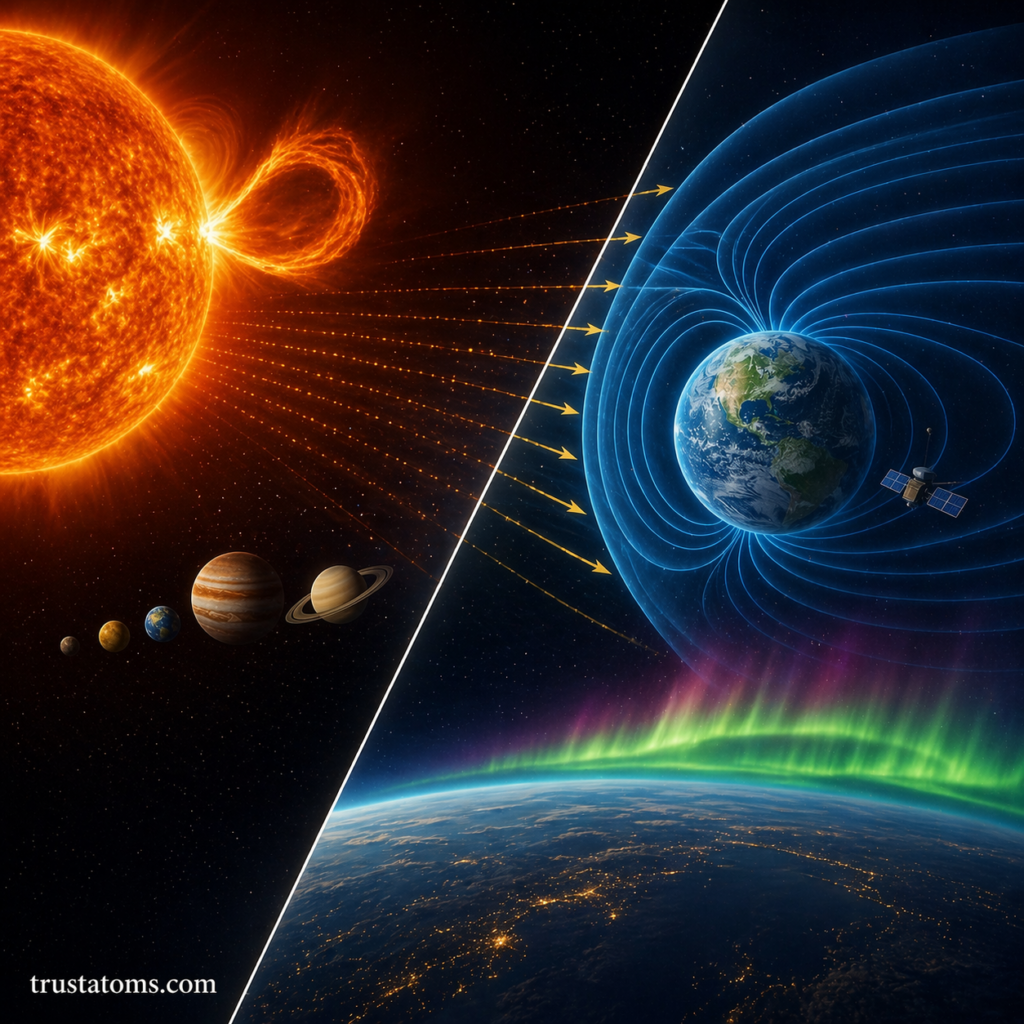
The solar wind directly influences planets, especially those with magnetic fields.
Effects on Earth:
- Creates auroras (Northern and Southern Lights)
- Interacts with Earth’s magnetosphere
- Can disrupt satellites and communication systems
- Drives space weather events
Earth is protected by its magnetosphere, which deflects most solar wind particles. Without it, our atmosphere could gradually erode.
Effects on other planets:
- Mars: Weak magnetic field allows atmospheric loss
- Venus: Thick atmosphere interacts directly with solar wind
- Jupiter: Strong magnetic field creates intense radiation belts
Each planet responds differently depending on its magnetic field and atmosphere.
Space Weather and Solar Activity
The solar wind is not constant—it becomes more intense during periods of high solar activity, such as solar flares and coronal mass ejections (CMEs).
Space weather impacts:
- Geomagnetic storms on Earth
- GPS and radio signal disruptions
- Power grid failures in extreme cases
- Increased radiation risk for astronauts
Monitoring solar activity is essential for protecting modern technology and space missions.
The Heliosphere as a Cosmic Shield
One of the most important roles of the heliosphere is protecting the solar system from harmful cosmic radiation.
Protective functions:
- Reduces the number of high-energy galactic cosmic rays
- Shields planetary atmospheres from direct exposure
- Helps maintain conditions suitable for life on Earth
However, this shielding is not perfect—some cosmic rays still penetrate into the inner solar system.
Exploring the Edge of the Heliosphere
Space missions have provided valuable insights into the outer boundaries of the heliosphere.
Notable missions:
- Voyager 1 – crossed the heliopause in 2012
- Voyager 2 – crossed in 2018
These spacecraft are now traveling through interstellar space, sending back data about the boundary between our solar system and the galaxy.
Why the Solar Wind and Heliosphere Matter
Understanding these systems is crucial for both science and practical applications.
Key reasons:
- Protecting satellites and communication systems
- Planning safe space travel missions
- Understanding atmospheric evolution on planets
- Studying how stars influence surrounding space
The solar wind and heliosphere are fundamental to how our solar system functions and survives in a dynamic galaxy.
Final Thoughts
The solar wind is an invisible but powerful force that shapes the entire solar system. By creating the heliosphere, the Sun forms a protective boundary that shields planets from much of the harsh radiation of interstellar space.
As research continues—especially through missions like the Voyager probes—we gain a deeper understanding of how our Sun interacts with the galaxy and how these interactions make life on Earth possible.