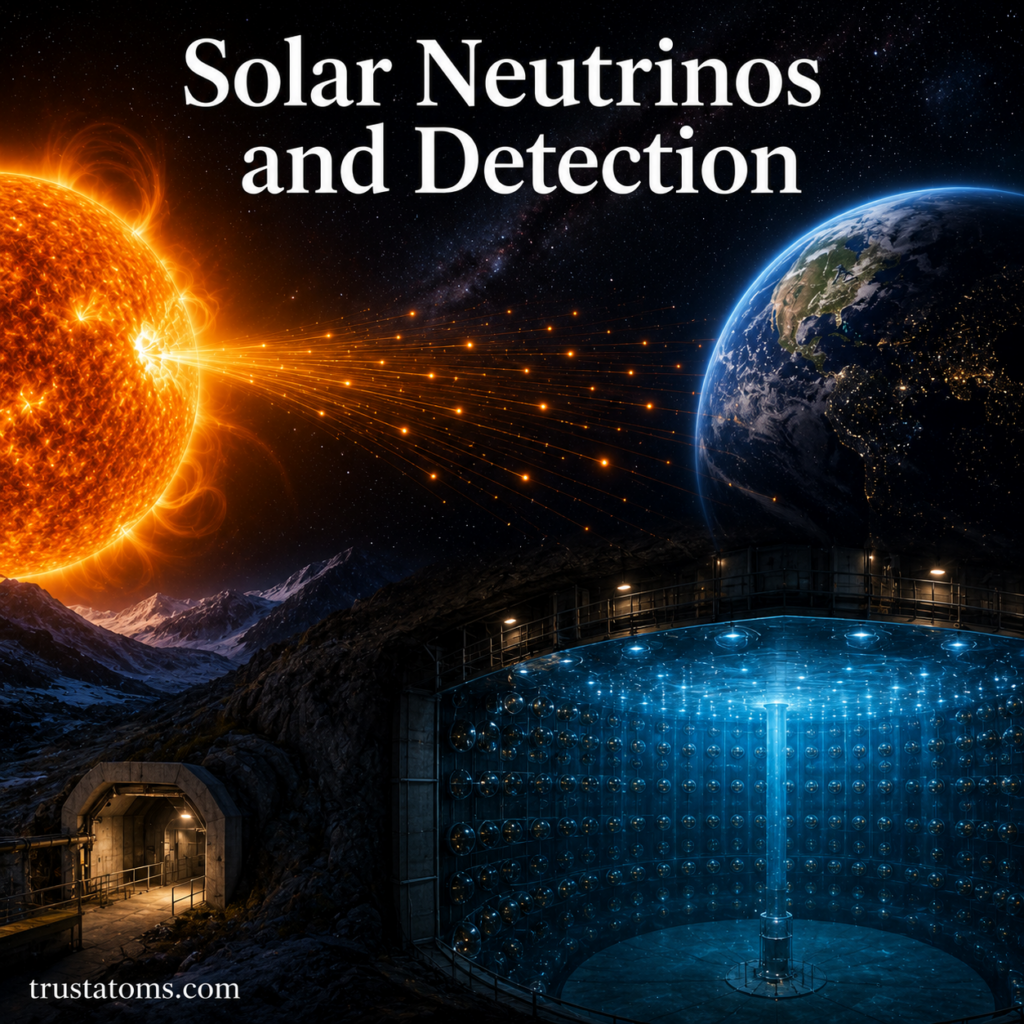
The Sun constantly produces enormous amounts of energy through processes occurring deep within its interior. Alongside light and heat, these processes also create tiny subatomic particles called neutrinos.
Solar neutrinos are incredibly difficult to detect because they interact only weakly with matter. Trillions of them pass through your body every second without leaving any trace. Despite their elusive nature, studying solar neutrinos has become one of the most important areas in modern astrophysics and particle physics.
By detecting neutrinos from the Sun, scientists can directly observe activity occurring deep inside the solar interior — regions that ordinary light cannot immediately escape from.
This guide explores what solar neutrinos are, how they form, why they matter, and how researchers detect these ghost-like particles.
What Are Neutrinos?
Neutrinos are extremely small, electrically neutral particles.
They belong to a group called leptons and are among the most abundant particles in the universe.
Neutrinos have several unusual properties:
- Extremely tiny mass
- No electric charge
- Very weak interaction with matter
- Nearly travel at the speed of light
Because they rarely collide with atoms, neutrinos can pass through entire planets almost unaffected.
Scientists often describe neutrinos as “ghost particles” because they are so difficult to observe.
How Solar Neutrinos Are Produced
Solar neutrinos form during energetic reactions occurring inside the Sun.
Many scientific models describe the Sun as generating energy through nuclear fusion processes that convert hydrogen into helium.
One commonly discussed sequence is the proton-proton chain reaction:
- Hydrogen nuclei interact
- Protons combine under extreme conditions
- Energy is released
- Neutrinos are produced as byproducts
These neutrinos escape from the Sun almost instantly.
Unlike photons, which can take extremely long periods of time to move from the solar interior to the surface, neutrinos travel directly into space at nearly light speed.
This makes them valuable tools for studying the Sun’s interior in real time.
Why Solar Neutrinos Matter
Solar neutrinos provide important evidence about the energetic processes occurring within the Sun.
Before neutrino experiments, scientists relied mostly on indirect observations and theoretical models to explain how the Sun produces energy. Detecting solar neutrinos gave researchers additional ways to test those models.
Studying neutrinos also helps researchers:
- Understand stellar energy production
- Test particle physics theories
- Study weak nuclear interactions
- Investigate neutrino mass
- Explore physics beyond the Standard Model
Solar neutrino research connects astronomy and quantum physics in powerful ways.
The Solar Neutrino Problem
One of the biggest mysteries in 20th-century astrophysics involved missing neutrinos.
Early Predictions
Scientists developed solar models predicting how many neutrinos the Sun should produce.
In the 1960s, physicist Raymond Davis Jr. built one of the first major solar neutrino detectors.
However, experiments detected only about one-third of the expected neutrinos.
This discrepancy became known as the “solar neutrino problem.”
Possible Explanations
Researchers considered several possibilities:
- Solar models were incomplete or incorrect
- Internal solar processes worked differently than expected
- Neutrinos changed during travel
Over time, evidence increasingly supported the third explanation.
Scientists eventually discovered that neutrinos can oscillate between different types, or “flavors,” as they travel through space.
Neutrino Flavors
There are three known neutrino flavors:
- Electron neutrinos
- Muon neutrinos
- Tau neutrinos
The Sun mainly produces electron neutrinos.
Early detectors were sensitive mostly to electron neutrinos, meaning transformed neutrinos were missed.
Neutrino oscillation explained why detectors observed fewer neutrinos than predicted.
This discovery was significant because it provided evidence that neutrinos possess mass, something not originally included in earlier versions of the Standard Model of particle physics.
How Scientists Detect Solar Neutrinos
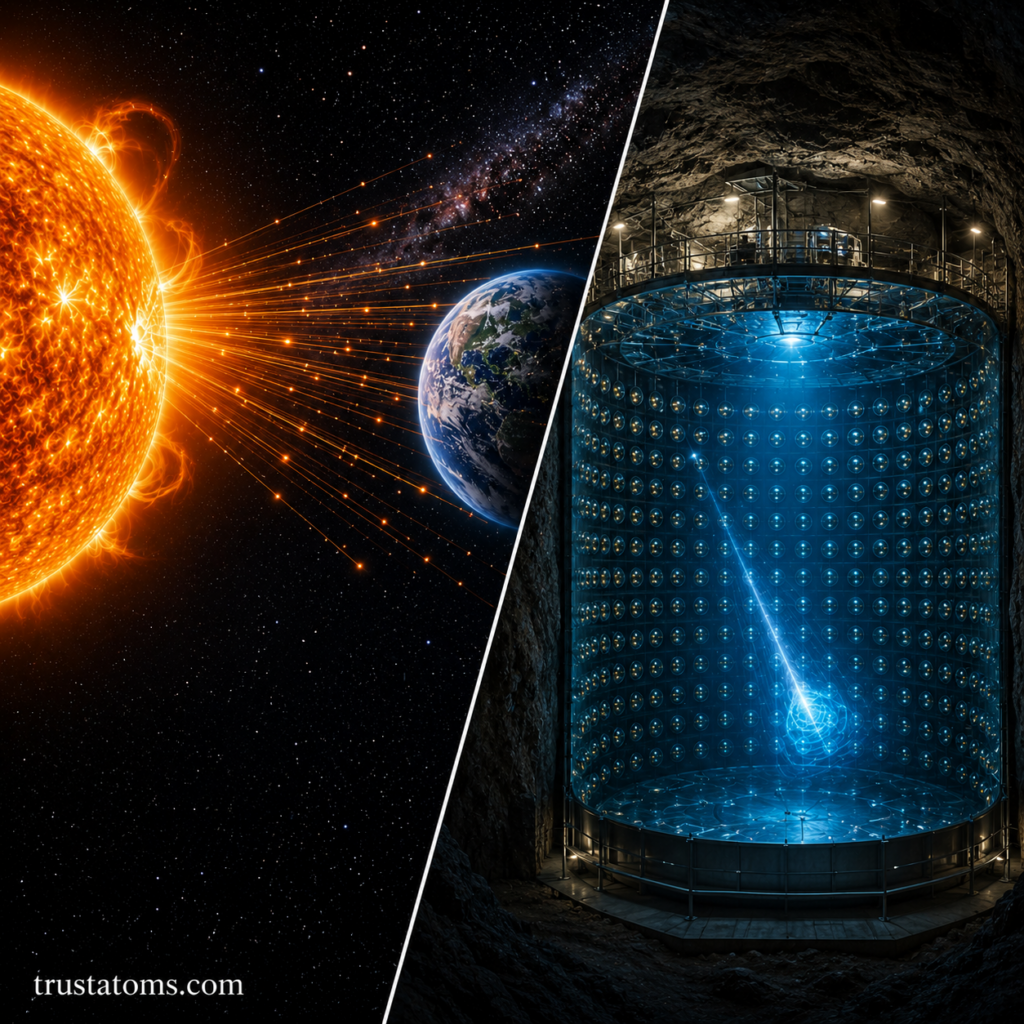
Detecting neutrinos is extremely challenging because they interact so weakly with matter.
To improve detection chances, scientists build:
- Massive underground detectors
- Highly sensitive instruments
- Shielded observation facilities
Underground locations help block interference from cosmic rays and background radiation.
Chlorine Detectors
The first successful solar neutrino detector used chlorine.
Homestake Experiment
Located deep underground in South Dakota, the Homestake experiment used:
- A large tank filled with cleaning fluid rich in chlorine
- Rare neutrino interactions converting chlorine atoms into argon atoms
Scientists periodically extracted argon atoms and counted them.
Although only a few atoms were detected each month, the experiment provided groundbreaking evidence of solar neutrinos.
Water Cherenkov Detectors
Modern neutrino observatories often use enormous tanks of ultra-pure water.
When a neutrino occasionally interacts with water molecules:
- Charged particles may form
- These particles move faster than light travels through water
- A faint blue glow called Cherenkov radiation appears
Sensitive photodetectors capture this light.
Super-Kamiokande
One of the most famous neutrino observatories is Super-Kamiokande in Japan.
It contains:
- About 50,000 tons of ultra-pure water
- Thousands of light-sensitive detectors
- Deep underground shielding
Super-Kamiokande helped confirm neutrino oscillations and transformed modern particle physics.
Heavy Water Detectors
Another major breakthrough came from the Sudbury Neutrino Observatory (SNO) in Canada.
SNO used heavy water, which contains deuterium instead of regular hydrogen.
This allowed scientists to detect:
- Electron neutrinos
- Muon neutrinos
- Tau neutrinos
The experiment showed that the “missing” neutrinos were actually changing flavor during travel from the Sun to Earth.
This solved the solar neutrino problem.
Underground Neutrino Laboratories
Most neutrino observatories are built deep underground.
Reasons include:
- Reduced cosmic ray interference
- Stable environmental conditions
- Lower radiation background
- Improved detector sensitivity
Some facilities are located:
- Inside mountains
- In deep mines
- Beneath thick rock layers
These underground laboratories are among the quietest scientific environments on Earth.
Neutrino Oscillation and Physics
Neutrino oscillation became one of the most important discoveries in particle physics.
The phenomenon suggests:
- Neutrinos have mass
- Quantum mechanics governs flavor changes
- Existing physics models require refinement
Researchers continue studying:
- Exact neutrino masses
- Oscillation rates
- Possible new neutrino types
- Matter-antimatter asymmetry
Neutrino physics may eventually help scientists better understand why the observable universe contains more matter than antimatter.
Solar Models and Neutrino Research
Solar neutrino observations help scientists refine models of the Sun.
Researchers compare:
- Predicted neutrino production
- Observed neutrino flux
- Estimated reaction rates
- Solar core temperature models
This improves understanding of:
- Stellar evolution
- Energy transport
- Nuclear processes within stars
- Stellar lifecycles
Neutrino astronomy allows scientists to study stellar interiors in ways impossible with ordinary light.
Neutrino Astronomy
Neutrinos can travel enormous distances without being absorbed.
Because of this, they provide information from places ordinary radiation cannot easily escape.
Neutrino astronomy studies particles from:
- The Sun
- Supernovae
- Black holes
- Neutron stars
- Active galaxies
Unlike photons, neutrinos often pass directly through dense matter clouds, carrying information from deep inside energetic cosmic environments.
Supernova Neutrinos
When massive stars explode as supernovae, they release enormous bursts of neutrinos.
In many scientific models:
- Most supernova energy escapes as neutrinos
- Only a smaller portion becomes visible light
In 1987, detectors observed neutrinos from Supernova 1987A before the visible explosion became fully apparent.
This event demonstrated how neutrinos can provide early information about energetic cosmic events.
Future Neutrino Detectors
Scientists are developing even larger and more advanced neutrino observatories.
Future goals include:
- Measuring neutrino mass more precisely
- Detecting low-energy solar neutrinos
- Studying cosmic neutrino sources
- Searching for sterile neutrinos
- Investigating possible dark matter connections
Upcoming projects may greatly expand neutrino astronomy over the coming decades.
Challenges in Neutrino Detection
Despite technological advances, neutrino research remains difficult.
Major challenges include:
- Extremely low interaction rates
- Background noise
- Massive detector costs
- Complex calibration requirements
- Rare observable events
Many detectors wait days or weeks to record only a small number of interactions.
However, even limited observations can reveal important insights about the universe.
Why Solar Neutrinos Are Important
Solar neutrino research has significantly influenced both astronomy and physics.
It has contributed to:
- Better understanding of solar processes
- Evidence supporting neutrino oscillation
- Research into neutrino mass
- New tools for studying stars
- Deeper investigation into fundamental particles
These discoveries continue shaping modern physics and astrophysics research.
Final Thoughts
Solar neutrinos are among the most mysterious particles studied in modern science. Produced deep within the Sun, they travel almost undisturbed across space and through matter, carrying valuable information about energetic processes occurring inside stars.
Although detecting neutrinos is incredibly challenging, decades of research have led to major discoveries about particle physics, quantum mechanics, and the structure of the universe.
As neutrino observatories become more advanced, scientists may uncover even deeper insights into how stars function, how matter behaves, and how the cosmos operates on the smallest scales.