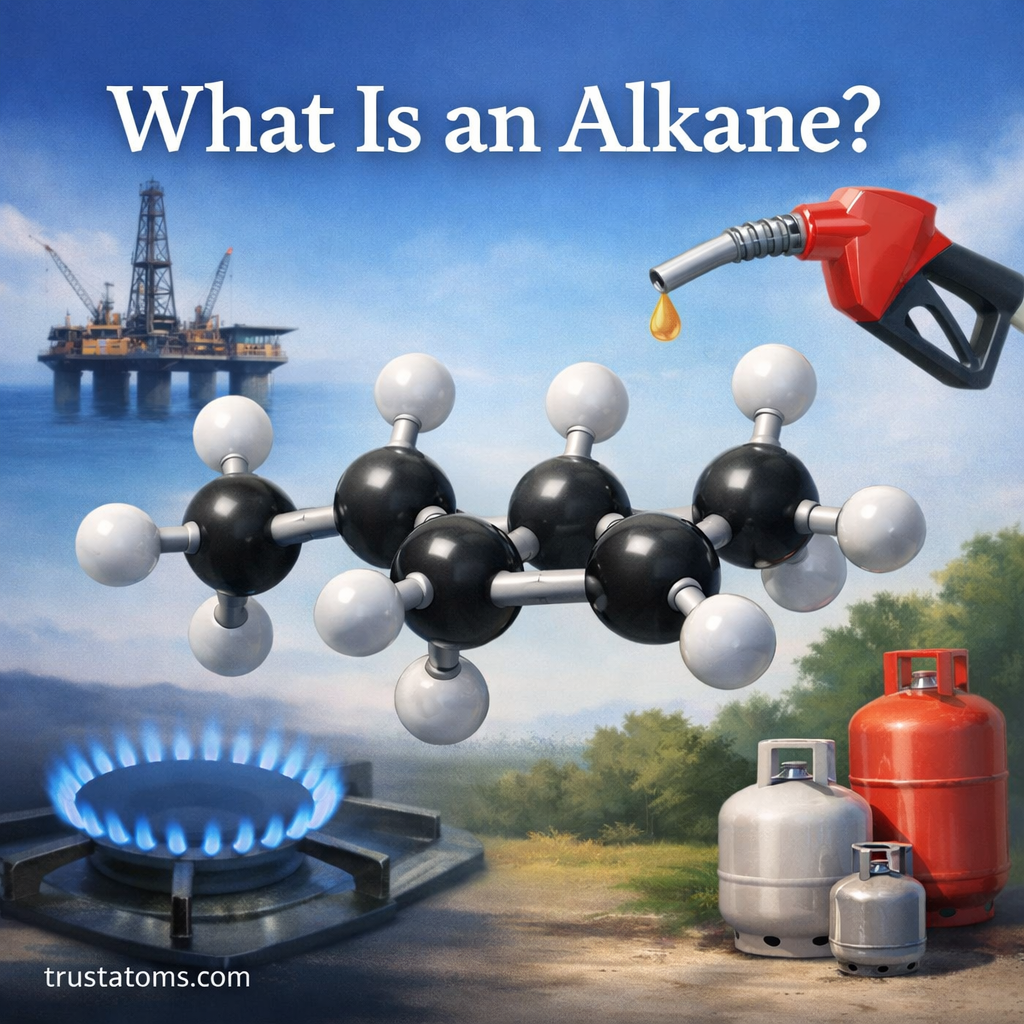
Alkanes are one of the most fundamental groups of organic compounds in chemistry. They form the basic framework of many fuels, materials, and everyday chemical products.
In simple terms, an alkane is a hydrocarbon that contains only single bonds between carbon atoms. Because of this structure, alkanes are often described as saturated hydrocarbons, meaning the carbon atoms hold the maximum number of hydrogen atoms possible.
Understanding alkanes is important because they are the simplest organic molecules and serve as the starting point for learning about more complex organic chemistry reactions.
Definition of an Alkane
An alkane is a type of hydrocarbon made up entirely of:
- Carbon atoms (C)
- Hydrogen atoms (H)
All the carbon atoms are connected by single covalent bonds, forming a stable chain or branching structure.
Alkanes follow a general chemical formula:
CₙH₂ₙ₊₂
Where:
- n represents the number of carbon atoms in the molecule.
This formula helps chemists predict how many hydrogen atoms are attached to a carbon chain of a given length.
Key Characteristics of Alkanes
Alkanes share several important properties that make them easy to recognize in chemistry.
1. Saturated Hydrocarbons
Alkanes are called saturated because their carbon atoms are bonded with the maximum number of hydrogen atoms possible.
Unlike other hydrocarbons, they do not contain double or triple bonds.
2. Single Bonds Only
The carbon atoms in alkanes are connected only by single covalent bonds.
This makes the molecules relatively stable and less reactive compared to many other organic compounds.
3. Nonpolar Molecules
Most alkanes are nonpolar, meaning they do not mix well with water.
Instead, they dissolve better in other nonpolar substances like oils or organic solvents.
4. Combustible
Alkanes are highly useful as fuels because they burn easily in the presence of oxygen.
During combustion, alkanes typically produce:
- Carbon dioxide
- Water
- Heat energy
This property makes them valuable in gasoline, natural gas, propane, and other fuels.
Examples of Common Alkanes
Alkanes vary depending on how many carbon atoms they contain. The simplest members form the beginning of what chemists call the alkane series.
Some common examples include:
- Methane (CH₄) – the simplest alkane and main component of natural gas
- Ethane (C₂H₆) – found in natural gas and used in chemical production
- Propane (C₃H₈) – commonly used in heating and cooking fuel
- Butane (C₄H₁₀) – used in lighters and portable fuel canisters
- Octane (C₈H₁₈) – a major component of gasoline
As the carbon chain grows longer, the molecules become heavier and their physical properties change.
Structure of Alkanes
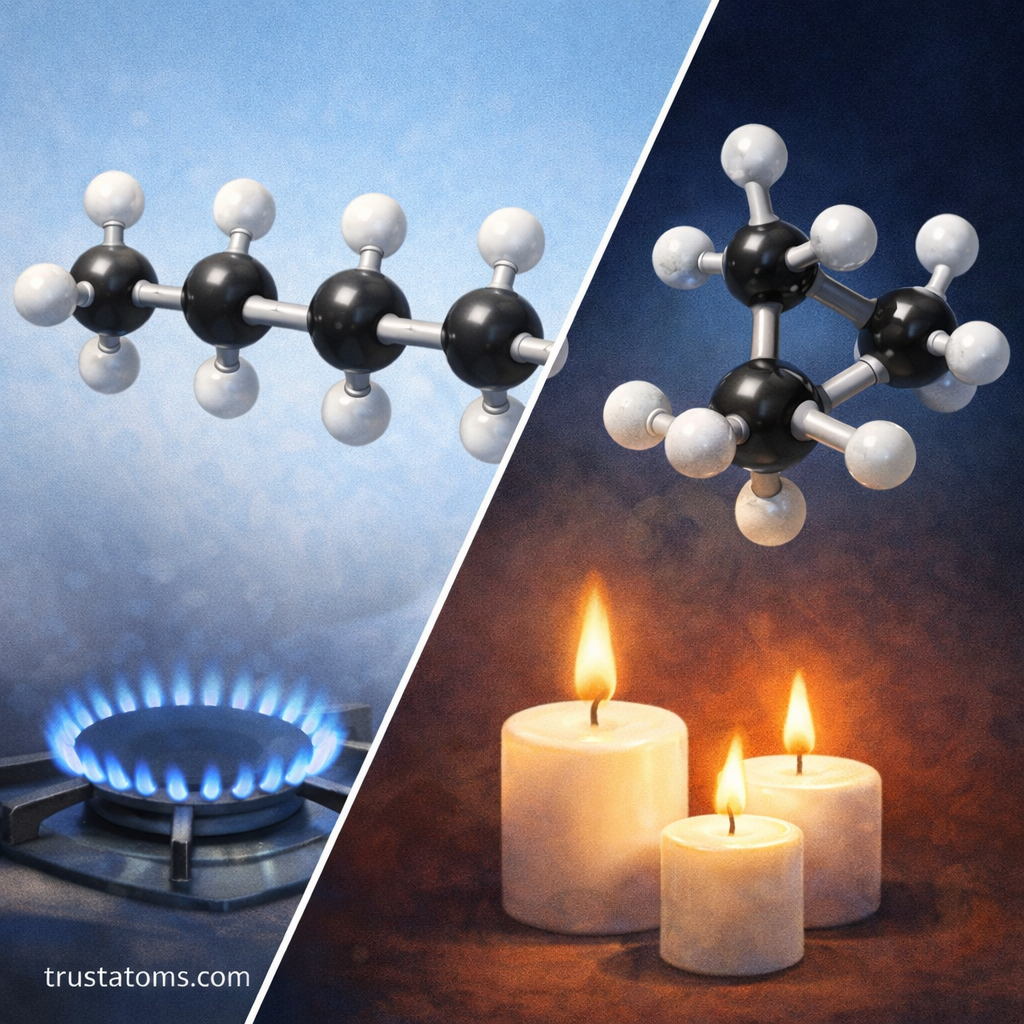
Alkanes can appear in several structural forms depending on how the carbon atoms are arranged.
Straight-Chain Alkanes
In straight-chain alkanes, carbon atoms form a continuous linear chain.
These are often called normal alkanes.
Example:
- Propane
- Butane
- Pentane
Branched Alkanes
Some alkanes contain branches, where carbon atoms extend off the main chain.
Branching can change important properties such as:
- Boiling point
- Stability
- Fuel performance
This is why branched alkanes are often preferred in gasoline blends.
Physical Properties of Alkanes
The physical behavior of alkanes depends largely on the length of their carbon chains.
State of Matter
Different alkanes exist in different physical states:
- 1–4 carbon atoms → gases
- 5–17 carbon atoms → liquids
- 18+ carbon atoms → waxy solids
Boiling and Melting Points
As the carbon chain gets longer:
- Molecular weight increases
- Intermolecular forces become stronger
- Boiling points rise
This is why methane is a gas, while heavier hydrocarbons can form liquids or wax-like solids.
Solubility
Alkanes are generally:
- Insoluble in water
- Soluble in nonpolar substances
This happens because water molecules are polar and do not interact strongly with nonpolar hydrocarbons.
How Alkanes Are Found in Nature
Alkanes occur naturally in several major energy resources.
Common sources include:
- Natural gas
- Petroleum (crude oil)
- Biogenic processes from decaying organic matter
Methane is particularly abundant and forms through natural biological processes such as decomposition in wetlands or digestion in animals.
Uses of Alkanes
Alkanes are widely used across energy, industry, and everyday products.
Fuel Sources
Many alkanes are burned to produce energy.
Examples include:
- Natural gas (methane)
- Propane heating fuel
- Gasoline components
Chemical Manufacturing
Alkanes serve as starting materials for many chemical reactions that produce:
- Plastics
- Synthetic fibers
- Detergents
- Industrial solvents
Household and Industrial Applications
Certain alkanes are used in everyday products such as:
- Lighter fluid
- Cooking gas
- Candle wax (paraffin)
- Lubricants
Why Alkanes Matter in Organic Chemistry
Alkanes are often the first compounds studied in organic chemistry because they provide a simple foundation for understanding carbon-based molecules.
Learning about alkanes helps students understand:
- Carbon bonding
- Molecular structure
- Hydrocarbon classifications
- Fuel chemistry
- Reaction fundamentals
From this starting point, chemists can explore more complex hydrocarbons like alkenes, alkynes, and aromatic compounds.
Final Thoughts
Alkanes are the simplest type of hydrocarbon, consisting only of carbon and hydrogen atoms connected by single bonds. Despite their simple structure, they play an enormous role in energy production, industrial chemistry, and everyday life.
From methane in natural gas to octane in gasoline, alkanes form the backbone of many fuels and chemical processes. Understanding how they work provides a strong foundation for exploring the broader world of organic chemistry.