A “year” is not the same everywhere in the solar system. On Earth, it takes about 365 days to orbit the Sun—but on other planets, a year can last just a few months or extend for decades.
These differences come down to orbital periods, which describe how long a planet takes to complete one full trip around the Sun. Understanding orbital periods helps explain seasons, planetary motion, and the structure of our solar system.
What Is an Orbital Period?
An orbital period is the time it takes for a planet (or any object) to complete one full orbit around another object, such as the Sun.
Key points:
- Defines the length of a planet’s year
- Measured in Earth days or years
- Depends on distance from the Sun
- Influenced by gravitational forces
The farther a planet is from the Sun, the longer its orbital period tends to be.
Why Orbital Periods Differ
Not all planets move at the same speed or distance from the Sun, which leads to variations in their orbital periods.
Main factors:
- Distance from the Sun
- Orbital speed
- Gravitational pull of the Sun
- Interaction with other celestial bodies
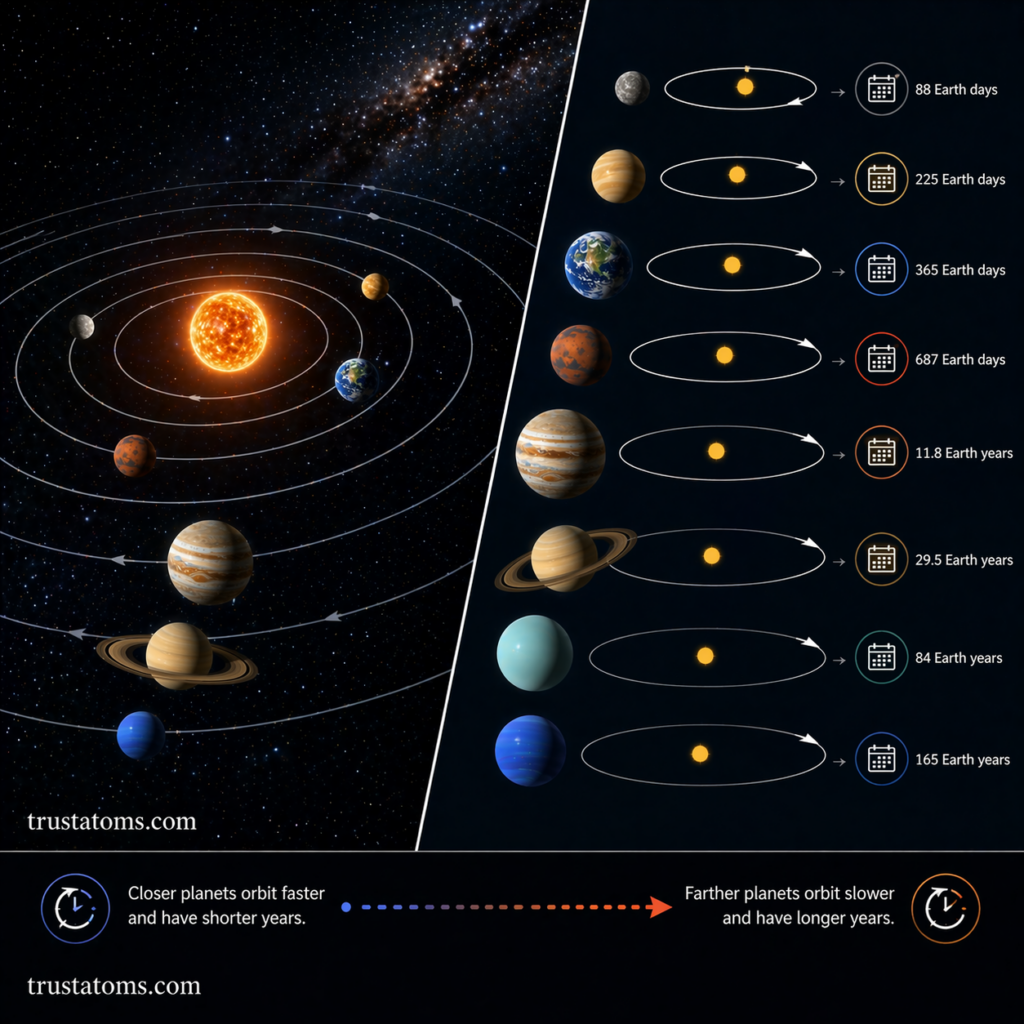
Planets closer to the Sun move faster and complete their orbits more quickly than those farther away.
Kepler’s Laws and Planetary Motion
The motion of planets is governed by principles first described by Johannes Kepler.
Kepler’s key ideas:
- Planets orbit the Sun in elliptical paths
- A line from a planet to the Sun sweeps equal areas in equal times
- The square of a planet’s orbital period is proportional to the cube of its distance from the Sun
These laws explain why outer planets move more slowly and take longer to complete an orbit.
Orbital Periods of the Planets
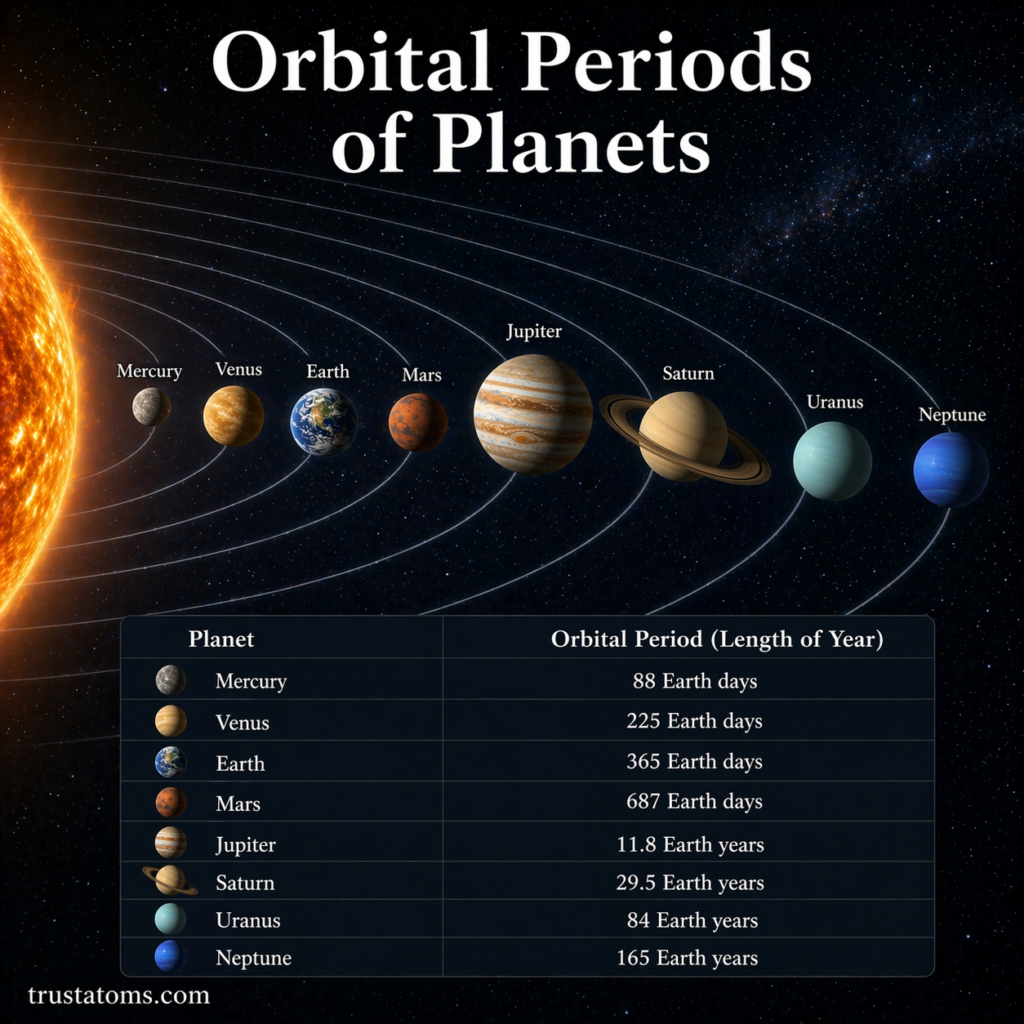
Each planet in the solar system has a unique orbital period.
Inner planets:
- Mercury
- About 88 Earth days
- Venus
- About 225 Earth days
- Earth
- 365 days
- Mars
- About 687 days
Outer planets:
- Jupiter
- About 11.8 Earth years
- Saturn
- About 29.5 Earth years
- Uranus
- About 84 Earth years
- Neptune
- About 165 Earth years
This wide range shows how dramatically a “year” can differ depending on location in the solar system.
Orbital Speed and Distance
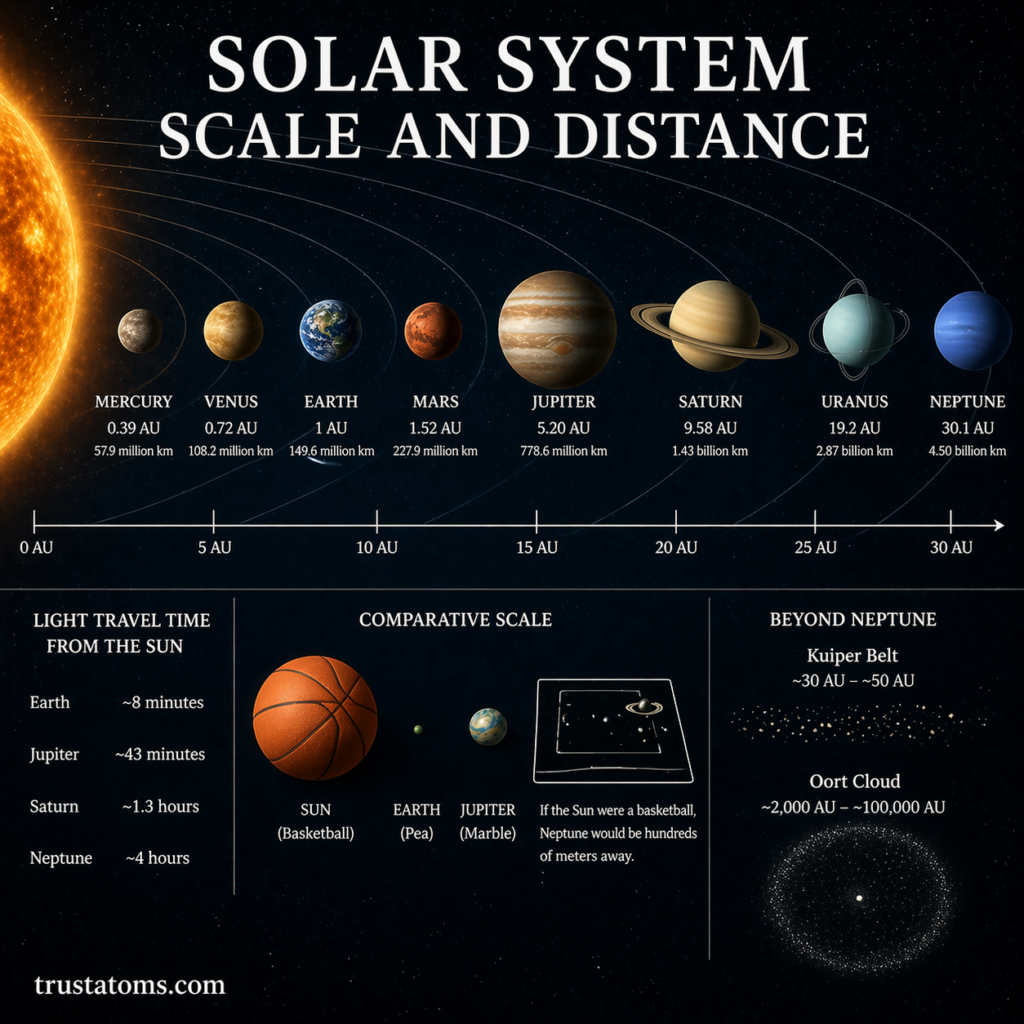
There is a strong relationship between how fast a planet moves and how far it is from the Sun.
Key relationships:
- Closer planets move faster
- Distant planets move slower
- Orbital paths become larger with distance
For example, Mercury travels quickly along a tight orbit, while Neptune moves slowly along a much larger path.
What Is an Elliptical Orbit?
Planetary orbits are not perfect circles—they are ellipses, meaning slightly stretched circles.
Features of elliptical orbits:
- The Sun sits at one focus of the ellipse
- Distance between a planet and the Sun varies slightly
- Orbital speed changes depending on position
When a planet is closer to the Sun, it moves faster. When it is farther away, it slows down.
How Orbital Period Affects Seasons
On Earth, seasons are mainly caused by axial tilt, but orbital period still plays a role.
Effects of orbital period:
- Determines how long a full seasonal cycle lasts
- Influences how long each season persists
- Affects climate patterns over time
On planets with longer orbital periods, seasons can last for years or even decades.
Orbital Resonance and Gravitational Effects
Some planets and moons influence each other through gravitational interactions.
Orbital resonance:
- Occurs when two objects have related orbital periods
- Creates repeating gravitational effects
- Can stabilize or alter orbits
For example, some of Jupiter’s moons are locked in resonance, affecting their motion and geology.
Why Orbital Periods Matter
Orbital periods are essential for understanding planetary systems.
Key importance:
- Helps predict planetary positions
- Defines calendar systems
- Aids in space mission planning
- Supports the study of exoplanets
Scientists use orbital data to understand how solar systems form and evolve.
Final Thoughts
Orbital periods reveal the rhythm of the solar system. From Mercury’s rapid journey around the Sun to Neptune’s long, slow orbit, each planet follows its own timeline.
By studying these patterns, we gain a deeper understanding of gravity, motion, and the cosmic forces that shape our universe.