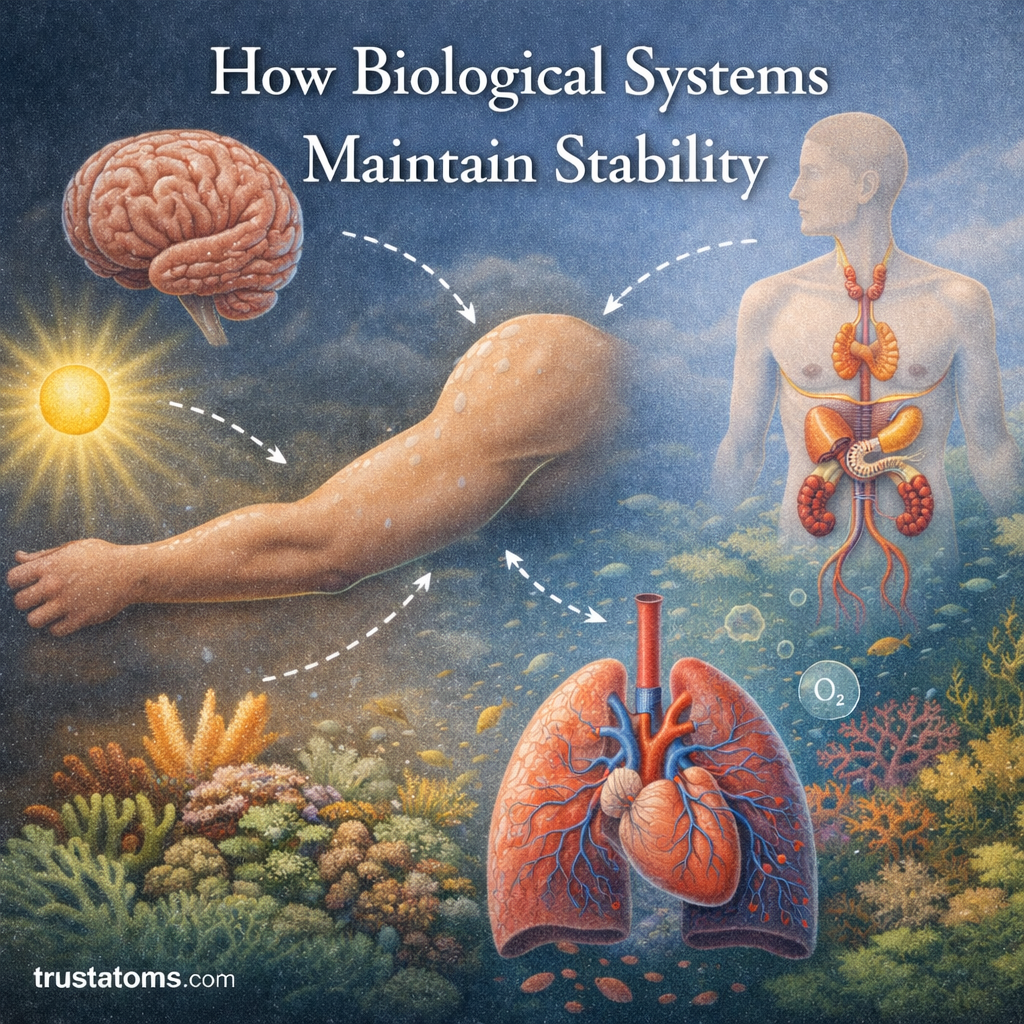
Living organisms constantly face changes both inside and outside their bodies. Temperature fluctuates, nutrients vary, and environmental conditions shift. Despite these challenges, living systems are able to maintain a relatively stable internal environment.
This ability to maintain stability is essential for survival and is known in biology as homeostasis. Biological systems use complex regulatory processes to monitor conditions and adjust when necessary.
Understanding how biological systems maintain stability helps explain how organisms function, adapt, and survive in changing environments.
What Is Biological Stability?
Biological stability refers to the ability of living systems to maintain balanced internal conditions even when external conditions change.
In most cases, this stability involves maintaining consistent levels of:
- Body temperature
- Water balance
- Blood sugar levels
- Oxygen and carbon dioxide levels
- pH balance
- Nutrient availability
Without these stable conditions, cells would not function properly and life processes would break down.
The Concept of Homeostasis
The primary mechanism behind biological stability is homeostasis.
Homeostasis is the process by which organisms regulate internal conditions to keep them within a safe and functional range.
Instead of keeping conditions perfectly constant, homeostasis maintains them within acceptable limits that allow biological processes to continue efficiently.
Examples of homeostasis include:
- Humans sweating when body temperature rises
- Plants opening and closing stomata to regulate water loss
- The pancreas controlling blood sugar levels
These responses help organisms adjust to internal and external changes.
Components of Homeostatic Regulation
Most homeostatic systems operate using a feedback loop that includes three main components.
1. Receptor
The receptor detects a change in the internal or external environment.
Examples include:
- Temperature-sensitive nerve cells in the skin
- Chemical sensors in blood vessels
- Light-sensitive cells in the eye
The receptor sends information about the change to a control center.
2. Control Center
The control center processes information and determines the appropriate response.
Examples include:
- The brain regulating body temperature
- The pancreas regulating blood glucose
- Hormone-producing glands managing metabolism
The control center sends instructions to effectors.
3. Effector
The effector carries out the response that restores stability.
Examples include:
- Sweat glands cooling the body
- Muscles producing heat through shivering
- Cells absorbing glucose from the bloodstream
Together, receptors, control centers, and effectors maintain stable conditions.
Negative Feedback: The Most Common Stability Mechanism
Most biological systems maintain stability through negative feedback loops.
Negative feedback occurs when a change in a system triggers responses that reverse or reduce that change.
Example: Body Temperature Regulation
When body temperature rises:
- Temperature receptors detect the increase.
- The brain processes the signal.
- Sweat glands release sweat to cool the body.
- Blood vessels near the skin expand to release heat.
When the body cools down, these responses stop.
Negative feedback prevents conditions from moving too far away from the optimal range.
Positive Feedback: Amplifying Biological Processes
Although less common, positive feedback loops also play a role in biological regulation.
Positive feedback amplifies a change rather than reversing it.
This process usually occurs during specific biological events and stops once the event is completed.
Example: Blood Clotting
When a blood vessel is damaged:
- Platelets attach to the damaged area.
- Chemical signals attract more platelets.
- The clot grows rapidly until the wound is sealed.
Once the clot forms, the process stops.
Positive feedback is useful for processes that must happen quickly and completely.
Stability at the Cellular Level

Cells must maintain stable internal conditions to function properly.
Important cellular stability processes include:
- Regulating water and ion balance
- Maintaining internal pH
- Controlling nutrient intake
- Removing waste products
Cell membranes play a key role by controlling what enters and leaves the cell.
Specialized proteins within the membrane act as channels and pumps that regulate movement of substances.
Stability in Organ Systems
Many organ systems work together to maintain homeostasis.
Nervous System
The nervous system detects environmental changes and quickly sends signals throughout the body.
Functions include:
- Monitoring body temperature
- Controlling reflex responses
- Coordinating muscle activity
Endocrine System
The endocrine system uses hormones to regulate long-term processes such as:
- Growth
- Metabolism
- Blood sugar levels
- Stress responses
Hormones travel through the bloodstream and influence many organs simultaneously.
Respiratory and Circulatory Systems
These systems help maintain stable oxygen and carbon dioxide levels.
The lungs bring oxygen into the body, while the circulatory system transports gases and nutrients to cells.
Together they help maintain chemical balance in the body.
Stability in Ecosystems
Stability is not limited to individual organisms. Ecosystems also maintain balance through complex interactions between species and their environment.
Important ecosystem stability processes include:
- Nutrient cycling
- Energy flow through food chains
- Predator-prey relationships
- Plant growth regulating carbon dioxide levels
When ecosystems remain balanced, populations and resources remain relatively stable.
What Happens When Stability Is Disrupted?
If biological stability cannot be maintained, organisms may experience stress, illness, or death.
Examples include:
- Dehydration disrupting water balance
- Diabetes affecting blood sugar regulation
- Fever altering body temperature control
- Ecosystem imbalance causing species decline
Understanding how stability is disrupted helps scientists develop treatments and conservation strategies.
Why Biological Stability Is Essential
Maintaining stability is critical for all life processes.
Biological stability allows organisms to:
- Maintain proper enzyme activity
- Support cell function
- Coordinate organ systems
- Respond to environmental changes
- Sustain life over time
Without homeostasis, complex life forms would not be able to survive.
Final Thoughts
Biological systems maintain stability through carefully coordinated processes that regulate internal conditions. Homeostasis, feedback loops, and cooperation among organ systems all play essential roles in maintaining balance.
From the cellular level to entire ecosystems, stability allows life to function even in changing environments. By studying these processes, scientists gain insight into health, disease, and the delicate balance that supports life on Earth.