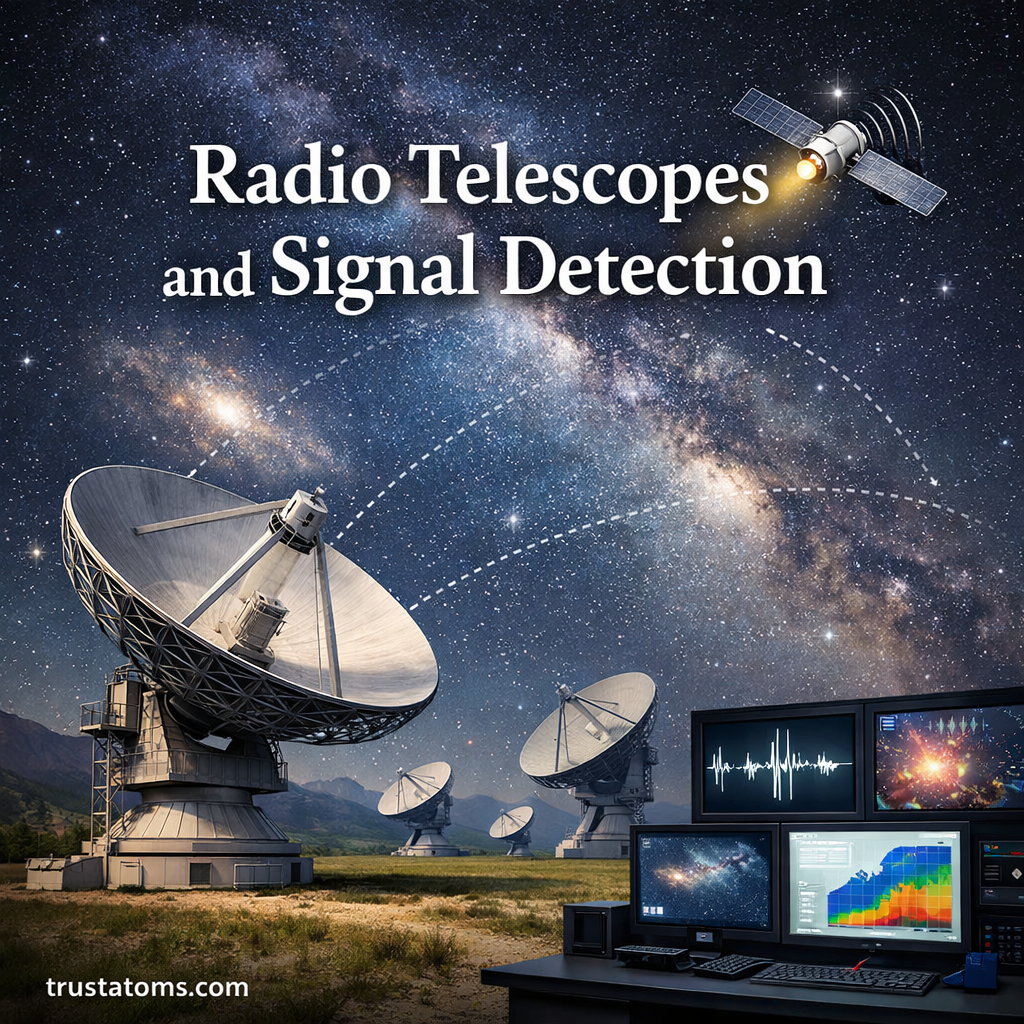
Radio telescopes allow scientists to explore the universe in a completely different way than traditional optical telescopes. Instead of capturing visible light, they detect radio waves—longer wavelengths of electromagnetic radiation that can pass through dust, gas, and even clouds.
This ability makes radio telescopes essential for studying distant galaxies, black holes, pulsars, and even signals from the early universe.
What Are Radio Telescopes?
A radio telescope is a specialized instrument designed to collect and measure radio frequency signals from space. These signals are naturally emitted by many celestial objects.
Unlike optical telescopes, which rely on mirrors or lenses to focus light, radio telescopes typically use large dish-shaped antennas to gather and concentrate radio waves.
Key components of a radio telescope
- Large parabolic dish (antenna) to collect radio waves
- Receiver to detect and amplify signals
- Data processing system to convert signals into usable information
- Mounting system to track objects across the sky
How Radio Telescopes Work
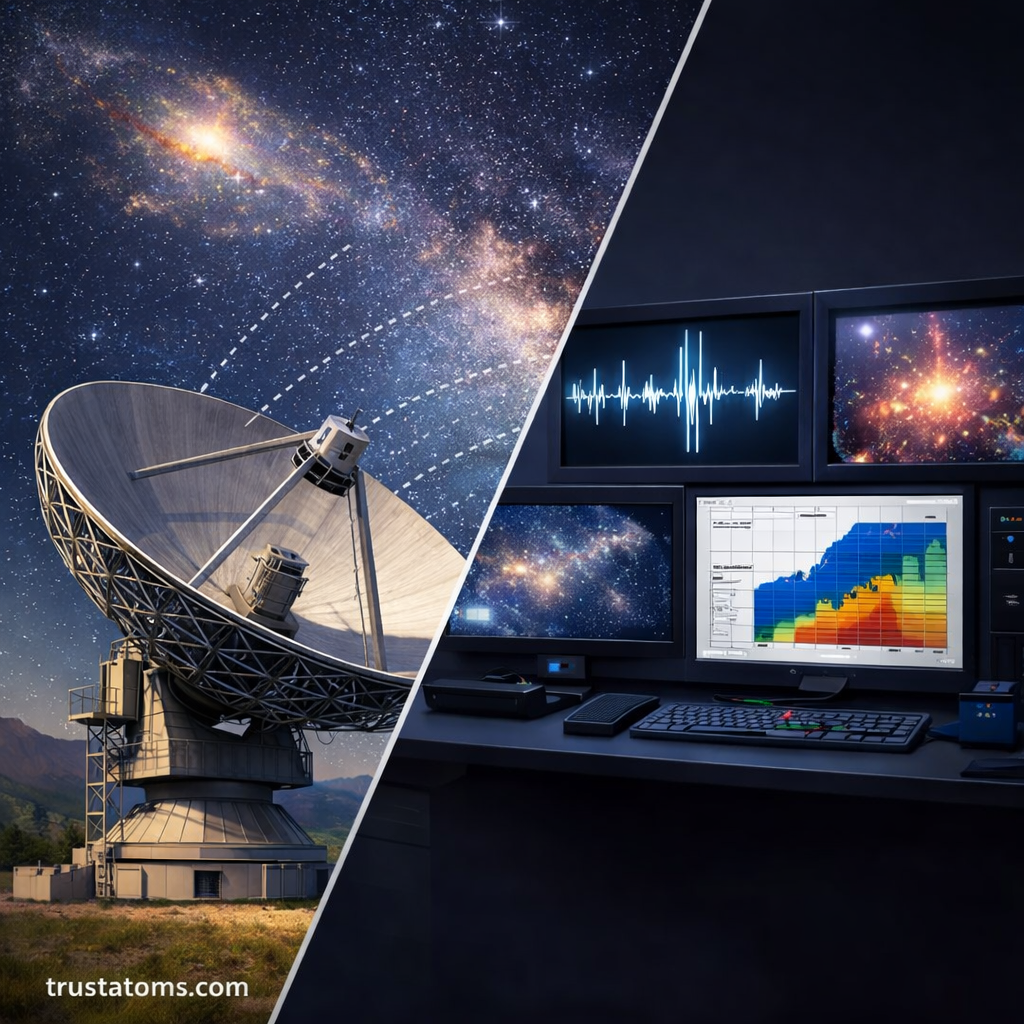
Radio telescopes operate by capturing faint radio signals and converting them into data that scientists can analyze.
Step-by-step process
- The dish collects incoming radio waves from space
- The waves are reflected toward a central receiver
- The receiver converts the waves into electrical signals
- Signals are amplified and filtered to remove noise
- Computers process the data into images, graphs, or sound
Because radio signals are extremely weak by the time they reach Earth, sensitive equipment and precise calibration are essential.
What Is Signal Detection in Radio Astronomy?
Signal detection is the process of identifying meaningful radio signals from space and separating them from background noise.
This is one of the most challenging aspects of radio astronomy because Earth itself produces a lot of interference, including:
- Cell phone signals
- Television broadcasts
- Satellite communications
- Natural atmospheric noise
Techniques used in signal detection
- Filtering: Removing unwanted frequencies
- Amplification: Strengthening weak signals
- Interferometry: Combining signals from multiple telescopes
- Noise reduction algorithms: Cleaning up data digitally
Interferometry: Combining Multiple Telescopes
One of the most powerful techniques in radio astronomy is interferometry. This involves linking multiple radio telescopes together to act as a single, larger instrument.
Benefits of interferometry
- Higher resolution images
- Greater sensitivity to faint signals
- Ability to study extremely distant objects
A famous example is the Very Large Array, which uses dozens of antennas working together.
What Can Radio Telescopes Detect?
Radio telescopes reveal phenomena that are invisible to optical instruments.
Common discoveries include
- Pulsars (rapidly rotating neutron stars)
- Quasars (extremely bright galactic centers)
- Cosmic microwave background radiation
- Gas clouds where new stars form
- Signals from galaxies billions of light-years away
They also played a key role in detecting the cosmic background radiation, which supports the theory of the Big Bang.
Advantages of Radio Telescopes
Radio telescopes offer several unique benefits compared to optical telescopes.
Key advantages
- Work day and night, regardless of sunlight
- Can observe through clouds, dust, and gas
- Detect objects invisible in visible light
- Provide insight into early universe conditions
Limitations and Challenges
Despite their advantages, radio telescopes face several challenges.
Common limitations
- Radio interference from human technology
- Large size required for better resolution
- Complex data processing needs
- High construction and maintenance costs
To reduce interference, many radio observatories are built in remote locations.
Why Radio Telescopes Matter
Radio telescopes have transformed our understanding of the universe. They allow scientists to study phenomena that cannot be seen with traditional telescopes, helping uncover the structure and history of the cosmos.
From mapping galaxies to detecting signals from the early universe, radio astronomy continues to push the boundaries of scientific discovery.
Final Thoughts
Radio telescopes and signal detection are essential tools in modern astronomy. By capturing invisible radio waves and turning them into meaningful data, these instruments open a window into parts of the universe that would otherwise remain hidden.
As technology improves, radio telescopes will continue to reveal new insights about space, time, and the origins of the universe.