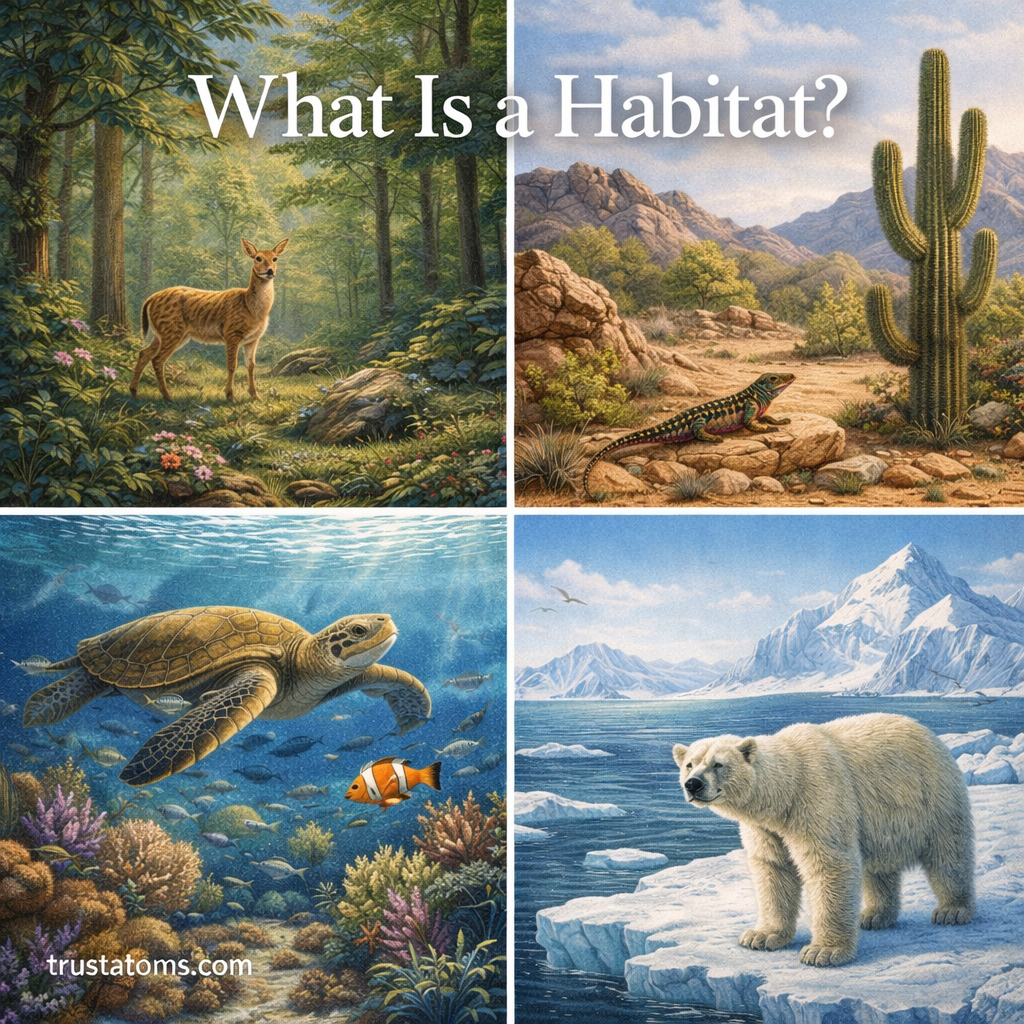
A habitat is the natural environment where a plant, animal, or microorganism lives. It provides the food, water, shelter, space, and environmental conditions an organism needs to survive and reproduce.
Habitats exist in forests, deserts, oceans, wetlands, and even small spaces beneath rocks or inside decaying logs. Studying habitats is an important part of the science of biology because it helps explain why species live in particular places and how they interact with their surroundings.
Different organisms require different conditions. A frog may depend on a freshwater pond for reproduction, while a cactus can survive in dry environments where many other plants cannot. A habitat is suitable only when it meets the needs of the species living there.
The Basic Definition of a Habitat
In biology, a habitat is the specific physical environment occupied by an organism or population. It includes both living components, such as plants and prey animals, and nonliving conditions, such as temperature, moisture, sunlight, and soil.
Most animal habitats must provide several basic resources:
- Food or access to suitable energy sources.
- Water in a form the organism can use.
- Shelter from predators and environmental extremes.
- Enough space for feeding, movement, and reproduction.
- Suitable temperature, moisture, and other physical conditions.
These requirements differ among species. Fish need water with appropriate oxygen levels, while many desert reptiles depend on shaded hiding places to avoid overheating.
Understanding these requirements helps conservationists identify which environments need protection. Conservation Strategies for Biodiversity examines approaches used to preserve species and the habitats supporting them.
Key Components of a Suitable Habitat
A habitat must provide the right combination of resources and environmental conditions. Having sufficient food alone does not guarantee that an organism can survive there.
Food and Energy Sources
Organisms obtain energy in different ways. Plants capture sunlight through photosynthesis, herbivores consume plants, predators eat other animals, and decomposers obtain nutrients from organic material.
The availability of these resources influences how many individuals a habitat can support. Seasonal food shortages may cause animals to migrate, change their feeding behavior, or experience population declines.
Water and Moisture
Water availability affects nearly every habitat. Aquatic organisms live directly in water, while terrestrial species obtain it through rainfall, surface water, food, or underground sources.
Some desert animals conserve water through specialized kidneys or behavioral adaptations. Amphibians generally require moist environments because their skin is involved in water exchange and, in many species, respiration.
Shelter and Breeding Areas
Shelter protects organisms from predators, severe weather, and temperature extremes. Examples include underground burrows, tree cavities, coral formations, and dense vegetation.
Suitable breeding areas are equally important. Many birds require nesting sites, while numerous amphibians depend on freshwater environments where their eggs and young can develop.
Temperature, Sunlight, and Soil
Physical conditions determine which organisms can tolerate a habitat. Temperature affects metabolism, sunlight influences plant growth, and soil characteristics determine water retention and nutrient availability.
For example, a shaded forest floor generally supports different plant communities than an exposed grassland because light, moisture, and soil conditions differ.
Major Types of Habitats

Habitats are commonly grouped into terrestrial and aquatic environments. Each category contains smaller habitats with distinct physical conditions and biological communities.
Terrestrial Habitats
Terrestrial habitats exist on land and support a wide variety of ecosystems.
Common examples include:
- Forests, where trees provide shade, food, and shelter.
- Grasslands, which support grazing animals and ground-nesting birds.
- Deserts, where organisms tolerate limited rainfall and temperature extremes.
- Tundra, characterized by cold conditions and short growing seasons.
- Mountain habitats, where temperature and vegetation change with elevation.
Aquatic Habitats
Aquatic habitats occur in freshwater, saltwater, and environments where the two mix. Water depth, temperature, salinity, oxygen availability, and movement influence which organisms can live there.
Examples include rivers, lakes, oceans, coral reefs, estuaries, and wetlands. Freshwater fish generally require different conditions from marine fish, while estuaries support species adapted to changing salinity.
How Organisms Adapt to Their Habitats
Adaptations are inherited characteristics that improve an organism’s ability to survive or reproduce under particular environmental conditions. They may involve physical structures, internal processes, or behavior.
Examples include:
- Thick insulating fur in mammals living in cold environments.
- Camouflage that makes animals harder for predators or prey to detect.
- Water-storing tissues in many desert plants.
- Gills that allow fish to extract dissolved oxygen from water.
- Nocturnal activity that helps some desert animals avoid daytime heat.
According to evolutionary biology, adaptations develop across generations as natural selection favors inherited traits that improve reproductive success in particular environments. Individual organisms can also adjust their behavior or physiology during their lifetimes, but these adjustments are not necessarily inherited adaptations.
Habitat vs. Ecosystem: What’s the Difference?
A habitat describes where a particular organism lives. An ecosystem includes the organisms in an area, their physical surroundings, and the interactions connecting them.
Consider a freshwater pond. The pond functions as an ecosystem containing fish, insects, plants, microorganisms, water, and nutrients. Within it, submerged vegetation may provide a specific habitat for insect larvae, while muddy edges support different organisms.
A biome is a broader geographic region characterized by general climate conditions and biological communities, such as tropical rainforest or tundra.
Ecology is the scientific study of relationships between organisms and their environments, including how habitats influence species distribution and interactions.
How Habitat Size and Quality Affect Wildlife
Habitat quality describes how well an environment meets a species’ needs. Two areas may look similar but differ substantially in available food, nesting sites, pollution levels, or exposure to predators.
For example, imagine two ponds of similar size. One contains aquatic plants, shallow breeding areas, and clean water. The other has little vegetation and receives polluted runoff. Although both contain water, the first may provide better conditions for frogs to reproduce successfully.
Habitat size also matters. Large animals may require extensive territories, while some insects can complete their life cycles within a small patch of vegetation.
Connected habitats allow organisms to move between areas to find food, mates, and suitable breeding conditions. Roads and development can divide continuous habitats into isolated patches, a process called habitat fragmentation.
Habitat Loss and Its Effects on Biodiversity
One of the greatest threats to biodiversity is habitat destruction.
Habitat loss occurs when natural environments are removed, degraded, or altered so extensively that they no longer support their original communities.
Major causes include deforestation, agricultural expansion, urban development, pollution, and changes in climate conditions.
When habitats disappear, organisms may lose food sources, nesting areas, and access to other populations. Species with specialized environmental requirements are often particularly vulnerable because suitable replacement habitats may be scarce.
Protecting and Restoring Habitats
Habitat conservation involves maintaining environments that support native species and ecological processes. Effective approaches depend on the species involved and the pressures affecting an area.
Common conservation measures include:
- Establishing protected areas and wildlife reserves.
- Restoring wetlands, forests, and other damaged environments.
- Maintaining wildlife corridors between habitat patches.
- Reducing pollution and managing invasive species.
- Using land and water resources in ways that limit ecological damage.
Restoration may involve replanting native vegetation, removing barriers to stream flow, or improving water quality. Scientists monitor wildlife populations and environmental conditions to evaluate whether these efforts are successful.
Frequently Asked Questions
Can two different species share the same habitat?
Yes. Many species occupy the same habitat but use different resources or areas within it. For example, birds, insects, fungi, and mammals may all live in a forest while obtaining food and shelter in different ways.
Can a habitat be very small?
Yes. A habitat can be as small as the space beneath a fallen log or as extensive as an ocean region. Its size depends on the organism being studied and the environmental conditions it requires.
What happens when an animal’s habitat changes?
Animals may move to another suitable area, adjust their behavior, or experience reduced survival and reproduction. If changes are severe and alternative habitats are unavailable, populations may decline or disappear locally.
A habitat is more than the location where an organism is found; it is the combination of resources and environmental conditions that makes survival and reproduction possible. Understanding habitat quality, species adaptations, and the effects of fragmentation helps scientists explain wildlife distribution and identify effective conservation measures. Protecting suitable habitats supports both individual species and the ecological communities they form.
Sources: OpenStax, Biology 2e; Encyclopaedia Britannica, “Habitat”; International Union for Conservation of Nature (IUCN), The IUCN Red List of Threatened Species.