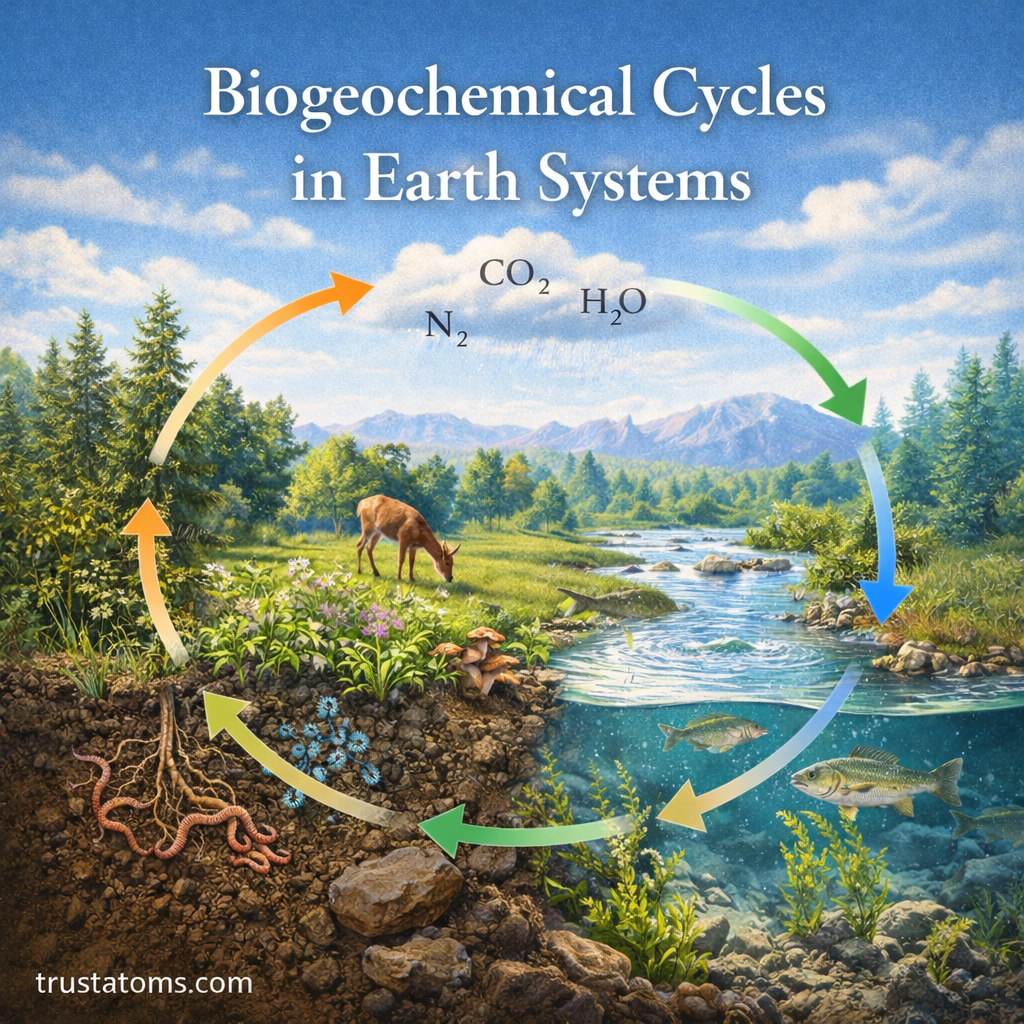
Biogeochemical cycles are fundamental processes that move essential chemical elements through Earth’s living and non-living systems. These cycles connect the biosphere (living organisms) with the atmosphere, hydrosphere, and geosphere, allowing nutrients to circulate through ecosystems and support life.
Without these cycles, critical elements such as carbon, nitrogen, and phosphorus would become locked in one location and unavailable to organisms. Instead, biogeochemical cycles continually redistribute these elements, maintaining ecological balance across the planet.
Understanding these cycles helps scientists study ecosystem productivity, climate change, and environmental sustainability.
What Are Biogeochemical Cycles?
A biogeochemical cycle describes the movement of chemical elements through biological, geological, and chemical processes.
The word itself reflects its components:
- Bio – living organisms
- Geo – Earth’s land, rocks, and soil
- Chemical – the elements and compounds involved
These cycles explain how elements travel through different parts of Earth’s system, including:
- Atmosphere
- Soil and rocks
- Oceans and freshwater
- Living organisms
Unlike energy, which flows in one direction through ecosystems, nutrients are recycled repeatedly through biogeochemical cycles.
Why Biogeochemical Cycles Are Important
Biogeochemical cycles maintain the availability of nutrients required for life.
They support ecosystems by:
- Recycling essential elements
- Maintaining soil fertility
- Supporting plant growth
- Sustaining food webs
- Regulating atmospheric composition
Without these cycles, ecosystems would quickly lose the nutrients needed for biological processes such as growth, reproduction, and metabolism.
The Main Components of Biogeochemical Cycles
Most biogeochemical cycles involve interactions between several major Earth systems.
The Biosphere
The biosphere includes all living organisms such as:
- Plants
- Animals
- Microorganisms
- Fungi
Living organisms absorb, transform, and redistribute chemical elements through metabolic processes and feeding relationships.
The Atmosphere
The atmosphere stores important gases used in many cycles.
Examples include:
- Carbon dioxide (CO₂)
- Nitrogen gas (N₂)
- Oxygen (O₂)
- Water vapor
These gases move between the atmosphere and ecosystems through processes such as respiration, photosynthesis, and evaporation.
The Hydrosphere
The hydrosphere includes all water on Earth:
- Oceans
- Rivers
- Lakes
- Groundwater
- Ice and glaciers
Water acts as a transport system, dissolving and carrying nutrients across ecosystems.
The Geosphere
The geosphere consists of:
- Soil
- Rocks
- Sediments
- Earth’s crust
Many nutrients are stored in rocks and minerals and are released slowly through processes such as weathering and erosion.
Major Biogeochemical Cycles
Several important cycles move essential elements through Earth systems.
The Carbon Cycle
The carbon cycle regulates the movement of carbon between the atmosphere, organisms, oceans, and land.
Carbon enters ecosystems when plants absorb carbon dioxide during photosynthesis.
The carbon cycle includes several steps:
- Plants convert carbon dioxide into organic compounds.
- Animals consume plants or other animals and incorporate carbon into their bodies.
- Organisms release carbon through respiration.
- Decomposers break down dead organisms and return carbon to soil and the atmosphere.
Large carbon reservoirs exist in:
- Forests
- Ocean sediments
- Fossil fuels
- Soil organic matter
The carbon cycle plays a key role in regulating Earth’s climate.
The Nitrogen Cycle
Nitrogen is essential for building proteins, DNA, and other biological molecules. However, most organisms cannot use nitrogen directly from the atmosphere.
The nitrogen cycle converts nitrogen gas into usable forms.
Key steps include:
Nitrogen Fixation
Specialized bacteria convert atmospheric nitrogen into ammonia.
Nitrification
Soil bacteria convert ammonia into nitrates, which plants can absorb.
Assimilation
Plants absorb nitrates and incorporate nitrogen into their tissues.
Denitrification
Other bacteria convert nitrates back into nitrogen gas, returning it to the atmosphere.
This cycle allows nitrogen to move between soil, organisms, and the atmosphere.
The Phosphorus Cycle
Phosphorus is an essential nutrient used in:
- DNA and RNA
- Cellular energy molecules (ATP)
- Cell membranes
The phosphorus cycle differs from other cycles because it does not typically involve the atmosphere.
Instead, phosphorus moves through:
- Rocks and minerals
- Soil
- Water bodies
- Living organisms
The cycle begins when weathering releases phosphorus from rocks into soil. Plants absorb phosphorus from soil, and animals obtain it by consuming plants or other animals.
When organisms die or produce waste, decomposers return phosphorus to soil and sediments.
The Water Cycle
Water is crucial for transporting nutrients and supporting life.
The water cycle, also known as the hydrologic cycle, moves water through Earth’s systems.
Key processes include:
- Evaporation from oceans and land
- Condensation forming clouds
- Precipitation such as rain or snow
- Runoff flowing into rivers and oceans
- Groundwater movement through soil and rock
As water moves through ecosystems, it transports nutrients that support biological processes.
Biological Processes Driving These Cycles
Several biological processes help move elements through ecosystems.
Photosynthesis
Plants convert carbon dioxide and sunlight into organic molecules.
Respiration
Organisms release carbon dioxide into the atmosphere while producing energy.
Decomposition
Decomposers break down dead organisms and recycle nutrients into soil.
Nutrient Uptake
Plants absorb nutrients such as nitrogen and phosphorus from soil and water.
These biological activities ensure that nutrients remain available to organisms.
Human Impacts on Biogeochemical Cycles

Human activities can significantly alter natural cycles.
Major impacts include:
- Burning fossil fuels
- Deforestation
- Agricultural fertilizer use
- Industrial pollution
- Urban development
For example, increased carbon dioxide emissions from fossil fuel combustion contribute to climate change.
Excess nitrogen and phosphorus from fertilizers can enter water systems and cause eutrophication, leading to harmful algal blooms and reduced oxygen levels in aquatic ecosystems.
Understanding biogeochemical cycles helps scientists develop strategies for managing environmental challenges.
Biogeochemical Cycles and Ecosystem Stability
Healthy ecosystems depend on balanced nutrient cycling. When these cycles function properly, ecosystems can support diverse plant and animal populations.
Balanced cycles help ecosystems:
- Maintain soil productivity
- Support plant growth
- Sustain food webs
- Recover from disturbances
- Regulate environmental conditions
Disruptions to these cycles can lead to reduced biodiversity and ecosystem instability.
Key Takeaways
Biogeochemical cycles are essential processes that move nutrients through Earth’s systems.
Important points include:
- These cycles connect living organisms with the atmosphere, water, and soil.
- Nutrients are continuously recycled rather than lost.
- Major cycles include carbon, nitrogen, phosphorus, and water.
- Biological processes such as photosynthesis and decomposition drive nutrient movement.
- Human activities can significantly affect these natural cycles.
Understanding these processes helps scientists protect ecosystems and maintain environmental balance.
Final Thoughts
Biogeochemical cycles form the foundation of life on Earth. By continuously recycling essential elements through biological, geological, and chemical pathways, these cycles ensure that ecosystems remain productive and sustainable.
From carbon moving through forests and oceans to nitrogen circulating through soil and microbes, biogeochemical cycles connect all living organisms to the planet’s natural systems. Studying these cycles allows scientists to better understand Earth’s complex environmental processes and the role humans play within them.