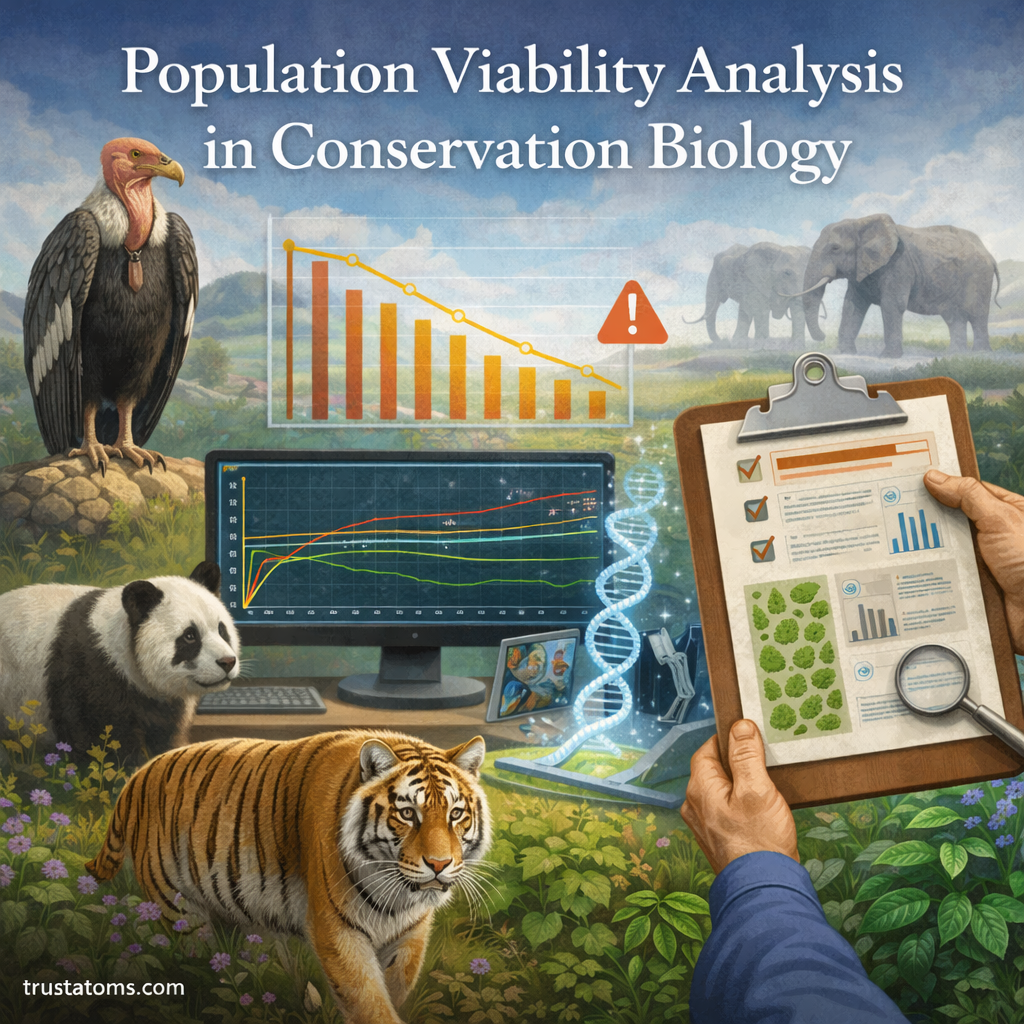
Population viability analysis (PVA) is a scientific method that estimates the risk of a wildlife population declining or becoming extinct over a specified period. It combines population data, mathematical models, and environmental uncertainty to help conservationists evaluate threats and compare strategies for protecting vulnerable species.
As an application of biology, PVA connects reproduction, survival, genetics, and ecology to practical conservation decisions. Researchers use it to investigate whether a population can persist despite habitat loss, disease, environmental changes, or random events.
Unlike a simple population forecast, PVA often examines thousands of possible futures. Its results describe risks under specific assumptions rather than predicting exactly what will happen to a species.
What Is Population Viability Analysis?
Population Viability Analysis (PVA) is a scientific method used by conservation biologists to estimate the probability that a population will survive or become extinct within a defined period.
Researchers build models representing reproduction, mortality, migration, and environmental conditions. These models simulate possible population trajectories and estimate how frequently extinction or severe decline occurs.
PVA builds on the mathematical approaches described in population modeling in ecology, but focuses specifically on persistence, extinction risk, and conservation decisions.
Its findings can inform conservation strategies for biodiversity, including habitat protection, wildlife corridors, and endangered species recovery programs.
What Questions Can PVA Answer?
Population viability analysis helps conservationists investigate questions that cannot be answered reliably from a single population count.
- What is the estimated probability of extinction over the next 50 or 100 years?
- How might habitat loss affect future population size?
- Would improving adult survival or reproductive success provide greater benefits?
- How could disease outbreaks or extreme weather affect recovery?
- Which management strategy is most likely to reduce extinction risk?
These questions help researchers compare conservation options before committing limited resources. PVA is especially useful when direct observation of long-term outcomes would take decades.
Biological Factors Included in PVA Models
Population viability models rely on multiple biological and ecological parameters that influence population growth or decline.
Population Size and Age Structure
The number of individuals in a population affects its vulnerability to random events. Small populations may be particularly sensitive to unexpected deaths, poor breeding seasons, and environmental disturbances.
Age structure also matters. A population containing many individuals but few reproductive adults may have limited potential for recovery.
Birth Rates, Death Rates, and Migration
Researchers estimate reproductive success, survival probabilities, and movement between populations. These variables help simulate population dynamics over time.
For example, improving adult survival may substantially benefit a long-lived species that produces relatively few offspring. In a short-lived species, reproductive success may have a stronger influence on population growth.
Environmental Variation
Rainfall, temperature, food availability, and habitat quality can vary between years. These changes may affect many individuals simultaneously, producing unusually successful or unsuccessful breeding seasons.
PVA models can incorporate environmental variation by allowing survival and reproduction to change between simulated years.
Genetic Diversity and Inbreeding
Small, isolated populations may experience increased inbreeding and the loss of genetic variation. Inbreeding depression can reduce survival or reproductive success when harmful inherited variants become more likely to occur together.
Some PVA models incorporate genetic effects, although reliable estimates are not available for every species. Genetic diversity is one consideration alongside habitat conditions and demographic performance.
Catastrophic Events
Wildfires, severe storms, disease outbreaks, and other major disturbances can cause sudden population declines. Their consequences depend on event severity, population distribution, and the ability of surviving individuals to reproduce.
Researchers may include estimated probabilities of such events when sufficient evidence exists. Because rare events are difficult to measure, these assumptions require careful testing.
Types of Population Viability Models

Different modeling approaches provide different levels of detail. Researchers select methods based on the species, available data, and conservation questions being investigated.
Deterministic Models
Deterministic models use fixed relationships and parameter values. Given the same starting conditions, they produce the same projected outcome.
They are useful for examining general population trends but do not represent random differences between individuals or unpredictable environmental events.
Stochastic Models
Stochastic models incorporate randomness into population simulations. Births, deaths, environmental conditions, or other events may vary between simulation runs.
Repeated simulations produce a range of possible outcomes, allowing researchers to estimate extinction probabilities rather than a single future population size.
Individual-Based Models
Individual-based models represent organisms separately, potentially tracking each individual’s age, sex, survival, reproduction, movement, and genetic relationships.
These models can capture detailed biological differences but require more information and computational resources. Greater complexity does not automatically make predictions more reliable.
A Practical Example of Population Viability Analysis
Consider a hypothetical endangered bird population containing 80 individuals in a fragmented forest. Conservationists want to compare two management strategies: protecting additional nesting habitat or reducing adult mortality.
Researchers construct a model using estimated survival rates, breeding success, environmental variation, and the current population size. They then run 1,000 simulations for each strategy over a 50-year period.
Suppose the hypothetical results are:
| Scenario | Simulations ending in extinction | Estimated 50-year extinction risk |
|---|---|---|
| No additional management | 400 of 1,000 | 40% |
| Protect nesting habitat | 250 of 1,000 | 25% |
| Reduce adult mortality | 120 of 1,000 | 12% |
These invented figures illustrate how PVA results are interpreted; they are not findings from an actual wildlife study. Under the assumed conditions, reducing adult mortality produces the lowest estimated extinction risk.
Conservationists would still need to evaluate costs, feasibility, data quality, and uncertainty before choosing a strategy. A model comparison identifies promising options, not guaranteed outcomes.
How Scientists Conduct a PVA
A population viability analysis usually follows a structured process, although the details vary between projects.
- Define the conservation question: Identify the population, time horizon, and outcome being assessed.
- Collect ecological data: Gather population counts, survival estimates, reproductive rates, and habitat information.
- Construct the model: Represent demographic processes, environmental variation, and relevant threats.
- Evaluate the model: Compare predictions with available observations and examine whether assumptions are reasonable.
- Run conservation scenarios: Simulate different management actions and environmental conditions.
- Assess uncertainty: Test how results change when uncertain parameters or assumptions are modified.
Results may include estimated extinction probability, future population size, population growth rate, or the likelihood of falling below a specified threshold.
How PVA Supports Conservation Decisions
Endangered Species Recovery
Recovery teams use PVA to compare strategies for increasing survival and reproduction. Models can help identify which demographic changes are most likely to improve persistence.
For example, protecting breeding adults may provide greater benefits than increasing juvenile survival in some long-lived species. The result depends on species biology and available evidence.
Habitat Protection and Wildlife Corridors
Habitat fragmentation can isolate populations and restrict movement. PVA can compare outcomes under different assumptions about habitat availability, migration, and local extinction.
Models may help evaluate whether connecting habitat patches could improve persistence by allowing individuals to move between populations.
Wildlife Reintroduction
When conservationists reintroduce a species, PVA can help compare release sizes, age distributions, and expected survival rates.
These analyses can also examine whether repeated releases might be more effective than a single introduction. Successful establishment still depends on habitat quality, disease risks, and other factors that models may not fully capture.
Climate Change and Environmental Risk
Changes in temperature, rainfall, and habitat conditions may alter survival and reproductive success. Researchers can incorporate alternative environmental scenarios into PVA models to explore possible consequences.
These projections help identify management strategies that remain useful across a range of uncertain future conditions.
Understanding Minimum Viable Population Size
Minimum viable population size refers to the population size estimated to provide a specified probability of persistence over a defined period under particular conditions.
There is no universal minimum number of individuals that guarantees survival for every species. A population’s viability depends on reproduction, survival, genetic diversity, environmental variability, and connections with other populations.
For this reason, conservationists should not treat a single population threshold as a permanent measure of safety. The estimated minimum can change when model assumptions or environmental conditions change.
Limitations and Uncertainty in PVA
Population viability analysis is only as reliable as the information and assumptions used to construct it. Several limitations require careful interpretation.
- Incomplete data: Rare or elusive species may be difficult to count or monitor accurately.
- Uncertain parameters: Survival and reproduction estimates may be based on small samples.
- Unexpected events: New diseases, habitat disturbances, or environmental changes may occur in ways not represented by the model.
- Long-term uncertainty: Predictions become increasingly dependent on assumptions as the forecast period extends.
Researchers address these problems through sensitivity analysis, alternative scenarios, and updated field observations. Comparing results across plausible assumptions is often more informative than relying on one extinction probability.
Improving PVA With Modern Ecological Data
Advances in wildlife monitoring, satellite imagery, genetic analysis, and computational methods are expanding the information available for population viability models.
Satellite observations can help researchers track habitat changes, while genetic data can improve understanding of population connectivity and inbreeding. Long-term monitoring provides evidence for evaluating whether model predictions match observed trends.
New technologies can improve model detail, but careful study design remains essential. More data are useful only when they accurately represent the population and processes being investigated.
Frequently Asked Questions
What Does Population Viability Analysis Measure?
PVA estimates population outcomes under specified conditions, commonly including extinction probability, population decline, and future abundance over a defined period. It can also compare the effects of conservation interventions.
Can PVA Predict Exactly When a Species Will Become Extinct?
No. PVA estimates probabilities and possible population trajectories rather than exact extinction dates. Results depend on the model’s assumptions, available data, and environmental conditions.
What Is the Difference Between PVA and Population Modeling?
Population modeling broadly examines changes in population size, structure, and interactions. PVA applies modeling methods specifically to questions about population persistence, extinction risk, and conservation management.
Population viability analysis helps conservationists translate wildlife monitoring data into estimates of extinction risk and comparisons of management strategies. Its greatest practical value comes from identifying which threats most affect survival and testing whether proposed interventions could reduce those risks. Because every projection depends on uncertain assumptions, PVA works best when paired with continued field monitoring and regular model updates.
Sources: Morris and Doak, Quantitative Conservation Biology: Theory and Practice of Population Viability Analysis; Beissinger and McCullough, Population Viability Analysis; International Union for Conservation of Nature, Guidelines for Reintroductions and Other Conservation Translocations.