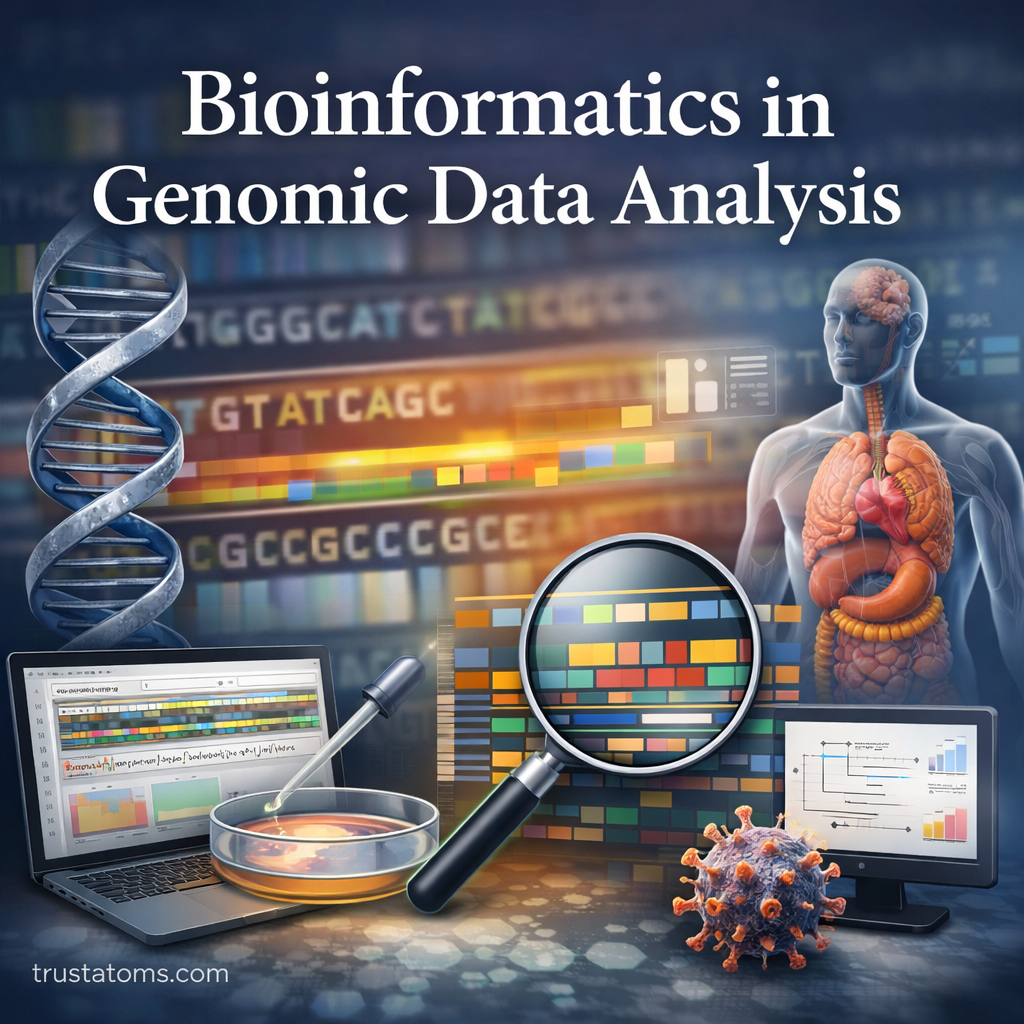
Genomic research has expanded rapidly over the past few decades, producing enormous volumes of biological data. Sequencing technologies can now generate millions or even billions of DNA reads in a single experiment. To make sense of this information, scientists rely on bioinformatics—a field that combines biology, computer science, statistics, and mathematics to analyze complex biological data.
Bioinformatics plays a crucial role in genomic data analysis, helping researchers interpret DNA sequences, identify genes, detect mutations, and understand how genetic variations influence health, disease, and evolution.
What Is Bioinformatics?
Bioinformatics is the interdisciplinary science focused on collecting, storing, processing, and analyzing biological data using computational tools.
In genomics, bioinformatics enables scientists to:
- Organize large DNA sequencing datasets
- Compare genomes between species or individuals
- Identify genes and regulatory regions
- Detect genetic mutations or variations
- Predict biological functions from sequence data
Without bioinformatics, modern genomics would be nearly impossible, since raw sequencing output is far too large and complex for manual analysis.
Why Bioinformatics Is Essential in Genomic Research
Modern sequencing technologies generate massive datasets. For example, sequencing a single human genome produces hundreds of gigabytes of raw data.
Bioinformatics provides the computational infrastructure needed to manage and interpret this information.
Key reasons bioinformatics is essential include:
- Handling large-scale genomic datasets
- Automating sequence comparison and analysis
- Identifying patterns within DNA sequences
- Supporting reproducible scientific workflows
- Integrating genomic data with clinical or environmental data
These capabilities allow researchers to uncover insights that would otherwise remain hidden within massive biological datasets.
Types of Genomic Data Analyzed Using Bioinformatics
Genomic studies generate many types of biological data. Bioinformatics tools help analyze and interpret each of these data forms.
DNA Sequence Data
DNA sequencing produces raw nucleotide sequences consisting of:
- Adenine (A)
- Thymine (T)
- Cytosine (C)
- Guanine (G)
Bioinformatics pipelines process these sequences to identify genes, mutations, and structural variations.
Gene Expression Data
Gene expression analysis measures how actively genes are being used by cells. Techniques such as RNA sequencing allow researchers to examine which genes are turned on or off under different conditions.
Bioinformatics tools analyze this data to identify patterns associated with diseases, environmental stress, or developmental stages.
Variant Data
Genomic variants represent differences in DNA sequences between individuals or populations. These differences include:
- Single nucleotide polymorphisms (SNPs)
- Insertions and deletions
- Structural variations
Bioinformatics tools detect and classify these variants, which can help explain genetic diseases and evolutionary relationships.
Key Steps in Genomic Data Analysis
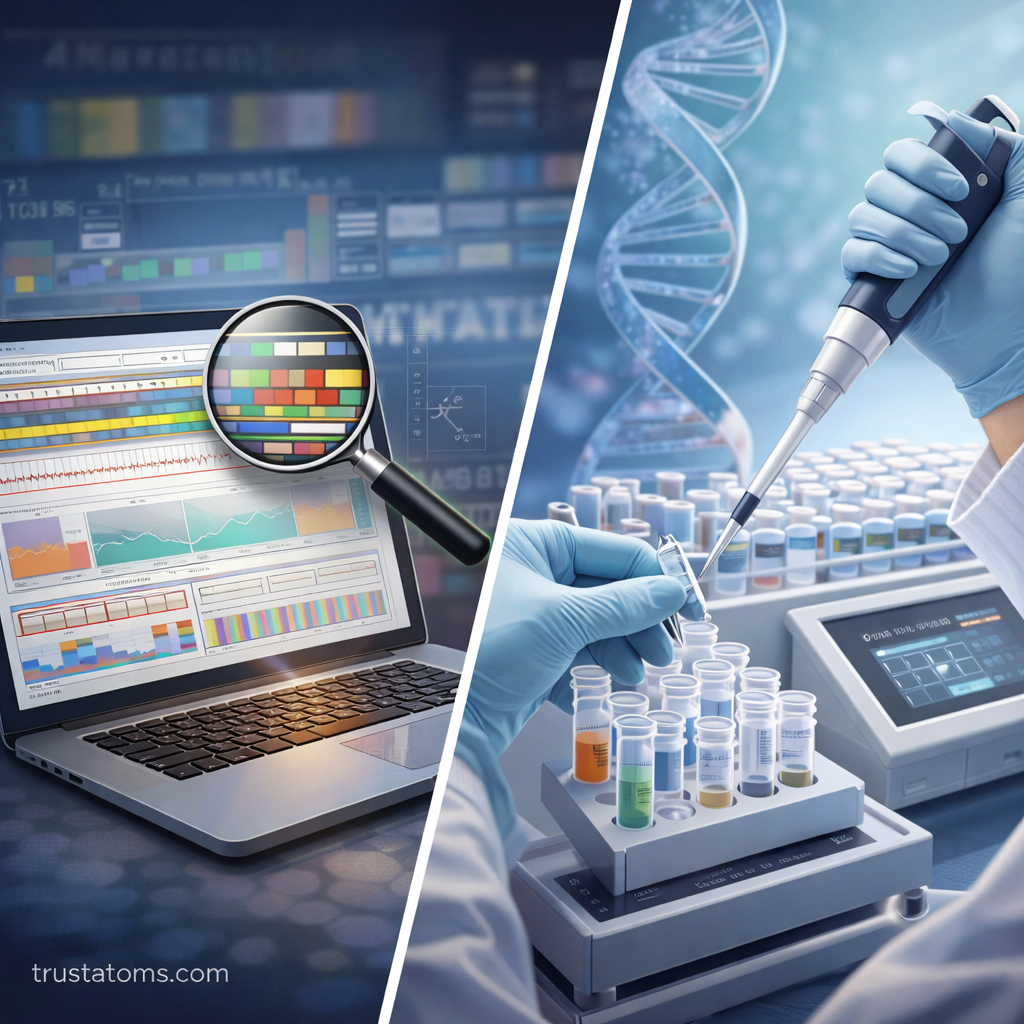
Bioinformatics workflows typically follow a series of steps that transform raw sequencing data into meaningful biological insights.
1. Data Acquisition
Genomic analysis begins with sequencing technologies such as next-generation sequencing (NGS). These technologies produce large sets of short DNA fragments called reads.
These reads are stored in specialized formats used by bioinformatics software.
2. Quality Control
Raw sequencing data often contains errors or low-quality reads.
Quality control tools evaluate sequencing accuracy and remove problematic data. Common quality checks include:
- Detecting sequencing errors
- Filtering low-quality reads
- Removing adapter sequences
This step ensures that downstream analyses are reliable.
3. Sequence Alignment
Sequence alignment maps short DNA reads to a reference genome, which serves as a template.
This process helps determine where each read originated within the genome.
Alignment tools allow researchers to:
- Reconstruct entire genomes
- Identify mutations
- Detect genomic rearrangements
4. Variant Calling
After alignment, bioinformatics tools analyze differences between the sample genome and the reference genome.
Variant calling identifies genetic differences such as:
- Point mutations
- Insertions
- Deletions
- Copy number changes
These variants can provide clues about disease risk or biological function.
5. Functional Annotation
Once variants or genes are identified, scientists interpret their biological meaning through annotation.
Annotation tools link genomic features to known information, including:
- Gene function
- Protein coding regions
- Regulatory elements
- Known disease associations
This step transforms raw genomic data into biological knowledge.
Common Bioinformatics Tools Used in Genomic Analysis
Many specialized software tools are used in genomic bioinformatics pipelines.
Some widely used categories include:
Sequence Alignment Tools
These programs align sequencing reads to reference genomes.
Examples include:
- Read mapping software
- Whole genome alignment tools
- Protein sequence comparison programs
Genome Assembly Tools
Genome assembly reconstructs full genomes from fragmented sequencing reads.
These tools are especially important for:
- Newly sequenced organisms
- Environmental genomics studies
- Microbial genome analysis
Variant Detection Tools
Variant analysis software identifies and classifies genetic differences across genomes.
These tools are widely used in:
- Disease genetics
- Population genomics
- Personalized medicine research
Visualization Platforms
Visualization tools help scientists explore genomic data interactively.
These platforms allow researchers to:
- View gene locations
- Examine mutation patterns
- Compare genomic regions across samples
Applications of Bioinformatics in Genomic Science
Bioinformatics-driven genomic analysis has applications across many areas of biology and medicine.
Medical Genetics
Bioinformatics helps identify mutations associated with inherited diseases and complex conditions such as cancer.
This information supports:
- Early diagnosis
- Targeted therapies
- Personalized medicine
Evolutionary Biology
Comparing genomes across species reveals how organisms evolved over time.
Bioinformatics allows scientists to:
- Trace evolutionary relationships
- Study natural selection
- Investigate species divergence
Infectious Disease Research
Genomic analysis of pathogens helps researchers understand how viruses and bacteria evolve.
Bioinformatics supports:
- Tracking disease outbreaks
- Identifying drug resistance mutations
- Developing vaccines
Agriculture and Crop Science
Bioinformatics helps improve crop traits by identifying genes linked to:
- Drought resistance
- Pest resistance
- Nutritional quality
Genomic insights can guide selective breeding and agricultural biotechnology.
Challenges in Genomic Bioinformatics
Despite its power, genomic data analysis presents several challenges.
Data Volume
Modern sequencing generates extremely large datasets that require powerful computing infrastructure and efficient storage systems.
Computational Complexity
Analyzing genomes involves sophisticated algorithms and statistical models that must process millions of data points accurately.
Data Interpretation
Identifying genetic variants is only the first step. Determining whether those variants affect biological function or disease risk remains a complex task.
Data Integration
Researchers increasingly combine genomic data with other biological datasets, such as:
- Proteomics
- Metabolomics
- Clinical health records
Integrating these diverse data sources requires advanced computational approaches.
The Future of Bioinformatics in Genomics
Bioinformatics continues to evolve alongside advances in sequencing technologies and artificial intelligence.
Emerging trends include:
- AI-driven genomic analysis
- Real-time genome sequencing
- Cloud-based bioinformatics platforms
- Integration of multi-omics datasets
- Personalized genomic medicine
As genomic data continues to grow, bioinformatics will remain essential for turning raw biological information into meaningful scientific discoveries.
Final Thoughts
Bioinformatics has become a cornerstone of modern genomic research. By combining computational tools with biological knowledge, scientists can analyze enormous genetic datasets and uncover insights into disease, evolution, and biological function.
As sequencing technologies continue to advance, the role of bioinformatics will only expand, helping researchers unlock deeper understanding of the genetic code that shapes all living organisms.