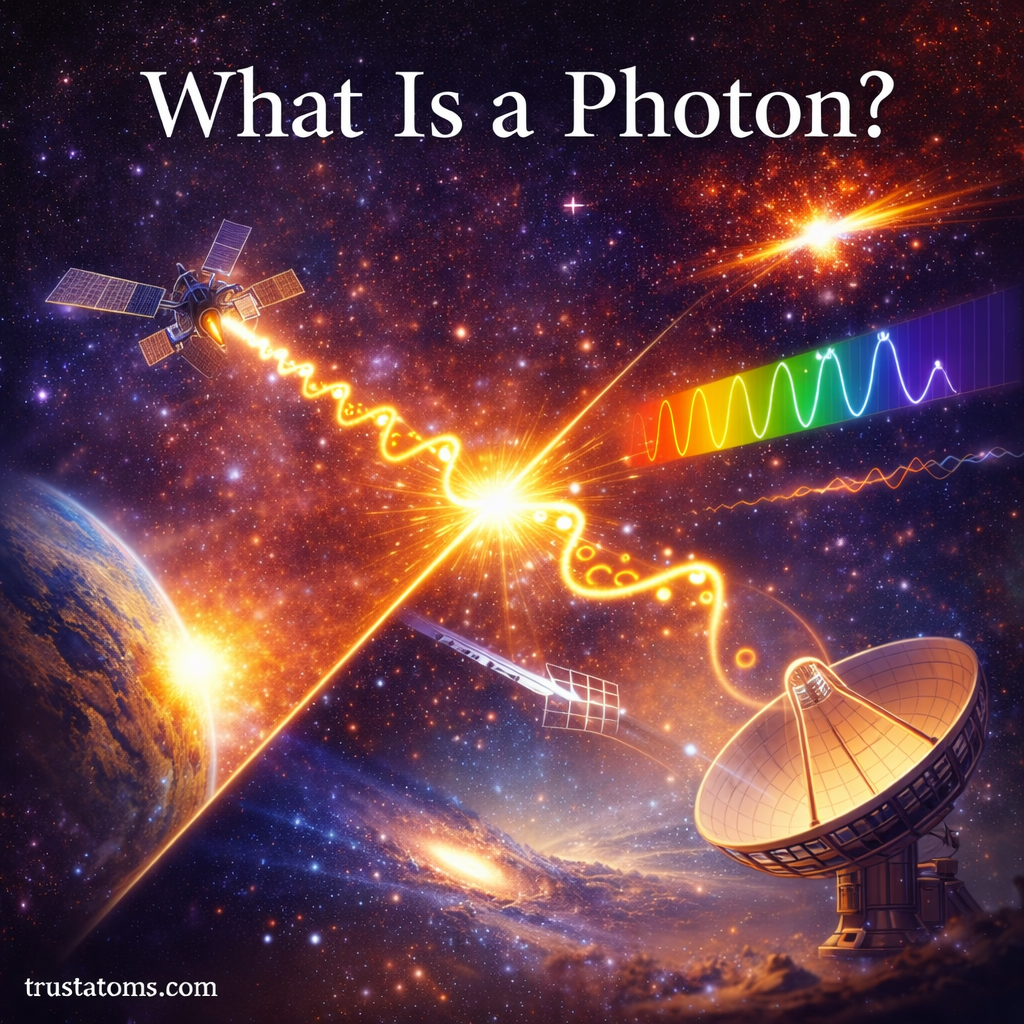
A photon is the fundamental particle of light and the carrier of the electromagnetic force. It is one of the most important particles in physics because it allows energy to travel through space in the form of electromagnetic radiation.
Photons are responsible for everything from visible light and radio waves to X-rays and gamma rays. Whenever light travels through space, it does so as a stream of photons.
Unlike many other particles, photons have no mass and move at the speed of light, making them unique in the world of physics.
The Basic Definition of a Photon
A photon is an elementary particle that represents a single unit (or quantum) of electromagnetic energy.
Photons are part of a larger category of particles called bosons, which are particles that transmit forces between matter.
Key characteristics of photons include:
- No rest mass
- No electric charge
- Always travel at the speed of light in a vacuum
- Carry energy and momentum
Photons are the particles that make up electromagnetic radiation, including:
- Visible light
- Infrared radiation
- Ultraviolet light
- Radio waves
- X-rays
- Gamma rays
Although these forms of radiation differ in energy and wavelength, they are all made of photons.
How Photons Were Discovered
The concept of the photon emerged during the early development of quantum physics.
In the late 19th century, scientists believed light behaved purely like a wave. However, experiments began revealing behavior that waves alone could not explain.
The Photoelectric Effect
In 1905, physicist Albert Einstein explained the photoelectric effect by proposing that light travels in discrete packets of energy.
These packets were later called photons.
The photoelectric effect showed that:
- Light can knock electrons out of metals
- The energy of the light depends on its frequency
- Light behaves like both a wave and a particle
Einstein’s work on this phenomenon earned him the 1921 Nobel Prize in Physics.
Wave–Particle Duality
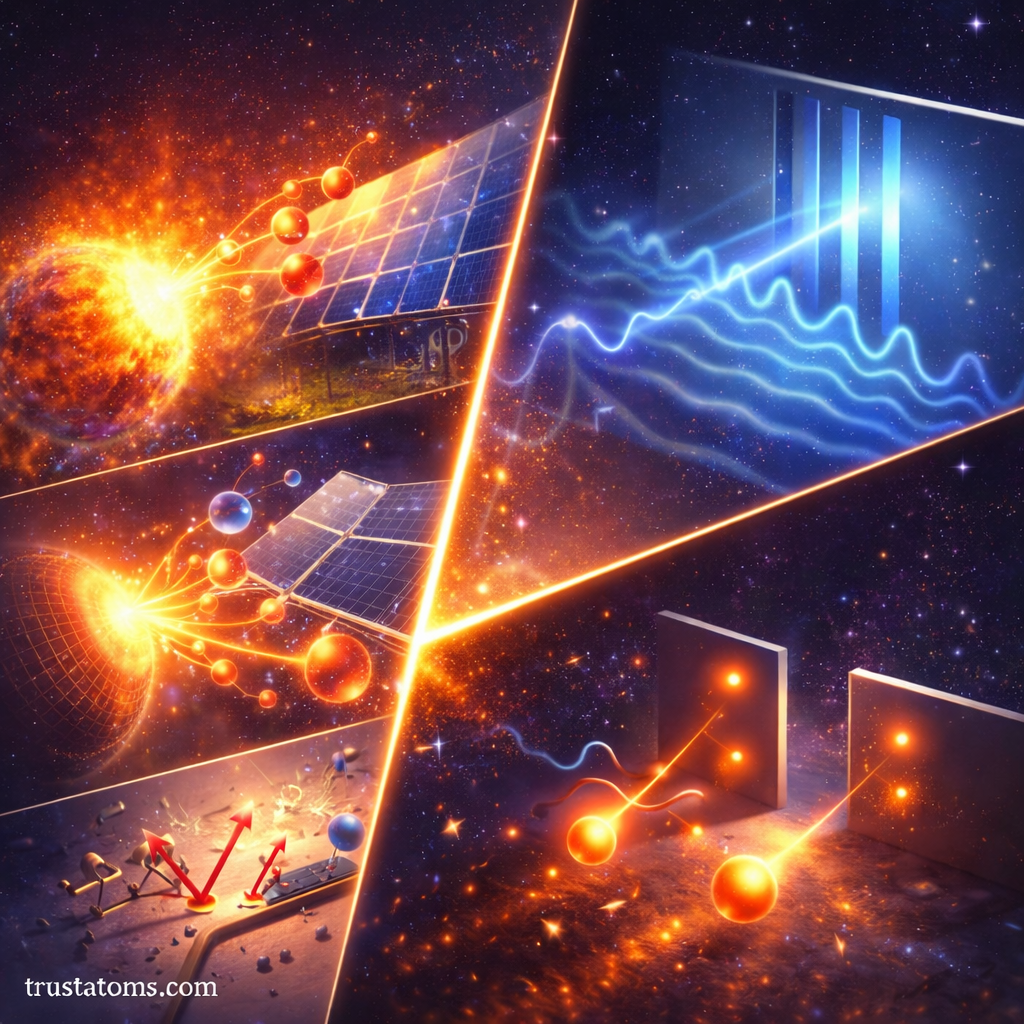
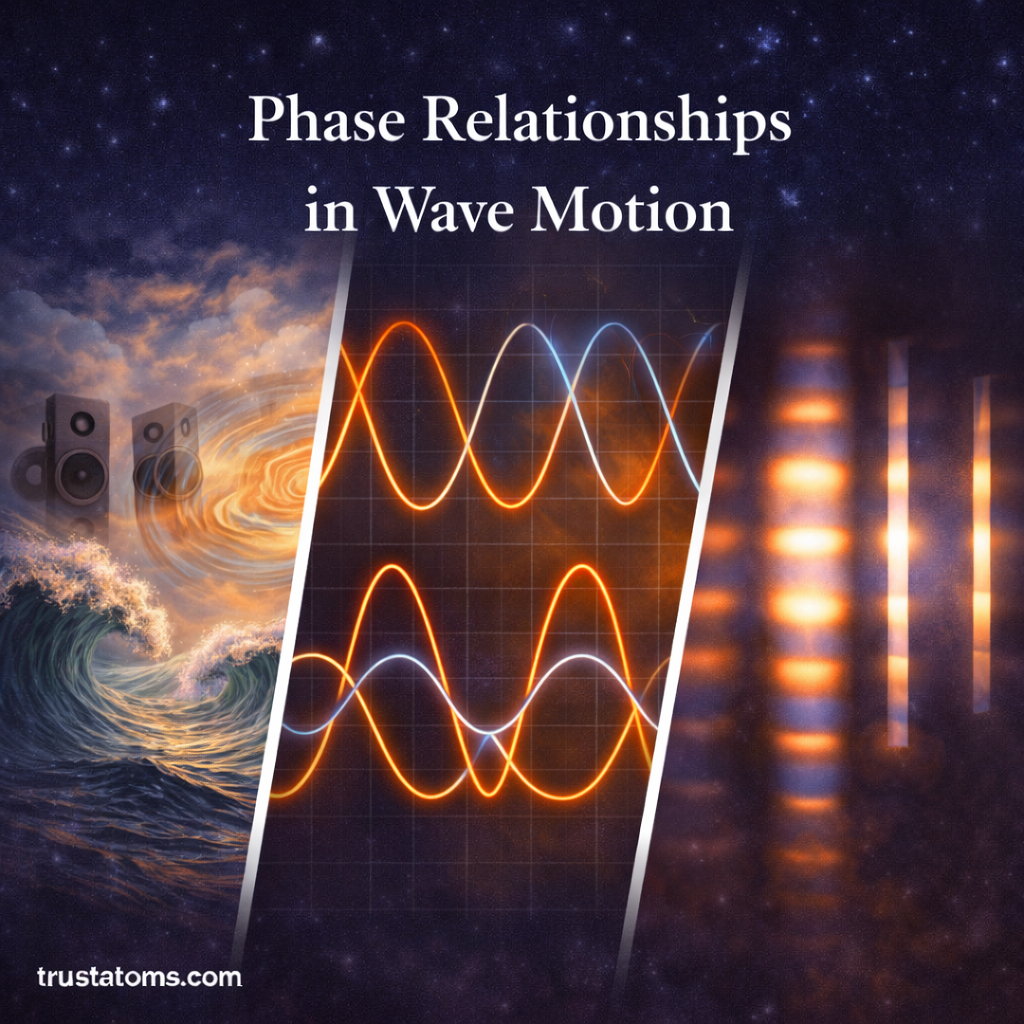
One of the most fascinating aspects of photons is that they display wave–particle duality.
This means photons behave both like:
- A wave, spreading out and forming interference patterns
- A particle, delivering energy in discrete units
Examples of wave behavior include:
- Diffraction
- Interference
- Refraction
Examples of particle behavior include:
- The photoelectric effect
- Individual photon detection in sensors
This dual nature is a key idea in quantum mechanics.
Properties of Photons
Photons have several unique properties that distinguish them from other particles.
Speed
Photons always travel at the speed of light in a vacuum, approximately:
300,000 kilometers per second (186,000 miles per second).
Nothing in the universe can move faster.
Energy
The energy of a photon depends on its frequency.
Higher frequency radiation carries more energetic photons.
Examples:
- Radio photons → low energy
- Visible light photons → moderate energy
- Gamma-ray photons → extremely high energy
Momentum
Even though photons have no mass, they still carry momentum.
This allows photons to exert pressure on objects, known as radiation pressure.
This principle is used in concepts such as solar sails for spacecraft.
Photons in the Electromagnetic Spectrum
Photons make up the entire electromagnetic spectrum.
Different types of electromagnetic radiation correspond to photons with different energies and wavelengths.
Major regions of the spectrum include:
- Radio waves
- Microwaves
- Infrared radiation
- Visible light
- Ultraviolet radiation
- X-rays
- Gamma rays
All of these forms of radiation travel as photons, even though they interact with matter differently.
How Photons Interact With Matter
Photons interact with matter in several important ways.
Absorption
Atoms can absorb photons, gaining energy.
This process occurs in:
- Photosynthesis
- Solar panels
- Light-sensitive sensors
Emission
Atoms can release photons when electrons drop to lower energy levels.
This produces light from sources such as:
- Stars
- Light bulbs
- Lasers
Scattering
Photons can also bounce off particles.
One example is Rayleigh scattering, which explains why the sky appears blue.
Why Photons Are Important
Photons play a central role in many natural processes and technologies.
Energy From the Sun
The Sun emits enormous numbers of photons.
These photons provide energy for:
- Earth’s climate
- Photosynthesis
- Solar power
Communication Technology
Many modern technologies rely on photons, including:
- Fiber optic internet
- Laser communication
- Satellite signals
Medical Imaging
Photons are used in several medical technologies:
- X-ray imaging
- Radiation therapy
- PET scans
These applications rely on the ability of photons to penetrate and interact with matter.
Photons in Modern Physics
Photons are essential to quantum field theory, where they are considered the force carrier of the electromagnetic interaction.
In the Standard Model of particle physics:
- Matter particles interact by exchanging photons
- These interactions produce electric and magnetic forces
This makes photons a key component in understanding how particles influence each other.
Final Thoughts
A photon is the fundamental particle of light and the carrier of electromagnetic energy. Although it has no mass and no electric charge, it plays a critical role in how energy moves throughout the universe.
From sunlight and lasers to fiber optic communication and quantum physics, photons are involved in countless natural phenomena and modern technologies.
By studying photons, scientists gain deeper insight into the behavior of light, energy, and the fundamental laws that govern the universe.