Chemical bonds allow atoms to join together and form molecules. While some bonds share electrons evenly, others distribute electrons unevenly between atoms. These unevenly shared bonds are called polar bonds, and they play a major role in chemistry, biology, and everyday life.
Polar bonds explain why water dissolves many substances, how biological molecules interact, and why some compounds behave differently from others. Understanding polar bonds helps reveal how atoms form stable molecules and how those molecules interact with their environment.
What Is a Polar Bond?
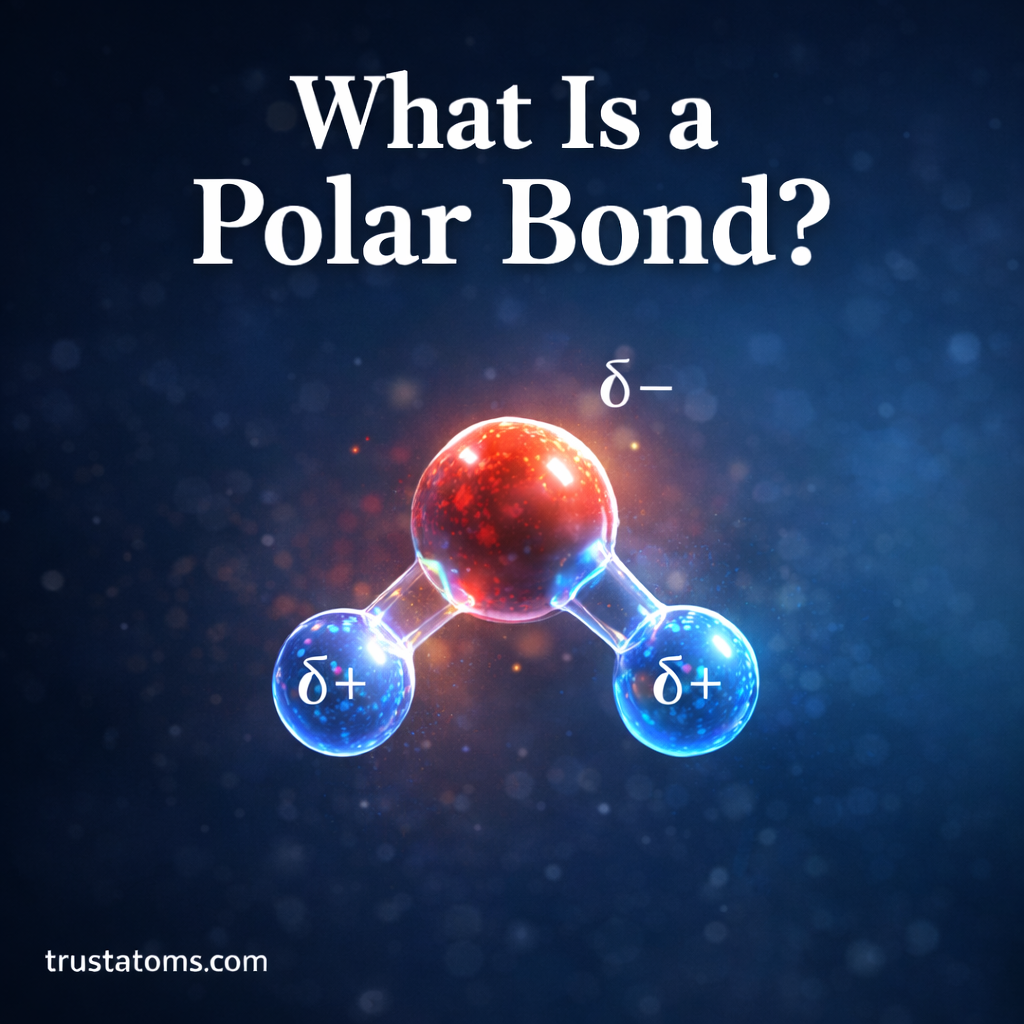
A polar bond is a type of covalent bond where electrons are shared unequally between two atoms.
This unequal sharing occurs because one atom attracts electrons more strongly than the other. The atom with the stronger pull gains a slightly negative charge, while the other atom develops a slightly positive charge.
This separation of charge creates a dipole, meaning the molecule has two poles:
- A partially negative end (δ−)
- A partially positive end (δ+)
Polar bonds are therefore sometimes described as partially charged covalent bonds.
Why Polar Bonds Form
Polar bonds form when atoms have different electronegativities.
Electronegativity is a measure of how strongly an atom attracts electrons in a chemical bond. When two bonded atoms differ in electronegativity, the electrons spend more time near the more electronegative atom.
The greater the difference in electronegativity, the more polar the bond becomes.
Key points about polar bond formation:
- Electrons are shared, but not equally
- The more electronegative atom pulls electrons closer
- Partial charges form within the bond
- A dipole moment develops
These features make polar bonds behave differently from nonpolar bonds.
Polar vs Nonpolar Bonds
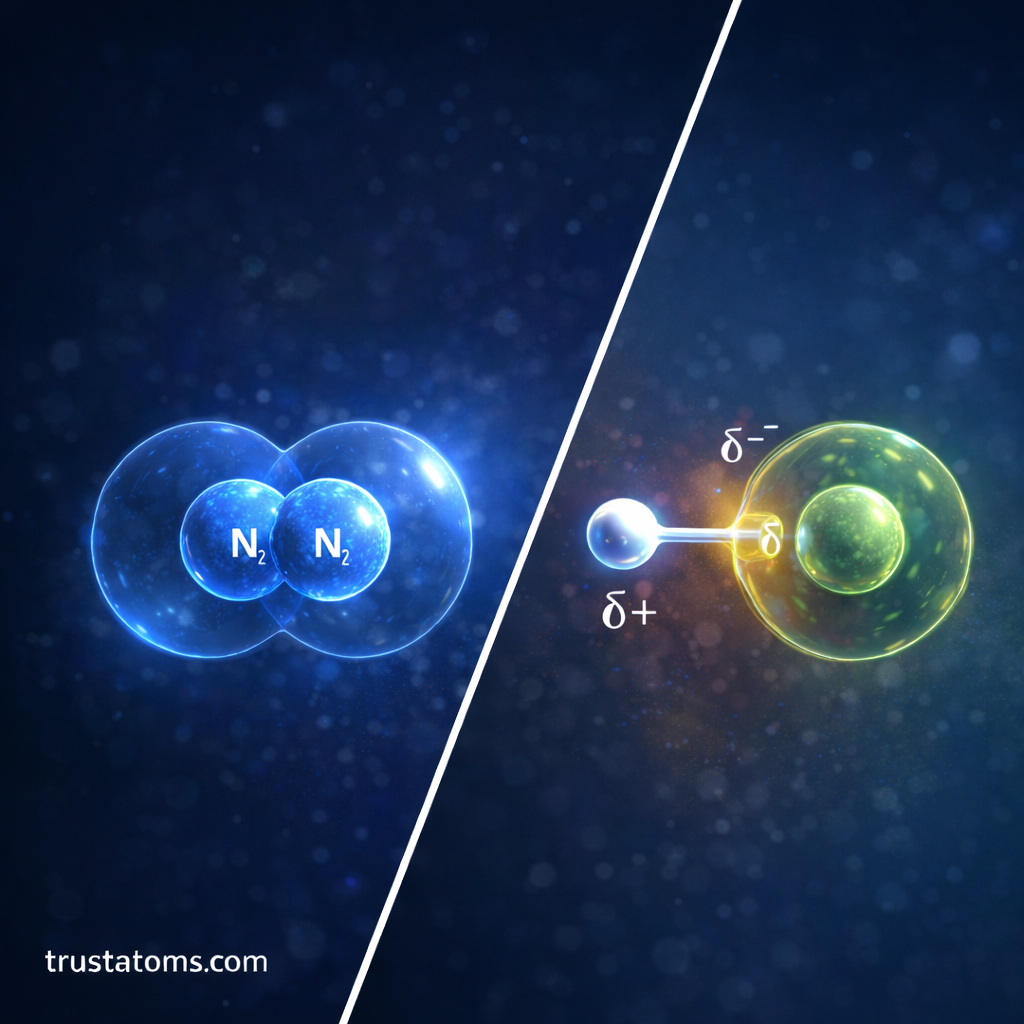
To understand polar bonds more clearly, it helps to compare them with nonpolar bonds.
Nonpolar Bonds
In nonpolar covalent bonds, electrons are shared equally between atoms.
This typically occurs when the atoms are identical or have very similar electronegativities.
Examples include:
- Hydrogen gas (H₂)
- Oxygen gas (O₂)
- Nitrogen gas (N₂)
Because the electrons are shared evenly, there are no partial charges.
Polar Bonds
In polar bonds, electrons are shared unevenly.
Examples include:
- Hydrogen chloride (HCl)
- Water (H₂O)
- Ammonia (NH₃)
In these molecules, one atom attracts electrons more strongly, creating positive and negative regions.
The Role of Electronegativity
Electronegativity differences determine whether a bond becomes polar.
A general guideline is:
- Very small difference → Nonpolar covalent bond
- Moderate difference → Polar covalent bond
- Large difference → Ionic bond
Examples of electronegativity differences:
- Carbon–Hydrogen → Mostly nonpolar
- Oxygen–Hydrogen → Polar
- Sodium–Chlorine → Ionic
Polar bonds exist in the middle range between purely covalent and purely ionic bonding.
Example of a Polar Bond: Water
One of the most well-known examples of polar bonding occurs in water (H₂O).
In a water molecule:
- Oxygen is more electronegative than hydrogen
- Oxygen pulls the shared electrons closer
- Oxygen becomes partially negative (δ−)
- Hydrogen atoms become partially positive (δ+)
Because of these partial charges, water molecules attract each other through hydrogen bonding, which gives water many of its unique properties.
These properties include:
- High boiling point
- Strong surface tension
- Excellent solvent ability
Without polar bonds, water would behave very differently.
How Polar Bonds Affect Molecules
Polar bonds influence the overall behavior of molecules.
When polar bonds are arranged asymmetrically in a molecule, they create a polar molecule. This means the molecule has an overall positive and negative side.
Important effects of molecular polarity include:
- Solubility in water
- Intermolecular forces
- Chemical reactivity
- Biological interactions
For example, many biological molecules depend on polarity to interact with proteins, enzymes, and cell membranes.
Polar Molecules vs Nonpolar Molecules
A molecule may contain polar bonds but still be nonpolar overall if the bond polarities cancel each other out.
Polar Molecules
Polar molecules have an uneven distribution of charge.
Examples include:
- Water (H₂O)
- Ammonia (NH₃)
- Hydrogen fluoride (HF)
These molecules often dissolve easily in water.
Nonpolar Molecules
Nonpolar molecules have no overall charge separation.
Examples include:
- Carbon dioxide (CO₂)
- Methane (CH₄)
- Oxygen gas (O₂)
Even if individual bonds are slightly polar, the molecular shape can cancel the dipole effects.
Why Polar Bonds Matter in Chemistry
Polar bonds help explain many chemical and physical properties of substances.
They influence:
- Molecular attraction
- Solubility
- Boiling points
- Chemical reactions
- Biological processes
Many essential processes in living organisms depend on polarity, including enzyme interactions and cell membrane behavior.
In chemistry, polarity also helps predict whether substances will mix or separate.
A common rule is:
“Like dissolves like.”
Polar substances tend to dissolve in other polar substances, while nonpolar substances dissolve in nonpolar environments.
Everyday Examples of Polar Bonds
Polar bonds appear in many substances we encounter daily.
Examples include:
- Water molecules in drinking water
- Ammonia used in household cleaners
- Hydrogen fluoride in industrial chemistry
- Alcohol molecules used in disinfectants
These polar molecules interact strongly with other polar substances, making them useful in many chemical applications.
Final Thoughts
A polar bond is a covalent bond in which electrons are shared unequally between atoms due to differences in electronegativity. This unequal sharing creates partial charges within the bond, forming positive and negative regions.
Polar bonds play an essential role in chemistry, influencing molecular behavior, intermolecular forces, and biological interactions. From water’s unique properties to the behavior of many chemical compounds, polar bonding helps explain how molecules interact and function in the natural world.
Understanding polar bonds provides a foundation for exploring broader topics such as molecular polarity, intermolecular forces, and chemical reactions.