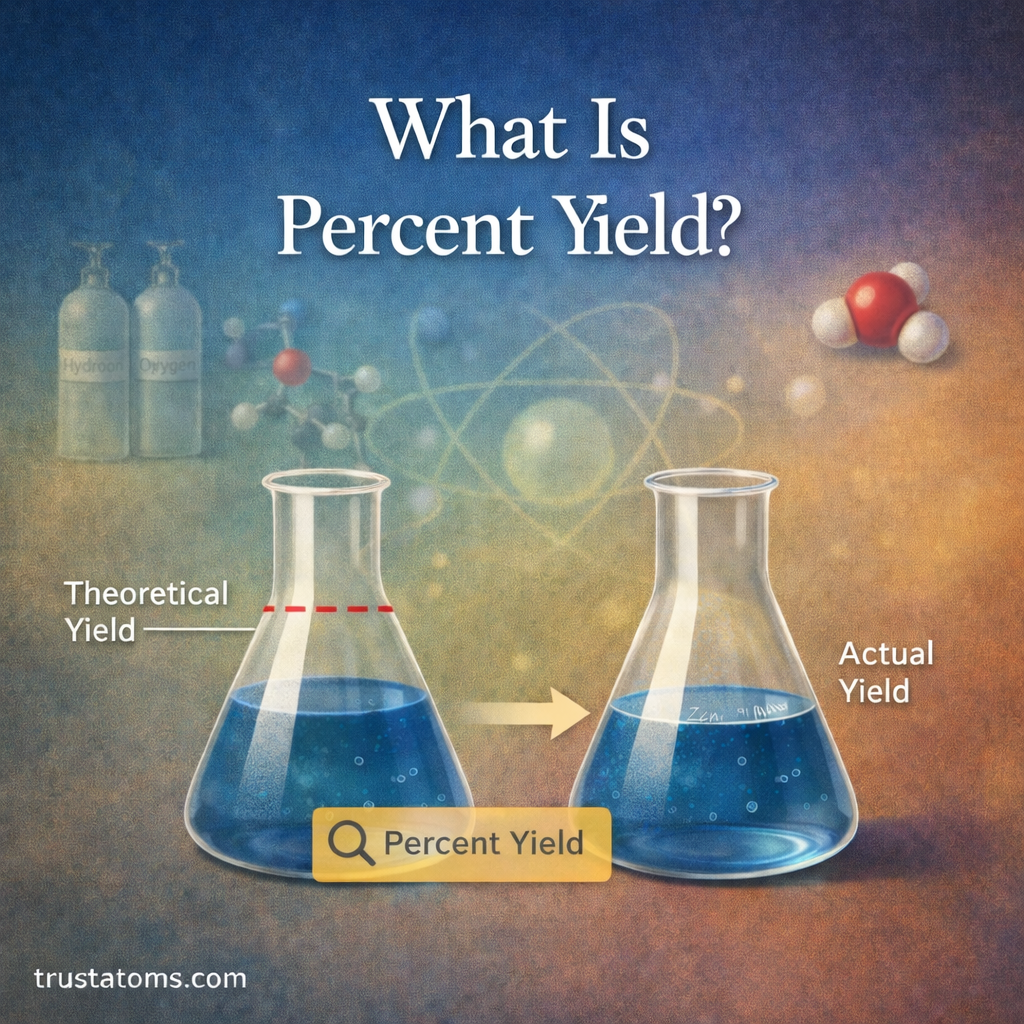
In chemistry, reactions rarely produce the exact amount of product predicted by calculations. Even with carefully controlled experiments, some materials may be lost, reactions may not go to completion, or side reactions may occur. Because of this, chemists use percent yield to measure how efficient a chemical reaction actually is.
Percent yield compares the amount of product obtained in a real experiment to the maximum amount that could theoretically be produced. This value helps scientists determine whether a reaction is working efficiently or if improvements are needed.
Understanding percent yield is an important skill in chemistry, especially when studying reaction efficiency, laboratory experiments, and industrial chemical processes.
Understanding Percent Yield in Chemistry
Percent yield is a measurement that tells chemists how close a reaction comes to producing the ideal amount of product.
It compares two important values:
- Theoretical yield – the maximum amount of product predicted using stoichiometry
- Actual yield – the amount of product actually produced during the experiment
By comparing these two values, chemists can determine the efficiency of a reaction.
A reaction that produces product close to the theoretical maximum will have a high percent yield, while one that produces less product will have a lower percent yield.
The Percent Yield Formula
Chemists calculate percent yield using a simple ratio.
\text{Percent Yield} = \frac{\text{Actual Yield}}{\text{Theoretical Yield}} \times 100
This equation converts the ratio into a percentage, making it easier to evaluate how successful the reaction was.
For example:
- If the actual yield equals the theoretical yield, the percent yield is 100%.
- If the actual yield is lower than the theoretical yield, the percent yield will be less than 100%.
Example of a Percent Yield Calculation
Consider a reaction where calculations predict that 12 grams of product should form.
After performing the experiment, the chemist collects 9 grams of product.
Step-by-step calculation:
- Identify the actual yield: 9 grams
- Identify the theoretical yield: 12 grams
- Divide actual yield by theoretical yield
- Multiply the result by 100
Calculation:
Percent yield = (9 ÷ 12) × 100
Percent yield = 75%
This means the reaction produced 75 percent of the maximum predicted product.
Why Percent Yield Is Important
Percent yield is widely used in chemistry because it provides insight into how efficiently a reaction occurs.
Chemists rely on percent yield to:
- Evaluate reaction performance
- Compare different experimental methods
- Identify sources of product loss
- Improve laboratory procedures
- Optimize industrial chemical processes
In large-scale manufacturing, even small improvements in percent yield can lead to significant cost savings.
Why Percent Yield Is Usually Less Than 100%
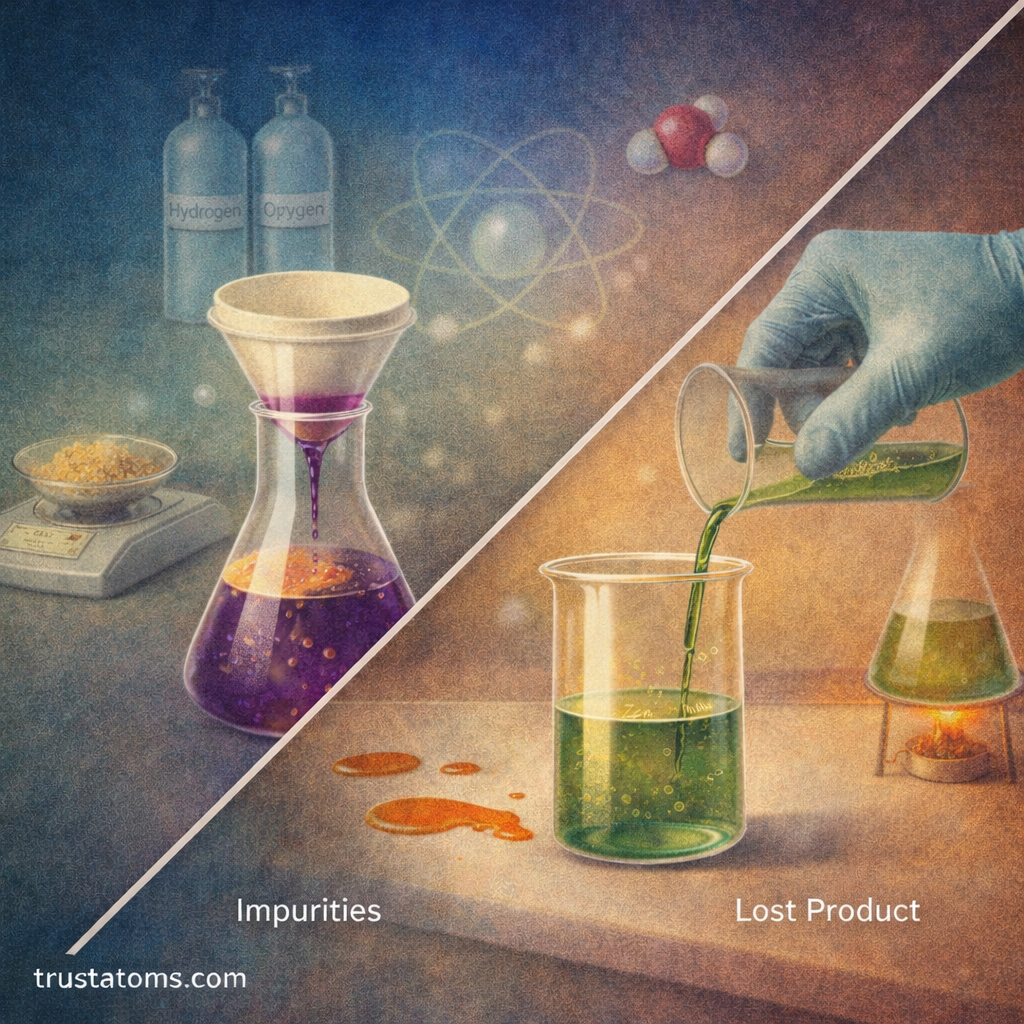
In most chemical reactions, percent yield is below 100 percent. Several factors contribute to this outcome.
Incomplete Reactions
Some reactants may remain unreacted because the reaction does not go to completion.
Side Reactions
Reactants sometimes form additional unwanted products instead of the desired compound.
Product Loss During Separation
Products may be lost during processes such as:
- filtration
- evaporation
- purification
- transfer between containers
Measurement Errors
Small errors in measuring reactants or products can affect yield calculations.
Because of these factors, real-world reactions rarely achieve perfect efficiency.
Can Percent Yield Be Greater Than 100%?
In theory, percent yield should not exceed 100 percent. However, experimental results can sometimes appear to give yields greater than 100%.
This usually happens because of:
- impurities in the product
- leftover solvents or water
- inaccurate measurements
- incomplete drying of the product
When this occurs, chemists re-examine the experiment to identify the source of the error.
Percent Yield in Industrial Chemistry
Percent yield plays a major role in large-scale chemical production.
Industries such as pharmaceuticals, plastics, fuels, and fertilizers depend on reactions that produce high yields. Improving percent yield can help companies:
- reduce raw material waste
- lower production costs
- improve manufacturing efficiency
- minimize environmental impact
Because of this, industrial chemists continuously refine reactions to maximize yield while maintaining safety and quality.
Tips for Improving Percent Yield in Experiments
Chemists often take steps to increase percent yield during laboratory work.
Common strategies include:
- carefully measuring reactants
- controlling temperature and pressure conditions
- minimizing product loss during transfer
- improving purification techniques
- preventing contamination
Attention to detail during experiments can significantly improve reaction outcomes.
Final Thoughts
Percent yield is a key concept in chemistry that measures the efficiency of chemical reactions. By comparing actual yield with theoretical yield, chemists can determine how successful a reaction was and identify ways to improve it.
From classroom experiments to industrial manufacturing, percent yield provides valuable insight into how chemical reactions behave in real-world conditions.