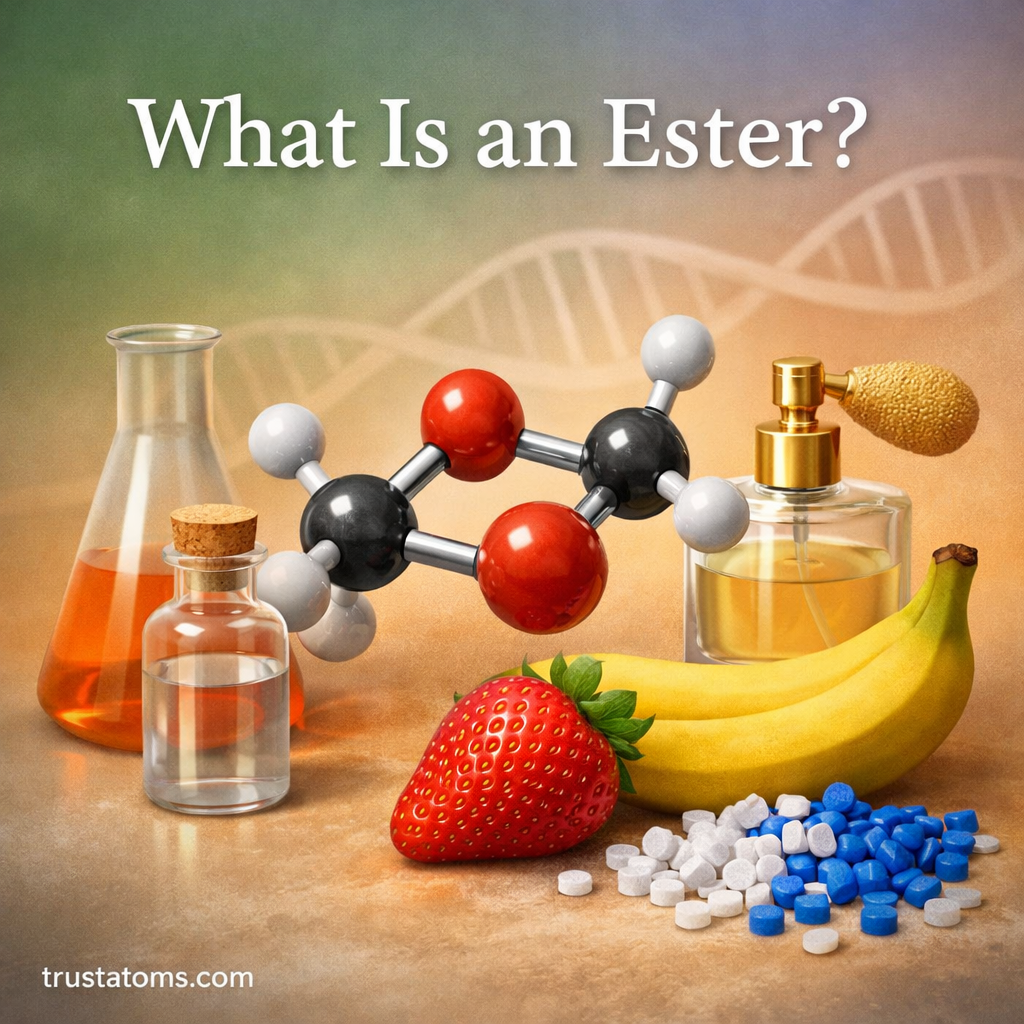
Esters are a class of organic compounds widely found in nature and commonly used in everyday products such as perfumes, flavorings, and solvents. Chemically, an ester forms when an alcohol reacts with a carboxylic acid in a process known as esterification.
These compounds are known for their pleasant, often fruity aromas, which is why they are frequently used in artificial flavorings and fragrances. Beyond their smells, esters also play important roles in biology, chemistry, and industrial manufacturing.
Understanding esters helps explain how many natural scents and flavors are produced, as well as how certain plastics, solvents, and biological molecules function.
The Basic Structure of an Ester
An ester is an organic molecule that contains a specific functional group known as the ester group. This group consists of a carbon atom bonded to:
- A double-bonded oxygen (C=O)
- A single-bonded oxygen connected to another carbon chain
In simplified terms, the structure looks like this:
R–COO–R′
Where:
- R represents a hydrocarbon chain from a carboxylic acid
- R′ represents a hydrocarbon chain from an alcohol
Because two different carbon chains are involved, esters can vary widely in structure and properties.
How Esters Form (Esterification)
Esters are typically produced through a chemical reaction called esterification. This occurs when a carboxylic acid reacts with an alcohol.
The reaction can be summarized as:
Carboxylic Acid + Alcohol → Ester + Water
Steps in the Process
- A carboxylic acid molecule interacts with an alcohol molecule.
- The molecules rearrange their bonds.
- A water molecule (H₂O) is released.
- The remaining atoms form a new ester compound.
This reaction often requires:
- Heat
- An acid catalyst (commonly sulfuric acid)
Because esterification is reversible, chemists sometimes remove the produced water to push the reaction toward forming more ester.
Common Examples of Esters
Many esters are responsible for the natural scents and flavors found in fruits. Different molecular structures create different aromas.
Examples include:
- Ethyl acetate – commonly used as a solvent and has a sweet smell
- Isoamyl acetate – gives bananas their characteristic aroma
- Ethyl butyrate – smells like pineapple
- Methyl salicylate – known as wintergreen oil
These compounds are often synthesized in laboratories and used in food flavoring and fragrance manufacturing.
Where Esters Are Found in Nature
Esters occur naturally in many biological systems.
Fruits and Plant Aromas
Many fruit scents come from mixtures of esters produced during ripening. These chemicals help attract animals that spread seeds.
Fats and Oils
Natural fats and oils are also related to esters. They are made from glycerol combined with fatty acids, forming molecules called triglycerides.
Triglycerides are essential energy storage molecules in living organisms.
Biological Molecules
Esters also appear in:
- Lipids
- Phospholipids in cell membranes
- Certain hormones and biochemical compounds
These molecules are important for cellular structure and metabolism.
Industrial Uses of Esters

Esters are extremely valuable in modern manufacturing and chemical industries.
Common Applications
- Perfumes and fragrances
Esters produce pleasant smells used in cosmetics and scented products. - Food flavorings
Artificial fruit flavors often rely on ester compounds. - Solvents
Esters such as ethyl acetate are used in paints, coatings, and nail polish removers. - Plastic and polymer production
Some plastics, including polyesters, are made from ester linkages. - Pharmaceuticals
Certain medicines contain ester groups that affect how drugs are absorbed in the body.
Properties of Esters
Esters share several chemical and physical characteristics.
Typical Ester Properties
- Often have pleasant fruity odors
- Usually volatile liquids
- Less polar than alcohols or acids
- Moderately soluble in water (especially small esters)
- Highly soluble in organic solvents
Their volatility and scent are why esters evaporate easily and carry aromas into the air.
How Esters Are Named
Chemists follow systematic naming rules for esters.
An ester’s name contains two parts:
- The alkyl group from the alcohol
- The acid-derived portion ending in -ate
Example
Ethyl acetate:
- Ethyl comes from ethanol (the alcohol)
- Acetate comes from acetic acid
This naming system helps chemists quickly understand the components that formed the ester.
Ester Hydrolysis (Breaking Esters Apart)
Esters can also undergo the reverse reaction called hydrolysis.
In hydrolysis:
Ester + Water → Carboxylic Acid + Alcohol
This reaction occurs:
- In acidic conditions
- In basic conditions (called saponification when fats are involved)
Saponification is the chemical process used to make soap from fats and oils.
Why Esters Are Important in Chemistry
Esters are important because they connect several major areas of chemistry:
- Organic synthesis
- Food chemistry
- Biochemistry
- Industrial manufacturing
They demonstrate how functional groups influence properties such as smell, solubility, and chemical reactivity.
Studying esters also introduces key chemical concepts like:
- Functional groups
- Reaction reversibility
- Catalysis
- Organic reaction mechanisms
Because they appear in nature, industry, and biology, esters are one of the most widely encountered classes of organic compounds.
Final Thoughts
An ester is an organic compound formed when an alcohol reacts with a carboxylic acid. Recognized by their distinctive –COO– functional group, esters are responsible for many natural fruit aromas and play vital roles in both biological systems and industrial chemistry.
From perfumes and flavorings to plastics and pharmaceuticals, esters demonstrate how simple molecular changes can lead to a wide range of useful materials.
Understanding esters provides a foundation for learning more advanced topics in organic chemistry and helps explain many everyday chemical phenomena.