The human brain is capable of incredible complexity, allowing us to think, reason, speak, plan, and interpret the world around us. At the center of these abilities is the cerebral cortex, the outer layer of the brain responsible for many of our highest cognitive functions.
From solving math problems to recognizing faces and forming memories, the cerebral cortex plays a key role in how we experience and understand reality. This article explores the structure of the cerebral cortex, the regions involved in higher processing, and how this remarkable brain layer enables complex human behavior.
What Is the Cerebral Cortex?
The cerebral cortex is the thin, wrinkled outer layer of the brain that covers the cerebral hemispheres. Although it is only about 2–4 millimeters thick, it contains billions of neurons that handle advanced information processing.
The cortex is responsible for many functions that distinguish humans from other animals, including:
- Conscious thought
- Language processing
- Decision-making
- Memory formation
- Sensory interpretation
- Voluntary movement control
The folds and ridges seen on the brain’s surface help increase the cortex’s surface area, allowing more neurons to fit within the skull.
Structure of the Cerebral Cortex
The cerebral cortex is divided into two hemispheres:
- Left hemisphere
- Right hemisphere
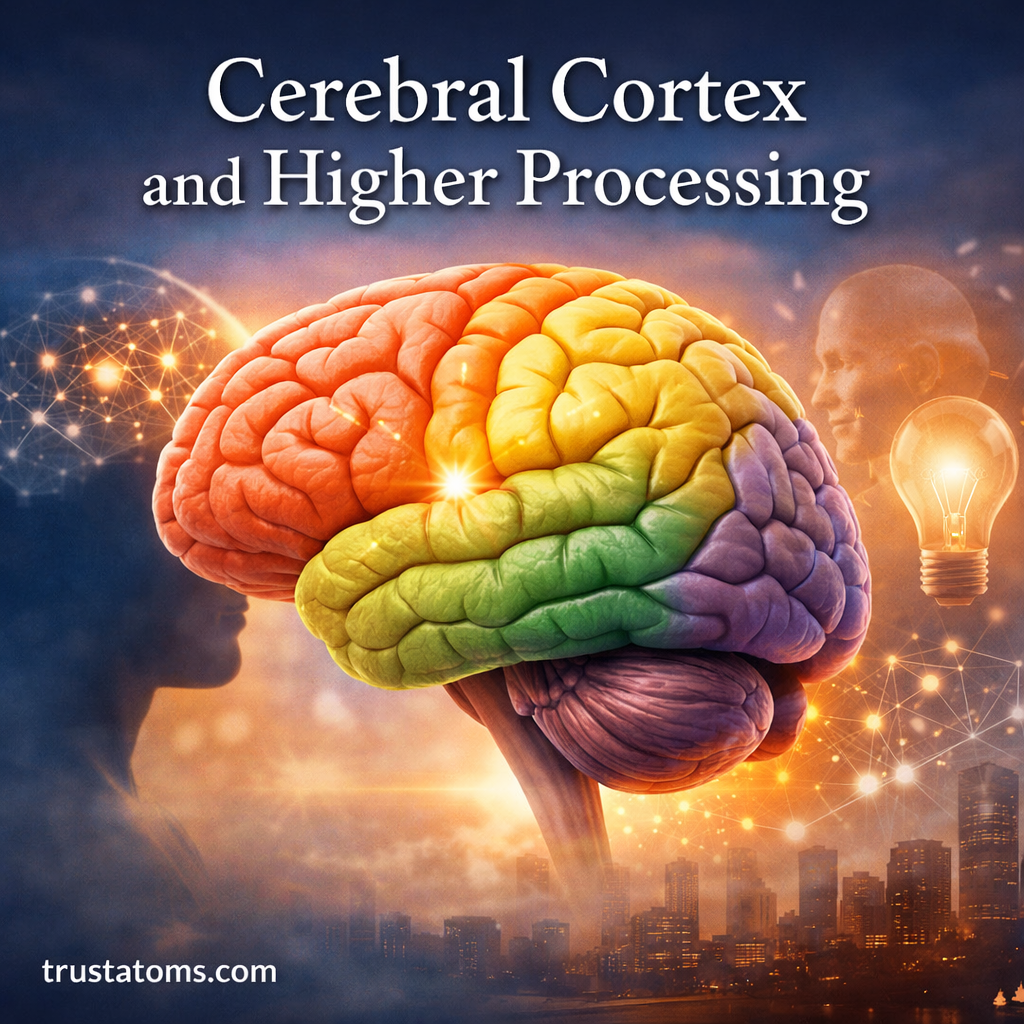
Each hemisphere is further divided into four main lobes, each with specialized functions.
The Four Lobes of the Cerebral Cortex
Frontal Lobe
The frontal lobe is involved in many executive functions and higher-level cognitive processes.
Key responsibilities include:
- Decision-making
- Planning and problem-solving
- Personality expression
- Voluntary movement control
- Speech production
The frontal lobe also houses the primary motor cortex, which controls voluntary muscle movement.
Parietal Lobe
The parietal lobe processes sensory information related to touch, pressure, temperature, and pain.
Functions include:
- Interpreting sensory input from the body
- Spatial awareness and orientation
- Integrating sensory information
The primary somatosensory cortex, located in this lobe, receives sensory signals from the skin, muscles, and joints.
Temporal Lobe
The temporal lobe is primarily associated with hearing, memory, and language comprehension.
Important roles include:
- Processing auditory information
- Understanding spoken language
- Memory formation
- Recognizing objects and faces
This region contains structures that work closely with the hippocampus, which is essential for forming new memories.
Occipital Lobe
The occipital lobe is responsible for processing visual information.
Key functions include:
- Interpreting shapes and colors
- Recognizing movement
- Identifying objects and faces
The primary visual cortex in this lobe receives signals from the eyes and converts them into meaningful visual perception.
Higher Processing in the Cerebral Cortex

Higher processing refers to complex mental activities that involve interpreting information, making decisions, and generating responses.
These processes depend on communication between multiple cortical regions rather than a single area.
Examples of higher processing include:
- Logical reasoning
- Language comprehension
- Abstract thinking
- Emotional regulation
- Long-term planning
- Creative problem solving
These abilities rely heavily on networks within the cortex that connect different brain regions.
Association Areas of the Cortex
While primary sensory and motor areas process basic information, association areas handle more advanced interpretation and integration.
Association areas allow the brain to combine information from different senses and apply it to decision-making.
Major functions of association areas include:
- Integrating sensory information
- Interpreting experiences
- Forming memories
- Supporting language and reasoning
For example, recognizing a friend’s face requires visual information from the occipital lobe, memory input from the temporal lobe, and interpretation by association areas.
The Role of the Prefrontal Cortex
The prefrontal cortex, located in the front portion of the frontal lobe, is one of the most advanced regions of the cerebral cortex.
It plays a critical role in:
- Complex decision-making
- Social behavior
- Self-control
- Goal setting
- Future planning
This region helps regulate impulses and allows individuals to evaluate consequences before taking action.
Damage to the prefrontal cortex can lead to changes in personality, poor judgment, and difficulty controlling behavior.
Communication Between Cortical Regions
The cerebral cortex works efficiently because its regions are interconnected through neural pathways.
Important communication structures include:
- Corpus callosum – connects the left and right hemispheres
- White matter tracts – bundles of nerve fibers linking cortical areas
- Thalamus connections – relay sensory signals to the cortex
These connections allow the brain to integrate information rapidly and coordinate complex behaviors.
Plasticity of the Cerebral Cortex
One of the most remarkable features of the cerebral cortex is neuroplasticity, the brain’s ability to reorganize itself by forming new neural connections.
Neuroplasticity allows the brain to:
- Adapt to new learning experiences
- Recover partially from injury
- Strengthen frequently used neural pathways
- Modify behavior through practice and repetition
This adaptability is especially strong during childhood but continues throughout life.
Why the Cerebral Cortex Matters
The cerebral cortex is essential for the abilities that define human intelligence and consciousness.
Without it, functions such as language, reasoning, creativity, and voluntary movement would not be possible.
Key contributions of the cerebral cortex include:
- Enabling conscious awareness
- Allowing complex problem-solving
- Supporting communication through language
- Coordinating sensory interpretation and response
In essence, the cerebral cortex transforms raw sensory input into meaningful thoughts, actions, and experiences.
Final Thoughts
The cerebral cortex represents the brain’s center for higher processing and advanced cognition. Through its interconnected regions and specialized lobes, it allows humans to interpret the world, communicate, make decisions, and learn from experience.
As neuroscience continues to advance, researchers are gaining deeper insights into how the cerebral cortex works and how its networks support everything from everyday decision-making to creativity and innovation.
Understanding this remarkable brain structure helps reveal how our thoughts, behaviors, and perceptions emerge from the complex activity of billions of neurons working together.