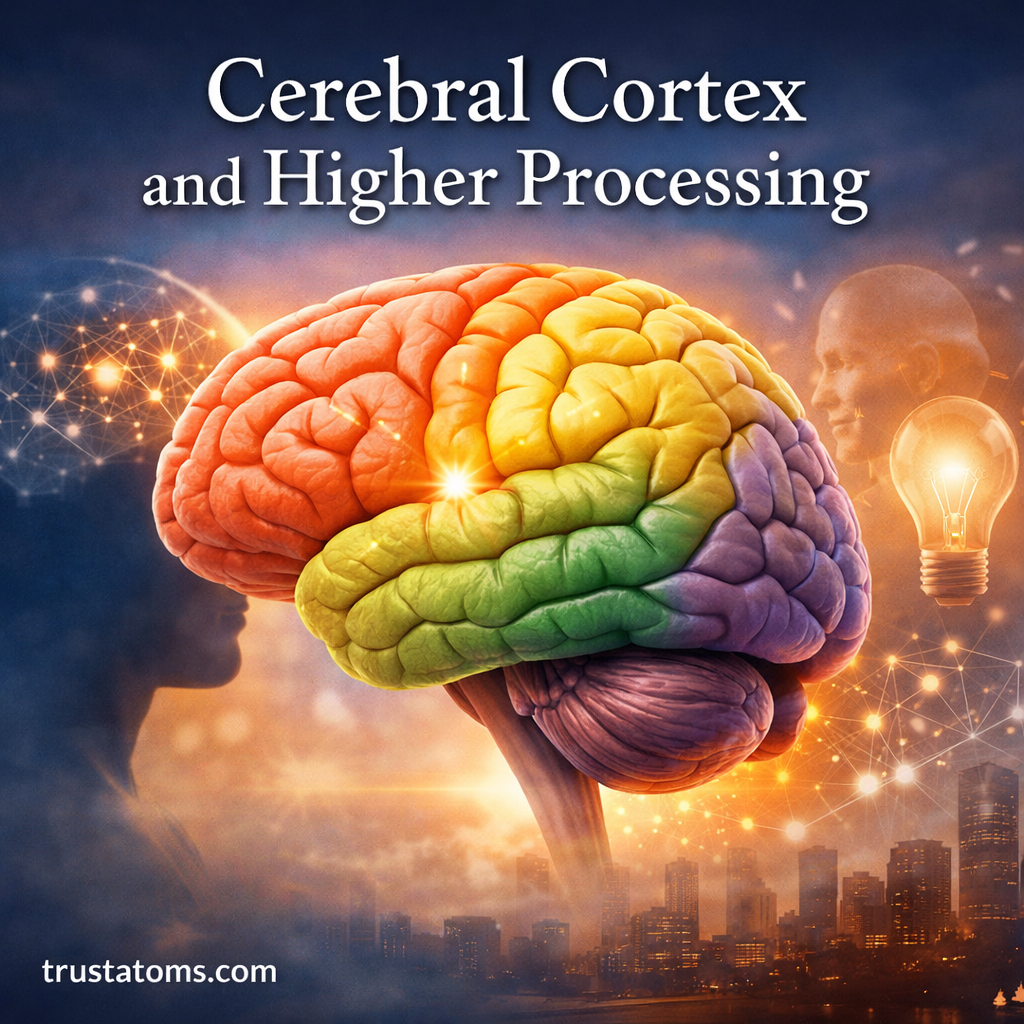
The cerebral cortex is the outer layer of the cerebrum that processes sensory information, controls voluntary movement, and supports higher mental functions such as reasoning, language, and decision-making. Higher processing occurs when interconnected cortical regions combine information, draw on previous experiences, and help the brain select appropriate responses.
Understanding the cerebral cortex connects brain structure with behavior, an important subject in human anatomy. From recognizing a familiar face to planning tomorrow’s activities, cortical networks work with other brain structures to support perception, memory, and purposeful action.
What Is the Cerebral Cortex?
The cerebral cortex is a thin layer of gray matter covering the two cerebral hemispheres. It is approximately 2–4 millimeters thick in many regions and contains billions of neurons arranged in interconnected networks.
Its surface contains raised folds called gyri and grooves called sulci. These folds increase the available surface area, allowing extensive neural tissue to fit inside the skull.
The left and right hemispheres share many functions but show some specialization. For example, language processing is predominantly left-lateralized in most people. The patterns and limitations of this specialization are explained in brain lateralization.
The cortex does not operate independently. The cerebellum helps refine movement and supports aspects of learning, as described in cerebellum function. Cortical networks also interact with the hippocampus and other structures involved in memory systems, particularly when forming and retrieving experiences.
The Four Lobes of the Cerebral Cortex
Each cerebral hemisphere is commonly divided into four major lobes. Although particular functions are associated with each lobe, most complex activities involve communication across several regions.
Frontal Lobe: Planning and Voluntary Movement
The frontal lobe occupies the front portion of the cerebral hemisphere. It supports planning, attention, decision-making, behavioral control, and voluntary movement.
The primary motor cortex, located near the back of the frontal lobe, sends commands involved in controlling skeletal muscles. In the language-dominant hemisphere, regions including Broca’s area contribute to speech production.
Parietal Lobe: Touch and Spatial Awareness
The parietal lobe processes bodily sensations and helps the brain understand where objects and body parts are located in space. Its primary somatosensory cortex receives information related to touch, pressure, and body position, while associated networks process temperature and pain.
Parietal regions also combine visual and sensory information to guide actions such as reaching for a cup or navigating around furniture.
Temporal Lobe: Hearing, Language, and Memory
The temporal lobe contains cortical areas involved in hearing, language comprehension, object recognition, and memory processing. The primary auditory cortex receives sound-related information, while additional regions help interpret speech and recognize familiar sounds.
Medial temporal structures, including the hippocampus, contribute to forming new declarative memories. These structures interact with cortical regions where different aspects of remembered experiences are represented.
Occipital Lobe: Visual Processing
The occipital lobe is located at the back of the brain and specializes in visual processing. Its primary visual cortex receives signals relayed from the retina through the thalamus.
Additional visual regions analyze features such as color, shape, and motion. Recognizing an object requires further processing through networks extending into the temporal and parietal lobes.
How the Cerebral Cortex Performs Higher Processing

Higher processing refers to mental activities that require more than detecting a sensation or producing a simple movement. These activities include interpreting information, comparing alternatives, retrieving memories, solving problems, and planning actions.
Consider reading a message that asks you to meet a friend at a new location. Visual regions process the written words, language networks interpret their meaning, memory systems provide relevant experiences, and frontal and parietal networks help plan the route and decide when to leave.
This everyday task illustrates how higher processing depends on coordinated activity across the brain rather than one isolated center responsible for thinking.
Association Areas Combine Information
Primary sensory areas receive and initially process specific types of input, while primary motor areas contribute to movement commands. Association areas participate in interpreting information, connecting it with previous knowledge, and coordinating more complex responses.
For example, recognizing a friend’s face involves visual processing in occipital and temporal regions, interaction with memory networks, and potentially emotional responses supported by other brain structures.
Association processing is distributed across multiple networks. No single association area performs all reasoning, recognition, or conscious thought.
The Prefrontal Cortex and Executive Functions
The prefrontal cortex occupies the anterior portion of the frontal lobe and supports executive functions: mental processes that help people organize behavior toward goals.
These functions include working memory, attention regulation, impulse control, planning, and evaluating possible consequences. Working memory temporarily maintains information needed for a task, such as remembering a short set of instructions while carrying them out.
Prefrontal damage can affect judgment, emotional regulation, personality, and the ability to organize daily activities. The effects depend on which regions and connections are affected.
Communication Between Cortical Regions
The cerebral cortex works efficiently because its regions are interconnected through neural pathways.
Bundles of nerve fibers within the brain’s white matter transmit signals between cortical regions and other structures. Several types of connections support this communication:
- Association fibers: Connect cortical areas within the same hemisphere.
- Commissural fibers: Connect the hemispheres, particularly through the corpus callosum.
- Projection fibers: Connect the cortex with structures such as the thalamus, brainstem, and spinal cord.
The thalamus relays and helps regulate many signals traveling to the cortex. Together, these pathways allow sensory information, memory-related activity, and motor commands to be coordinated across different parts of the nervous system.
Plasticity of the Cerebral Cortex
Neuroplasticity is the nervous system’s ability to change its organization and connections in response to experience, learning, or injury. In the cerebral cortex, repeated activity can strengthen or weaken communication between neurons and modify how networks process information.
Learning a musical instrument offers an example. Repeated practice engages sensory, motor, auditory, and attention networks, and experience can gradually change how efficiently these networks work together.
These processes are examined in neural plasticity in learning, including how practice and experience influence neural connections.
Plasticity is especially prominent during development but continues throughout adulthood. Following brain injury, it may support some functional recovery, although the extent varies considerably.
What Happens When Cortical Regions Are Damaged?
Damage to the cerebral cortex can affect different abilities depending on the location and extent of injury. Stroke, traumatic brain injury, tumors, and neurological diseases may disrupt cortical tissue or its connections.
- Damage to motor regions may cause weakness or difficulty controlling movement.
- Injury to language-related regions may produce aphasia, affecting speech or comprehension.
- Occipital damage may impair portions of the visual field.
- Prefrontal injury may interfere with planning, attention, and behavioral regulation.
Because brain functions depend on networks, damage to connections can also produce difficulties even when a particular cortical region remains intact.
Frequently Asked Questions
Is the cerebral cortex responsible for all thinking?
No. The cortex supports many cognitive functions, but thinking also depends on interactions with structures such as the thalamus, hippocampus, basal ganglia, and cerebellum. Complex cognition emerges from coordinated activity across these networks.
What is the difference between the cerebrum and cerebral cortex?
The cerebrum includes the cerebral cortex, underlying white matter, and deeper structures. The cerebral cortex is specifically the outer gray matter layer covering the cerebral hemispheres.
Can the cerebral cortex change as adults learn?
Yes. Adult cortical networks retain the capacity for plasticity. Learning and repeated practice can modify synaptic connections and patterns of neural activity, although the degree of change depends on experience, age, and other factors.
The cerebral cortex supports higher processing through specialized regions that communicate within larger brain networks. Its frontal, parietal, temporal, and occipital lobes contribute different kinds of information, while association areas and connections integrate those signals into perception, decisions, and actions. Cortical plasticity also allows these networks to adapt as people learn and respond to new experiences.
This article is for general education and is not medical advice. Talk to a qualified health professional about any medical concern.
Sources: Kandel et al., Principles of Neural Science; Purves et al., Neuroscience; National Institute of Neurological Disorders and Stroke.