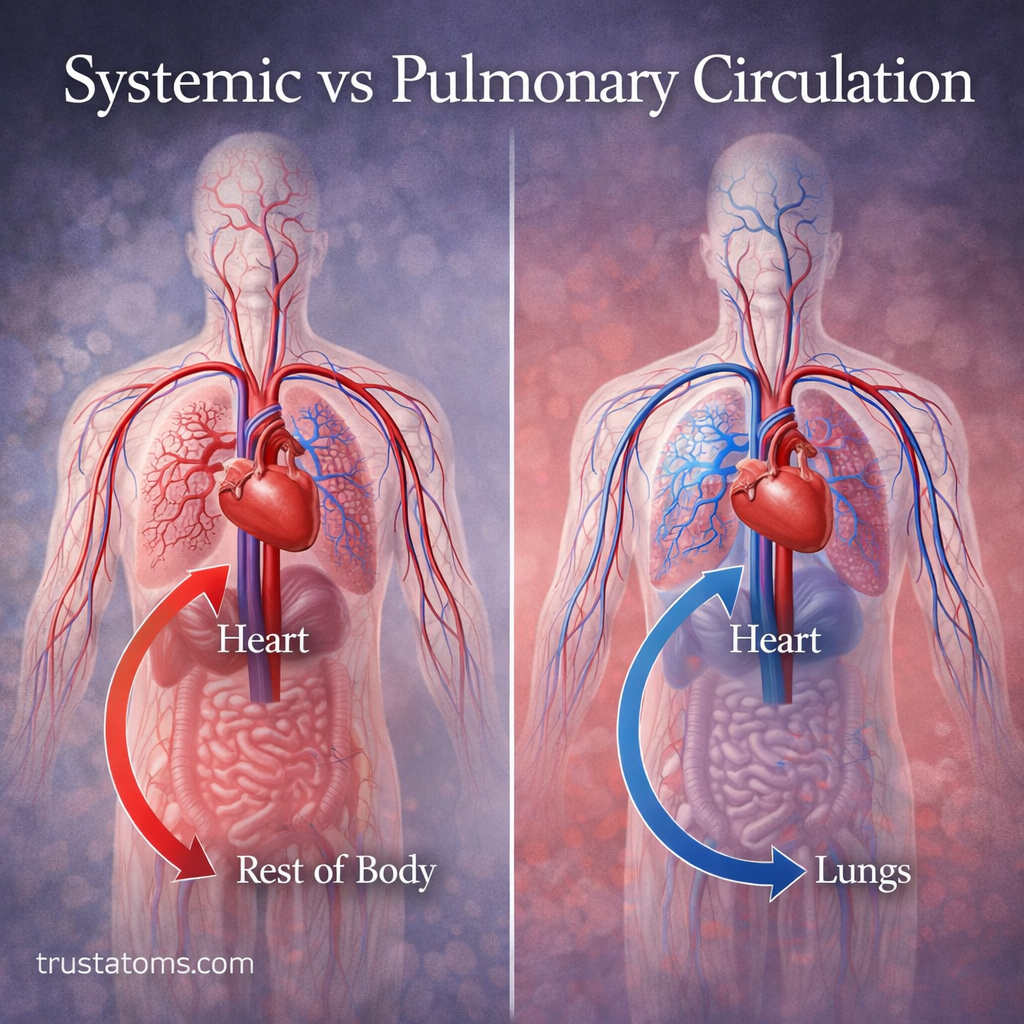
Your circulatory system is responsible for transporting oxygen, nutrients, and waste products throughout your body. At the core of this system are two essential pathways: systemic circulation and pulmonary circulation.
While they work together seamlessly, each serves a distinct purpose. Understanding how these two types of circulation differ—and how they connect—helps explain how your body stays alive and functioning every second.
What Is Circulation?
Circulation refers to the continuous movement of blood through the heart and blood vessels.
Its primary roles include:
- Delivering oxygen and nutrients to tissues
- Removing carbon dioxide and waste products
- Supporting immune function
- Regulating body temperature
This process is powered by the heart and divided into two main loops.
Overview of the Two Circulatory Pathways
The human circulatory system is made up of:
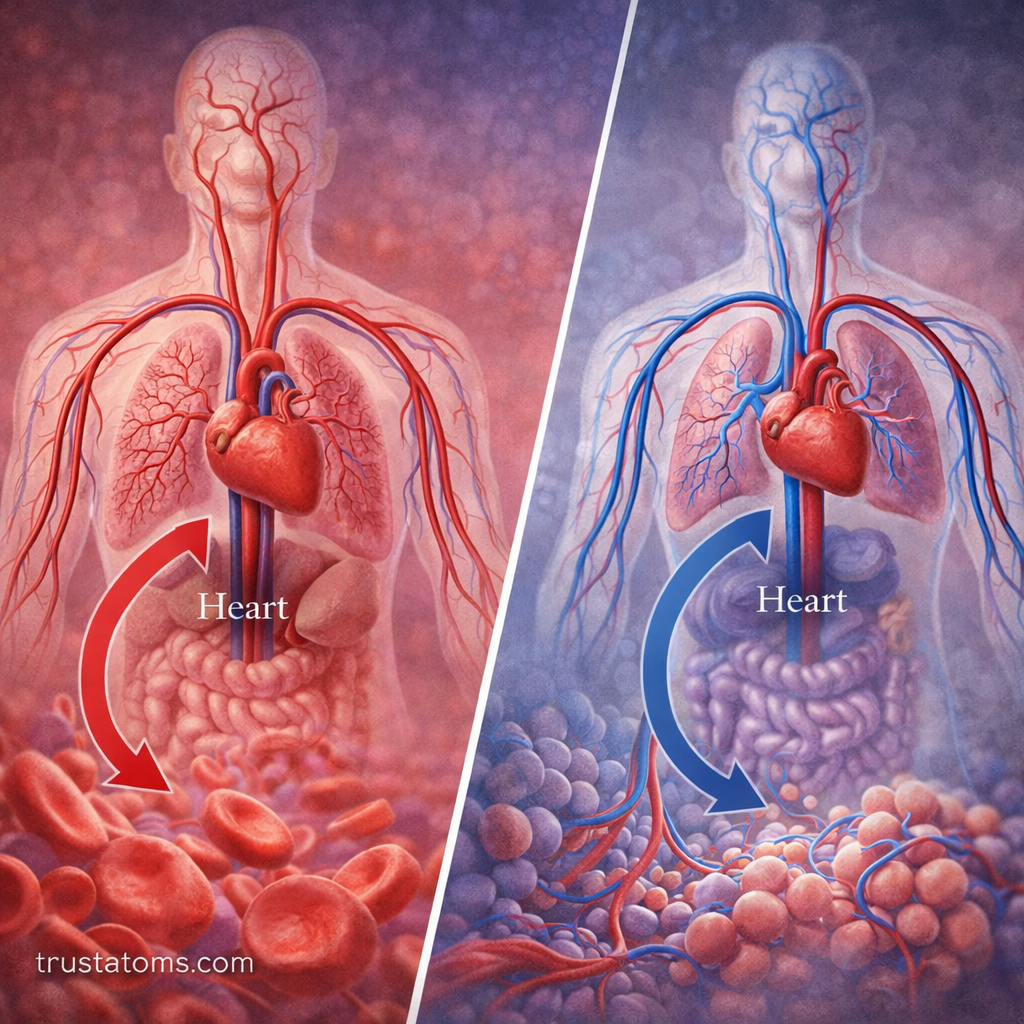
- Pulmonary circulation (heart ↔ lungs)
- Systemic circulation (heart ↔ rest of the body)
These two pathways form a closed-loop system, ensuring blood is constantly moving and being refreshed with oxygen.
What Is Pulmonary Circulation?
Pulmonary circulation is the pathway that carries blood between the heart and the lungs.
Main function:
- To oxygenate blood and remove carbon dioxide
How it works:
- Deoxygenated blood enters the right side of the heart
- It is pumped into the pulmonary arteries
- Blood travels to the lungs
- Carbon dioxide is released, and oxygen is absorbed
- Oxygen-rich blood returns to the left side of the heart
This process prepares blood to supply the rest of the body.
What Is Systemic Circulation?
Systemic circulation moves oxygen-rich blood from the heart to the rest of the body and back.
Main function:
- To deliver oxygen and nutrients to tissues
How it works:
- Oxygenated blood leaves the left side of the heart
- It travels through arteries to body tissues
- Cells use oxygen and nutrients
- Deoxygenated blood returns via veins
- Blood flows back to the right side of the heart
This loop supports every organ and system in your body.
Key Differences Between Systemic and Pulmonary Circulation
Understanding the differences helps clarify their unique roles.
Pulmonary circulation:
- Involves the lungs
- Carries deoxygenated blood away from the heart
- Returns oxygenated blood to the heart
- Shorter and lower-pressure system
Systemic circulation:
- Involves the entire body
- Carries oxygenated blood away from the heart
- Returns deoxygenated blood to the heart
- Longer and higher-pressure system
How the Two Systems Work Together
Systemic and pulmonary circulation are not separate—they are interconnected parts of a single continuous cycle.
The cycle looks like this:
- Blood returns from the body to the right side of the heart
- It is sent to the lungs via pulmonary circulation
- Oxygenated blood returns to the left side of the heart
- It is pumped throughout the body via systemic circulation
This cycle repeats continuously, ensuring oxygen delivery and waste removal.
Role of the Heart in Circulation
The heart acts as a dual pump, coordinating both circulatory pathways.
Right side of the heart:
- Pumps blood to the lungs (pulmonary circulation)
Left side of the heart:
- Pumps blood to the body (systemic circulation)
This separation ensures efficient oxygenation and distribution.
Why Pressure Differences Matter
The two circulatory systems operate under different pressures.
Pulmonary circulation:
- Lower pressure
- Protects delicate lung tissues
- Allows efficient gas exchange
Systemic circulation:
- Higher pressure
- Needed to push blood throughout the entire body
- Ensures oxygen reaches distant tissues
Maintaining this balance is essential for proper function.
What Happens When Circulation Is Disrupted?
Problems in either system can affect overall health.
Pulmonary circulation issues:
- Pulmonary hypertension
- Reduced oxygen exchange
- Shortness of breath
Systemic circulation issues:
- High blood pressure (hypertension)
- Poor blood flow to organs
- Increased risk of heart disease
Because the systems are connected, issues in one often affect the other.
Simple Comparison Summary
Here’s a quick side-by-side overview:
Pulmonary Circulation:
- Heart ↔ lungs
- Oxygenates blood
- Lower pressure
- Shorter pathway
Systemic Circulation:
- Heart ↔ body
- Delivers oxygen and nutrients
- Higher pressure
- Longer pathway
Final Thoughts
Systemic and pulmonary circulation are essential components of the human circulatory system. Together, they create a continuous loop that keeps oxygen flowing, nutrients delivered, and waste removed.
By working in perfect coordination, these two systems support every function in your body—from breathing to movement to cellular repair.
Understanding how they differ—and how they connect—provides a clearer picture of how your body sustains life every moment.