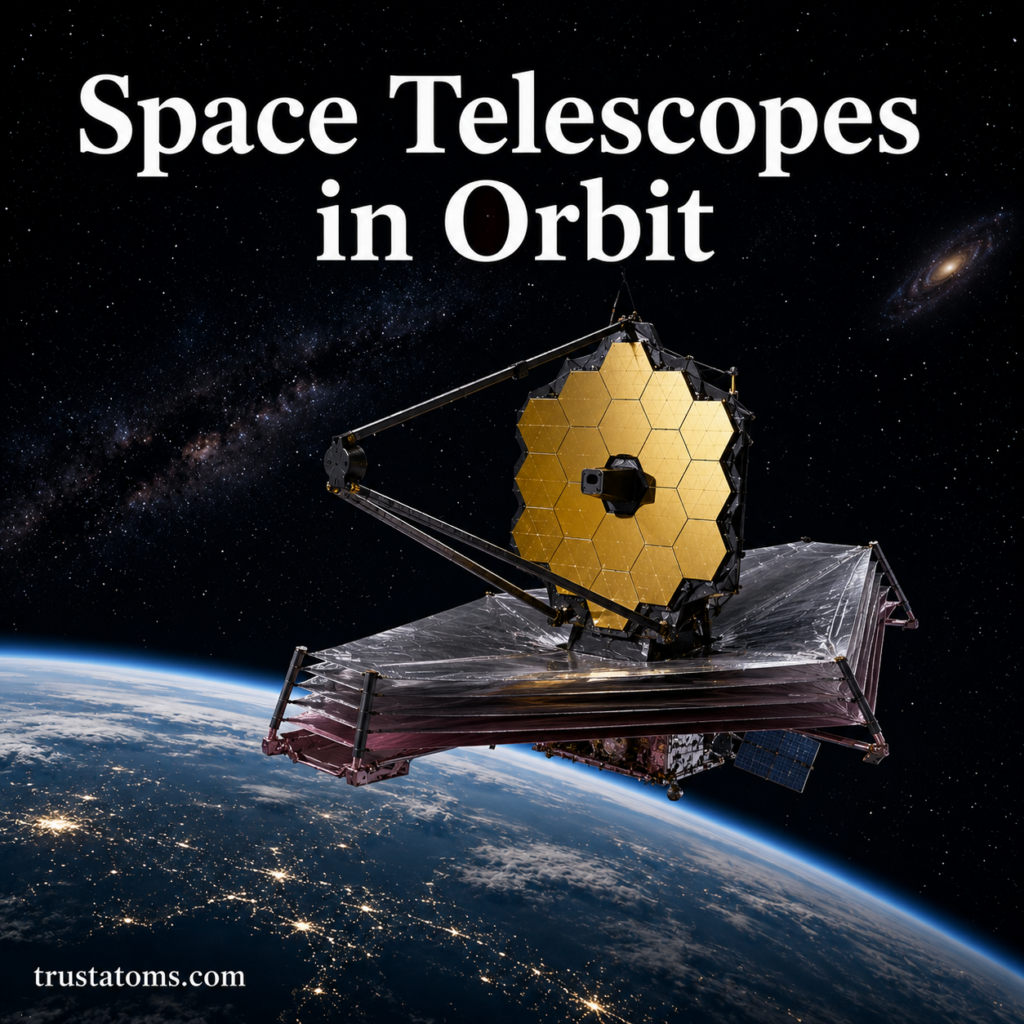
Space telescopes have revolutionized astronomy by allowing scientists to observe the universe without interference from Earth’s atmosphere. Positioned high above the planet, these powerful observatories capture images and data from distant stars, galaxies, planets, and cosmic events with remarkable clarity.
From studying black holes to discovering exoplanets, space telescopes continue to expand humanity’s understanding of the universe.
What Are Space Telescopes?
Space telescopes are astronomical observatories placed in orbit around Earth or at strategic points in space.
Unlike ground-based telescopes, they operate outside Earth’s atmosphere, which means they avoid:
- Atmospheric distortion
- Weather interference
- Light pollution
This allows them to collect clearer and more detailed observations across multiple wavelengths of light.
Why Telescopes Are Placed in Space
Earth’s atmosphere blocks or distorts many forms of electromagnetic radiation.
Advantages of Space-Based Observation
- Sharper and clearer images
- Continuous observation without weather interruptions
- Detection of infrared, ultraviolet, and X-ray radiation
- Reduced atmospheric interference
Space telescopes can study parts of the universe that ground-based observatories cannot easily detect.
How Space Telescopes Work
Space telescopes function similarly to ground telescopes but are specially engineered for operation in space.
Light Collection
Mirrors or lenses gather incoming light from distant objects.
Scientific Instruments
Onboard instruments analyze data such as:
- Brightness
- Temperature
- Chemical composition
- Motion
Data Transmission
Information is sent back to Earth using communication antennas and tracking networks.
Orbit and Positioning
Many telescopes remain in carefully selected orbits to maintain stable observation conditions.
Types of Space Telescopes
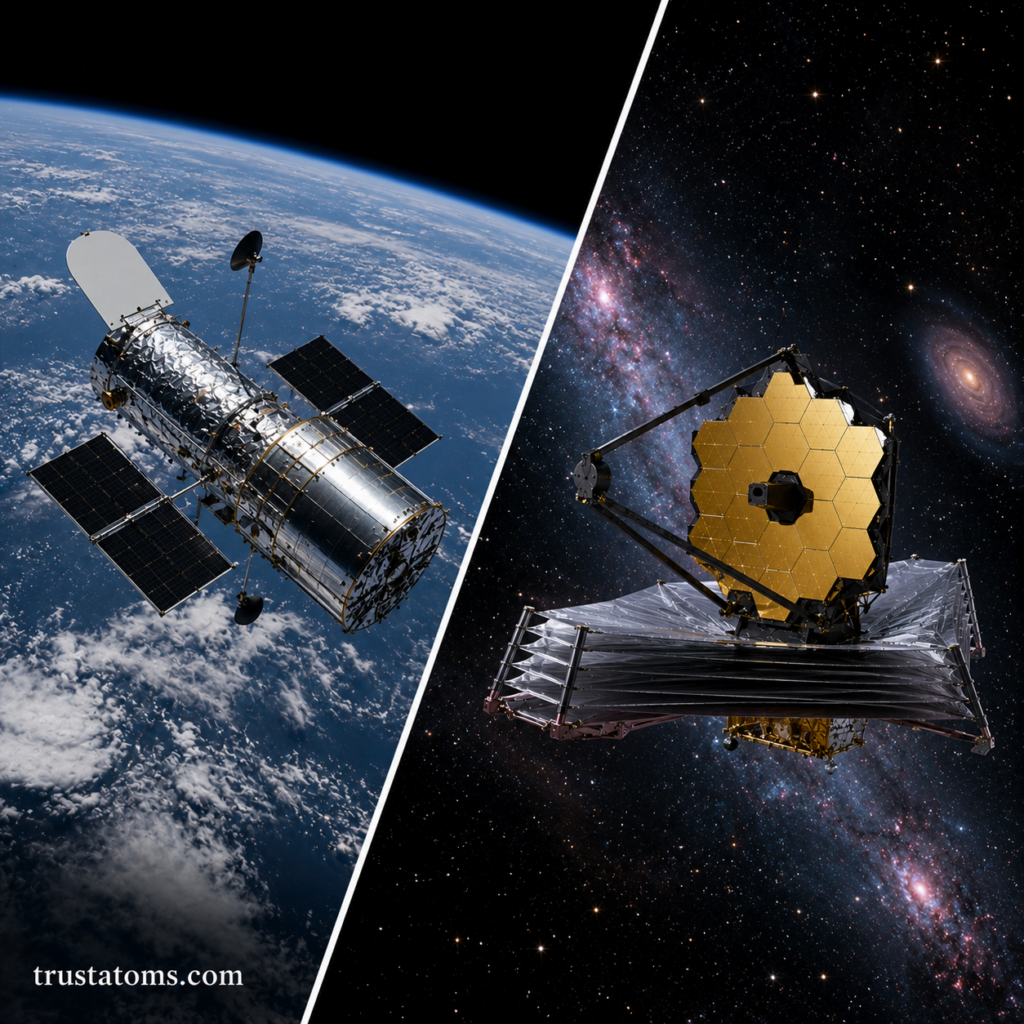
Different telescopes are designed to observe specific parts of the electromagnetic spectrum.
Optical Telescopes
These observe visible light, similar to what human eyes can see.
Used for:
- Galaxies
- Stars
- Nebulae
Infrared Telescopes
Infrared observatories detect heat radiation.
Useful for:
- Studying star formation
- Observing dust-covered regions
- Detecting distant galaxies
Ultraviolet Telescopes
These examine high-energy ultraviolet radiation from:
- Young stars
- Hot gases
- Stellar explosions
X-Ray Telescopes
X-ray observatories study extremely energetic cosmic events such as:
- Black holes
- Supernova remnants
- Neutron stars
Radio Observatories in Space
These detect long-wavelength radio emissions from space objects.
Major Discoveries from Space Telescopes
Space telescopes have contributed to some of the most important discoveries in astronomy.
Deep-Space Imaging
Scientists captured images of:
- Distant galaxies
- Star-forming regions
- Cosmic structures billions of light-years away
Exoplanet Research
Space telescopes helped identify planets orbiting other stars.
Black Hole Observations
Observations revealed:
- High-energy activity near black holes
- Interactions between matter and gravity
Expanding Universe Studies
Data from telescopes improved understanding of:
- Cosmic expansion
- Dark matter
- Dark energy
Key Technologies Used in Space Telescopes
Space observatories rely on advanced engineering systems.
Precision Mirrors
- Highly polished mirrors collect faint light
- Some use segmented mirror designs
Stabilization Systems
- Keep telescopes accurately pointed
- Prevent vibration and movement
Cooling Systems
Infrared telescopes often require:
- Extremely low temperatures
- Heat shielding from sunlight
Solar Panels
Provide electrical power for:
- Instruments
- Computers
- Communication systems
Onboard Computers
Control:
- Observation schedules
- Data processing
- Telescope orientation
Challenges of Operating Telescopes in Space
Although space telescopes offer major advantages, they also face significant challenges.
Launch Risks
- Sensitive equipment must survive rocket launches
Harsh Space Environment
- Radiation exposure
- Extreme temperatures
- Micrometeoroid impacts
Limited Repair Opportunities
Most telescopes cannot easily be repaired once deployed.
Communication Delays
Large amounts of data must be transmitted over long distances.
The Importance of Orbit Selection
The location of a telescope greatly affects its performance.
Low Earth Orbit
Advantages:
- Easier communication
- Closer proximity for servicing missions
Deep Space Locations
Some telescopes operate far from Earth to:
- Reduce heat interference
- Improve observation stability
Stable Gravitational Points
Special orbital positions help maintain:
- Consistent temperatures
- Minimal fuel use
The Future of Space Telescopes
Future space observatories will become even more powerful and specialized.
Next-Generation Technologies
Upcoming telescopes may feature:
- Larger segmented mirrors
- Improved infrared sensitivity
- Advanced AI-assisted data analysis
Search for Habitable Worlds
Future missions aim to:
- Detect Earth-like exoplanets
- Analyze planetary atmospheres
- Search for biosignatures
Multi-Wavelength Astronomy
Combining observations across multiple wavelengths will provide deeper understanding of the universe.
Why Space Telescopes Matter
Space telescopes have transformed astronomy and modern science.
Scientific Benefits
- Improve understanding of cosmic origins
- Reveal hidden structures in space
Technological Innovation
- Drive advances in optics and engineering
Public Inspiration
- Stunning space imagery inspires interest in science and exploration
Exploration Preparation
- Help identify targets for future robotic and human missions
Final Thoughts
Space telescopes in orbit have fundamentally changed how humanity observes the universe. By escaping Earth’s atmosphere, these observatories provide clearer views of distant galaxies, stars, black holes, and planets.
As technology advances, future space telescopes will continue pushing the boundaries of discovery, helping scientists answer some of the biggest questions about the universe and our place within it.