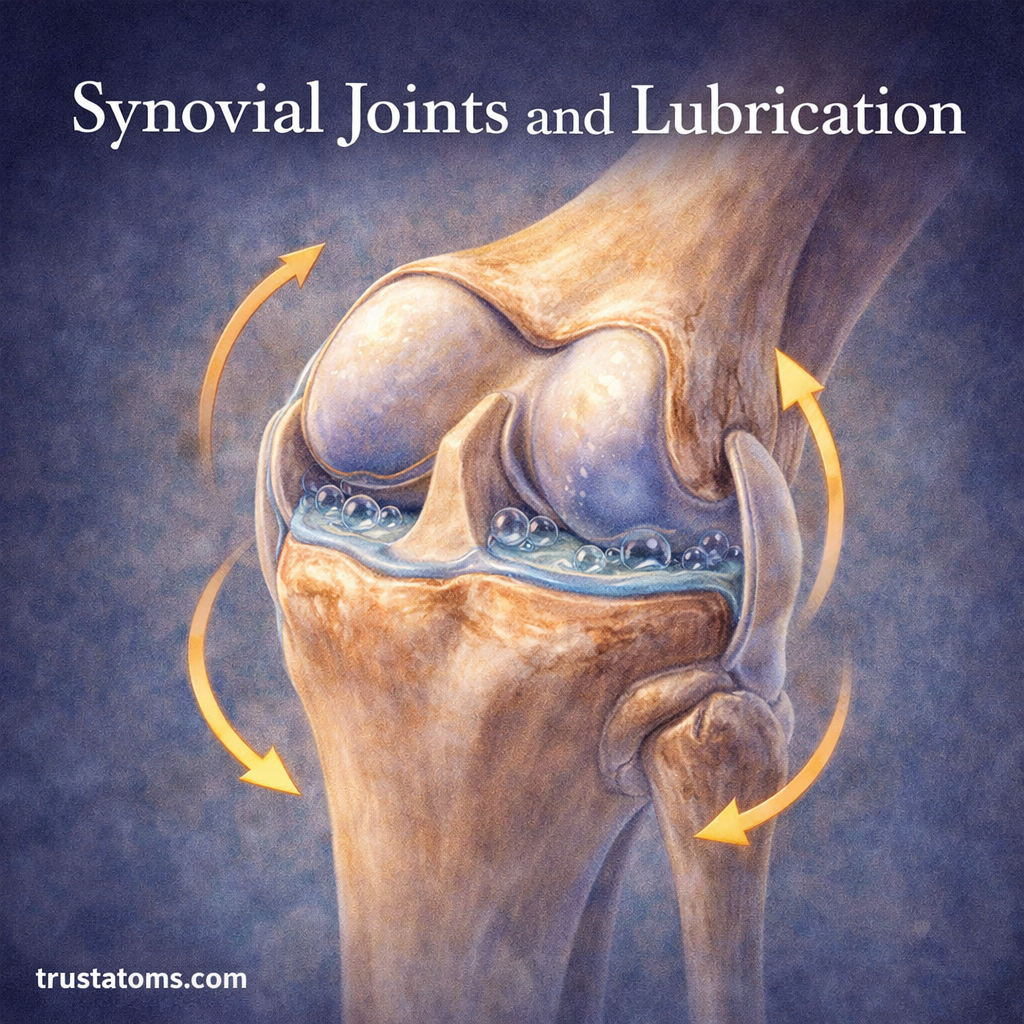
Synovial joints are freely movable connections between bones that use articular cartilage and synovial fluid to reduce friction during movement. Their lubrication system allows joint surfaces to glide smoothly while distributing mechanical loads and protecting the underlying bones.
Synovial joints are the most mobile and commonly used joints in the human body. From walking and running to lifting and rotating, their specialized structures demonstrate how human anatomy supports controlled movement and mechanical stability.
What Are Synovial Joints?
Synovial joints are connections between bones that contain a fluid-filled joint cavity enclosed by a capsule. Unlike fibrous or cartilaginous joints, they permit substantial movement in one or more directions.
Common examples include the knee, hip, shoulder, elbow, wrist, and finger joints. Their shapes determine which movements are possible, while surrounding tissues help maintain stability.
For example, the hip is a ball-and-socket joint that permits movement in several directions, whereas the elbow primarily operates as a hinge. Both rely on smooth cartilage surfaces and lubrication to function efficiently.
Structure of a Synovial Joint
Several anatomical components work together to allow movement while maintaining joint integrity.
- Articular cartilage: Smooth hyaline cartilage covers the ends of bones, distributes pressure, and provides a low-friction surface.
- Synovial membrane: The inner lining of the joint capsule produces and regulates components of synovial fluid.
- Joint capsule: A fibrous outer layer encloses the joint cavity and helps stabilize the connection.
- Synovial fluid: A viscous fluid lubricates cartilage surfaces and transports nutrients and metabolic waste.
- Ligaments: Strong connective tissue bands help limit excessive movement and maintain alignment.
Joint function depends on more than lubrication alone. Joint Stability explains how ligaments, muscles, and other supporting tissues prevent unwanted movement.
Different joints also face different mechanical demands. Hip Joint Mechanics and Stability examines load-bearing movement at the hip, while Knee Joint Mechanics describes how forces pass through the knee during activity.
What Is Joint Lubrication?
Joint lubrication is the reduction of friction between moving articular surfaces. In synovial joints, this is mainly achieved through synovial fluid and cartilage interaction.
Healthy articular cartilage is naturally smooth and contains a water-rich matrix that responds to pressure. Synovial fluid adds lubricating molecules that help the surfaces slide past each other without excessive resistance.
This combination is especially effective because cartilage is not rigid. It deforms slightly under load, helping spread forces over a larger contact area.
How Synovial Fluid Protects Moving Joints
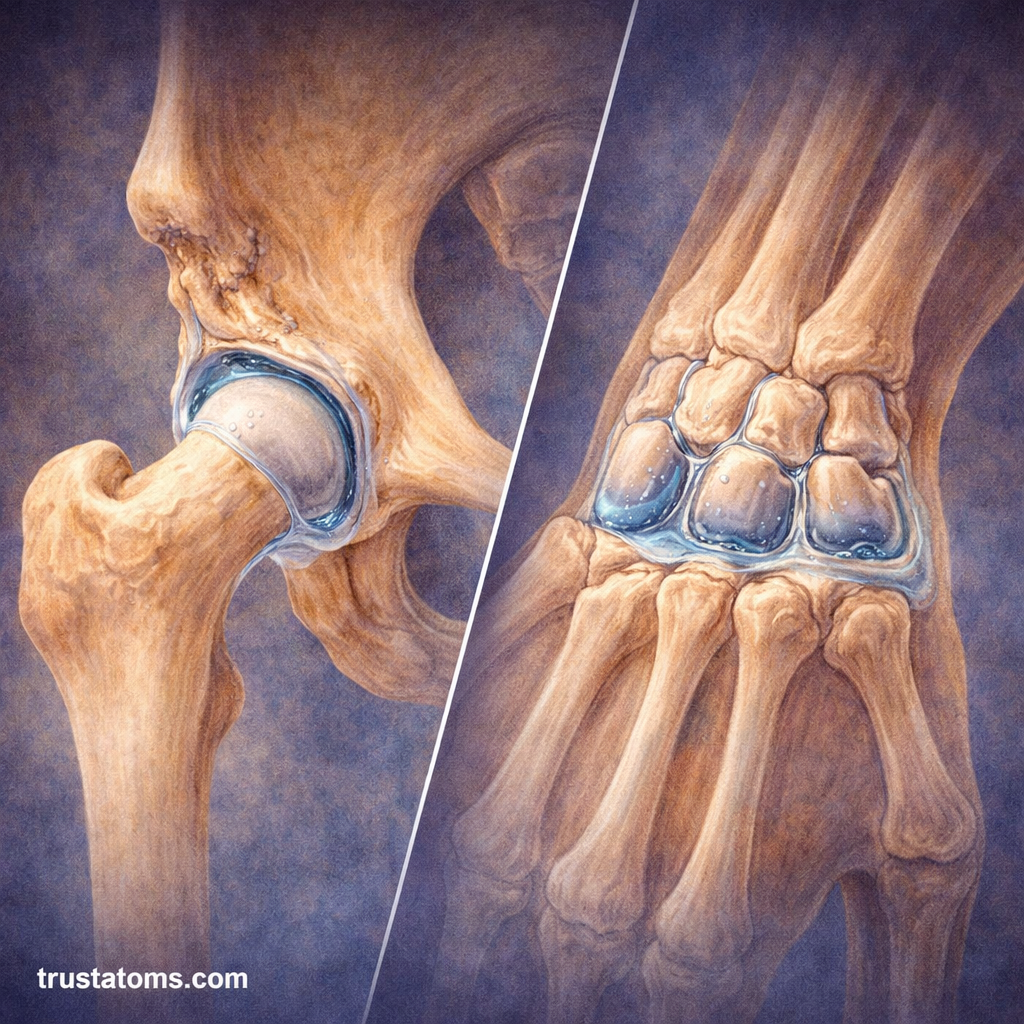
Synovial fluid is a specialized liquid derived partly from blood plasma and modified by cells in the synovial membrane. It contains water, electrolytes, hyaluronic acid, lubricin, and other molecules.
Hyaluronic acid contributes to the fluid’s viscosity, while lubricin helps reduce friction at cartilage surfaces. Their combined effects support lubrication under different movement and loading conditions.
Synovial fluid also helps deliver nutrients to articular cartilage, which lacks its own blood vessels. Movement and changes in pressure promote the exchange of dissolved substances between the fluid and cartilage tissue.
Three Mechanisms of Synovial Joint Lubrication
Joint surfaces use several overlapping lubrication mechanisms rather than relying on a single permanent fluid layer.
Boundary Lubrication
Boundary lubrication occurs when lubricating molecules form protective layers on cartilage surfaces. These molecular layers reduce friction when opposing surfaces are close together, particularly during slow movement or sustained loading.
Lubricin and certain phospholipids contribute to this process by helping cartilage surfaces slide against one another.
Fluid Film Lubrication
Fluid film lubrication occurs when fluid separates moving surfaces and carries part of the mechanical load. Depending on movement and pressure, the fluid layer can reduce direct contact between opposing cartilage surfaces.
This mechanism is particularly useful during motion, although its effectiveness depends on joint geometry, loading, and fluid behavior.
Weeping and Interstitial Fluid Lubrication
Articular cartilage contains a large amount of water within its extracellular matrix. When compressed, fluid pressure inside the cartilage supports much of the applied load, reducing stress on the solid tissue framework.
Fluid can move between cartilage and the surrounding joint space as loading changes. This behavior contributes to lubrication and is sometimes described using the term weeping lubrication.
How Cartilage Absorbs and Distributes Pressure
Articular cartilage contains chondrocytes embedded in a matrix rich in collagen, proteoglycans, and water. Collagen provides structural strength, while proteoglycans help retain water and resist compression.
When a joint bears weight, fluid pressure and the solid cartilage matrix share the load. The tissue gradually deforms and recovers as pressure changes.
Consider walking up a flight of stairs. Each step places changing forces across the knee and hip. Cartilage deformation, interstitial fluid pressure, and joint lubrication help distribute these forces while allowing the bones to move relative to one another.
Factors That Affect Joint Lubrication
The effectiveness of joint lubrication depends on the condition of cartilage, synovial fluid, and surrounding structures.
- Joint movement: Regular motion promotes fluid exchange and helps maintain cartilage nutrition.
- Mechanical loading: Appropriate loading supports tissue function, while excessive or abnormal forces can contribute to damage.
- Inflammation: Changes in the synovial membrane can alter fluid composition and joint function.
- Cartilage condition: Surface damage and changes in cartilage composition can impair load distribution and increase friction.
- Aging and injury: Tissue changes over time or following trauma may affect joint mechanics and lubrication.
Normal hydration supports overall tissue function, but drinking extra water does not directly increase synovial fluid production or restore damaged cartilage.
Joint Conditions That Affect Lubrication and Movement
Joint discomfort does not always mean there is too little synovial fluid. Pain and stiffness can result from several interacting changes in cartilage, bone, synovium, and surrounding tissues.
- Osteoarthritis: A condition involving changes in cartilage, underlying bone, and other joint tissues that can cause pain and reduced mobility.
- Synovitis: Inflammation of the synovial membrane, often associated with swelling, discomfort, and changes in joint fluid.
- Joint injuries: Damage to cartilage, ligaments, or other structures can disrupt alignment and alter how forces pass through the joint.
Persistent joint swelling, pain, warmth, or restricted movement should be assessed by a qualified health professional. A suddenly hot, swollen joint accompanied by fever requires urgent medical evaluation.
Supporting Healthy Synovial Joint Function
Several practical habits help maintain mobility and reduce unnecessary mechanical stress.
- Stay physically active with movements appropriate for your health and abilities.
- Strengthen muscles surrounding major joints to improve support and movement control.
- Increase exercise intensity gradually to avoid sudden excessive loading.
- Maintain a healthy body weight when appropriate to reduce loading on weight-bearing joints.
- Allow adequate recovery after strenuous activity or joint injury.
Frequently Asked Questions
What produces synovial fluid?
Synovial fluid forms from fluid filtered from blood plasma and substances produced by cells of the synovial membrane. These cells contribute molecules such as hyaluronic acid and lubricin, which help maintain the fluid’s lubricating properties.
Does movement help lubricate joints?
Yes. Movement changes pressure within the joint and promotes fluid exchange between synovial fluid and cartilage. This helps distribute nutrients and supports the normal mechanical behavior of cartilage, although movement cannot reverse every form of joint damage.
Does joint cracking mean the cartilage is wearing out?
Not necessarily. Painless joint cracking can occur through changes in gas cavities within synovial fluid or movement of nearby tissues. However, cracking accompanied by pain, swelling, or loss of movement may indicate a problem requiring evaluation.
Synovial joints achieve low-friction movement through the combined properties of synovial fluid, articular cartilage, and specialized lubricating molecules. Their ability to distribute pressure depends on healthy cartilage, coordinated joint movement, and stable supporting structures. Regular appropriate activity helps maintain these systems, while injury or inflammation can interfere with their normal function.
This article is for general education and is not medical advice. Talk to a qualified health professional about any medical concern.
Sources: OpenStax, Anatomy and Physiology 2e; Standring, Gray’s Anatomy: The Anatomical Basis of Clinical Practice; Nordin and Frankel, Basic Biomechanics of the Musculoskeletal System.