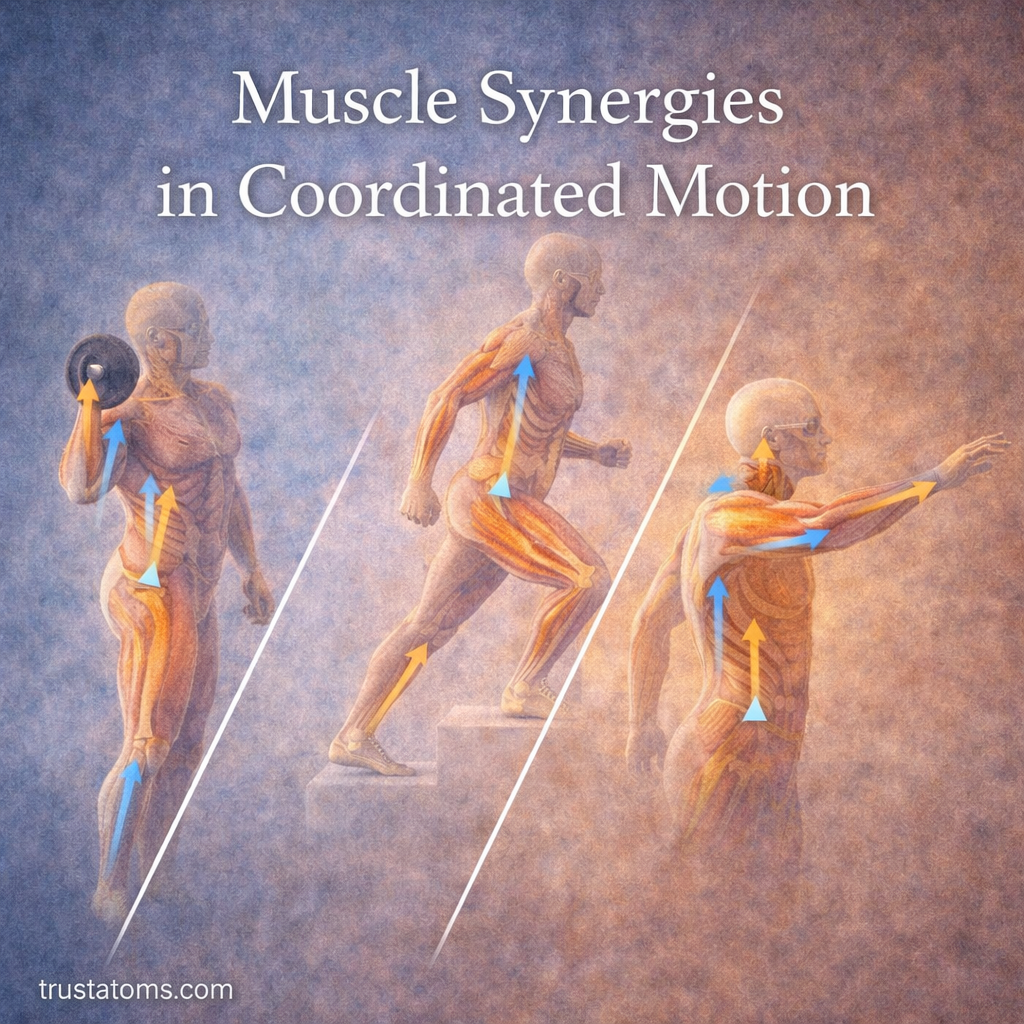
Muscle synergies are the coordinated patterns of muscle activity that allow the body to move smoothly and efficiently. Instead of muscles working in isolation, groups of muscles activate together in precise sequences to produce controlled motion.
Understanding muscle synergies helps explain how complex movements—like walking, reaching, or lifting—are performed with ease and coordination.
What Are Muscle Synergies?
Muscle synergies refer to groups of muscles that are activated together by the nervous system to perform a specific movement.
Key Concept
- The brain does not control each muscle individually
- Instead, it activates pre-organized patterns of muscle groups
Why This Matters
- Simplifies motor control
- Improves efficiency
- Enables faster and more coordinated movement
How the Nervous System Controls Synergies
The central nervous system (CNS) plays a major role in coordinating muscle synergies.
Key Components Involved
- Brain (motor cortex) – plans and initiates movement
- Spinal cord – coordinates reflexes and basic patterns
- Sensory feedback – adjusts movement in real time
How It Works
- The brain sends a movement command
- Muscle groups are activated in a coordinated pattern
- Sensory feedback refines the motion
- Adjustments are made instantly for balance and accuracy
This process allows for smooth and adaptive movement.
Types of Muscle Roles in a Synergy
Within a muscle synergy, different muscles have specific roles.
Primary Roles
- Agonists (prime movers): produce the main movement
- Antagonists: oppose the movement and provide control
- Synergists: assist the primary movers
- Stabilizers: maintain joint stability and posture
Example: Bending the Elbow
- Biceps act as the agonist
- Triceps act as the antagonist
- Forearm muscles assist as synergists
- Shoulder muscles stabilize the joint
Examples of Muscle Synergies in Everyday Movement
Muscle synergies are involved in nearly all daily activities.
Walking
- Coordinated activation of hip, knee, and ankle muscles
- Alternating patterns between left and right sides
- Continuous balance adjustments
Reaching and Grasping
- Shoulder and arm muscles position the hand
- Forearm and hand muscles control grip
- Stabilizing muscles maintain posture
Lifting an Object
- Core muscles stabilize the spine
- Leg muscles generate force
- Arm muscles guide and control the load
Why Muscle Synergies Improve Efficiency
Muscle synergies reduce the complexity of movement control.
Benefits
- Fewer signals needed from the brain
- Faster response times
- Reduced energy expenditure
- Improved coordination
Example
Instead of activating dozens of muscles individually, the body activates a single coordinated pattern, making movement more efficient.
Muscle Synergies and Motor Learning
Muscle synergies are not fixed—they develop and improve with practice.
How Learning Occurs
- Repetition strengthens neural pathways
- Movements become more automatic over time
- Coordination improves with experience
Examples
- Learning to ride a bike
- Practicing a sport
- Developing fine motor skills (e.g., writing)
The Role of Feedback in Coordinated Motion
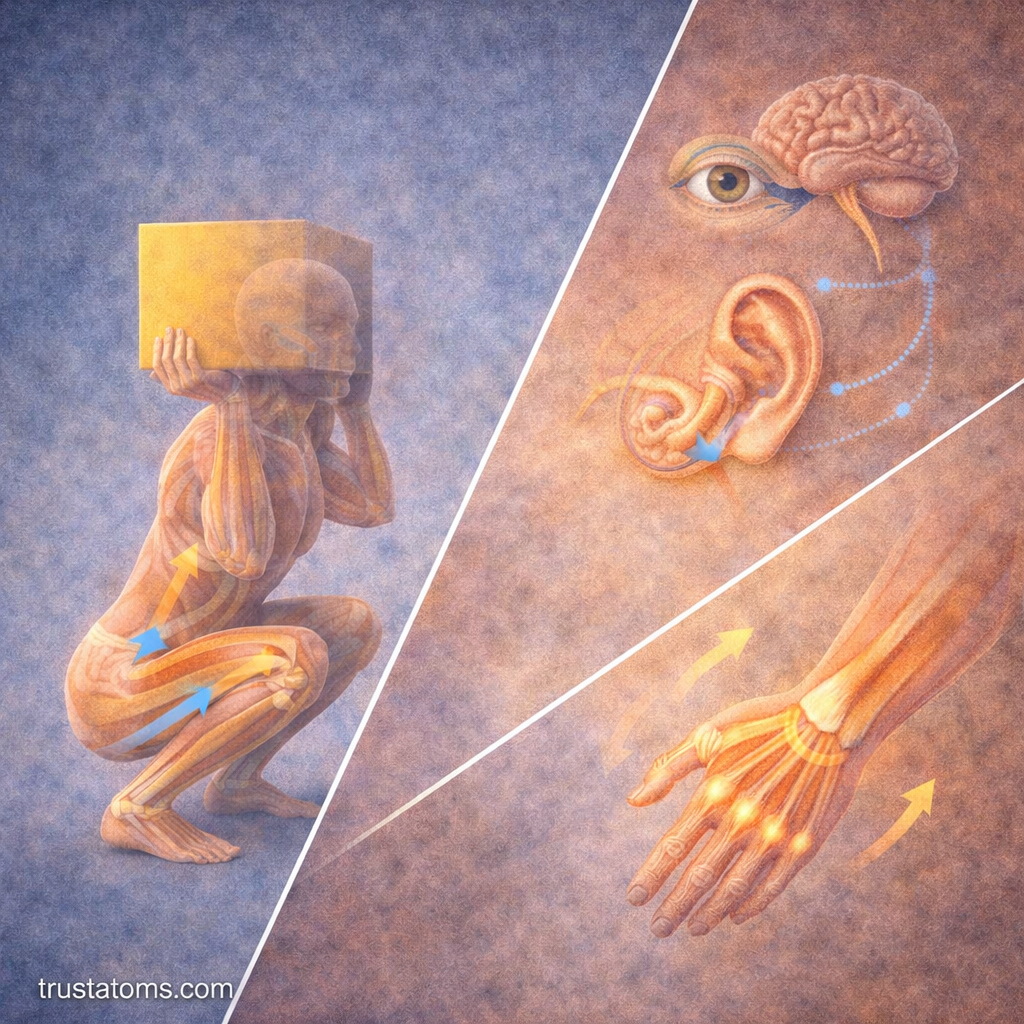
Sensory feedback helps refine muscle synergies during movement.
Types of Feedback
- Proprioception: awareness of body position
- Visual input: guides movement accuracy
- Vestibular system: maintains balance
Why Feedback Matters
- Corrects errors in real time
- Adjusts force and direction
- Maintains stability during movement
What Happens When Synergies Are Disrupted?
Disruptions in muscle synergies can lead to poor coordination and movement difficulties.
Common Causes
- Neurological conditions
- Muscle weakness or imbalance
- Injury or pain
- Lack of practice or conditioning
Effects
- Uncoordinated or jerky movements
- Reduced efficiency
- Increased fatigue
- Higher risk of injury
Improving Muscle Synergies
Muscle synergies can be enhanced through training and proper movement habits.
Practical Strategies
- Practice functional movements (e.g., squats, lunges)
- Focus on proper technique
- Strengthen stabilizing muscles
- Improve balance and coordination
- Incorporate variety in movement patterns
Why Muscle Synergies Are Essential
Muscle synergies allow the body to perform complex movements with precision and efficiency.
Key Takeaways
- Muscle synergies involve coordinated activation of multiple muscles
- The nervous system simplifies movement through patterns
- Different muscles play specific roles within each synergy
- Practice and feedback improve coordination
- Disruptions can affect movement quality and safety
Final Thoughts
Muscle synergies are the foundation of coordinated motion in the human body. They enable smooth, efficient, and adaptable movement by organizing muscles into functional groups.
By understanding and improving these coordinated patterns, you can enhance performance, reduce injury risk, and move more effectively in everyday life.