Understanding how your muscles generate force is essential for grasping everything from basic movement to athletic performance. At the core of this process are motor units, the functional building blocks that control muscle contraction and strength output.
This guide explains what motor units are, how they work, and how they influence force production in the human body.
What Is a Motor Unit?
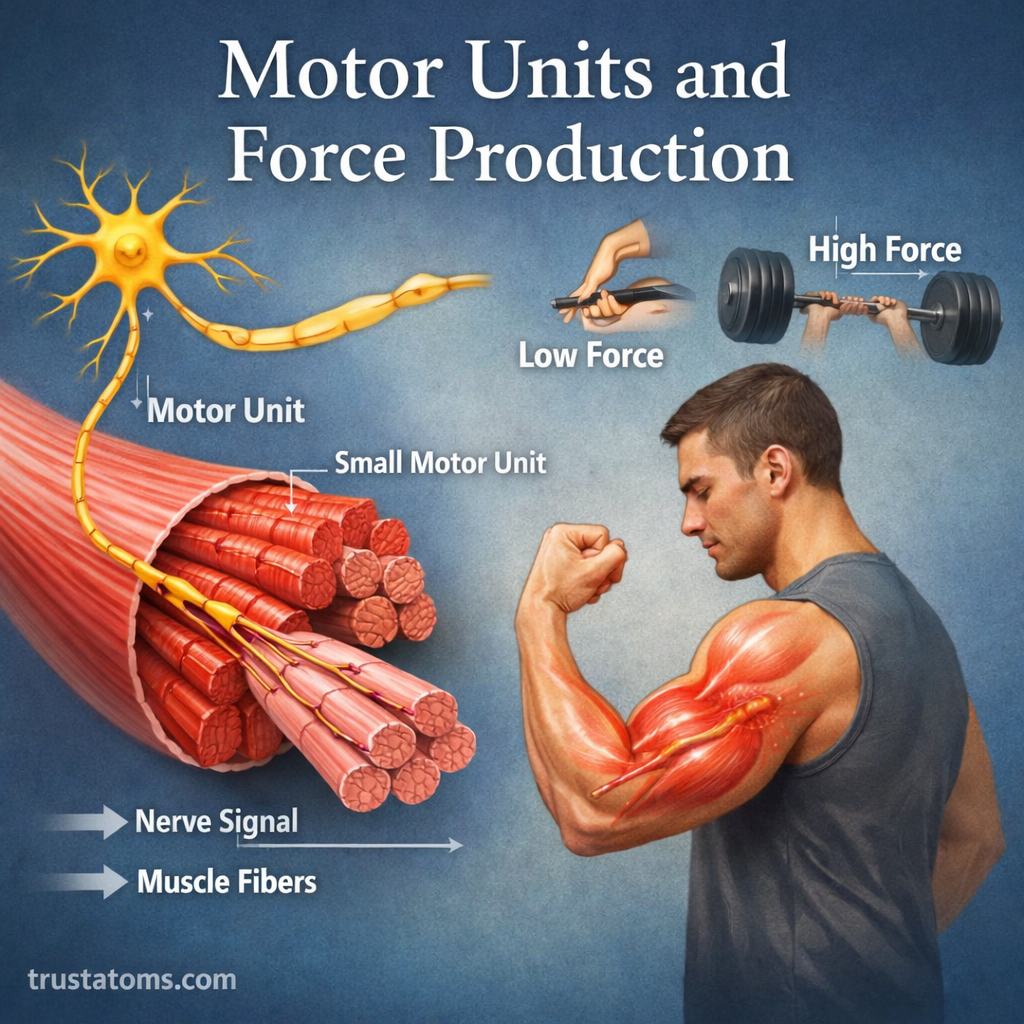
A motor unit consists of two main components:
- A single motor neuron (nerve cell)
- All the muscle fibers it controls
When the motor neuron sends a signal, all the muscle fibers within that unit contract simultaneously. This is known as the all-or-none principle.
Key Takeaway
- One motor neuron = controls multiple muscle fibers
- All fibers in that unit contract together when activated
Types of Motor Units
Motor units vary depending on their size and function. These differences directly impact how force is produced.
1. Small Motor Units
- Control fewer muscle fibers
- Generate low force
- Highly precise movements
- Fatigue-resistant
Examples:
- Eye muscles
- Finger movements
2. Large Motor Units
- Control many muscle fibers
- Generate high force
- Less precise control
- Fatigue more quickly
Examples:
- Quadriceps
- Calf muscles
How Motor Units Produce Force
Force production in muscles depends on two primary mechanisms:
1. Motor Unit Recruitment
This refers to the number of motor units activated during a movement.
- Low effort → few motor units activated
- High effort → more motor units activated
This follows the size principle:
- Small motor units are recruited first
- Larger motor units are added as needed
Why This Matters
- Allows smooth, controlled movement
- Prevents unnecessary energy use
- Scales force based on demand
2. Rate Coding (Frequency of Stimulation)
This refers to how often a motor neuron sends signals to its muscle fibers.
- Low frequency → weaker contractions
- High frequency → stronger, sustained contractions
At very high frequencies, contractions can merge into a smooth, continuous contraction called tetanus.
The All-or-None Principle Explained
Each individual motor unit follows the all-or-none rule:
- If the signal reaches threshold → full contraction
- If not → no contraction
However, whole muscles can produce varying force levels because:
- Multiple motor units are involved
- They can be activated in different combinations
Factors That Affect Force Production
Several variables influence how much force a muscle can generate:
1. Number of Active Motor Units
- More recruited units = greater force
2. Muscle Fiber Type
- Fast-twitch fibers → high force, quick fatigue
- Slow-twitch fibers → lower force, high endurance
3. Muscle Length
- Optimal length produces maximum force
- Too stretched or too shortened reduces efficiency
4. Neural Input
- Stronger signals from the nervous system increase contraction strength
Motor Units in Everyday Movement

Motor units allow your body to adapt force precisely depending on the task.
Examples
- Holding a pen:
Uses small motor units for fine control - Lifting a heavy box:
Recruits large motor units for maximum force - Walking vs sprinting:
- Walking → mostly small, fatigue-resistant units
- Sprinting → large, powerful units added
Motor Units and Strength Training
Strength training directly impacts how motor units function.
Early Strength Gains
Often come from neural adaptations, not muscle size:
- Improved motor unit recruitment
- Better synchronization
- Increased firing rate
Long-Term Adaptations
- Muscle fiber growth (hypertrophy)
- More efficient force production
Training Implications
- Heavy lifting → recruits large motor units
- Explosive training → improves firing rate
- Endurance training → enhances fatigue resistance
Common Misconceptions
“Muscles contract partially”
Not exactly.
- Individual motor units are all-or-none
- Whole muscles appear to contract partially due to varying recruitment
“Strength is only about muscle size”
False.
- Neural control (motor units) plays a major role
- Two people with similar muscle size can have different strength levels
Why Motor Units Matter
Understanding motor units helps explain:
- How strength is developed
- Why coordination improves with practice
- How fatigue affects performance
- Differences between precision and power movements
Final Thoughts
Motor units are the foundation of muscle control and force production. By adjusting how many motor units are activated and how frequently they fire, the body can produce anything from delicate, precise movements to powerful, explosive actions.
This system allows for efficiency, adaptability, and control, making it one of the most important mechanisms in human anatomy and movement science.