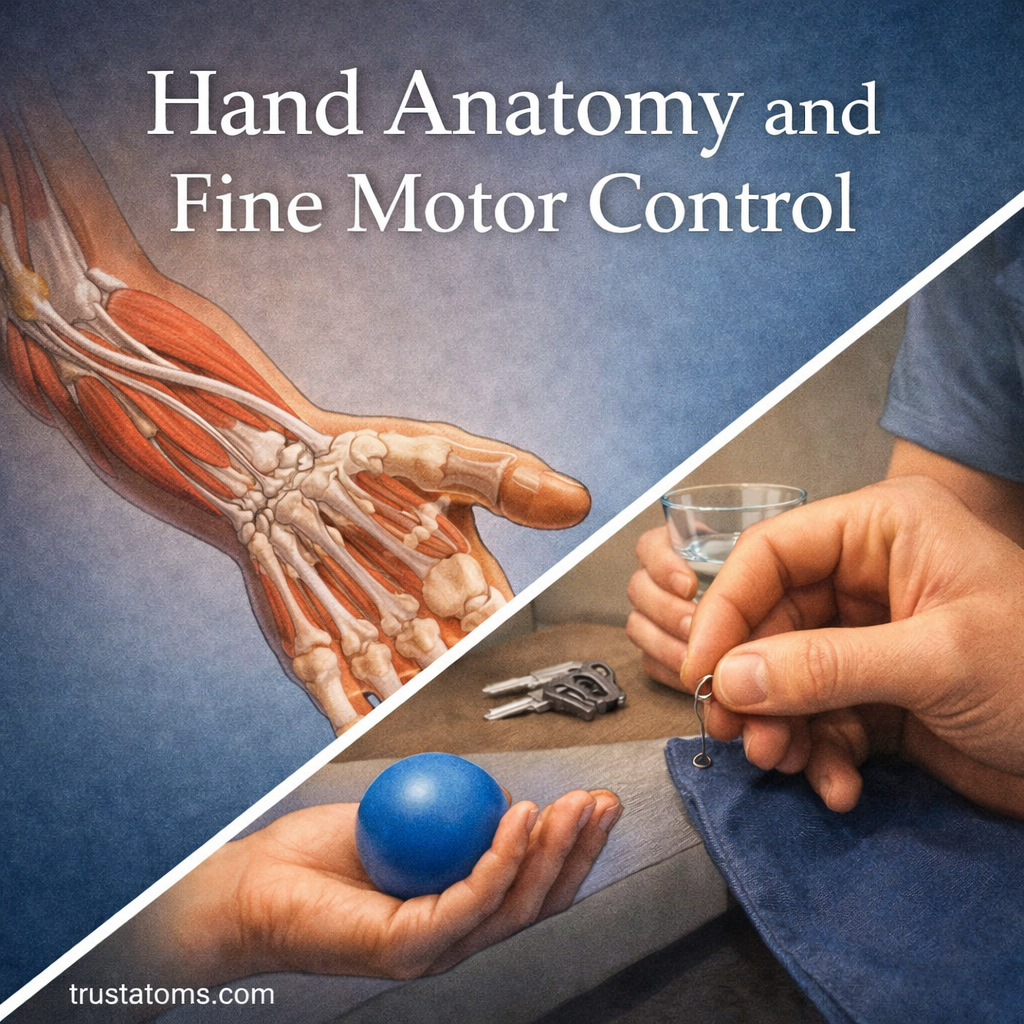
The human hand is one of the most intricate and functionally advanced structures in the body. It allows us to perform precise tasks like writing, typing, and buttoning a shirt, as well as powerful actions like gripping and lifting.
Hand anatomy and fine motor control work together to enable these movements. This coordination involves bones, muscles, tendons, nerves, and sensory feedback systems operating with remarkable precision.
Overview of Hand Anatomy
The hand is composed of multiple structures that provide both strength and flexibility.
Bones of the Hand
The hand contains 27 bones, divided into three groups:
- Carpals (8 bones): form the wrist
- Metacarpals (5 bones): form the palm
- Phalanges (14 bones): form the fingers
These bones create a framework that supports movement and grip.
Joints
Key joints allow for a wide range of motion:
- Wrist joint: enables flexion, extension, and rotation
- Metacarpophalangeal joints (knuckles): allow bending and spreading of fingers
- Interphalangeal joints: control finger flexion and extension
Muscles of the Hand
Hand movement depends on both intrinsic and extrinsic muscles.
Extrinsic Muscles
- Located in the forearm
- Control large movements of the fingers and wrist
- Provide strength for gripping
Intrinsic Muscles
- Located within the hand
- Responsible for fine motor control
- Allow precise finger movements and coordination
These muscles work together to balance strength and precision.
Tendons and Ligaments
Tendons and ligaments play key roles in movement and stability.
Tendons
- Connect muscles to bones
- Transmit force to move fingers and wrist
- Allow smooth, controlled motion
Ligaments
- Connect bones to each other
- Stabilize joints
- Prevent excessive movement
Nerve Supply and Sensory Function
The hand is highly sensitive due to its rich nerve supply.
Major Nerves
- Median nerve: controls thumb movement and sensation in the palm
- Ulnar nerve: controls fine motor movements of the fingers
- Radial nerve: supports wrist and finger extension
Sensory Feedback
The hand provides detailed sensory information:
- Touch
- Pressure
- Temperature
- Texture
This feedback is essential for adjusting grip and movement in real time.
What Is Fine Motor Control?
Fine motor control refers to the ability to perform small, precise movements using the hands and fingers.
Examples include:
- Writing or drawing
- Typing on a keyboard
- Picking up small objects
- Buttoning clothes
These actions require coordination between muscles, joints, and the nervous system.
How Fine Motor Control Works
Fine motor skills depend on several coordinated processes:
1. Motor Planning
The brain determines:
- What movement is needed
- How much force to apply
- Which muscles to activate
2. Muscle Activation
- Intrinsic and extrinsic muscles work together
- Movements are smooth and controlled
3. Sensory Feedback
- Adjusts grip strength
- Prevents dropping or crushing objects
- Improves accuracy
Types of Hand Movements
Different tasks require different types of movements.
Precision Movements
- Use fingertips and thumb
- Allow detailed control
- Example: picking up a coin
Power Movements
- Use the entire hand
- Provide strength and stability
- Example: holding a tool
Coordinated Movements
- Combine multiple joints and muscles
- Require timing and control
- Example: typing or playing an instrument
Factors That Affect Fine Motor Control
Several factors influence hand function:
Physical Factors
- Muscle strength
- Joint flexibility
- Hand size and structure
Neurological Factors
- Brain function
- Nerve signaling
- Coordination ability
External Factors
- Object size and shape
- Surface texture
- Environmental conditions
Common Issues Affecting Hand Function
Problems with hand anatomy or control can impact daily life.
Musculoskeletal Conditions
- Arthritis
- Tendon injuries
- Joint stiffness
Nerve-Related Conditions
- Carpal tunnel syndrome
- Nerve compression
- Peripheral neuropathy
Functional Limitations
- Reduced grip strength
- Poor coordination
- Difficulty with fine tasks
Improving Fine Motor Skills
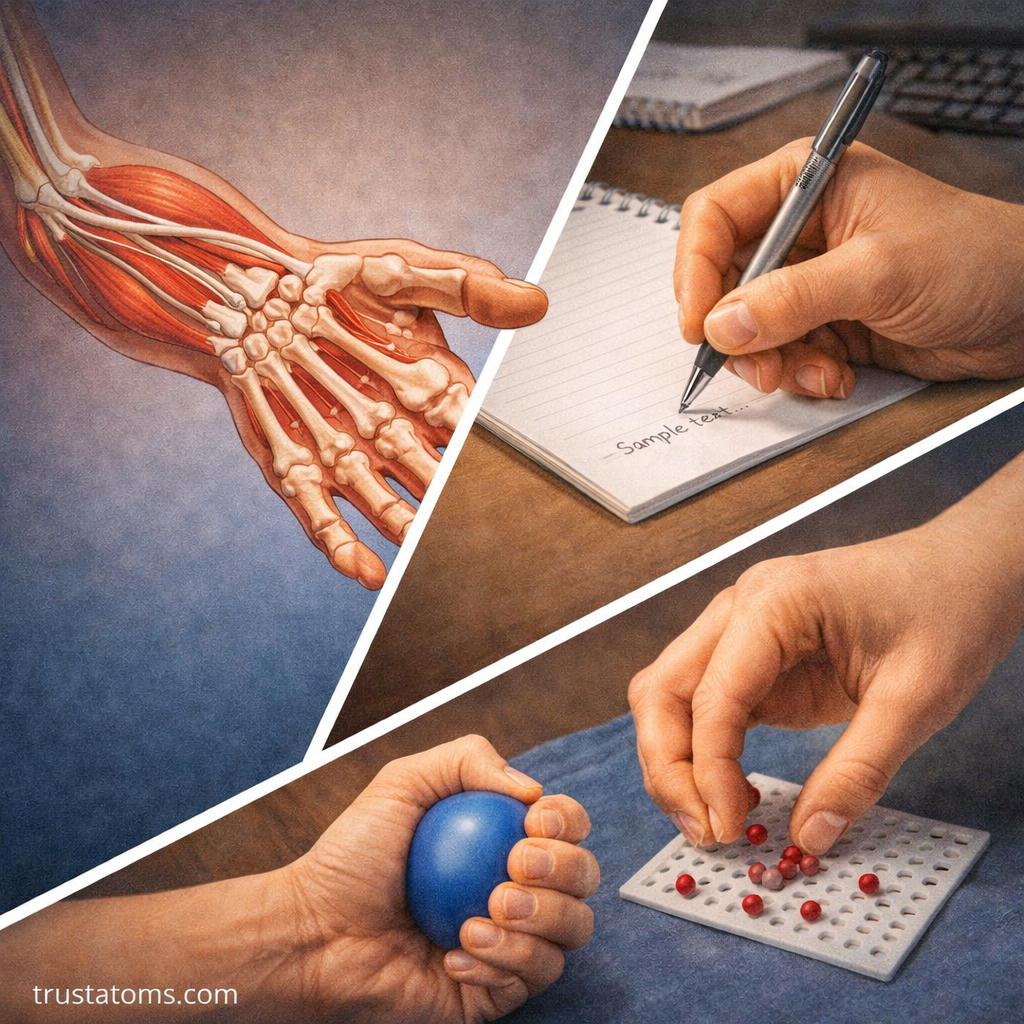
Fine motor control can be improved with practice and training.
Practical Exercises
- Squeezing stress balls
- Practicing handwriting or drawing
- Using small objects like beads or coins
- Finger coordination drills
Strength and Flexibility
- Stretching hand and finger muscles
- Strengthening grip and pinch
- Maintaining joint mobility
Consistent practice supports better control and dexterity.
Why Hand Anatomy Matters
The structure of the hand directly influences its function. Its combination of strength, flexibility, and sensitivity allows humans to interact with the world in complex ways.
Understanding hand anatomy and fine motor control helps:
- Improve performance in daily tasks
- Support rehabilitation after injury
- Prevent long-term damage
- Enhance precision and coordination
Final Thoughts
Hand anatomy and fine motor control demonstrate the incredible complexity of human movement. From powerful grips to delicate finger movements, the hand is uniquely designed for versatility and precision.
By understanding how these systems work together, we can better care for our hands, improve function, and appreciate their essential role in everyday life.