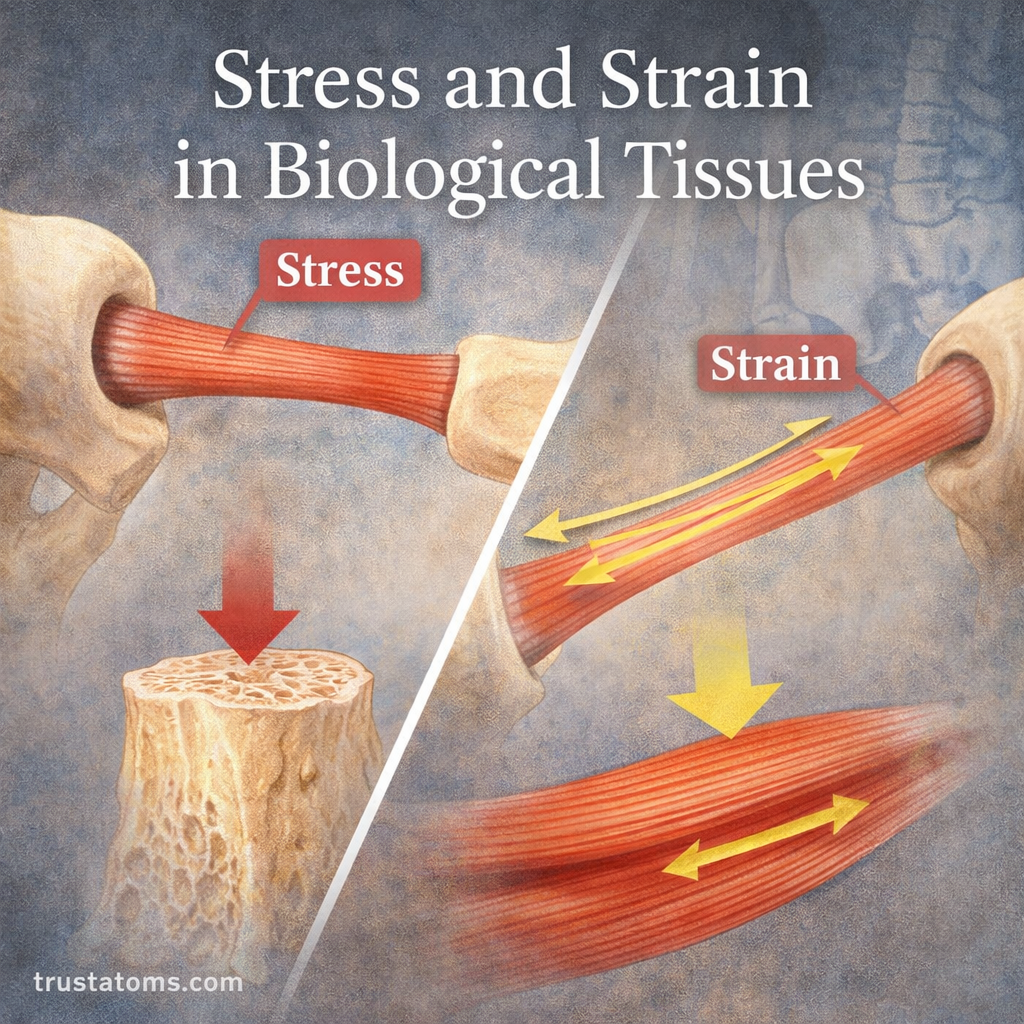
Stress in biological tissues is the internal force per unit area produced by loading, while strain is the resulting change in a tissue’s size or shape relative to its original dimensions. Together, stress and strain explain how bones, muscles, tendons and ligaments bear loads, adapt, and sometimes fail.
These mechanical principles help explain everyday activities such as walking, lifting, and jumping. Understanding them connects human anatomy with biomechanics, the study of forces and movement in living systems.
What Is Stress in Biological Tissues?
Mechanical stress describes how internal forces are distributed across an area of tissue. It is commonly expressed in pascals (Pa), equivalent to newtons of force per square meter. Stress depends on both the applied load and the area over which that load is distributed.
For a simple, uniformly loaded surface, average normal stress equals force divided by area. A force of 100 newtons distributed across 0.01 square meters produces an average stress of 10,000 pascals, or 10 kilopascals. Real biological tissues have more complex shapes and loading patterns, so their internal stress is rarely perfectly uniform.
Three Main Types of Mechanical Stress
- Tensile stress: Pulling forces that stretch tissues, such as tension in the Achilles tendon during walking or running.
- Compressive stress: Forces that squeeze tissues, such as the load experienced by vertebral bodies when supporting body weight.
- Shear stress: Forces acting parallel to a surface that tend to make adjacent layers slide relative to each other.
These forces frequently occur together. Load Bearing in the Spine examines how vertebrae and discs distribute forces, while Knee Joint Mechanics explains force transmission through a major weight-bearing joint. Rotational loading is explored in Torque Production at Joints.
What Is Strain and How Is It Measured?
Strain measures deformation rather than force. In a simple stretching test, engineering strain equals the change in length divided by the original length. Because it is a ratio of two lengths, strain has no physical unit and is often expressed as a percentage.
Consider a tendon segment that measures 10 centimeters before loading and 10.2 centimeters while stretched. Its length increases by 0.2 centimeters, producing an engineering strain of 0.02, or 2%. This illustrates how strain is calculated, not a universal safe stretching limit for tendons.
Strain may involve stretching, shortening, or changes in shape. The amount of deformation depends on the tissue’s mechanical properties, the direction of loading, and how quickly the force is applied.
How Stress and Strain Relate to Tissue Stiffness
Scientists study tissue behavior by plotting stress against strain. The resulting stress-strain curve shows how much deformation occurs as loading increases.
In a linear elastic material, the slope of this curve is Young’s modulus, a measure of material stiffness. A higher modulus means greater stress is needed to produce the same strain. Biological tissues, however, often show nonlinear behavior, meaning their stiffness changes as they stretch or compress.
For example, collagen-rich tissues may initially stretch relatively easily as their fibers straighten. As loading increases, the aligned fibers resist further deformation more strongly. This produces a curved stress-strain relationship rather than a perfectly straight line.
Elastic vs. Plastic Deformation in Biological Tissues
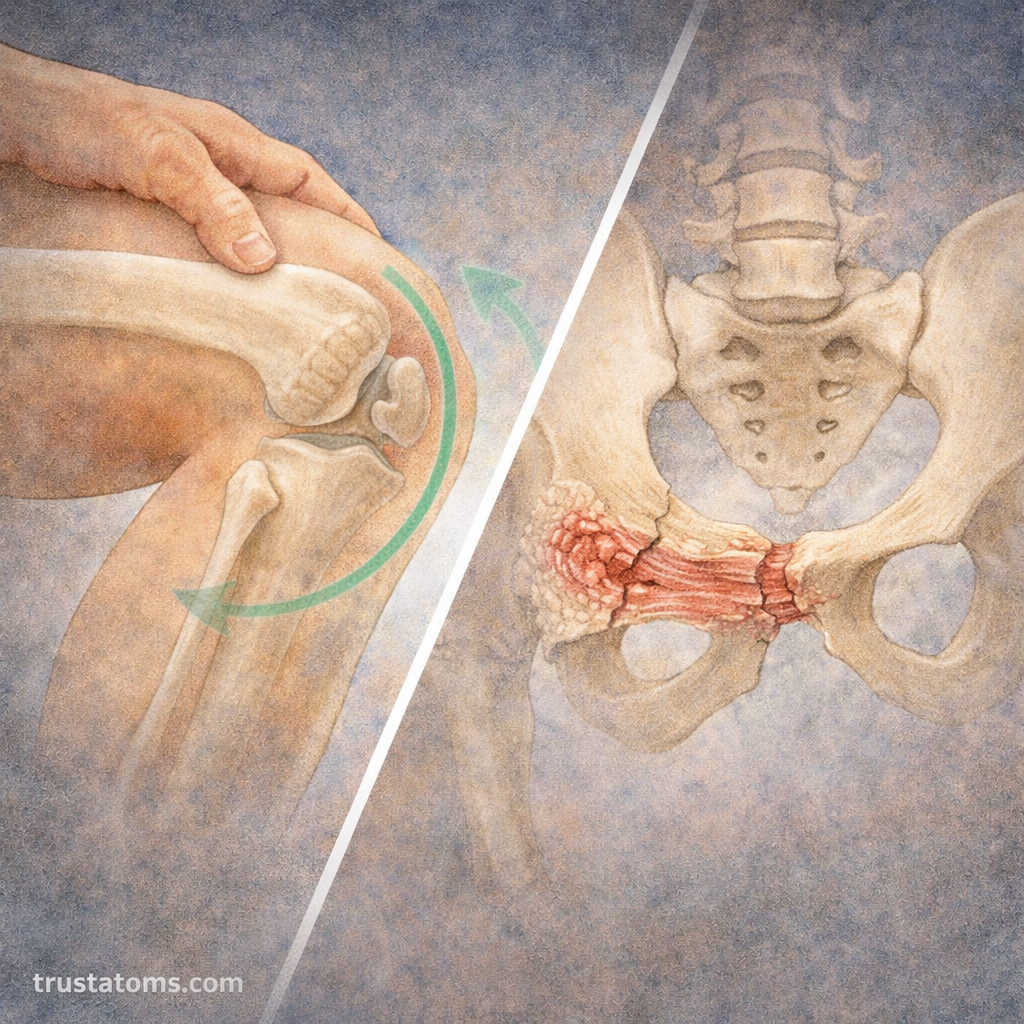
Tissues may recover after deformation or retain lasting changes, depending on the magnitude and duration of loading.
Elastic Deformation
Elastic deformation is reversible. When the applied force is removed, the tissue returns toward its original dimensions. Tendons, ligaments, and bones all exhibit elastic behavior within appropriate loading ranges.
Plastic Deformation
Plastic deformation is permanent. It occurs when loading exceeds the range of fully recoverable deformation, potentially producing lasting changes in tissue structure. Further loading may cause microscopic damage or complete failure, such as a tear or fracture.
Biological tissues also exhibit viscoelastic behavior: their response depends on time and loading speed. A tendon held under a constant load may gradually lengthen, a phenomenon called creep. Under a constant deformation, its internal stress may decrease over time through stress relaxation.
How Bones, Muscles, Tendons, and Ligaments Respond
Different tissues have distinct mechanical properties because their structures and functions differ.
| Tissue | Mechanical Behavior | Main Function |
|---|---|---|
| Bone | Stiff and resistant to compression, tension, and bending, with strength varying by direction. | Supports the body and transmits loads. |
| Muscle | Produces active tension through contraction and responds to stretching. | Generates force and controls movement. |
| Tendon | Collagen-rich and strong under tension, with elastic and viscoelastic properties. | Transfers muscle force to bone. |
| Ligament | Resists tensile loading and limits excessive joint displacement. | Connects bones and stabilizes joints. |
These differences explain why the same external force can produce different amounts of strain in different tissues. Mechanical behavior also varies within a tissue according to fiber orientation, composition, and loading direction.
Factors That Change Tissue Response to Loading
Several biological and mechanical factors influence how tissues deform and recover.
- Age: Changes in collagen, bone structure, and tissue composition can alter stiffness and resistance to injury.
- Physical activity: Appropriate repeated loading can stimulate tissue adaptation, while prolonged inactivity may reduce strength.
- Hydration: Proper hydration maintains tissue elasticity and viscoelastic behavior, although the effects depend on tissue composition and loading conditions.
- Nutrition: Adequate energy, protein, and essential nutrients support tissue maintenance and repair.
- Loading rate: Rapid loading can change apparent stiffness and increase injury risk when forces exceed tissue tolerance.
- Previous injury: Scar formation and altered tissue organization may change mechanical behavior.
How Repeated Loading Produces Tissue Adaptation
Living tissues respond to mechanical demands through biological remodeling. Cells detect mechanical signals and adjust tissue maintenance, repair, or structural organization over time.
Weight-bearing exercise can stimulate changes in bone mass and architecture. Resistance training increases muscle strength, while progressive tendon loading may improve tendon stiffness and load-bearing capacity.
Adaptation depends on adequate recovery. Loading that increases faster than a tissue can repair may accumulate microscopic damage instead of producing beneficial changes. Different tissues also adapt at different rates.
When Mechanical Loading Causes Injury
Injury can occur when a single excessive load overwhelms tissue strength or when repeated loading produces damage faster than the body can repair it.
- Muscle or tendon strain: Overstretching or tearing of muscle fibers or tendon tissue.
- Ligament sprain: Stretching or tearing of ligament fibers when joint loading exceeds their tolerance.
- Bone stress injury: Accumulated microscopic damage from repetitive loading, potentially progressing to a stress fracture.
- Tendon overuse injury: Changes in tendon structure and function associated with repeated loading and insufficient recovery.
In biomechanics, the word strain describes deformation, while a muscle strain is an injury diagnosis. The terms are related but are not interchangeable.
Applying Stress and Strain Principles to Exercise and Rehabilitation
Understanding mechanical loading helps explain why exercise programs often increase resistance gradually. Progressive loading gives tissues an opportunity to adapt while limiting abrupt increases in mechanical demand.
Movement technique, training volume, rest, and individual tissue capacity all influence injury risk. Rehabilitation programs may use carefully controlled loading to restore strength and function, with progression based on the affected tissue and clinical assessment.
Frequently Asked Questions
What is the difference between stress and strain?
Stress measures internal force per unit area and is expressed in units such as pascals. Strain measures relative deformation and is usually expressed as a ratio or percentage. Stress describes loading within a material; strain describes how that material changes shape or size.
Can stress strengthen biological tissues?
Yes. Appropriate mechanical loading can stimulate bone remodeling, muscle strengthening, and tendon adaptation. The response depends on load magnitude, frequency, recovery, and the condition of the tissue. Excessive loading can cause damage instead of improvement.
Why do tendons and ligaments respond differently to force?
Tendons primarily transmit muscular forces to bones, while ligaments connect bones and help stabilize joints. Differences in collagen organization, structure, and function influence their stiffness, deformation, and response to loading.
Stress and strain provide a mechanical explanation for how the body supports weight, produces movement, and responds to physical activity. Their relationship helps distinguish normal, recoverable deformation from loading that may cause lasting damage. Understanding these differences is useful when examining tissue adaptation, exercise progression, and injury mechanisms.
This article is for general education and is not medical advice. Talk to a qualified health professional about any medical concern.
Sources: Nordin and Frankel’s Basic Biomechanics of the Musculoskeletal System; Fung’s Biomechanics: Mechanical Properties of Living Tissues; OpenStax, Anatomy and Physiology 2e.