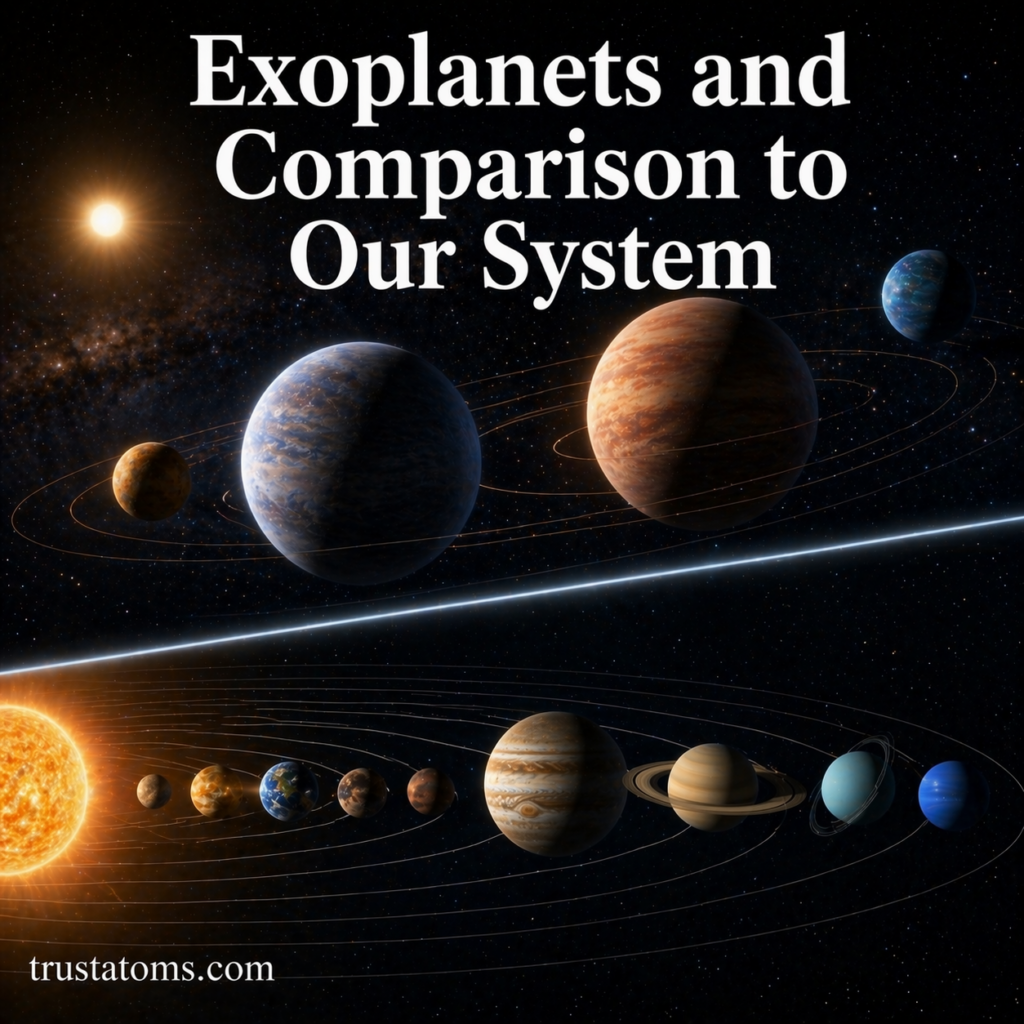
The discovery of planets beyond our solar system—known as exoplanets—has transformed modern astronomy. These distant worlds orbit stars other than the Sun, offering a broader perspective on how planetary systems form and evolve.
By comparing exoplanets to the planets in our own solar system, scientists can better understand what makes Earth unique—and whether similar worlds might exist elsewhere.
What Are Exoplanets?
Exoplanets are planets that orbit stars outside our solar system.
Key Characteristics
- They vary widely in size, composition, and temperature
- Some are rocky like Earth
- Others are gas giants like Jupiter
- Many exist in environments very different from anything in our system
Since the first confirmed discovery in the 1990s, thousands of exoplanets have been identified.
How Scientists Detect Exoplanets
Because exoplanets are extremely far away, scientists use indirect methods to detect them.
Main Detection Methods
- Transit Method
- Measures dips in a star’s brightness when a planet passes in front
- Used by missions like Kepler Space Telescope
- Radial Velocity Method
- Detects small “wobbles” in a star caused by a planet’s gravity
- Direct Imaging
- Captures actual images of large planets far from their stars
- Gravitational Microlensing
- Observes light bending due to a planet’s gravitational field
Each method reveals different details about a planet’s size, orbit, and composition.
Types of Exoplanets
Exoplanets come in a surprising variety of types, many of which don’t exist in our solar system.
Common Categories
- Hot Jupiters
- Gas giants orbiting extremely close to their stars
- Much hotter than Mercury
- Super-Earths
- Larger than Earth but smaller than Neptune
- May be rocky or gaseous
- Mini-Neptunes
- Smaller versions of Neptune with thick atmospheres
- Ocean Worlds
- Planets potentially covered in global oceans
These categories show that planetary systems can be far more diverse than our own.
How Our Solar System Compares
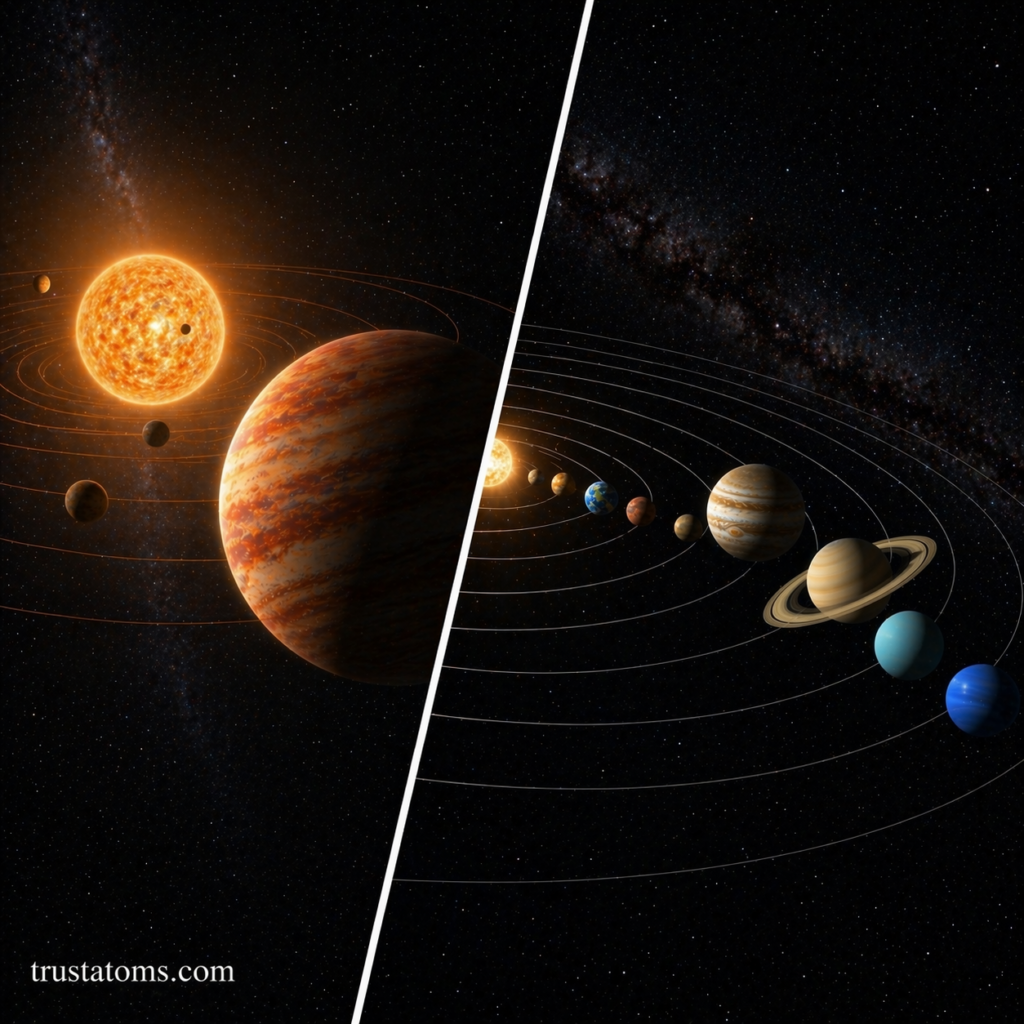
Our solar system has a relatively orderly structure compared to many exoplanet systems.
Key Differences
- Planets orbit in nearly circular paths
- Gas giants like Saturn are far from the Sun
- Rocky planets are located closer to the Sun
In contrast, many exoplanet systems have:
- Giant planets extremely close to their stars
- Highly elliptical (stretched) orbits
- Planets packed very closely together
What Makes Earth Unique?
Among all known planets, Earth remains special for its ability to support life.
Key Factors
- Located in the habitable zone (right distance from the Sun)
- Presence of liquid water
- Stable atmosphere and climate
- Protective magnetic field
Scientists use Earth as a baseline when searching for potentially habitable exoplanets.
The Search for Habitable Exoplanets
One of the biggest goals in astronomy is finding planets that could support life.
What Scientists Look For
- Distance from the host star (habitable zone)
- Evidence of water or water vapor
- Atmospheric composition (oxygen, methane, etc.)
- Planet size and surface conditions
Missions like the James Webb Space Telescope are helping analyze exoplanet atmospheres in greater detail.
Famous Exoplanet Systems
Several exoplanet systems have captured scientific attention.
Notable Examples
- TRAPPIST-1 System
- Contains seven Earth-sized planets
- Several are in the habitable zone
- Proxima Centauri b
- Closest known exoplanet to Earth
- Orbits Proxima Centauri
- Kepler-186f
- Earth-sized planet in the habitable zone
These discoveries suggest that Earth-like planets may be more common than once thought.
What Exoplanets Teach Us About Planet Formation
Studying exoplanets helps scientists refine models of how planetary systems form.
Key Insights
- Planetary migration is common
- Gas giants can move closer to their stars
- Systems may form in chaotic ways
This contrasts with the relatively stable formation history of our solar system.
The Future of Exoplanet Research
Technology continues to improve our ability to study distant worlds.
What’s Next?
- More powerful space telescopes
- Improved atmospheric analysis
- Direct imaging of Earth-like planets
- Continued discovery of new planetary systems
Future missions may even detect signs of life beyond Earth.
Final Thoughts
Exoplanets have reshaped our understanding of the universe. By comparing these distant worlds to our own solar system, scientists are uncovering just how diverse planetary systems can be.
While Earth remains unique, the growing number of exoplanet discoveries suggests that habitable worlds may exist elsewhere. As technology advances, we move closer to answering one of humanity’s biggest questions: Are we alone in the universe?