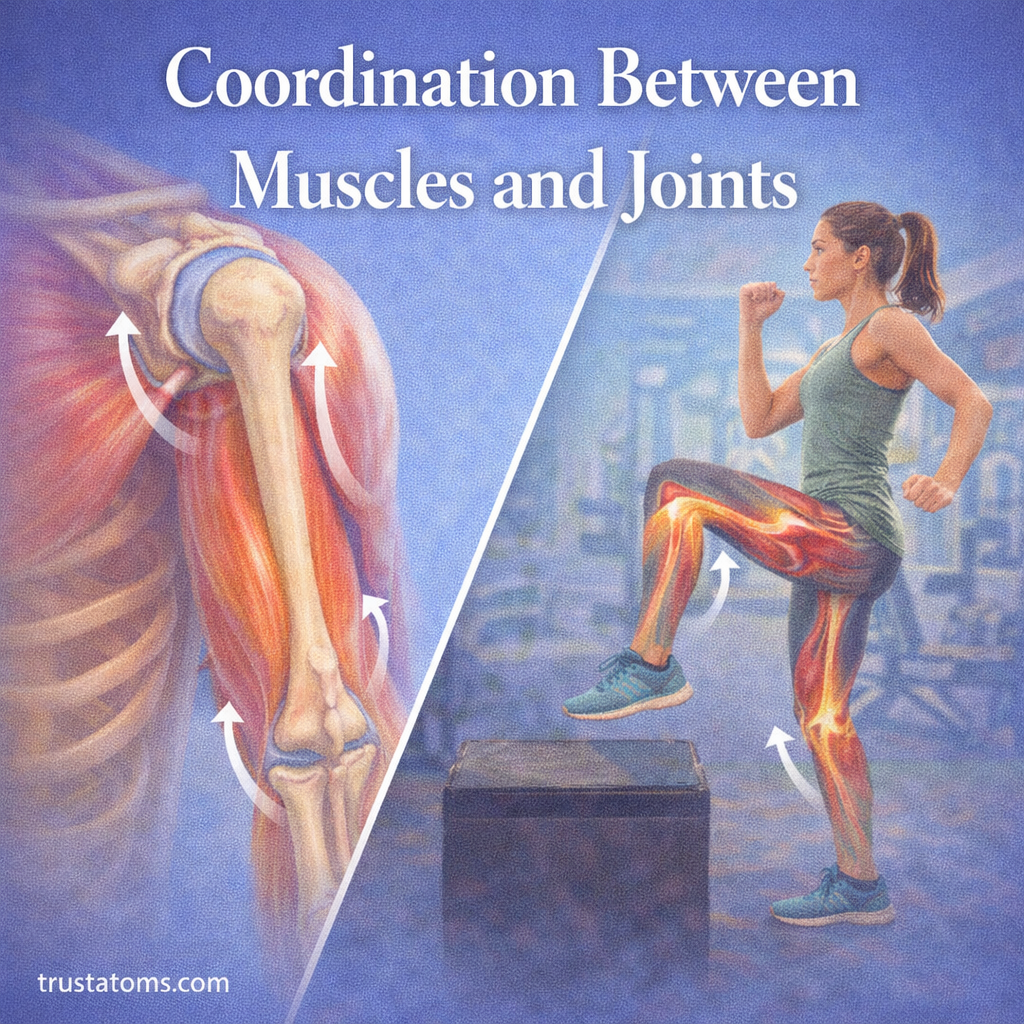
Muscles and joints work together through carefully timed muscle contractions, joint movement, and signals from the nervous system. This coordination allows the body to walk, reach, lift, and maintain balance while controlling the direction and force of each movement.
Understanding this relationship is an important part of human anatomy. Even an ordinary action, such as climbing a staircase, requires several muscle groups to move and stabilize multiple joints at the same time.
What Is Muscle and Joint Coordination?
Muscle and joint coordination is the process of organizing muscle activity to produce controlled movement across one or more joints. The nervous system regulates which muscles activate, how strongly they contract, and when they relax.
Muscles rarely work alone. Instead, they form coordinated groups that generate movement while limiting unwanted motion. This cooperation is explained further in Muscle Synergies in Coordinated Motion.
Coordination becomes especially noticeable at complex joints. For example, the shoulder requires several muscles to position and stabilize the arm while allowing movement in different directions. The relationship between mobility and stability is explored in Shoulder Joint Mechanics and Mobility.
How Muscles and Joints Work Together
Skeletal muscles attach to bones through tendons. When a muscle contracts, it produces tension that can pull on bones and create movement around a joint. Ligaments, joint capsules, and surrounding muscles help maintain joint stability.
Because muscles pull rather than push, opposing muscle groups often control movement in different directions. The amount of turning force generated around a joint is called torque. For a closer explanation of this mechanical relationship, see Torque Production at Joints.
Four Muscle Roles During Movement
- Agonists: Muscles primarily responsible for producing a particular movement, such as the biceps brachii during elbow bending.
- Antagonists: Muscles that oppose or control the movement, such as the triceps brachii during elbow bending.
- Synergists: Muscles that assist the main movers or reduce unwanted movement.
- Stabilizers: Muscles that maintain the position of a joint or body segment while another part moves.
These roles can change depending on the activity. A muscle that produces movement during one exercise may help stabilize a joint during another.
How Joint Structure Determines Movement
Joints connect bones, but their shapes determine which movements are possible. Different joint structures provide different combinations of mobility and stability.
| Joint Type | Example | Primary Movement |
|---|---|---|
| Hinge | Elbow | Bending and straightening |
| Ball-and-socket | Shoulder and hip | Movement in multiple directions, including rotation |
| Pivot | Upper neck | Rotation around an axis |
| Plane | Some wrist and foot joints | Small gliding movements |
Joint structure does not determine movement by itself. Muscles, tendons, ligaments, and the nervous system also influence how far and how smoothly a joint moves.
How the Nervous System Coordinates Movement
The brain and spinal cord coordinate muscle activity using information from sensory receptors throughout the body. Motor neurons carry commands to skeletal muscles, while sensory pathways provide feedback about movement and body position.
The cerebellum helps refine movement timing and accuracy. The spinal cord also supports rapid reflex responses and contributes to coordinated movement patterns.
During an activity, the nervous system continually adjusts muscle activation as body position, resistance, or balance changes. Many of these adjustments occur automatically, without conscious attention to individual muscles.
Proprioception and Joint Position Sensing
Proprioception is your body’s ability to sense its position in space.
Sensory receptors in muscles, tendons, and joint-related tissues help the nervous system monitor position, movement, and tension. Muscle spindles detect changes in muscle length, while Golgi tendon organs respond to muscle tension.
This feedback helps you touch your nose with your eyes closed or adjust your footing without constantly watching your feet. Learn more about how the brain interprets these signals in proprioception and body position sensing.
A Practical Example: Climbing a Staircase
Imagine stepping onto a stair approximately 18 centimeters (7 inches) high. Although the action feels simple, several joints and muscle groups must coordinate to lift your body and maintain balance.
- Preparing to step: Hip and knee muscles position the leading leg while the supporting leg maintains balance.
- Placing the foot: Muscles around the ankle adjust foot position for contact with the stair.
- Raising the body: The quadriceps extend the leading knee while the gluteal muscles help extend the hip.
- Maintaining stability: Core and hip muscles limit excessive trunk and pelvic movement as body weight shifts.
If the stair is unexpectedly higher or the surface is uneven, sensory feedback helps the nervous system adjust muscle activity. This illustrates how coordination combines movement production, balance, and continuous correction.
Fine and Gross Motor Coordination in Daily Life
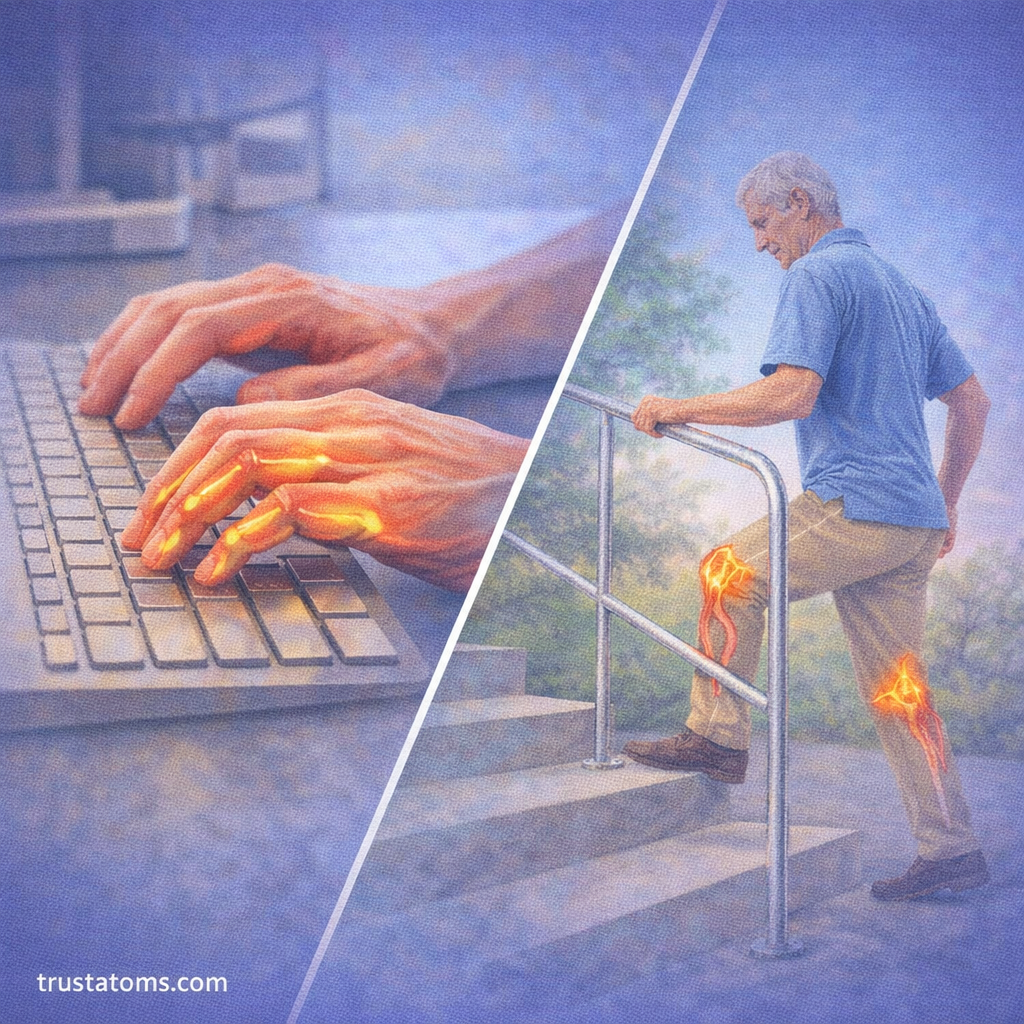
Fine motor coordination involves small, precise movements, such as typing, writing, or fastening a button. These activities require accurate control of muscles acting on the fingers, hands, and wrists.
Gross motor coordination involves larger movements, such as walking, running, jumping, and carrying objects. These activities require cooperation among multiple joints and larger muscle groups.
Many everyday activities combine both types. Carrying a full glass of water while walking requires precise hand control alongside coordinated movement of the legs and trunk.
Factors That Influence Coordination
Movement coordination changes with physical condition, practice, and environmental demands. Common influences include:
- Muscle strength: Adequate force helps support joints and control movement.
- Joint mobility: Available movement range affects how the body performs an action.
- Fatigue: Tired muscles can make precise timing and balance more difficult.
- Practice: Repeated movement helps the nervous system develop more consistent movement patterns.
- Environment: Uneven ground, footwear, and unexpected obstacles change movement demands.
Exercises That Develop Muscle and Joint Coordination
Coordination can improve through activities that challenge balance, movement accuracy, and controlled changes in body position.
- Single-leg balance: Practice standing on one leg near a stable support to challenge ankle and hip control.
- Controlled step-ups: Step onto a low, stable platform while keeping the knee aligned with the foot.
- Bodyweight squats: Coordinate hip, knee, and ankle movement at a comfortable depth.
- Slow reaching exercises: Practice maintaining trunk stability while moving the arms in different directions.
- Direction-change drills: Begin with slow, deliberate changes in walking direction before increasing speed.
Begin with movements you can perform comfortably and accurately. Increase difficulty gradually rather than sacrificing control for speed. Pain, persistent instability, or unexplained coordination problems warrant evaluation by a qualified health professional.
Frequently Asked Questions
Can muscle coordination improve with practice?
Yes. Repeated practice helps the nervous system refine muscle activation patterns and movement timing. Balance exercises, controlled strength training, and skill-specific activities can improve coordination over time.
What happens when muscles around a joint are poorly coordinated?
Poor coordination may cause inefficient movement, reduced balance, or difficulty controlling joint position. Depending on the activity, this can increase unwanted joint loading, although coordination alone does not determine injury risk.
Is muscle strength the same as muscle coordination?
No. Strength describes the ability to produce force, while coordination describes how muscles organize and time their activity. A strong person may still need practice to perform an unfamiliar movement smoothly and accurately.
Smooth movement depends on more than muscle strength or flexible joints. It emerges when the nervous system coordinates muscle force, joint position, and sensory feedback to match the demands of an activity. Practicing controlled movements can help make everyday actions more consistent and efficient.
This article is for general education and is not medical advice. Talk to a qualified health professional about any medical concern.
Sources: OpenStax, Anatomy and Physiology 2e; Hall, Guyton and Hall Textbook of Medical Physiology; Neumann, Kinesiology of the Musculoskeletal System: Foundations for Rehabilitation.