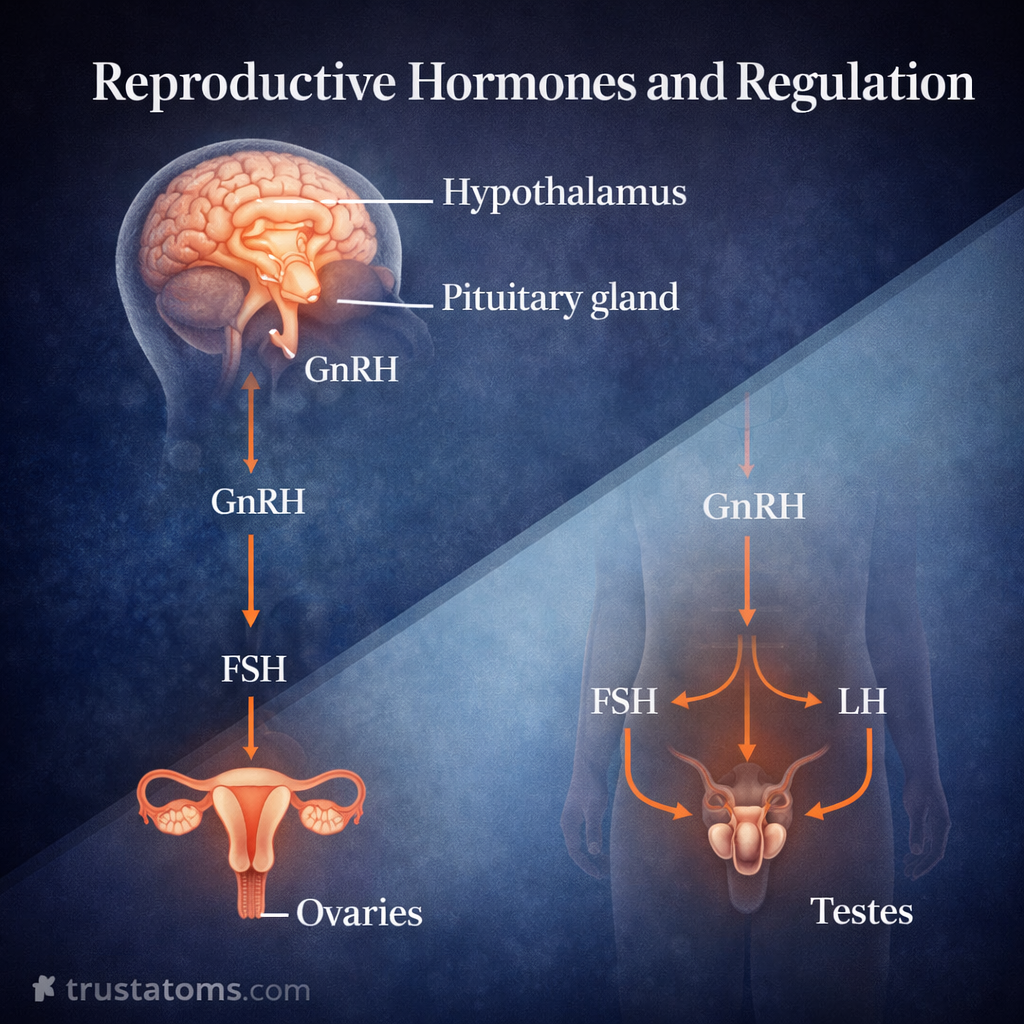
Reproductive hormones are chemical messengers that control sexual development, sperm and egg production, menstrual cycles, and pregnancy. Their regulation depends on communication between the brain and reproductive organs, using feedback signals to adjust hormone release as the body’s needs change.
These hormones play a central role in human anatomy, controlling processes such as puberty, the menstrual cycle, sperm production, pregnancy, and overall fertility. Although hormone levels naturally fluctuate, the underlying control system coordinates reproductive activity throughout different stages of life.
What Are Reproductive Hormones?
Reproductive hormones are substances released by endocrine glands into the bloodstream. They bind to receptors in specific cells, influencing reproductive organ development, hormone production, and fertility.
Six hormones are especially important in reproductive regulation:
- Gonadotropin-releasing hormone (GnRH): Signals the pituitary gland to release reproductive hormones.
- Follicle-stimulating hormone (FSH): Supports ovarian follicle development and sperm production.
- Luteinizing hormone (LH): Triggers ovulation and stimulates testosterone production.
- Estrogen: Supports reproductive development and growth of the uterine lining.
- Progesterone: Prepares and supports the uterine lining for pregnancy.
- Testosterone: Supports sperm production and male sexual development.
How the Hypothalamic-Pituitary-Gonadal Axis Works
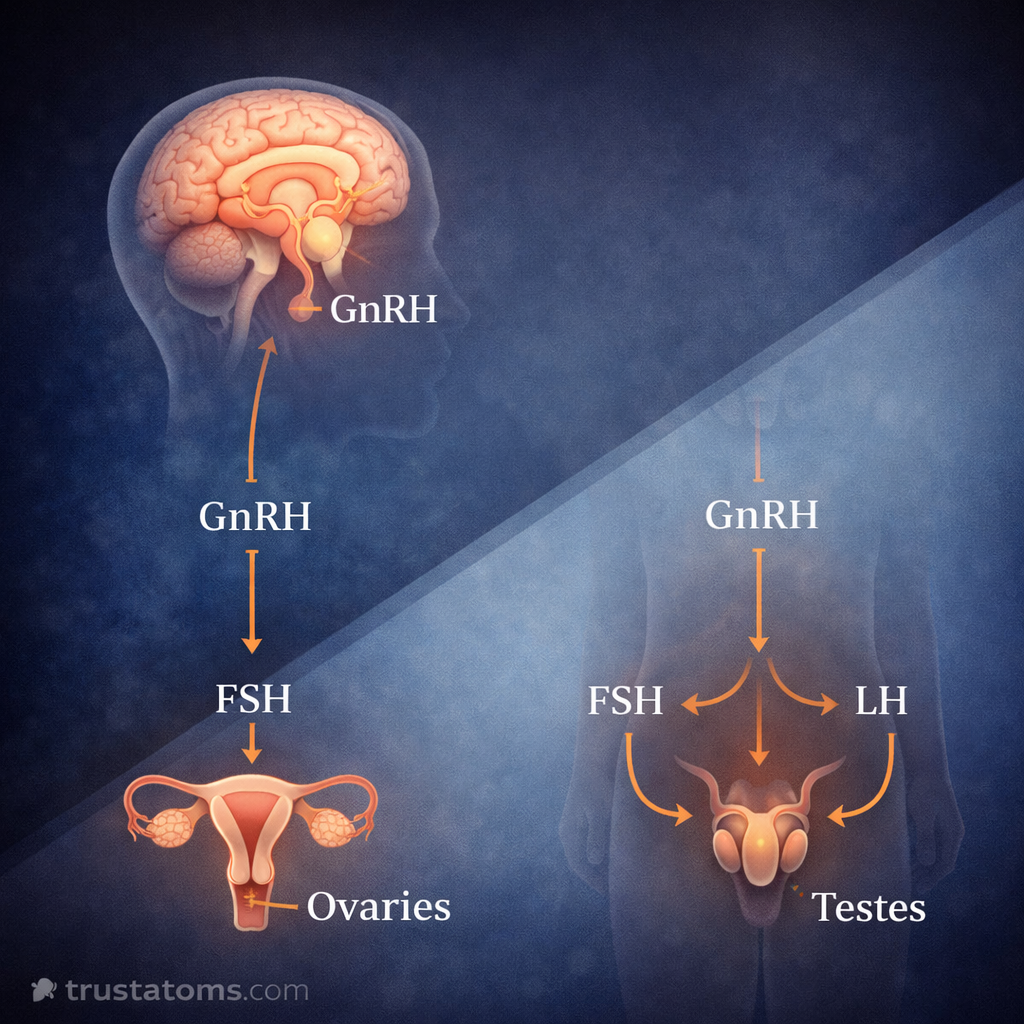
The hypothalamic-pituitary-gonadal (HPG) axis is the main communication pathway controlling reproductive hormones. It connects the hypothalamus, anterior pituitary gland, and gonads through a sequence of hormonal signals.
The Hormonal Signaling Sequence
- The hypothalamus releases GnRH in pulses.
- GnRH stimulates the anterior pituitary gland.
- The pituitary releases LH and FSH into the bloodstream.
- LH and FSH act on the gonads (ovaries or testes).
- The gonads produce sex hormones (estrogen, progesterone, testosterone).
Hormones produced by the gonads then send feedback to the hypothalamus and pituitary. This allows the system to increase or decrease stimulation rather than continuously releasing hormones at the same rate.
How GnRH, FSH, and LH Control Reproduction
GnRH controls the release of LH and FSH, but its timing matters. Pulses of GnRH help maintain normal pituitary responses, while continuous exposure can suppress LH and FSH release.
In ovaries, FSH encourages follicles containing immature eggs to develop. LH supports ovarian hormone production and triggers ovulation when a sufficiently large surge occurs.
In testes, LH stimulates Leydig cells to produce testosterone. FSH acts on Sertoli cells, which support developing sperm. Both FSH signaling and testosterone are needed for normal sperm production.
Female Reproductive Hormones
Estrogen and progesterone coordinate changes in the ovaries and uterus. The Female Reproductive Anatomy Overview explains the structures involved in these processes.
Estrogen
Estrogen supports breast development, reproductive tissue maintenance, and growth of the uterine lining. It also contributes to bone health. Estradiol is the main estrogen during the reproductive years and is produced primarily by developing ovarian follicles.
Progesterone
After ovulation, the corpus luteum produces progesterone. This hormone changes the uterine lining into a state that can support implantation and helps maintain conditions needed during pregnancy. If pregnancy does not occur, progesterone levels decline before menstruation.
Male Reproductive Hormones
Testosterone is produced mainly by the testes and supports the development of male reproductive organs and secondary sexual characteristics, including facial hair and a deeper voice. It also contributes to muscle development, bone density, and sexual function.
Testosterone production is regulated by LH, while FSH and testosterone together support sperm development. Unlike the monthly ovarian cycle, testicular hormone production and sperm formation generally operate continuously after puberty, although hormone levels fluctuate throughout the day.
Hormonal Regulation of the Menstrual Cycle
The menstrual cycle demonstrates how reproductive hormones change in a coordinated sequence. A commonly used teaching example is a 28-day cycle, although normal cycle lengths and ovulation timing vary. The Menstrual Cycle Phases are controlled by changing concentrations of FSH, LH, estrogen, and progesterone.
| Phase | Main Hormonal Activity | What Happens |
|---|---|---|
| Menstrual | Estrogen and progesterone are low | The uterine lining sheds. |
| Follicular | FSH supports follicle growth; estrogen rises | A follicle develops and the uterine lining rebuilds. |
| Ovulation | A surge in LH occurs | The ovary releases an egg. |
| Luteal | Progesterone rises after ovulation | The uterine lining becomes receptive to implantation. |
For example, in a 28-day cycle, ovulation may occur around day 14. If pregnancy does not occur, the corpus luteum breaks down, estrogen and progesterone fall, and menstruation begins. Day 14 is an illustration, not a reliable prediction for every person or every cycle.
Negative and Positive Hormonal Feedback
Feedback mechanisms allow reproductive hormones to regulate their own production through signals returning to the brain.
Negative Feedback
Negative feedback generally reduces further hormone stimulation. Testosterone, progesterone, and estrogen can suppress GnRH, LH, or FSH release under appropriate conditions. Inhibin, produced by cells in the gonads, also helps limit FSH secretion.
Positive Feedback
Positive feedback temporarily increases hormone release. Near ovulation, sustained high estradiol levels stimulate a surge in LH. This unusual reversal of the typical feedback response helps trigger egg release.
Hormonal Changes During Puberty and Pregnancy
During puberty, increased pulsatile GnRH signaling activates the HPG axis. Rising reproductive hormone levels support sexual maturation, development of secondary sexual characteristics, and the eventual establishment of menstrual cycles or sperm production.
Pregnancy introduces additional hormonal regulation. Human chorionic gonadotropin (hCG), produced by placental tissue, maintains the corpus luteum early in pregnancy. The placenta subsequently becomes a major source of progesterone and estrogen, supporting the uterine environment and changes needed for fetal development.
Factors That Can Disrupt Reproductive Hormone Regulation
Reproductive hormone levels can change with age, nutritional status, significant physical stress, illness, and certain medications. Conditions affecting the hypothalamus, pituitary gland, ovaries, or testes can also alter hormone production.
Possible effects include irregular menstrual cycles, delayed puberty, reduced sperm production, or difficulty conceiving. These changes have many possible causes, so symptoms alone cannot identify a particular hormonal disorder.
Frequently Asked Questions
What controls the release of reproductive hormones?
The HPG axis controls most reproductive hormone activity. The hypothalamus releases GnRH, the pituitary releases FSH and LH, and the gonads respond by supporting reproduction and producing hormones that provide feedback.
Do males and females produce the same reproductive hormones?
Both produce GnRH, FSH, LH, estrogen, progesterone, and testosterone, but their concentrations, sources, and physiological patterns differ. These differences help regulate ovarian cycles, sperm production, and reproductive development.
Can stress affect reproductive hormones?
Yes. Significant physical or psychological stress can alter signaling between the hypothalamus and pituitary, sometimes affecting ovulation, menstrual regularity, or testosterone production. The effects depend on the severity and duration of stress and other health factors.
Reproductive hormone regulation depends on precisely timed signals, not simply on keeping every hormone at a constant level. The HPG axis and its feedback loops explain how the same reproductive system can adapt to puberty, monthly cycles, sperm production, and pregnancy.
This article is for general education and is not medical advice. Talk to a qualified health professional about any medical concern.
Sources: Guyton and Hall Textbook of Medical Physiology; Williams Textbook of Endocrinology; National Institute of Diabetes and Digestive and Kidney Diseases (NIDDK).