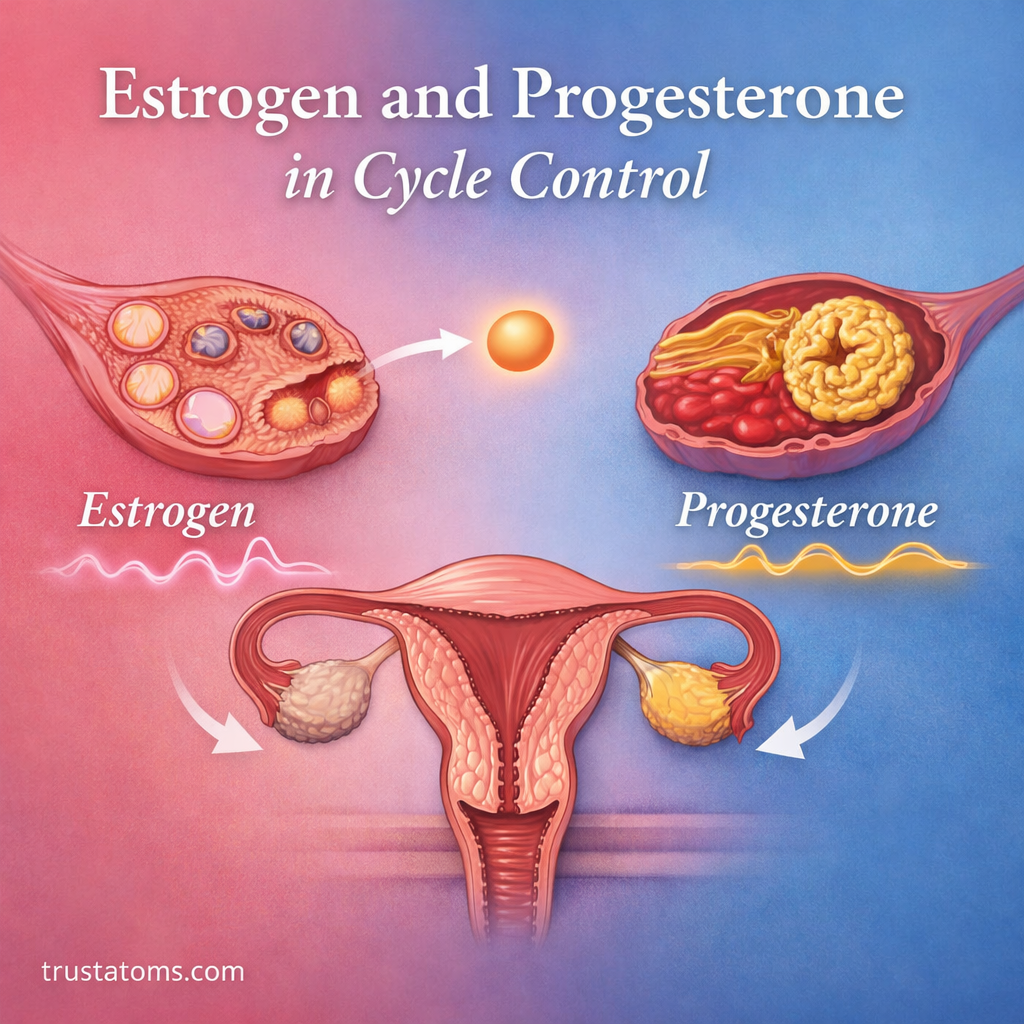
Estrogen and progesterone regulate the menstrual cycle by coordinating changes in the ovaries and uterine lining. Estrogen helps rebuild the uterine lining before ovulation, while progesterone prepares and maintains that lining after ovulation in case pregnancy occurs.
These two hormones act in a coordinated rhythm, controlling everything from ovulation to uterine lining development. Understanding their effects connects the study of human anatomy with the hormonal signals that regulate reproductive function.
Overview of the Menstrual Cycle
The menstrual cycle is a repeating sequence of hormonal and physical changes that prepares the reproductive system for a possible pregnancy. A 28-day cycle is commonly used as a teaching example, although adult cycles often range from approximately 21 to 35 days.
The cycle is commonly described using four stages:
- Menstruation: The uterine lining sheds when pregnancy has not occurred.
- Follicular phase: Ovarian follicles develop, estrogen generally rises, and the uterine lining rebuilds.
- Ovulation: A mature ovarian follicle releases an egg.
- Luteal phase: The corpus luteum produces progesterone, supporting the uterine lining.
Menstruation occurs during the early follicular phase, so these stages are not entirely separate. The Menstrual Cycle Phases article explains their timing in greater detail, while the Female Reproductive Anatomy Overview identifies the organs involved.
What Estrogen Does During the Menstrual Cycle
Estrogen refers to a group of related hormones, including estradiol, estrone, and estriol. Estradiol is the principal estrogen during most reproductive years and is produced mainly by developing ovarian follicles.
During the follicular phase, rising estradiol helps stimulate growth of the endometrium, the inner lining of the uterus. This is called the proliferative phase of the uterine cycle.
How Estrogen Helps Trigger Ovulation
Estrogen also participates in a feedback system involving the hypothalamus and pituitary gland. For much of the follicular phase, estrogen helps regulate the release of follicle-stimulating hormone (FSH) and luteinizing hormone (LH).
When estradiol remains sufficiently elevated near the end of the follicular phase, its feedback effect changes. This stimulates a surge in LH, which triggers the final stages of follicle maturation and ovulation.
Estrogen therefore does not release the egg directly. It helps create the hormonal conditions that produce the LH surge responsible for ovulation.
What Progesterone Does After Ovulation
Progesterone is a steroid hormone produced mainly by the corpus luteum during the luteal phase. The corpus luteum forms from the ovarian follicle after it releases an egg.
Progesterone transforms the estrogen-thickened endometrium into a more secretory tissue, preparing it for possible implantation. It also helps regulate uterine muscle activity and changes cervical mucus.
Progesterone and the Start of Menstruation
If pregnancy does not occur, the corpus luteum gradually breaks down. Progesterone and estrogen levels decline, removing the hormonal support that maintains the uterine lining.
This withdrawal initiates changes in the endometrium that lead to menstruation. If pregnancy occurs, human chorionic gonadotropin (hCG) helps maintain the corpus luteum until the placenta takes over sufficient hormone production.
How Estrogen and Progesterone Work Together
The two hormones have complementary effects rather than simply opposing one another. Estrogen promotes endometrial growth, while progesterone changes the developed lining into tissue capable of supporting early pregnancy.
| Feature | Estrogen | Progesterone |
|---|---|---|
| Main source during the cycle | Developing ovarian follicles | Corpus luteum after ovulation |
| Highest activity | Late follicular phase, with a smaller luteal rise | Luteal phase |
| Effect on uterine lining | Stimulates growth | Promotes secretory changes and maintenance |
| Relationship to ovulation | Sustained high levels help trigger the LH surge | Rises after ovulation and helps suppress another ovulatory cycle |
| Effect before menstruation | Levels decline | Levels decline |
Neither hormone independently controls the entire cycle. FSH, LH, and gonadotropin-releasing hormone (GnRH) are also necessary for coordinating ovarian activity.
Hormonal Timeline Across a Typical Cycle
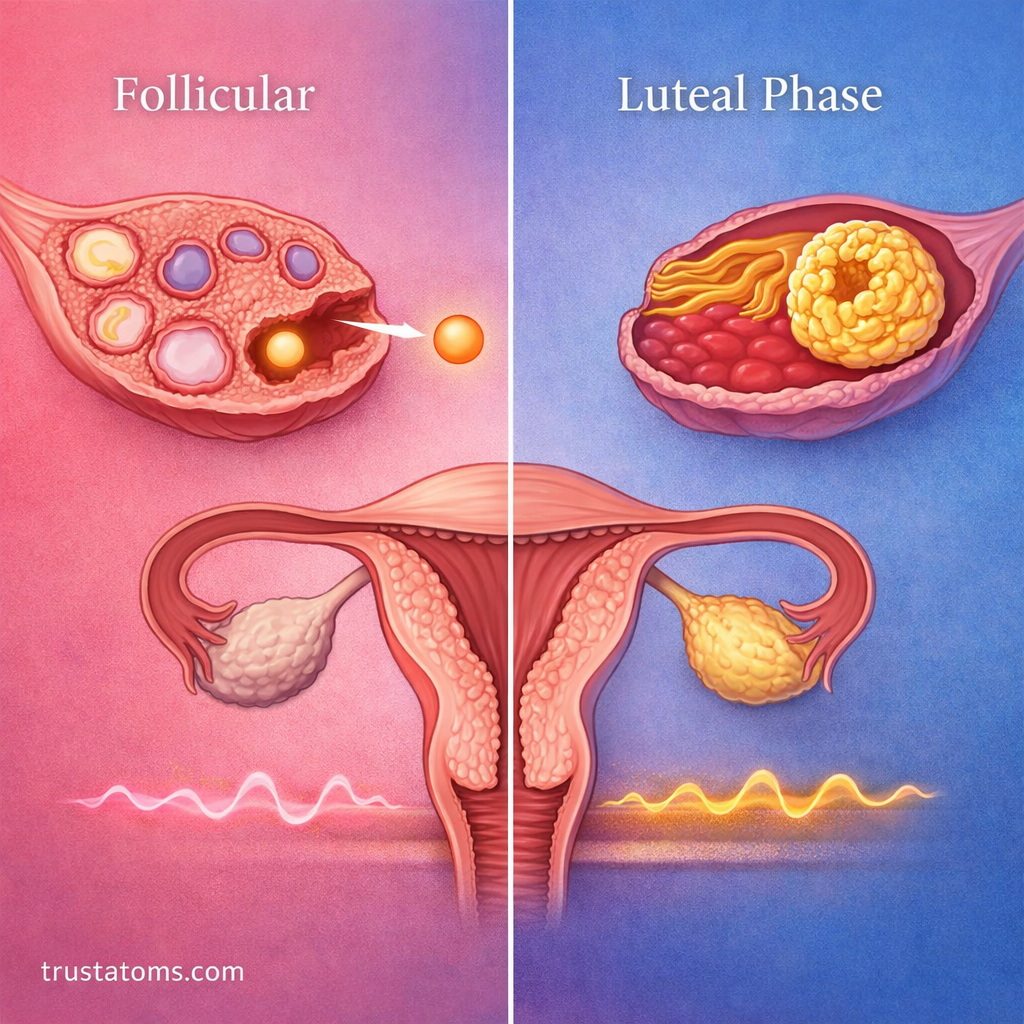
Consider a hypothetical 28-day menstrual cycle. The following timeline illustrates a common pattern, not a fixed schedule that applies to everyone.
- Days 1–5: Menstrual bleeding occurs as estrogen and progesterone remain relatively low. FSH helps recruit developing ovarian follicles.
- Days 6–13: A dominant follicle develops, estradiol rises, and the uterine lining thickens.
- Around day 14: Sustained high estradiol contributes to the LH surge, followed by ovulation.
- Days 15–28: The corpus luteum produces progesterone and estrogen. Without pregnancy, both decline near the end of the phase.
In this example, ovulation occurs near the midpoint. In real cycles, the follicular phase varies considerably, and ovulation does not necessarily happen on day 14. The luteal phase is generally more consistent, often lasting approximately 12–14 days.
What Happens When Hormone Patterns Change?
Normal hormone levels fluctuate throughout the cycle, so a single measurement cannot establish whether estrogen or progesterone is abnormally high or low without considering its timing.
When ovulation does not occur, a corpus luteum generally does not form, and the usual luteal progesterone rise is absent. This can contribute to irregular bleeding because the endometrium is not exposed to the normal sequence of estrogen and progesterone changes.
Changes in hormone regulation may be associated with missed periods, unusually heavy bleeding, irregular cycles, or difficulty becoming pregnant. These symptoms have multiple possible causes and do not automatically indicate an estrogen-progesterone imbalance.
Factors That Influence These Hormones
Estrogen and progesterone production depends on coordinated signals between the hypothalamus, pituitary gland, and ovaries. This system is called the hypothalamic-pituitary-ovarian axis.
Several factors can affect its activity:
- Stress: Significant physical or psychological stress may disrupt signals involved in ovulation.
- Energy availability: Inadequate nutrition, substantial weight changes, or excessive exercise can suppress reproductive hormone signaling.
- Age: Hormone patterns change during puberty and the transition toward menopause.
- Medical conditions: Polycystic ovary syndrome, thyroid disorders, and elevated prolactin can affect menstrual regularity.
- Medications: Hormonal contraceptives and certain other medications can alter natural cycling.
The broader functions of these hormones are discussed in Sex Hormones and Reproductive Regulation. For the signaling system that coordinates ovarian hormone production, see Reproductive Hormones and Regulation.
Frequently Asked Questions
Which hormone is highest before ovulation?
Estradiol typically rises substantially before ovulation. When elevated estradiol is sustained, it helps trigger the LH surge that leads to egg release. Progesterone remains comparatively low until after ovulation.
Why does progesterone rise after ovulation?
After ovulation, the ruptured follicle becomes the corpus luteum, which secretes progesterone. This hormone prepares the uterine lining for possible implantation and supports its secretory state during the luteal phase.
Can menstruation occur without ovulation?
Yes. Bleeding can occur during an anovulatory cycle, when no egg is released. However, this bleeding does not result from the usual sequence of ovulation, corpus luteum formation, and progesterone withdrawal that produces a typical menstrual period.
Estrogen and progesterone coordinate two distinct uterine changes: growth of the endometrium before ovulation and its preparation for possible implantation afterward. Their changing concentrations, together with FSH and LH, explain the timing of ovulation, the luteal phase, and menstrual bleeding when pregnancy does not occur.
This article is for general education and is not medical advice. Talk to a qualified health professional about any medical concern.
Sources: Guyton and Hall Textbook of Medical Physiology; Williams Gynecology; American College of Obstetricians and Gynecologists (ACOG).